Nepali Panchang Today (आजको पञ्चाङ्ग)
Today, Friday, 27 November 2026 (11 Mangsir 2083), the tithi is Krishna Tritiya until 10:04, then Chaturthi. The nakshatra is Ardra, the yoga is Shubha and the karana is Vishti. Sunrise in Kathmandu is at 06:34 and sunset at 17:08.
Panchang Today (आजको पञ्चाङ्ग)
Full panchang for 11 Mangsir 2083
| Five limbs (पञ्चाङ्ग) | |
|---|---|
| Tithi (तिथि) | Krishna Tritiya until 10:04, then Chaturthi (कृष्ण तृतीया, 10:04 सम्म) |
| Vaar (बार) | Shukrabar, Friday (शुक्रबार) |
| Nakshatra (नक्षत्र) | Ardra until 15:24, then Punarvasu (आर्द्रा, 15:24 सम्म) |
| Yoga (योग) | Shubha until 00:07 tomorrow, then Shukla (शुभ, भोलि 00:07 सम्म) |
| Karana (करण) | Vishti until 10:04, then Bava (विष्टि, 10:04 सम्म) |
| Sun and moon, Kathmandu (सूर्य र चन्द्र) | |
| Sunrise / Sunset | 06:34 / 17:08 |
| Day length (दिनमान) | 10 h 34 min |
| Moonrise / Moonset | 19:57 / 09:26 |
| Month and signs (मास र राशि) | |
| Lunar month (चान्द्र मास) | Mangsir, Krishna Paksha (मंसिर कृष्ण पक्ष) |
| Moon sign (चन्द्र राशि) | Mithun, Gemini (मिथुन) |
| Sun sign (सूर्य राशि) | Brishchik, Scorpio (वृश्चिक) |
| Season (ऋतु) | Hemanta, pre-winter (हेमन्त) |
| Ayana (अयन) | Dakshinayana (दक्षिणायन) |
| Timings (समय) | |
| Rahu Kaal (राहु काल) | 10:32 to 11:51 |
| Yamaganda (यमगण्ड) | 14:30 to 15:49 |
| Gulika (गुलिक काल) | 07:53 to 09:12 |
| Abhijit Muhurta (अभिजित मुहूर्त) | 11:30 to 12:12 |
| Dur Muhurta (दुर्मुहूर्त) | 08:41 to 09:23, 12:12 to 12:55 |
| Midday (मध्याह्न) | 11:51 |
| Other calendars | |
| Nepal Sambat | NS 1147 Kachhala Ga Tritiya (ने.सं. ११४७ कछलागा तृतीया) |
| Shaka Samvat (शाके) | 1948 |
| Samvatsara (संवत्सर) | Siddharthi (सिद्धार्थी) |
Times are for Kathmandu, Nepal Time (UTC+5:45). Each limb shown is the one running at sunrise, with the time it ends. Today's values match Drik Panchang and Ashesh for Kathmandu to within a few minutes. See the whole month in the Mangsir 2083 calendar.
Auspicious and inauspicious times today
| Muhurta | Time | What it is for |
|---|---|---|
| Auspicious (शुभ समय) | ||
| Brahma Muhurta (ब्रह्म मुहूर्त) | 04:46 to 05:40 | Before dawn. Meditation, study and prayer. |
| Pratah Sandhya (प्रातः सन्ध्या) | 05:13 to 06:34 | Morning twilight. Daily worship and sandhya rites. |
| Abhijit Muhurta (अभिजित मुहूर्त) | 11:30 to 12:12 | Midday. Good for almost any work; removes many defects of the day. |
| Vijaya Muhurta (विजय मुहूर्त) | 13:37 to 14:19 | Afternoon. Journeys, contests and work where success matters. |
| Sarvartha Siddhi Yoga (सर्वार्थ सिद्धि योग) | 15:24 to 06:35 tomorrow | Weekday and nakshatra combine so that all undertakings succeed. |
| Godhuli Muhurta (गोधूलि मुहूर्त) | 17:08 to 17:35 | Dusk. Traditionally used for marriage rites and auspicious beginnings. |
| Sayahna Sandhya (सायाह्न सन्ध्या) | 17:08 to 18:29 | Evening twilight. Evening worship and sandhya rites. |
| Nishita Muhurta (निशिता मुहूर्त) | 23:25 to 00:18 tomorrow | Midnight. Night worship, especially on Shivaratri and Janmashtami. |
| Inauspicious (अशुभ समय) | ||
| Dur Muhurta (दुर्मुहूर्त) | 08:41 to 09:23 | Inauspicious muhurta of the weekday. Avoid starting good work. |
| Dur Muhurta (दुर्मुहूर्त) | 12:12 to 12:55 | Inauspicious muhurta of the weekday. Avoid starting good work. |
| Varjyam (वर्ज्यम्) | 02:15 to 03:41, after midnight | Period of the nakshatra to be avoided for auspicious work. |
Choghadiya today (आजको चौघडिया)
The day, from sunrise to sunset, and the night, from sunset to the next sunrise, are each split into eight choghadiya. Amrit, Shubh and Labh are good for new work, Char is neutral, and Rog, Kaal and Udveg are avoided.
| Choghadiya | Time | Nature |
|---|---|---|
| Day (दिन) | ||
| Char (चर) | 06:34 to 07:53 | Neutral (सामान्य) |
| Labh (लाभ) | 07:53 to 09:12 | Good (शुभ) |
| Amrit (अमृत) | 09:12 to 10:32 | Good (शुभ) |
| Kaal (काल) | 10:32 to 11:51 | Avoid (अशुभ) |
| Shubh (शुभ) | 11:51 to 13:10 | Good (शुभ) |
| Rog (रोग) | 13:10 to 14:30 | Avoid (अशुभ) |
| Udveg (उद्वेग) | 14:30 to 15:49 | Avoid (अशुभ) |
| Char (चर) | 15:49 to 17:08 | Neutral (सामान्य) |
| Night (रात) | ||
| Labh (लाभ) | 17:08 to 18:49 | Good (शुभ) |
| Amrit (अमृत) | 18:49 to 20:30 | Good (शुभ) |
| Kaal (काल) | 20:30 to 22:11 | Avoid (अशुभ) |
| Shubh (शुभ) | 22:11 to 23:52 | Good (शुभ) |
| Rog (रोग) | 23:52 to 01:32 tomorrow | Avoid (अशुभ) |
| Udveg (उद्वेग) | 01:32 to 03:13, after midnight | Avoid (अशुभ) |
| Char (चर) | 03:13 to 04:54, after midnight | Neutral (सामान्य) |
| Labh (लाभ) | 04:54 to 06:35, after midnight | Good (शुभ) |
What is a panchang?
A panchang (पञ्चाङ्ग) is the Hindu almanac that gives five elements of each day: tithi, vaar, nakshatra, yoga and karana. The word is Sanskrit and means "having five limbs".
Nepal's calendar law defines it in the same five terms. The formation order of the Nepal Panchanga Nirnayak Bikas Samiti says: "“पञ्चाङ्ग” भन्नाले तिथि, बार, नक्षत्र, योग तथा करण सम्झनु पर्छ।" A patro (पात्रो), the calendar most families keep at home, adds festivals and the positions of the planets to these five elements. Digital Patro's Nepali calendar shows the patro view of every month.
The five limbs of the panchang
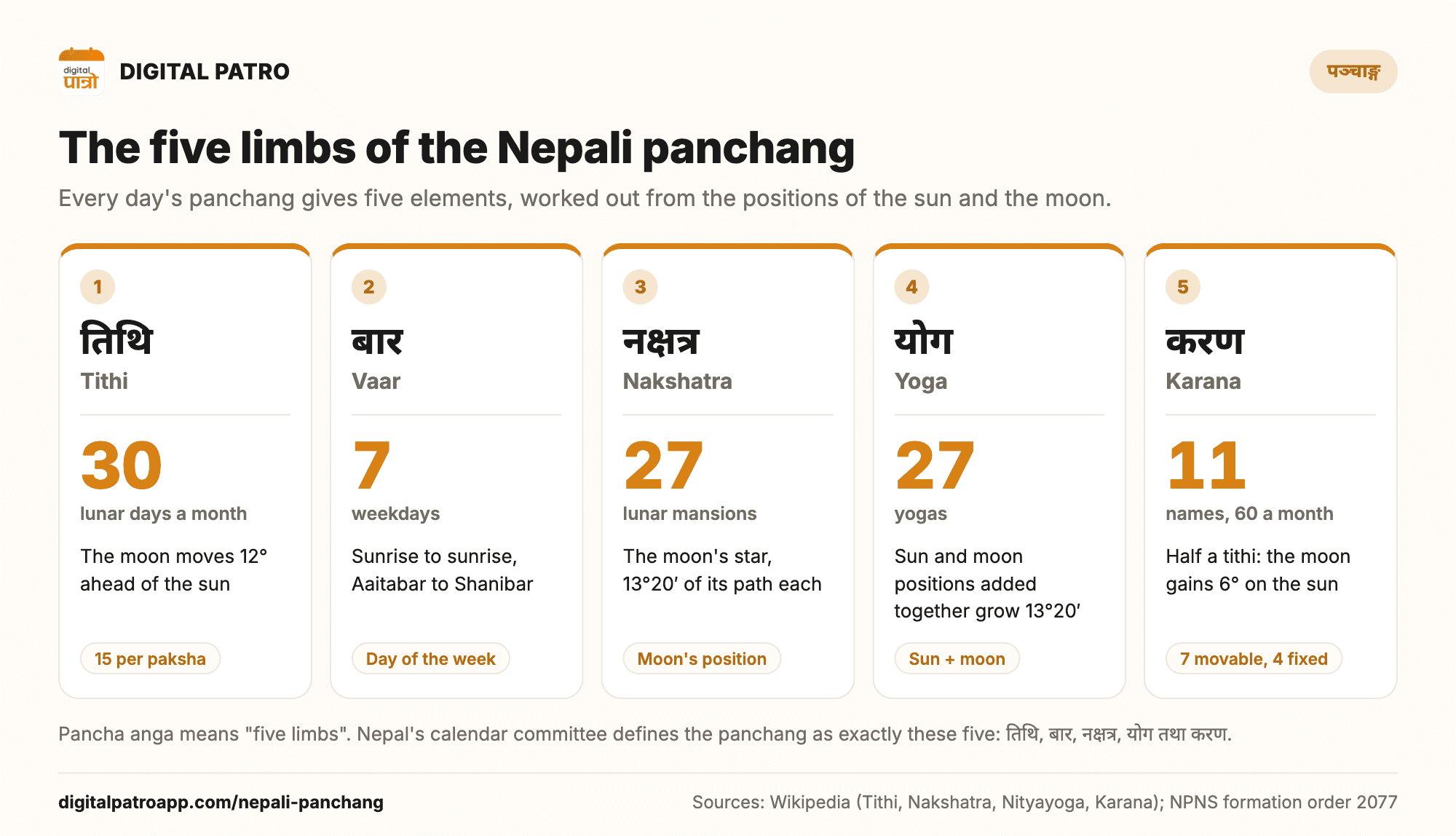
Figures in this image
| Limb | Count | Defined by |
|---|---|---|
| Tithi (तिथि) | 30 a lunar month | The moon gains 12° on the sun |
| Vaar (बार) | 7 weekdays | Sunrise to sunrise |
| Nakshatra (नक्षत्र) | 27 | 13°20′ of the moon's path each |
| Yoga (योग) | 27 | Sun and moon positions together grow 13°20′ |
| Karana (करण) | 11 names, 60 a month | Half a tithi, 6° |
Tithi (तिथि): the lunar day
A tithi is the time the moon takes to move 12 degrees further ahead of the sun. A lunar month has 30 tithis. A tithi lasts 23 hours 37.5 minutes on average and can run from 19 hours 59 minutes to 26 hours 47 minutes, so it rarely matches a calendar day. Festivals and fasts, such as Ekadashi and Purnima, follow the tithi.
Vaar (बार): the weekday
Vaar is the day of the week, from Aaitabar (Sunday) to Shanibar (Saturday). In the panchang, a day runs from one sunrise to the next.
Nakshatra (नक्षत्र): the moon's star
The path of the sun and moon across the sky is divided into 27 nakshatras of 13 degrees 20 minutes each. The nakshatra of the day is the one the moon is passing through. Today it is Ardra.
Yoga (योग)
Yoga is worked out from the positions of the sun and the moon added together. Each time that sum grows by 13 degrees 20 minutes, a new yoga begins. There are 27 yogas, from Vishkambha to Vaidhriti.
Karana (करण): half a tithi
A karana is half a tithi, the time the moon takes to gain 6 degrees on the sun, so a lunar month has 60 karanas. They use 11 names. Seven movable karanas repeat eight times through the month, and four fixed karanas (Shakuni, Chatushpada, Naga and Kimstughna) fall once, around the new moon. Vishti karana is also called Bhadra (भद्रा).
Shukla Paksha and Krishna Paksha
Each lunar month has two halves of 15 tithis. Shukla Paksha is the waxing half that ends on Purnima (full moon). Krishna Paksha is the waning half that ends on Aunsi (new moon).
Calendars in Nepal count the waning half after Kartik Purnima as part of Mangsir, which is why today reads Mangsir Krishna Tritiya. The lunar month and the solar month of the Nepali calendar carry the same names but start on different days.
How is today's tithi decided?
The tithi of the day is the tithi running at sunrise. Krishna Tritiya ends at 10:04 today, so the whole day is still called Tritiya, and Chaturthi begins at 10:04.
Why a tithi can repeat or be skipped
Because a tithi can be shorter or longer than a day, one tithi sometimes covers two sunrises and appears on two days in a row. This is called vriddhi or adhika tithi. Sometimes a tithi starts after one sunrise and ends before the next, so no day carries its name. This is called kshaya tithi.
Mangsir 2083 has both. Shukla Navami was running at sunrise on 2 and 3 Mangsir (18 and 19 November 2026), so Navami appears twice. Shukla Dwadashi started after sunrise on 5 Mangsir (21 November) and ended before the next sunrise, so it was skipped. Krishna Panchami is skipped in the same way on 12 Mangsir (28 November), which goes from Chaturthi straight to Shashthi the next day.
Who approves the panchang in Nepal?
The Nepal Panchanga Nirnayak Bikas Samiti (नेपाल पञ्चाङ्ग निर्णायक विकास समिति) approves the panchangs and wall calendars published in Nepal. It sits under the Ministry of Culture, Tourism and Civil Aviation.
The committee works under a formation order of 2077 BS, issued under the Development Board Act, 2013 BS, and published in the Nepal Gazette on 18 Shrawan 2078. Its work includes calculating the Nepali panchang, checking the panchangs registered with it, deciding tithis and festival dates, fixing auspicious times (saait) for weddings and bratabandha, and making the final decision on eclipses.
In its notice of 21 Bhadra 2083, the committee asked anyone who wants to publish a panchang or a wall calendar for 2084 BS to get its approval first, with the panchang section calculated by the सौरोक्त method.
Why two calendars can show a different tithi
Panchang makers calculate in different ways. Traditional methods use the average motion of the sun and moon, while modern almanacs use precise planetary tables. Their tithi end times can differ by several minutes and, rarely, by up to an hour. On days when a tithi ends close to sunrise, that is enough to change the tithi of the day. In Mangsir 2083, for example, some popular calendar apps show the next tithi on 3, 4 and 5 Mangsir.
Festival dates are fixed separately, by the official calendar. That is why Haribodhini Ekadashi was observed on 4 Mangsir (20 November 2026), a day whose sunrise tithi was Dashami. For festivals and holidays, follow the official holiday list.
How to read today's panchang
- "Until 10:04" means the tithi ends at that time and the next tithi starts then. In Nepali this is written "१०:०४ सम्म, त्यसपछि चतुर्थी".
- All times are for Kathmandu in Nepal Time (UTC+5:45). Sunrise and sunset come a few minutes earlier in eastern Nepal and later in western Nepal.
- Day length (dinman) is the time from sunrise to sunset: 10 h 34 min today.
- Rahu Kaal is one eighth of the time between sunrise and sunset, and its place in the day depends on the weekday. Tradition avoids starting new work in it. Today it runs from 10:32 to 11:51.
Names used in the panchang
The 30 tithis
The first 14 names are the same in both halves of the month. The 15th is Purnima in the bright half and Aunsi in the dark half.
| No. | Tithi |
|---|---|
| 1 | Pratipada प्रतिपदा |
| 2 | Dwitiya द्वितीया |
| 3 | Tritiya तृतीया |
| 4 | Chaturthi चतुर्थी |
| 5 | Panchami पञ्चमी |
| 6 | Shashthi षष्ठी |
| 7 | Saptami सप्तमी |
| 8 | Ashtami अष्टमी |
| 9 | Navami नवमी |
| 10 | Dashami दशमी |
| 11 | Ekadashi एकादशी |
| 12 | Dwadashi द्वादशी |
| 13 | Trayodashi त्रयोदशी |
| 14 | Chaturdashi चतुर्दशी |
| 15 | Purnima पूर्णिमा in Shukla Paksha, Aunsi औंसी in Krishna Paksha |
The 7 days of the week (vaar)
| Vaar | नेपाली | English |
|---|---|---|
| Aaitabar | आइतबार | Sunday |
| Sombar | सोमबार | Monday |
| Mangalbar | मंगलबार | Tuesday |
| Budhabar | बुधबार | Wednesday |
| Bihibar | बिहीबार | Thursday |
| Shukrabar | शुक्रबार | Friday |
| Shanibar | शनिबार | Saturday |
The 27 nakshatras
| No. | Nakshatra |
|---|---|
| 1 | Ashwini अश्विनी |
| 2 | Bharani भरणी |
| 3 | Krittika कृत्तिका |
| 4 | Rohini रोहिणी |
| 5 | Mrigashirsha मृगशीर्ष |
| 6 | Ardra आर्द्रा |
| 7 | Punarvasu पुनर्वसु |
| 8 | Pushya पुष्य |
| 9 | Ashlesha आश्लेषा |
| 10 | Magha मघा |
| 11 | Purva Phalguni पूर्व फाल्गुनी |
| 12 | Uttara Phalguni उत्तर फाल्गुनी |
| 13 | Hasta हस्त |
| 14 | Chitra चित्रा |
| 15 | Swati स्वाति |
| 16 | Vishakha विशाखा |
| 17 | Anuradha अनुराधा |
| 18 | Jyeshtha ज्येष्ठा |
| 19 | Mula मूल |
| 20 | Purva Ashadha पूर्वाषाढा |
| 21 | Uttara Ashadha उत्तराषाढा |
| 22 | Shravana श्रवण |
| 23 | Dhanishtha धनिष्ठा |
| 24 | Shatabhisha शतभिषा |
| 25 | Purva Bhadrapada पूर्व भाद्रपदा |
| 26 | Uttara Bhadrapada उत्तर भाद्रपदा |
| 27 | Revati रेवती |
The 27 yogas
| No. | Yoga |
|---|---|
| 1 | Vishkambha विष्कुम्भ |
| 2 | Priti प्रीति |
| 3 | Ayushman आयुष्मान |
| 4 | Saubhagya सौभाग्य |
| 5 | Shobhana शोभन |
| 6 | Atiganda अतिगण्ड |
| 7 | Sukarma सुकर्मा |
| 8 | Dhriti धृति |
| 9 | Shula शूल |
| 10 | Ganda गण्ड |
| 11 | Vriddhi वृद्धि |
| 12 | Dhruva ध्रुव |
| 13 | Vyaghata व्याघात |
| 14 | Harshana हर्षण |
| 15 | Vajra वज्र |
| 16 | Siddhi सिद्धि |
| 17 | Vyatipata व्यतीपात |
| 18 | Variyan वरीयान |
| 19 | Parigha परिघ |
| 20 | Shiva शिव |
| 21 | Siddha सिद्ध |
| 22 | Sadhya साध्य |
| 23 | Shubha शुभ |
| 24 | Shukla शुक्ल |
| 25 | Brahma ब्रह्म |
| 26 | Indra इन्द्र |
| 27 | Vaidhriti वैधृति |
The 11 karanas
| No. | Karana | Type |
|---|---|---|
| 1 | Bava बव | Movable (चर) |
| 2 | Balava बालव | Movable (चर) |
| 3 | Kaulava कौलव | Movable (चर) |
| 4 | Taitila तैतिल | Movable (चर) |
| 5 | Gara गर | Movable (चर) |
| 6 | Vanija वणिज | Movable (चर) |
| 7 | Vishti विष्टि | Movable (चर) |
| 8 | Shakuni शकुनि | Fixed (स्थिर) |
| 9 | Chatushpada चतुष्पद | Fixed (स्थिर) |
| 10 | Naga नाग | Fixed (स्थिर) |
| 11 | Kimstughna किंस्तुघ्न | Fixed (स्थिर) |
Questions about the panchang
What are the 5 parts of a panchang?
The five parts are tithi (lunar day), vaar (weekday), nakshatra (the moon's star), yoga and karana (half a tithi). Nepal's calendar committee defines panchang with exactly these five.
What is panchang called in English?
Panchang is usually translated as Hindu almanac or Hindu calendar. The Sanskrit word means "having five limbs", after its five elements.
What is tithi in English?
Tithi is a lunar day: the time the moon takes to move 12 degrees ahead of the sun. It lasts about 20 to 27 hours.
What is today's tithi?
Today is Krishna Tritiya until 10:04, then Chaturthi (11 Mangsir 2083, 27 November 2026).
How is the panchang calculated?
It is calculated from the positions of the sun and the moon. A tithi changes every 12 degrees of the moon's lead over the sun, a karana every 6 degrees, and a nakshatra or yoga every 13 degrees 20 minutes. Times on this page are calculated for Kathmandu.
Which panchang is official in Nepal?
Panchangs and wall calendars published in Nepal need approval from the Nepal Panchanga Nirnayak Bikas Samiti, the government committee that decides tithis, festival dates and saait.
What is Dashami tithi?
Dashami is the 10th tithi of either half of the lunar month. Bijaya Dashami, the main day of Dashain, falls on a Shukla Dashami. In 2083 it was on 4 Kartik (21 October 2026).
What is Rahu Kaal?
Rahu Kaal is a daily period, one eighth of the time from sunrise to sunset, that tradition avoids for starting new work. Its place in the day depends on the weekday. Today it is 10:32 to 11:51 in Kathmandu.
Read more about the calendar itself in Bikram Sambat explained.
Sources
- Meaning of panchang: Wikipedia, Panchangam, en.wikipedia.org/wiki/Panchangam
- Tithi, sunrise rule, kshaya and adhika tithi, calculation methods: Wikipedia, Tithi, en.wikipedia.org/wiki/Tithi
- Nakshatra: Wikipedia, Nakshatra, en.wikipedia.org/wiki/Nakshatra
- Yoga: Wikipedia, Nityayoga, en.wikipedia.org/wiki/Nityayoga
- Karana: Wikipedia, Karana (panchanga), en.wikipedia.org/wiki/Karaṇa_(pañcāṅga)
- Committee and legal definition: Nepal Panchanga Nirnayak Bikas Samiti, formation order 2077, npns.gov.np/pages/formation-order-8
- Approval notice for 2084 BS: Nepal Panchanga Nirnayak Bikas Samiti, npns.gov.np/content/18/notice-regarding-publication-of-panchang/
- Today's times and elements: Digital Patro panchang data for Kathmandu, checked against Drik Panchang and Ashesh on 27 November 2026.