Nepali Months: All 12 Months in English and Nepali (नेपाली महिना)
The Nepali calendar (Bikram Sambat) has 12 months: Baisakh, Jestha, Ashadh, Shrawan, Bhadra, Ashwin, Kartik, Mangsir, Poush, Magh, Falgun and Chaitra. The year starts on 1 Baisakh in mid-April, and each month has 29 to 32 days.
Each Nepali month starts on the day the sun enters a new zodiac sign (rashi), so every Nepali month begins around the middle of an English month. The table below gives the dates of each month in the current year, 2083 BS, from the Nepali calendar on Digital Patro.
The 12 Nepali months in order
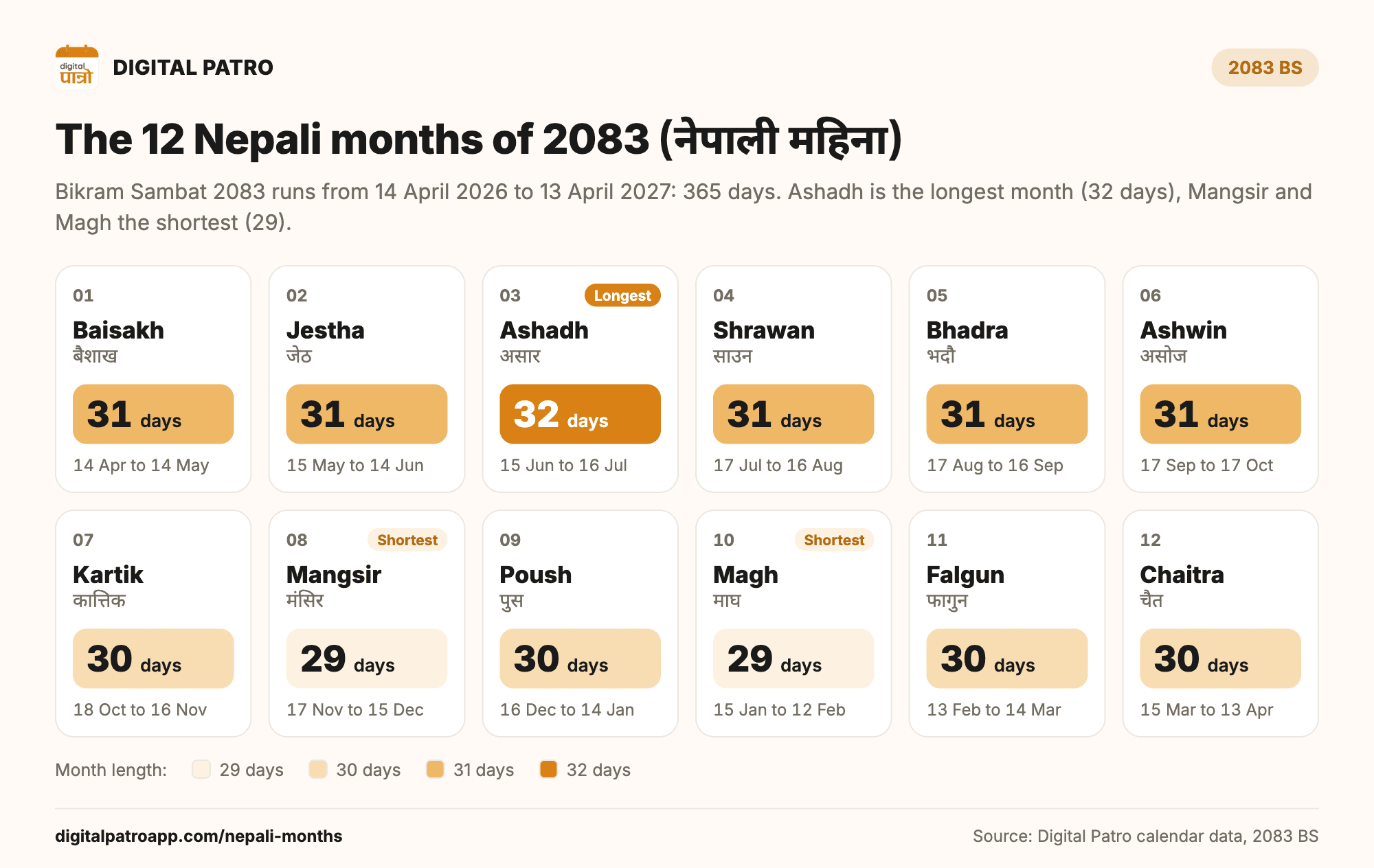
Figures in this image
| Month | Days in 2083 | Dates (AD) |
|---|---|---|
| Baisakh | 31 | 14 Apr to 14 May 2026 |
| Jestha | 31 | 15 May to 14 Jun 2026 |
| Ashadh | 32 | 15 Jun to 16 Jul 2026 |
| Shrawan | 31 | 17 Jul to 16 Aug 2026 |
| Bhadra | 31 | 17 Aug to 16 Sep 2026 |
| Ashwin | 31 | 17 Sep to 17 Oct 2026 |
| Kartik | 30 | 18 Oct to 16 Nov 2026 |
| Mangsir | 29 | 17 Nov to 15 Dec 2026 |
| Poush | 30 | 16 Dec to 14 Jan 2027 |
| Magh | 29 | 15 Jan to 12 Feb 2027 |
| Falgun | 30 | 13 Feb to 14 Mar 2027 |
| Chaitra | 30 | 15 Mar to 13 Apr 2027 |
| No. | Month | नेपाली | 2083 dates (AD) | Days | Sun enters | Season |
|---|---|---|---|---|---|---|
| 01 | Baisakh | बैशाख | 14 Apr to 14 May 2026 | 31 | Mesh मेष | Basanta वसन्त |
| 02 | Jestha | जेठ | 15 May to 14 Jun 2026 | 31 | Brish वृष | Grishma ग्रीष्म |
| 03 | Ashadh | असार | 15 Jun to 16 Jul 2026 | 32 | Mithun मिथुन | Grishma ग्रीष्म |
| 04 | Shrawan | साउन | 17 Jul to 16 Aug 2026 | 31 | Karkat कर्कट | Barsha वर्षा |
| 05 | Bhadra | भदौ | 17 Aug to 16 Sep 2026 | 31 | Singha सिंह | Barsha वर्षा |
| 06 | Ashwin | असोज | 17 Sep to 17 Oct 2026 | 31 | Kanya कन्या | Sharad शरद् |
| 07 | Kartik | कात्तिक | 18 Oct to 16 Nov 2026 | 30 | Tula तुला | Sharad शरद् |
| 08 | Mangsir | मंसिर | 17 Nov to 15 Dec 2026 | 29 | Brishchik वृश्चिक | Hemanta हेमन्त |
| 09 | Poush | पुस | 16 Dec to 14 Jan 2027 | 30 | Dhanu धनु | Hemanta हेमन्त |
| 10 | Magh | माघ | 15 Jan to 12 Feb 2027 | 29 | Makar मकर | Shishir शिशिर |
| 11 | Falgun | फागुन | 13 Feb to 14 Mar 2027 | 30 | Kumbha कुम्भ | Shishir शिशिर |
| 12 | Chaitra | चैत | 15 Mar to 13 Apr 2027 | 30 | Meen मीन | Basanta वसन्त |
2083 BS has 365 days. It started on 1 Baisakh 2083 (14 April 2026) and ends on 30 Chaitra 2083 (13 April 2027). Ashadh is the longest month this year with 32 days. Dates and day counts change every year: open any month in the 2083 calendar, or check a single date in the Nepali date converter.
Nepali months in English: other spellings
There is no single official English spelling for the Nepali months. Most months have a formal Sanskrit name and an everyday Nepali name, and both are written in English in several ways.
| Month | Formal name | Everyday name | Other spellings |
|---|---|---|---|
| Baisakh | वैशाख | बैशाख | Baishakh, Vaishakh |
| Jestha | ज्येष्ठ | जेठ | Jeth, Jyeshtha |
| Ashadh | आषाढ | असार | Asar, Ashar, Asadh |
| Shrawan | श्रावण | साउन | Saun, Saaun, Shravan |
| Bhadra | भाद्र | भदौ | Bhadau, Bhadrapada |
| Ashwin | आश्विन | असोज | Asoj, Aasoj, Ashoj |
| Kartik | कार्तिक | कात्तिक | Kattik, Kartika |
| Mangsir | मार्गशीर्ष | मंसिर | Mangshir, Marga, Margashirsha |
| Poush | पौष | पुस | Push, Paush |
| Magh | माघ | माघ | Maagh |
| Falgun | फाल्गुन | फागुन | Fagun, Phalgun, Phagun |
| Chaitra | चैत्र | चैत | Chait |
Why one month has several names
The formal names come from Sanskrit and appear on most printed calendars, including the month headings on Digital Patro. The everyday names are how people say them in Nepali: Saun for Shrawan, Asoj for Ashwin, Kattik for Kartik and Push for Poush. Both forms refer to the same month.
How many days are in a Nepali month?
A Nepali month has 29, 30, 31 or 32 days. The length of each month changes from year to year, and the 12 months add up to 365 or 366 days. There is no separate leap day as in the English calendar.
Days in each month from 2080 to 2085 BS, from Digital Patro's calendar data:
| Month | 2080 | 2081 | 2082 | 2083 | 2084 | 2085 |
|---|---|---|---|---|---|---|
| Baisakh | 31 | 31 | 31 | 31 | 31 | 31 |
| Jestha | 32 | 32 | 31 | 31 | 31 | 32 |
| Ashadh | 31 | 31 | 32 | 32 | 32 | 31 |
| Shrawan | 32 | 32 | 31 | 31 | 31 | 32 |
| Bhadra | 31 | 31 | 31 | 31 | 31 | 30 |
| Ashwin | 30 | 30 | 31 | 31 | 30 | 31 |
| Kartik | 30 | 30 | 30 | 30 | 30 | 30 |
| Mangsir | 30 | 30 | 29 | 29 | 30 | 30 |
| Poush | 29 | 29 | 30 | 30 | 29 | 29 |
| Magh | 29 | 30 | 29 | 29 | 30 | 30 |
| Falgun | 30 | 29 | 30 | 30 | 30 | 30 |
| Chaitra | 30 | 31 | 30 | 30 | 30 | 30 |
| Total | 365 | 366 | 365 | 365 | 365 | 366 |
Which Nepali month has 32 days?
Only Jestha, Ashadh and Shrawan reached 32 days between 2080 and 2085. In 2083 it is Ashadh, which runs from 15 June 2026 to 16 July 2026. Every 29-day month in these six years falls between Mangsir and Falgun.
Why the number of days changes
A Nepali month lasts as long as the sun takes to cross one rashi, a 30 degree section of the zodiac. The Earth moves fastest when it is closest to the sun, in early January, and slowest when it is farthest, in early July. So the sun takes longer to cross the summer signs, which gives Jestha, Ashadh and Shrawan 31 or 32 days, and less time to cross the winter signs, which gives Poush and Magh 29 or 30.
The sun enters each sign at a different hour every year, and a month is counted in whole days. That is why a month can gain or lose a day from one year to the next, as Ashwin does between 2083 (31 days) and 2084 (30 days).
Who sets the month lengths?
Month lengths are fixed in the panchanga (almanac) for each year. In Nepal, the Nepal Panchanga Nirnayak Bikas Samiti (नेपाल पञ्चाङ्ग निर्णायक विकास समिति), a government committee formed under an order of 2077 BS, reviews and approves the panchangas published each year.
Each Nepali month starts with a Sankranti
The first day of every Nepali month is a Sankranti, the day the sun moves into the next rashi. Baisakh starts with Mesh Sankranti, which is why the Nepali New Year falls in mid-April.
| Month | Sankranti | Zodiac sign (rashi) | 1st day in 2083 |
|---|---|---|---|
| Baisakh | Mesh Sankranti मेष संक्रान्ति | Aries मेष | 14 April 2026 |
| Jestha | Brish Sankranti वृष संक्रान्ति | Taurus वृष | 15 May 2026 |
| Ashadh | Mithun Sankranti मिथुन संक्रान्ति | Gemini मिथुन | 15 June 2026 |
| Shrawan | Saune Sankranti साउने सङ्क्रान्ति | Cancer कर्कट | 17 July 2026 |
| Bhadra | Singha Sankranti सिंह संक्रान्ति | Leo सिंह | 17 August 2026 |
| Ashwin | Kanya Sankranti कन्या संक्रान्ति | Virgo कन्या | 17 September 2026 |
| Kartik | Tula Sankranti तुला संक्रान्ति | Libra तुला | 18 October 2026 |
| Mangsir | Brishchik Sankranti वृश्चिक संक्रान्ति | Scorpio वृश्चिक | 17 November 2026 |
| Poush | Dhanu Sankranti धनु संक्रान्ति | Sagittarius धनु | 16 December 2026 |
| Magh | Maghe Sankranti माघे संक्रान्ति | Capricorn मकर | 15 January 2027 |
| Falgun | Kumbha Sankranti कुम्भ संक्रान्ति | Aquarius कुम्भ | 13 February 2027 |
| Chaitra | Meen Sankranti मीन संक्रान्ति | Pisces मीन | 15 March 2027 |
Nepali months follow the sidereal (nirayana) zodiac, so each Sankranti falls about three weeks after the date of the same sun sign in Western astrology. For the same reason, Maghe Sankranti on 1 Magh comes about three weeks after the December solstice.
Where the Nepali month names come from
Each month is named after the nakshatra (lunar mansion) in which the full moon falls during that month. Baisakh comes from Vishakha, Kartik from Krittika and Poush from Pushya.
| Month | Named after the nakshatra |
|---|---|
| Baisakh | Vishakha |
| Jestha | Jyeshtha |
| Ashadh | Purva Ashadha |
| Shrawan | Shravana |
| Bhadra | Purva Bhadrapada |
| Ashwin | Ashvini |
| Kartik | Krittika |
| Mangsir | Mrigashirsha |
| Poush | Pushya |
| Magh | Magha |
| Falgun | Phalguni (Purva and Uttara Phalguni) |
| Chaitra | Chitra |
These names first belonged to lunar months. Nepal uses the same names for its solar months. In India the lunar year of Vikram Samvat usually starts in Chaitra, while in Nepal the Bikram Sambat year starts with Baisakh.
Nepali months and the six seasons (ritu)
The traditional Nepali year has six seasons (ritu) of two months each: Basanta in Chaitra and Baisakh, Grishma in Jestha and Ashadh, Barsha in Shrawan and Bhadra, Sharad in Ashwin and Kartik, Hemanta in Mangsir and Poush, and Shishir in Magh and Falgun.
| Ritu | Months | Season | Roughly (2083) |
|---|---|---|---|
| Basanta वसन्त | Chaitra and Baisakh | Spring | mid-March to mid-May |
| Grishma ग्रीष्म | Jestha and Ashadh | Summer | 15 May to 16 Jul |
| Barsha वर्षा | Shrawan and Bhadra | Monsoon | 17 Jul to 16 Sep |
| Sharad शरद् | Ashwin and Kartik | Autumn | 17 Sep to 16 Nov |
| Hemanta हेमन्त | Mangsir and Poush | Pre-winter | 17 Nov to 14 Jan |
| Shishir शिशिर | Magh and Falgun | Winter | 15 Jan to 14 Mar |
Why some season lists differ
Some lists move each season one month earlier, for example Basanta in Falgun and Chaitra. The pairing above follows the sun's position: Basanta runs while the sun is in Meen and Mesh, which matches Chaitra and Baisakh.
Important days in each Nepali month
Some days fall in the same Nepali month every year: Nepali New Year on 1 Baisakh, Saune Sankranti on 1 Shrawan and Maghe Sankranti on 1 Magh. Festivals that follow the lunar tithi, such as Dashain and Tihar, can move from one month to another between years.
Nepal's fiscal year also follows the Nepali months. It starts on 1 Shrawan and ends on the last day of Ashadh. Public holidays in 2083 by month:
Some of these holidays apply only to certain communities, regions or employees. The holidays page shows who gets each day off.
Which Nepali month is it in each English month?
Every English month overlaps two Nepali months, because Nepali months start around the middle of English months. January, for example, is Poush until about the 14th and Magh after that.
| English month | Nepali months |
|---|---|
| January 2027 | Poush until 14 Jan, then Magh from 15 Jan |
| February 2027 | Magh until 12 Feb, then Falgun from 13 Feb |
| March 2027 | Falgun until 14 Mar, then Chaitra from 15 Mar |
| April 2026 | Chaitra 2082 until 13 Apr, then Baisakh from 14 Apr |
| May 2026 | Baisakh until 14 May, then Jestha from 15 May |
| June 2026 | Jestha until 14 Jun, then Ashadh from 15 Jun |
| July 2026 | Ashadh until 16 Jul, then Shrawan from 17 Jul |
| August 2026 | Shrawan until 16 Aug, then Bhadra from 17 Aug |
| September 2026 | Bhadra until 16 Sep, then Ashwin from 17 Sep |
| October 2026 | Ashwin until 17 Oct, then Kartik from 18 Oct |
| November 2026 | Kartik until 16 Nov, then Mangsir from 17 Nov |
| December 2026 | Mangsir until 15 Dec, then Poush from 16 Dec |
How to write a Nepali date
Nepali dates are written as year, month and day. 2083-08-11 or 2083/08/11 means 11 Mangsir 2083, which was 27 November 2026.
Months are numbered from 01 (Baisakh) to 12 (Chaitra), so Magh is month 10 and Chaitra is month 12. In Nepali, the day of the month is called gate (गते), as in "Mangsir 11 gate", and the last day of a month is masanta (मसान्त). To turn a Nepali date into an English one, use the BS to AD converter.
Nepal Sambat months
Nepal Sambat, the lunisolar calendar of the Newar community, has its own 12 months: Kachhala, Thinla, Pwanhela, Sila, Chila, Chaula, Bachhala, Tachhala, Dila, Gunla, Yanla and Kaula (कछला, थिंला, प्वँहेला, सिला, चिला, चौला, बछला, तछला, दिला, गुंला, ञंला, कौला). Its months follow the moon, and an extra month is added about every three years. Nepal Sambat 1147 started on 24 Kartik 2083 (10 November 2026), the day of Mha Puja.
Questions about Nepali months
What are the 12 months in Nepali?
In Nepali, the 12 months are बैशाख, जेठ, असार, साउन, भदौ, असोज, कात्तिक, मंसिर, पुस, माघ, फागुन and चैत. Written formally, they are वैशाख, ज्येष्ठ, आषाढ, श्रावण, भाद्र, आश्विन, कार्तिक, मार्गशीर्ष, पौष, माघ, फाल्गुन and चैत्र.
How many months are there in the Nepali calendar?
The Nepali calendar (Bikram Sambat) has 12 months in every year. It does not add a 13th month, because its months follow the sun.
Which is the first and last month of the Nepali year?
Baisakh is the first month and Chaitra is the last. 2083 BS started on 1 Baisakh (14 April 2026) and ends on 30 Chaitra (13 April 2027).
What is the 10th month in the Nepali calendar?
Magh is the 10th month. Magh 2083 runs from 15 January 2027 to 12 February 2027 and starts with Maghe Sankranti.
Is there a 32-day month in the Nepali calendar?
Yes. Jestha, Ashadh or Shrawan can have 32 days. In 2083, Ashadh has 32 days.
What is January in Nepali month?
January is Poush and Magh. In 2027, Poush runs until 14 Jan and Magh starts on 15 Jan.
Is the Nepali calendar solar or lunar?
The Nepali months are solar: each starts when the sun enters a new rashi. Festivals and fasts follow the lunar day (tithi), which you can see in the Nepali panchang.
What are the 6 seasons of Nepal?
Basanta (spring), Grishma (summer), Barsha (monsoon), Sharad (autumn), Hemanta (pre-winter) and Shishir (winter), each two Nepali months long.
Read more about the calendar itself in Bikram Sambat explained.
Sources
- Month order, spellings and solar months: Wikipedia, Vikram Samvat, en.wikipedia.org/wiki/Vikram_Samvat
- Solar months, rashi and Sankranti: Wikipedia, Hindu calendar, en.wikipedia.org/wiki/Hindu_calendar
- Six seasons: Wikipedia, Ritu (season), en.wikipedia.org/wiki/Ritu_(season)
- Earth's orbit and speed: Wikipedia, Earth's orbit, en.wikipedia.org/wiki/Earth's_orbit
- Fiscal year: Financial Procedures and Fiscal Responsibility Act 2076, Nepal Law Commission, lawcommission.gov.np/content/13412/
- Calendar approval: Nepal Panchanga Nirnayak Bikas Samiti, npns.gov.np/
- Nepal Sambat months: Wikipedia, Nepal Sambat, en.wikipedia.org/wiki/Nepal_Sambat
- Month dates and day counts: Digital Patro calendar data, 2080 to 2085 BS.