
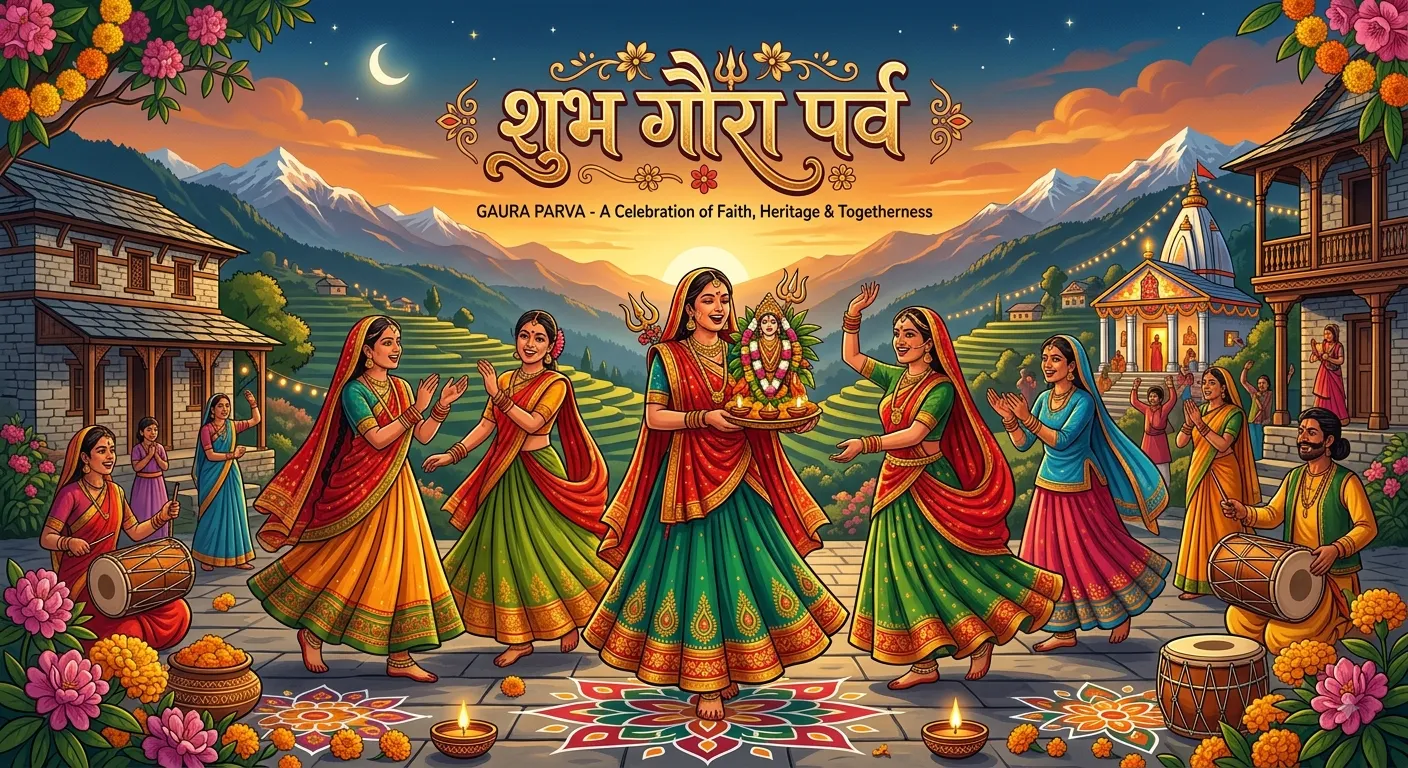
Ask someone from Doti, Baitadi, Bajhang, Achham, Dadeldhura, Kailali or Kanchanpur what their biggest festival is, and the answer will not be Dashain. It will be Gaura.
Gaura Parva is the festival of the Khas communities of Sudurpaschim and parts of Karnali. It is held in Bhadra; it runs from Panchami to Ashtami, and it centres on the marriage of Gauri to Shiva. Married women fast, soak five kinds of grain in a brass vessel, wash them at the village water source, install a goddess made of grass, tie a thread of dubo around their necks, and then the whole village stands in a circle and dances deuda until very late.
For people from the far west living in Kathmandu, in the Gulf, in the Kumaon hills or anywhere else, Gaura is the day they find each other. Tundikhel fills with deuda circles every year for exactly this reason. It is not just a festival there. It is how the region recognises its own.
|
Detail |
Information |
|
Nepali Name |
गौरा पर्व |
|
Other Names |
Gamara, Gaura Parba, Gora, Saton Athon (Kumaoni form), Satu Athu |
|
Month |
Bhadra |
|
Tithi Range |
Panchami to Ashtami, four days, with immersion 3 to 11 days later |
|
Fortnight |
Either Shukla Paksha or Krishna Paksha, decided each year |
|
Deity |
Gauri (Parvati), worshipped with Maheshwar (Shiva) |
|
Main Region |
Sudurpaschim Province and western parts of Karnali Province |
|
Also Celebrated In |
Kathmandu by the far-western diaspora, and the Kumaon division of Uttarakhand in India, especially Pithoragarh |
|
Communities |
Khas communities of the far west, across castes |
|
Signature Items |
Biruda, the five soaked grains, and the dubo dhago worn around the neck |
|
Signature Sound |
Deuda geet |
|
Holiday Status |
Not a national public holiday everywhere. Sudurpaschim Province declares a provincial holiday, and in some years the federal government has added a day |
This is the single most confusing thing about Gaura, and almost no page online explains it properly.
Gaura always runs from Panchami to Ashtami of Bhadra. What changes is which fortnight of Bhadra it falls in.
Gaura is observed in Shukla Paksha, the bright fortnight, when the moon is waxing. Ujyali means bright. In this pattern, Biruda Panchami falls a couple of days after Haritalika Teej, and Gaura Ashtami coincides with Durvashtami.
Gaura is observed in Krishna Paksha, the dark fortnight, when the moon is waning. Andheri means dark. In this pattern, Gaura Ashtami falls on or beside Krishna Janmashtami.
Which one applies is decided each year by the panchang, and the Nepal Panchanga Nirnayak Samiti sets the ruling that the official calendar follows. Households and villages also carry their own tradition, which is why two families in the same district can be observing on different days.
One rule that is consistently stated: a woman keeping the Gaura fast for the first time should begin with Ujyali Gaura, the bright fortnight version. Once begun, the family tradition is followed in later years.
The date carried on the national calendar is Bhadra 19, 2083, which is Friday 4 September 2026, falling alongside Krishna Janmashtami. That is the Andheri Gaura pattern. Households following Ujyali Gaura will observe the same sequence in the bright fortnight later in the same month, with Biruda Panchami falling in mid-September 2026.
Do not treat either as wrong. Check your own family's practice, and check the panchang for the current year.
Two accounts circulate, and both are told in the far west. They are not in competition, because they answer different questions.
Parvati, called Gauri, wanted Shiva as her husband. Shiva was in mourning and in withdrawal after the loss of Sati and had no interest in marriage. Gauri did not give up. She undertook a long and extremely severe tapasya, going without food and shelter, until Shiva accepted her.
Gaura Parva marks that marriage. The fast that women keep during Gaura is a small reenactment of Gauri's own fast, and the prayer attached to it is for the long life and health of the husband, for a good marriage for unmarried girls, and for the welfare of the household.
This is the account that explains why the festival is led by married women and why the central ritual is a wedding.
In this telling, King Sahasrarjuna killed the Brahmins of the lineage of Bhrigu. Their widows, left without protection, fasted and prayed to Gauri. A son born to one of them grew up and blinded the king, who then repented. The festival, in this account, honours the goddess as a protector of the defenceless rather than only as a bride.
This second story is why Gaura in the far west carries a note of protection and of collective survival, and not only of marital devotion.
The house is cleaned, and the walls are freshened, in many villages with red clay collected around Janai Purnima. New clothes are arranged. In the far west, this means the women's traditional set, and the region takes its dress on this day seriously.
Married women select and clean five kinds of grain and soak them in a brass or bronze vessel with water. This mixture is the biruda, and it is the heart of the festival. The women fast the whole day.
The five biruda are usually wheat, peas, horse gram and black gram, with the fifth varying by household and district, most commonly soybean or chickpea. Some households use seven or nine kinds rather than five.
The choice is not decorative. These are the pulses and grains the far western hills actually grow and store, and a bowl containing all of them is a statement that the household has come through the year.
The soaked grain is carried in procession to the nearest river, stream, pond or dhara, the village water spout. The women wash the biruda there together. This is the first day the deuda singing really begins, standing in the water and on the bank.
In many villages this is also the day the Gaura is prepared and installed, brought into the house of the eldest relative or into a common house that will hold it for the festival.
The Gaura, the image of the goddess, is made from grasses and plants gathered locally, bound into a form and placed in a bamboo basket, dressed in red cloth and ornaments. It is not carved, and it is not permanent. It is made new each year and returned to the water afterwards. Shiva, as Maheshwar, is represented alongside her, usually in stone or wood.
The dubo dhago is a thread made with dubo grass, worn around the neck by the women observing the festival. In the far west, it carries the same weight for women that the janai carries for men. That comparison is made locally, and it is the right way to understand it. It is not a bracelet or a decoration. It is the mark of the vow.
The main day. The wedding of Gauri and Maheshwar is performed. The biruda, now soaked and sprouted, is offered to the deities and then distributed to everyone present as prasad. Elders bless younger relatives by placing biruda on their heads.
The whole community gathers. Deuda runs through the day and long into the night. The far western diaspora in Kathmandu holds its own gatherings, with Tundikhel the best known venue.
The Gaura is not kept. Between three and eleven days after Ashtami, depending on local custom, the image is carried to a river, a water source or a peepal tree and immersed or laid to rest there. The festival closes when the goddess goes back into the water.
Deuda is the folk song and dance form of the far west, and Gaura is its high season.
Men and women stand in a circle, arms linked behind each other's backs or on each other's shoulders, and move together in a steady side-to-side step. The rhythm is carried by the feet and the body, not by heavy instrumentation. A large circle can hold dozens of people and can absorb newcomers all night without ever stopping.
Deuda geet is sung in the far western dialect, and it works by exchange. One side of the circle sings a couplet and the other side answers it. Verses are traded back and forth, often improvised, often teasing, sometimes competitive, sometimes about love, migration, absence, work, or the person standing opposite.
The rules of the exchange matter. A weak answering couplet loses the round. Skilled deuda singers in the far west have real local reputations built on the ability to compose a reply on the spot.
Because it needs nothing. No stage, no equipment, no ticket, no rehearsal. A deuda circle can start in a courtyard, in a field, at a water source or on a road, and it will hold anyone who joins it.
Sudurpaschim sends a very large share of its working-age men to India and to the Gulf. Gaura is one of the fixed points people come home for, and where they cannot come home, they hold deuda circles wherever they are. This is why the festival now appears in Kathmandu, in Delhi, in Dubai and across the Indian hill towns, and why deuda videos from those gatherings circulate every Bhadra.
The soaked, sprouted five-grain mixture, offered and then eaten as prasad. It is the only ritual food in the Nepali calendar that is a bowl of the region's own agriculture and nothing else.
Women observing Gaura fast on Panchami and again on Ashtami in many households, taking only fruit, milk, or a single meal without salt, depending on family practice.
Households prepare the food of the far west: sel roti, halwa, kheer, local rice varieties, and seasonal vegetables. In many villages, the festival is also the year's main occasion for feeding the extended family and for hosting relatives who have travelled back.
Women wear the traditional far western set with heavy silver and gold ornaments, including the distinctive regional necklaces and nose ornaments. Gaura is the day this dress comes out, and the photographs from it are a large part of how the region presents itself to the rest of Nepal.
The heartland. Doti, Baitadi, Bajhang, Bajura, Darchula, Dadeldhura, Achham, Kailali and Kanchanpur. Doti in particular is associated with the strongest continuous tradition.
Western districts of Karnali observe it, with local variation in the rituals and in the deuda style.
The far western community in Kathmandu holds large public celebrations. Tundikhel is the best-known gathering point, and the event has become a fixture on the capital's cultural calendar rather than a private community affair.
The same festival exists across the border in the Kumaon division of Uttarakhand, especially in Pithoragarh, where it is known as Saton Athon, meaning the seventh and the eighth, after the two main tithis. The cultural region of the far western hills does not stop at the Mahakali river, and Gaura is one of the clearest pieces of evidence for that.
Wherever there is a concentration of people from Sudurpaschim, there is a Gaura programme. Delhi, Mumbai, the Gulf states, Malaysia, the United Kingdom and Australia all have organised celebrations run by far-western associations.
Gaura Parva is a provincial and regional holiday rather than a straightforward national one, and the picture changes from year to year.
Sudurpaschim Province regularly declares a public holiday in the province for Gaura
In some years the federal government has also declared a holiday, giving the province two days
Because the main day frequently coincides with Krishna Janmashtami, which is a national public holiday, the two can overlap, and the province effectively gets its day covered by the federal calendar
Schools, offices and businesses across Sudurpaschim close regardless of what the gazette says, because the festival is too large to work through
Check the provincial notice for the current year rather than assuming. The province publishes it in advance.
| Term | Meaning |
|---|---|
| Gaura or Gauri | Parvati, the goddess of the festival |
| Maheshwar | Shiva, worshipped alongside Gaura |
| Gamara | An alternative name for the festival used in parts of the region |
| Biruda | The five soaked grains, the central offering of the festival |
| Biruda Panchami | The first day, when the grains are soaked |
| Dubo Dhago | A thread made with dubo grass, worn around the neck by observing women |
| Deuda | The circle dance and song tradition of the far west |
| Deuda Geet | Songs performed in the Deuda tradition |
| Atthe or Athon | The eighth day, which is the main day of Gaura |
| Ujyali Gaura | Gaura observed during the bright fortnight (Shukla Paksha) |
| Andheri Gaura | Gaura observed during the dark fortnight (Krishna Paksha) |
| Visarjan | The immersion of the Gaura image at the end of the festival |
| Dhara or Naula | A village water spout or spring where the Biruda is washed |
When is Gaura Parva celebrated?
→ Gaura Parva runs from Panchami to Ashtami of Bhadra. Whether that falls in the bright fortnight or the dark fortnight is decided each year by the panchang. On the national calendar for 2083 BS, the observance falls on Bhadra 19, which is 4 September 2026.
Why do I see two different dates for Gaura Parva?
→ Because Gaura is observed in two patterns. Ujyali Gaura falls in Shukla Paksha, the bright fortnight, and Andheri Gaura falls in Krishna Paksha, the dark fortnight. Different families and different districts follow different traditions, so both dates appear in the same Bhadra.
Which Gaura should someone fasting for the first time follow?
→ The commonly stated rule is that a first-time faster should begin with Ujyali Gaura, the bright fortnight version, and then follow the family tradition in later years.
What is biruda?
→ Biruda is the mixture of five soaked grains that sits at the centre of Gaura. Married women soak them in a brass or bronze vessel on Panchami, wash them at the village water source on Shashthi, offer them to the deities on Ashtami and then distribute them as prasad.
Which five grains are used in biruda?
→ Wheat, peas, horse gram and black gram are consistent across most households, with the fifth varying, most often soybean or chickpea. Some households use seven or nine kinds instead of five.
What is the dubo dhago?
→ A thread made with dubo grass, worn around the neck by women observing Gaura. In the far west it is understood to carry the same significance for women that the janai carries for men.
Where is Gaura Parva celebrated?
→ Across Sudurpaschim Province and the western districts of Karnali Province, by the far western community in Kathmandu, and in the Kumaon division of Uttarakhand in India, where it is called Saton Athon.
What is deuda?
→ Deuda is the circle dance and song form of far western Nepal. Participants link arms in a circle and move in a steady step while exchanging sung couplets back and forth between the two halves of the circle. It is the defining sound of Gaura.
Is Gaura Parva a public holiday in Nepal?
→ Sudurpaschim Province declares a provincial public holiday for it, and in some years the federal government has added a day. Because the main day often coincides with Krishna Janmashtami, which is a national holiday, the two frequently overlap. Check the current year's notice.
Who is the festival dedicated to?
→ Gauri, meaning Parvati, worshipped together with Maheshwar, meaning Shiva. The central ritual is the reenactment of their marriage.
Can men take part in Gaura Parva?
→ Yes. The fasting and the core worship are led by married women, but the festival is a whole community event and deuda is danced by everyone. Men take part in the gatherings, the singing and the feasting.
What happens to the Gaura image after the festival?
→ It is immersed. Between three and eleven days after Ashtami, depending on local custom, the grass image is carried to a river, a water source or a peepal tree and returned there. It is made new every year.
Is Gaura Parva the same as Teej?
→ No. They fall in the same month, and both are observed largely by women with fasting, which is why they get confused. Haritalika Teej is Bhadra Shukla Tritiya and is observed nationally. Gaura runs Panchami to Ashtami and is specific to the far west, with its own rituals, its own offering, and its own dance form.
What is Saton Athon?
→ The Kumaoni name for the same festival, meaning the seventh and the eighth, after the Saptami and Ashtami tithis on which the main rituals fall. It is celebrated in the Kumaon division of Uttarakhand, particularly in Pithoragarh.
How do you wish someone on Gaura Parva?
→ Common greetings are गौरा पर्वको हार्दिक शुभकामना and सम्पूर्ण दिदीबहिनी तथा दाजुभाइहरूमा गौरा पर्वको मंगलमय शुभकामना.