|
Detail |
Information |
|---|---|
|
Festival name |
Bhanu Jayanti (भानु जयन्ती) |
|
Honours |
Adikavi Bhanubhakta Acharya, the first poet of the Nepali language |
|
Date (BS) |
29 Ashadh, every year |
|
Date (AD) |
13 July, every year |
|
Type |
National literary and cultural observance |
|
Public holiday |
Not a public holiday |
|
Born |
13 July 1814 CE (29 Ashadh 1871 BS) |
|
Birthplace |
Chundi Ramgha village, Tanahun district, Nepal |
|
Died |
1868 CE (1925 BS), at Setighat, Tanahun |
|
Best known for |
Translating the Ramayana from Sanskrit into simple Nepali |
|
Famous title |
Adikavi (First Poet) |
|
Where celebrated |
Nepal, India (Darjeeling, Sikkim, Assam), Bhutan, and Nepali communities worldwide |
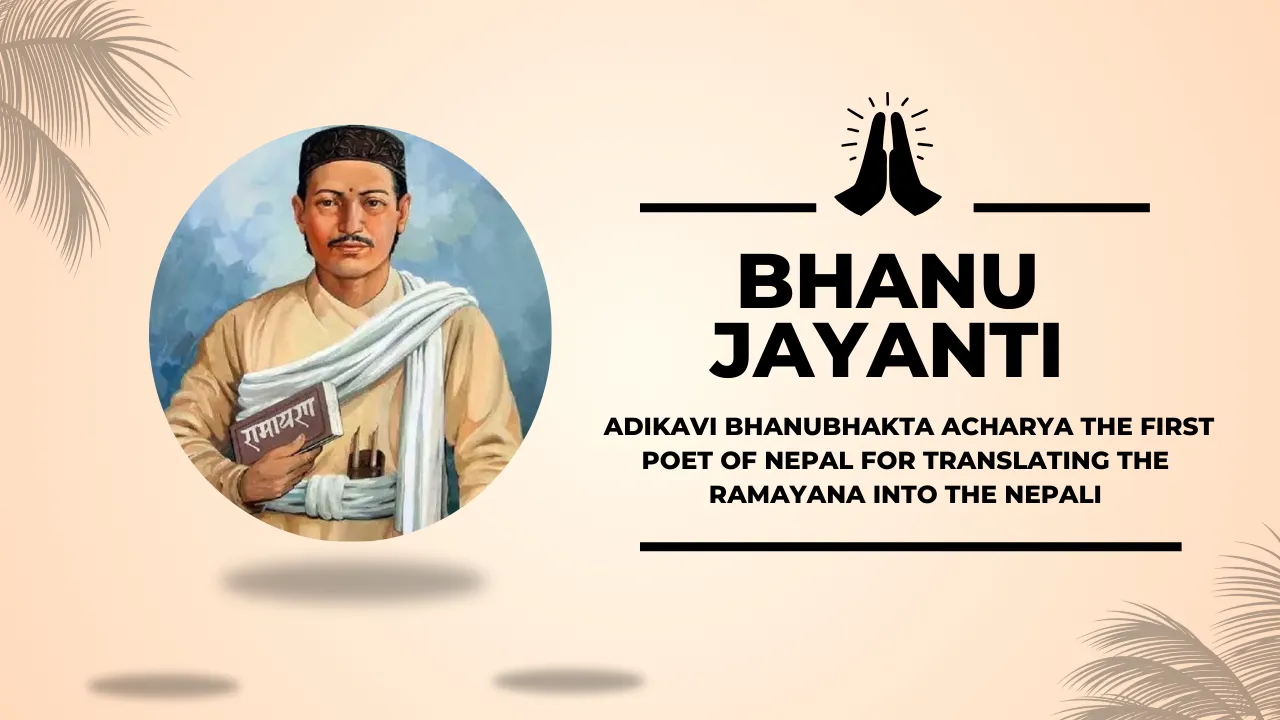
Bhanu Jayanti is the birthday of Bhanubhakta Acharya, the poet Nepal lovingly calls "Adikavi," which means the first poet. It falls every year on the 29th day of Ashadh in the Nepali calendar, which usually lands on the 13th of July. On this day, people across Nepal, Darjeeling, Sikkim, Bhutan, and Nepali-speaking homes around the world stop to remember the man who gave the Nepali language its first great book of poetry. Schools hold recitation contests, statues are draped with flower garlands, poets read verses in his honour, and the President and Prime Minister of Nepal also share messages about his gift to the nation.
What makes this day special is not just that a famous person was born. It is that one man, working alone in a village with no printing press and no fame, who wrote in the plain spoken language of ordinary people and lifted that language into literature. Before him, serious writing in this region was locked inside Sanskrit, a language only priests and scholars could read. Bhanubhakta opened that locked door. That is why, more than 200 years after his birth, Nepal still pauses every Ashadh to say thank you.
Bhanu Jayanti is always observed on the 29th day of Ashadh, the third month of the Bikram Sambat calendar. Ashadh falls in the middle of the monsoon, so the day almost always lands on the 13th of July in the Gregorian calendar. Because the Nepali and English calendars do not line up perfectly, the English date can shift by a day in some years, but the Nepali date stays fixed at 29 Ashadh.
Bhanubhakta Acharya was born in 1814, so his birthday has been counted for more than two centuries. In 2026, which is the year 2083 in the Bikram Sambat calendar, Nepal marks its 212th birth anniversary. Here are the dates for nearby years so you can plan:
|
Year (CE) |
Bikram Sambat |
Date |
Day |
|---|---|---|---|
|
2024 |
2081 BS |
13 July / 29 Ashadh |
Saturday |
|
2025 |
2082 BS |
13 July / 29 Ashadh |
Sunday |
|
2026 |
2083 BS |
13 July / 29 Ashadh |
Monday |
|
2027 |
2084 BS |
13 July / 29 Ashadh |
Tuesday |
|
2028 |
2085 BS |
13 July / 29 Ashadh |
Thursday |
Bhanubhakta Acharya was a poet, translator, and thinker who is honoured as the first great poet of the Nepali language. He was born on 29 Ashadh 1871 BS (13 July 1814) in the small hill village of Chundi Ramgha in Tanahun district, in what was then the young Kingdom of Nepal. His family was Brahmins, and his father, Dhananjaya Acharya, worked as a government official. The family was not poor. Bhanubhakta grew up with the comfort that most village children of his time never knew.
His early learning did not come from a school building. In those days, there were no public schools in the villages. Bhanubhakta was taught at home by his grandfather, Shreekrishna Acharya, a devout and learned man who filled the boy's mind with Sanskrit scriptures and religious stories. Later, he went to the holy city of Varanasi (Kashi) in India to study Sanskrit more deeply. One important point about his education is that he never received a Western, English-style schooling. This turned out to matter a great deal, because it kept his writing rooted in the sounds, feelings, and rhythms of everyday Nepali village life rather than in foreign forms.
The turning point in Bhanubhakta's life is one of the most loved stories in Nepali culture, and it explains the spirit of Bhanu Jayanti better than any other tale.
One day, he was walking through a village when he saw an elderly grass cutter, a "ghansi," working hard, cutting and selling grass for a living. Curious, he asked the man why he continued such difficult work at his age. The grass cutter replied that he was saving money to build a public well (kuwa). He explained that after his death, people would continue to use the well and remember him for doing something useful for society. He simply wanted to leave behind something good, a "kirti," a lasting mark of a life that helped others.
These words deeply moved Bhanubhakta. Here was a man with empty pockets thinking about how to serve the world, although he came from a respected and educated family. He realized that he had not yet done anything that would benefit future generations or make him remembered.
Inspired by the grass cutter's selfless thinking. He decided he would use the one gift he had, his skill with words, to leave something last forever. He translated the Ramayana into simple Nepali so that ordinary people, not just Sanskrit scholars, could read and understand it. Out of that moment came a short poem about the grass cutter that Nepali children still learn today. The original lines and their meaning are shared in the poems section below.
Bhanubhakta's greatest work was translating the epic Ramayana from Sanskrit into simple, spoken Nepali. To understand why this was so bold, you have to picture the world he lived in. Almost all serious religious writing was in Sanskrit. Sanskrit was beautiful, but very few people could read or understand it. It belonged to priests and scholars. The ordinary farmer, mother, or shopkeeper could hear the stories of Ram and Sita only if a learned person explained them out loud.
Bhanubhakta changed that. He retold the whole story of Ram in flowing Nepali verse that sounded less like a stiff textbook and more like a song. Scholars say he kept the "bhava" and "marma," the feeling and the inner meaning, of the original, while dressing it in words a village grandmother could follow. For the first time, families could read and recite the sacred epic in their own tongue. His version, later known as the Bhanubhaktako Ramayan, became the book that carried the Nepali language into millions of homes.
Bhanubhakta's life was not all quiet study. Because he was known as an honest and educated man, he was asked to help with some official paperwork. Through no real fault of his own, a problem with signed documents landed him in prison, where his health began to fail. Even behind bars, he kept writing. He worked on his Ramayana and composed sharp, witty verses about slow officials and endless delays.
The most famous story from this time is his verse petition. He wrote his plea for freedom not in dry legal language but in poetry, in the very Nepali tongue that the rulers of the day wanted to promote. The verses were so moving and so clever that, as the story goes, they helped win both his release and a reward. It is a beautiful example of how his words could open doors that money could not.
One of the saddest and most striking facts about Bhanubhakta is that he died without knowing he would become a national hero. He passed away in 1868 (1925 BS) at Setighat in Tanahun, still an ordinary man in the eyes of the world. His writings sat in scattered manuscripts and could easily have been lost forever.
The hero of the second half of the story is a younger poet named Motiram Bhatta. Years after Bhanubhakta's death, Motiram found his manuscripts, understood how important they were, and carried them to Benaras to have them printed. He published the Ramayana in the 1880s and also wrote the first biography of Bhanubhakta. It was Motiram Bhatta who gave him the title the whole nation now uses, "Adikavi," the first poet. Without Motiram's care, Nepal might never have known the man it now celebrates every Ashadh.
Many people think "Adikavi" means Bhanubhakta was simply the first person ever to write in Nepali. That is not quite what the title means, and the real meaning is more beautiful.
There were other writers before him. But according to Motiram Bhatta, who gave him the title, Bhanubhakta earned the name "first poet" because he was the first to write with a true understanding of the "marma," the deep inner heart, of poetry. Earlier writing often felt like rhymed information. Bhanubhakta's verses carried real feeling, devotion, music, and the warmth of the country. He wrote in pure, natural, colloquial Nepali, the way people actually spoke, instead of a stiff bookish style. Because of this, he is credited with laying the foundation stone of Nepali literature. Every Nepali poet who came after him, in a sense, walks on the road he built.
No page about Bhanu Jayanti is complete without his own words. Below are three of his most loved verses in the original Nepali, each followed by a simple explanation of the meaning. These are the lines recited at school programs and quoted in newspapers every Ashadh.
This is the poem born from his meeting with the poor old grass cutter. It is short, humble, and it holds the whole message of Bhanu Jayanti: a life is measured by what you leave behind for others, not by what you own.
भर् जन्म घाँस तिर मन् दिई धन कमायो नाम क्यै रहोस् पछि भनेर कुवा खनायो घाँसी दरिद्र घरको तर बुद्धि कस्तो म भानुभक्त धनी भैकन किन यस्तो
मेरा ईनार न त सत्तल पाटिकै छन् जे धन चीजहरु छन् घर भित्रनै छन् त्यस घाँसीले कसरी आज दिए छ अर्ति धिक्कार हो म कन बस्नु न राखि किर्ति
What it means: All his life, the grass cutter set his heart on cutting grass and slowly earned a little money. Then, wishing that his name would remain after him, he used that money to dig a public well for others. The grass cutter comes from a poor home, yet look at how wise he is. I, Bhanubhakta, am wealthy, so why have I done nothing like this? I have no wells, no rest houses, no roadside shelters built in my name. Whatever riches I have simply sit inside my house. See how that grass cutter has taught me a lesson today. Shame on me if I live and die without leaving behind any good deed to be remembered by.
These are the famous first lines of his Ramayana, the work that made the Nepali language a language of literature. The story opens with the sage Narad visiting Brahma in the heavens.
एक् दिन् नारद सत्यलोक् पुगि गया लोक्को गरूँ हित् भनी ब्रह्मा ताहिं थिया पर्या चरणमा खूसी गराया पनी
What it means: One day, the sage Narad traveled up to Satyalok, the world of truth, thinking he would do some good for all beings. Brahma, the creator, was there. Narad fell at his feet and pleased him with his respect. From this gentle beginning, Bhanubhakta unfolds the entire life of Lord Ram in easy, singing Nepali verse.
While he was held in prison over a paperwork dispute, Bhanubhakta wrote sharp, honest lines about the slow officials who kept delaying his case. This couplet shows his wit and his frustration with endless "come back tomorrow" answers.
बिन्ती डिट्ठा विचारीसित म कति गरूँ चुप् रहन्छन् नबोली बोल्छन् ता ख्याल् गर्या झैं अनि पछि दिनदिन् भन्दछन् भोली भोली
What it means: How much can I keep pleading with the court officials, the ditthas and bicharis? They sit silent and will not speak. When they finally do speak, they pretend to be looking into my case, and then, day after day, they simply keep saying "tomorrow, tomorrow." Anyone who has ever waited in a slow office will smile at how true these lines still feel.
Besides the Ramayana, Bhanubhakta left several shorter works that are still read and studied today. Each one shows a different side of his mind, from his deep devotion to his sense of duty and his humour.
Bhaktamala: a devotional work praising the great devotees of God, full of his warm religious feeling.
Prashnottar (Prashnottari): a work written in a question-and-answer form that shares moral and spiritual lessons.
Badhu Shiksha: a book of guidance and good manners written especially for young women and brides, offering advice on how to live a wise and respected life.
Ramgita and shorter verses: devotional songs and scattered poems, including the witty lines he wrote during his time in prison.
Together, these works prove that Bhanubhakta was not a one-book poet. He was a full literary voice who wrote about faith, daily life, right conduct, and the simple joys and troubles of ordinary people.
Bhanu Jayanti is far more than a birthday celebration for a poet who lived long ago. It carries several deep meanings that keep it alive year after year.
Bhanu Jayanti is mostly a cultural and literary day rather than a religious festival with rituals. The celebrations are gentle, thoughtful, and full of words, because words were his gift. Here is how people mark the day across Nepal and beyond.
He was born, and he died on land in Tanahun district, yet his words traveled to every corner where Nepali is spoken.
He never had a Western education, and that is part of why his Nepali sounds so natural and rooted.
He wrote much of his Ramayana while sitting in prison over a paperwork dispute that was not truly his fault.
He died in 1868 without fame, believing his work might be forgotten.
The title "Adikavi" was not used during his life. It was given later by the poet Motiram Bhatta.
His inspiration was not a king or a scholar but a poor grass cutter who wanted to dig a well for strangers.
His birthday, 29 Ashadh, is a national public holiday in Nepal to this day.
What is Bhanu Jayanti?
Bhanu Jayanti is the day Nepal celebrates the birth anniversary of Bhanubhakta Acharya, the first great poet of the Nepali language. It is a national and cultural observance, not a religious festival with rituals. The day is spent honouring his memory through poetry readings, school programs, and public tributes. It is celebrated in Nepal and in every place where Nepali-speaking people live.
Why is Bhanubhakta called Adikavi?
Adikavi means "the first poet." The title does not mean he was the very first person ever to write in Nepali. It means he was the first to write with a true understanding of the deep inner feeling of poetry, in pure and natural Nepali. The poet Motiram Bhatta gave him this title while writing his biography. Bhanubhakta is remembered as the writer who laid the foundation of Nepali literature.
When is Bhanu Jayanti celebrated?
Bhanu Jayanti is always celebrated on the 29th day of Ashadh in the Nepali calendar, which almost always falls on 13 July. In 2026, which is 2083 in the Bikram Sambat calendar, Bhanu Jayanti falls on Monday, 13 July. Because it is a government holiday, offices, banks, and most schools remain closed on this day. The Nepali date of 29 Ashadh stays fixed every year, even though the English date can shift by a day.
Who was Bhanubhakta Acharya?
Bhanubhakta Acharya was a Nepali poet, translator, and writer who lived from 1814 to 1868. He was born in Chundi Ramgha village in Tanahun district and learned Sanskrit at home from his grandfather. He is most famous for translating the epic Ramayana from Sanskrit into simple, spoken Nepali for the first time. Because of this work, he is honoured with the title Adikavi, the first poet.
What is the grass cutter (Ghansi) story?
As a young man, Bhanubhakta met a poor old grass cutter who was saving money to dig a public well so travelers could drink from it after he was gone. The grass cutter wanted to leave behind something good rather than wealth. Bhanubhakta, who was rich but had done nothing lasting, felt deeply ashamed and inspired. That meeting pushed him to use his gift for words to serve his people, and it led to his famous Ghansi poem.
What did Bhanubhakta Acharya write?
His greatest work is the Bhanubhaktako Ramayan, his Nepali translation of the Ramayana. He also wrote several other important works, including Bhaktamala, a devotional poem, Prashnottar, written in a question-and-answer form, and Badhu Shiksha, a book of guidance for young women. He also composed shorter devotional songs and witty verses, including poems written during his time in prison. Together, these works make him a complete literary voice, not just a single-book poet.
Why did Bhanubhakta translate the Ramayana into Nepali?
In his time, almost all sacred writing was in Sanskrit, a language only priests and scholars could read. Ordinary people could not read the story of Ram in their own tongue. Bhanubhakta wanted to open this treasure to everyone, so he retold the whole epic in flowing, everyday Nepali. His translation let common families read and recite the story at home for the first time, which is why it had such a huge effect on the language.
Is Bhanu Jayanti a public holiday in Nepal?
Yes, Bhanu Jayanti is a national public holiday in Nepal. Government offices, banks, and most schools and colleges are closed on 29 Ashadh. Many schools hold their literary programs a day or two earlier so that students can take part before the holiday. In Nepali-speaking areas of India, such as Darjeeling and Sikkim, the day is also widely observed with cultural events.
How is Bhanu Jayanti celebrated in schools?
Schools celebrate Bhanu Jayanti with poem recitation contests, essay-writing competitions, speeches about his life, quizzes, and short skits based on the grass-cutter story or the Ramayana. Students often recite his famous Ghansi poem because the lines are short and full of meaning. Teachers use the day to help children understand the value of their own language and the lesson of leaving behind good work. It is often a child's first real meeting with Nepali literature.
Where was Bhanubhakta Acharya born?
Bhanubhakta Acharya was born in Chundi Ramgha, a village in the Tanahun district of Nepal, on 29 Ashadh 1871 BS, which is 13 July 1814. He spent much of his life in the same region and died at Setighat in Tanahun in 1868. His birthplace is a place of pride for the district and is remembered during Bhanu Jayanti. Visitors and students sometimes travel there to honour the poet.
Who published Bhanubhakta's work after his death?
Bhanubhakta died in 1868 without fame, and his writings could have been lost. A younger poet named Motiram Bhatta found his manuscripts, understood their value, and took them to Benaras to be printed. He published the Ramayana in the 1880s and wrote the first biography of Bhanubhakta. Motiram Bhatta is also the person who first called him Adikavi, the title Nepal still uses today.
What is the difference between Bhanubhakta's Ramayan and other versions?
Bhanubhakta's Ramayan was the first full retelling of the epic in the Nepali language. Unlike the Sanskrit original, which few could read, his version used the plain spoken language of the people, so anyone could follow it. Scholars say his verses feel more like a song than a stiff text, while still keeping the true feeling and inner meaning of the story. This blend of simple language and deep feeling is what made it so loved and so important for Nepali literature.