
| Date | Summer Solstice (June 21) |
| Duration | Six-month period (until Uttaraayan / Makar Sankranti) |
| Observance | National and Regional |
| Celebrated in | Nepal, India, and Hindu communities worldwide |
| Observing Communities | Hindu practitioners, astronomers, astrologers, and devotees of traditional calendar systems |
| Type of Event | Astronomical and Spiritual |
| Purpose of Event | To mark the commencement of the sun's southward journey (Dakshinaayan), a significant astronomical and cosmological transition that governs auspicious timing in Hindu tradition for six months. |
| Holiday Status | Not an official public holiday in Nepal |
| First Observed in | Vedic period (ancient astronomical observation dating back thousands of years) |
Quick Fact: In Hindu cosmology, Dakshinaayan is sometimes called the "night of the gods", a period of six months when the sun moves southward. The Mahabharata records that the great warrior Bhishma Pitamah, who had the boon of choosing his death, deliberately held onto life through the entire Dakshinaayan period and waited for Uttaraayan (the sun's northward journey) to take his final breath, as dying during Uttaraayan is considered most auspicious for spiritual liberation.
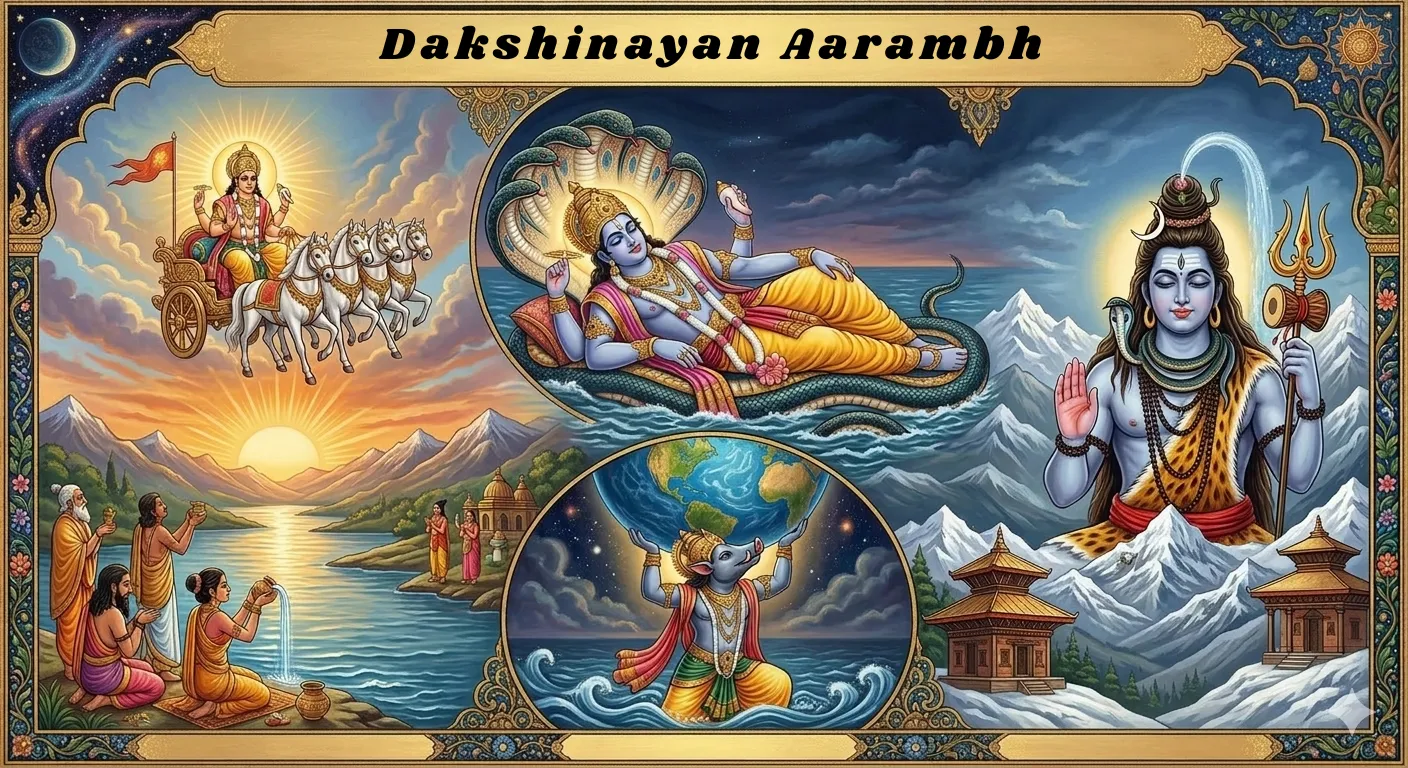
Dakshinaayan Arambha marks the commencement of the sun's southward journey (Dakshinaayan) in Hindu astronomy and cosmology, occurring at the summer solstice around June 21. This astronomical transition is one of the two most significant solar events in the Hindu calendar, fundamentally influencing the timing of auspicious ceremonies, religious practices, and daily life according to traditional Hindu astrology and Vedic principles.
The concept of Dakshinaayan (literally "southward journey") is one of the oldest astronomical observations codified in Hindu cosmological tradition, dating back to the Vedic period. Ancient Hindu astronomers meticulously tracked the sun's apparent movement between the tropics and embedded these observations into the religious and cultural calendar. Hindu tradition divides the year into two Ayanas: Uttaraayan (northward journey, winter solstice to summer solstice) and Dakshinaayan (southward journey, summer solstice to winter solstice). Uttaraayan is considered auspicious (associated with Devas/gods), while Dakshinaayan is associated with lunar deities and the inner, contemplative journey. The Bhagavad Gita (Chapter 8) and the Mahabharata reference these two paths in the context of the soul's journey after death, underscoring the deep cosmic significance embedded in these astronomical cycles.
This observance is marked to:
Acknowledge and honor a fundamental astronomical transition in Hindu cosmological understanding.
Understand the cyclical patterns of solar movement that govern Hindu calendar and ritual timing.
Initiate a period of spiritual introspection and inward contemplative practice aligned with cosmic cycles.
Acknowledge celestial mechanics as a divine principle woven into Hindu philosophy and daily life.
This transition is acknowledged through:
Puja and prayers at temples acknowledging the solar transition and seeking divine blessings.
Specific dietary adjustments and behavioral practices aligned with the new seasonal period.
Traditional avoidance of auspicious ceremonies such as weddings during the Dakshinaayan period.
Meditation, spiritual introspection, and turning of focus to inner practices.
Temple visits, astronomical discussions, and consultations with Jyotishis (Hindu astrologers).
This observance is significant because:
It is fundamental to Hindu cosmological understanding and the traditional Panchangam (almanac) system.
It directly influences Muhurat (auspicious timing) calculations for all major ceremonies and life events.
It represents the cyclical nature of cosmic existence embedded in Hindu philosophy.
It governs the traditional Hindu wedding season calendar for six months.
It demonstrates the sophisticated integration of astronomical observation with ancient Hindu wisdom traditions.
Dakshinaayan Arambha reminds devotees that human life is inextricably woven into the cosmic fabric of astronomical cycles. In acknowledging the sun's southward journey, Hindu tradition invites a corresponding inner journey—a turn toward contemplation, meditation, and the deepening of spiritual life that mirrors the gradual withdrawal of sunlight as days grow shorter.