
| Date | Kartik Krishna Ashtami (November 10, 2026) |
| Duration | Single day |
| Observance | Religious/Astrological |
| Celebrated in | Temples and homes throughout Hindu communities in Nepal and India |
| Observing Communities | Hindu devotees, particularly those seeking Mercury's blessings for wisdom and communication |
| Type of Event | Planetary Vrata (Ritual Fast) |
| Purpose of Event | Honoring Budha (Mercury) on the Ashtami tithi for blessings of wisdom, mental clarity, and successful communication |
| Holiday Status | Religious observance (not an official holiday) |
| First Observed in | Ancient Hindu period; integrated into astrological and ritual practice |
Quick Fact: In Hindu astrology (Jyotish), Budha (Mercury) governs intelligence, communication, learning, and analytical reasoning. Budhastami Vrata combines the power of the Ashtami tithi (eighth lunar day), associated with Goddess Durga, with Mercury's astrological influence, creating a powerful day for spiritual practices aimed at developing mental acuity and clear communication.
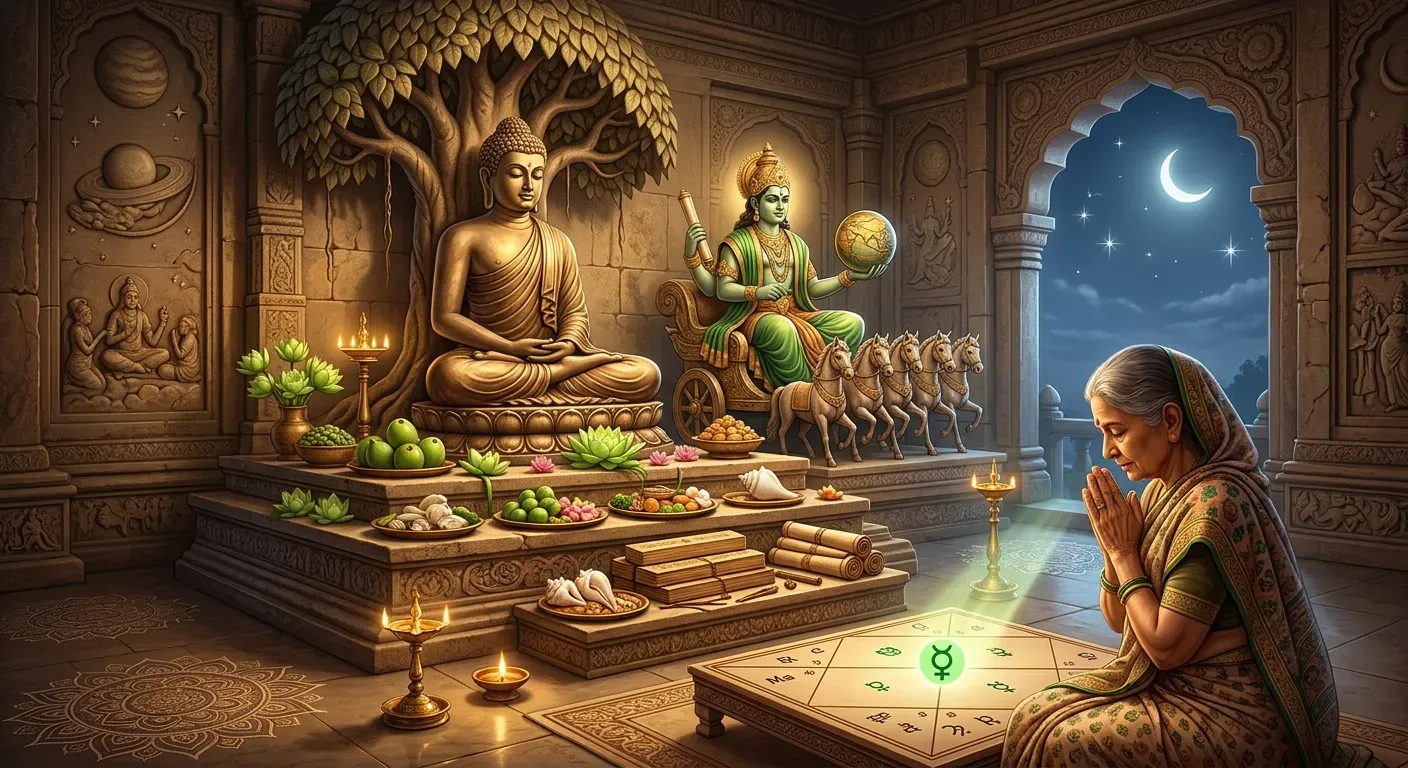
Budhastami Vrata is a ritual observance that honors Budha, the planet Mercury in Hindu astrology, on the eighth lunar day (Ashtami) of a particular month. This vrata represents one of Hinduism's many planetary fasting traditions (Graha Vratas), which aligns devotional practice with celestial bodies believed to influence human life and fortune. By observing this fast, devotees seek blessings for wisdom, intellectual clarity, effective communication, and success in educational and business pursuits.
Hindu astrology (Jyotish Shastra) is one of the six Vedangas, the auxiliary disciplines attached to the ancient Vedic corpus, and assigns profound spiritual significance to the nine celestial bodies (Navagrahas). Among these, Budha (Mercury) holds dominion over intellect, speech, commerce, mathematics, writing, and all forms of communication. In Hindu mythology, Budha is the son of the Moon (Chandra) and Tara (a star goddess), born from their union. He is depicted as a youthful, green-complexioned deity carrying a sword, shield, and mace, often riding a winged lion. Graha Vratas, planetary fasting observances, emerged from the Vedic tradition of aligning human spiritual practice with celestial cycles. The specific combination of Budha (Mercury day or Mercury-related worship) with the Ashtami tithi creates a particularly potent day for intellectual and communicative pursuits, believed to cleanse negative Mercury influences in the natal chart while attracting positive mercurial blessings.
This festival is mainly observed to:
Honor Mercury (Budha) as the planetary deity associated with wisdom, intelligence, and effective communication.
Seek blessings for mental clarity, sharp intellect, and success in educational and commercial pursuits.
Perform spiritual purification through fasting and meditation to reduce malefic Mercury influences in one's horoscope.
Develop intellectual discipline and enhance cognitive abilities through spiritual practice aligned with celestial rhythms.
Connect personal spiritual practice to the broader cosmic astrological influences recognized in Hindu tradition.
Budhastami Vrata is observed through astrologically informed spiritual practices:
Day-long fast with light food or milk-based offerings maintained throughout the observance period.
Prayers and green-colored offerings (Budha's color) to Mercury's planetary deity representation at temples or home shrines.
Meditation focused on wisdom, clarity of thought, and purification of intellectual processes.
Study of spiritual or philosophical texts dedicated to enhancing intellectual and spiritual development.
Recitation of Budha (Mercury) mantras such as "Om Budhaya Namah" to invoke mercurial blessings.
Budhastami Vrata is important for several reasons:
It represents the integration of astrological awareness into spiritual practice, a distinctive feature of Hindu religious life.
It emphasizes the role of mental discipline and intellectual development in achieving spiritual progress.
It celebrates wisdom and intelligence as divine gifts to be cultivated through both study and devotional practice.
It demonstrates the Hindu understanding of the cosmos as interconnected, with celestial bodies actively influencing human affairs.
It provides a framework for simultaneously developing intellectual and spiritual strengths through aligned practice.
Budhastami Vrata reminds practitioners that in Hindu philosophy, the pursuit of wisdom is never separate from spiritual practice. By fasting, praying, and offering devotion to Mercury's planetary deity on this auspicious Ashtami day, devotees seek to sharpen the instrument of the mind, transforming it from a source of confusion into a clear mirror reflecting divine intelligence and truth.