
| Date | Bhadra Shukla Dwadashi (September 13) |
| Duration | One-day celebration |
| Observance | Regional and Community |
| Celebrated in | Nepal, India, and Vaishnava communities worldwide |
| Observing Communities | Vishnu devotees, Vaishnavas, and Hindu spiritual seekers |
| Type of Event | Religious |
| Purpose of Event | To celebrate the prophesied appearance of Kalki, the tenth and final avatar of Lord Vishnu, who will restore dharma at the end of Kali Yuga and usher in a new cosmic age. |
| Holiday Status | Not an official public holiday in Nepal |
| First Observed in | Vedic period (based on prophetic references in Puranic texts) |
Quick Fact: According to Hindu Puranas, Kalki will appear at the end of Kali Yuga riding a white horse and carrying a blazing sword, destroying evil and restoring righteousness. The Kalki Purana describes him as the son of Vishnuyasha, born in Sambhala village. This makes Kalki Jayanti unique as a festival celebrating an avatar who is yet to appear in the world.
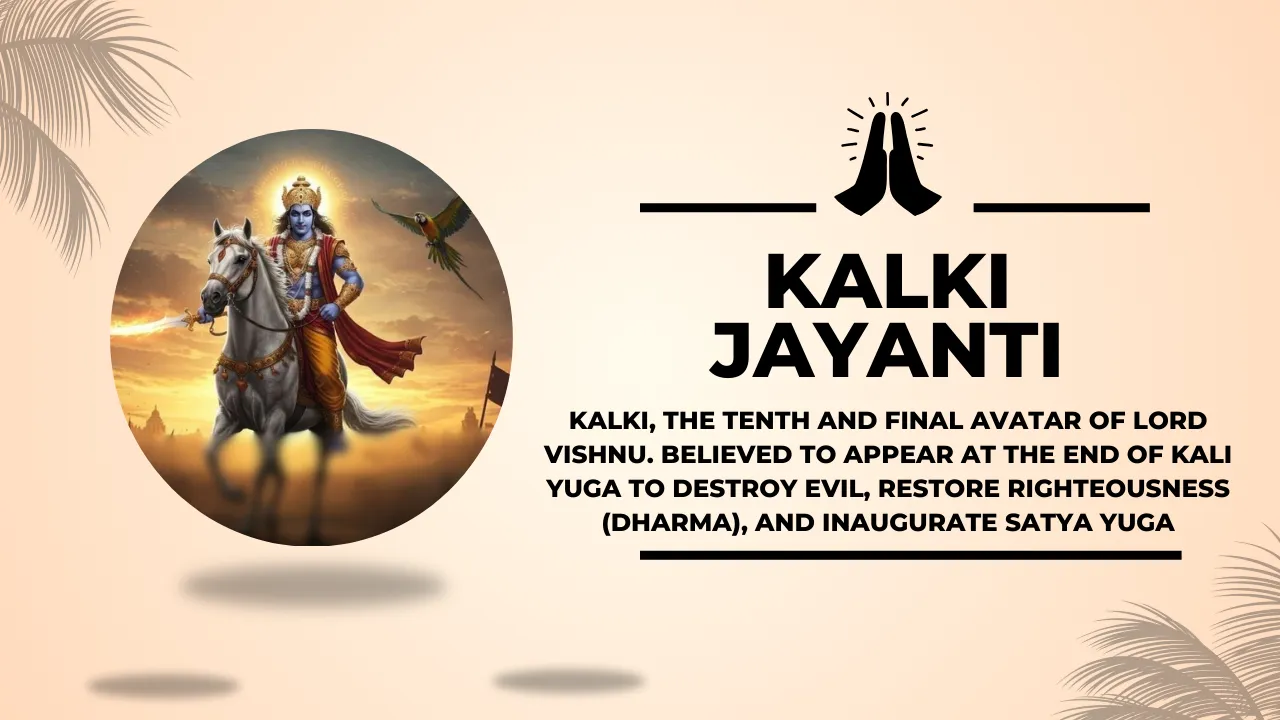
Kalki Jayanti celebrates the prophesied birth of Kalki, the tenth and final avatar (divine incarnation) of Lord Vishnu in Hindu philosophy and cosmology. Unlike other Jayantis that mark the birth of historical or legendary figures, Kalki Jayanti commemorates an avatar yet to appear, a celebration of divine promise and cosmic hope embedded in the Hindu understanding of time and creation.
Kalki Jayanti is rooted in Hindu Puranic texts, particularly the Agni Purana, Bhagavata Purana, and the dedicated Kalki Purana. According to these scriptures, Lord Vishnu will incarnate as Kalki at the end of Kali Yuga (the current age of darkness and moral decline) to restore dharma (righteousness) and destroy evil. Though Kalki has not yet been born, the birthday is celebrated based on astrological and scriptural calculations from ancient Hindu texts. This festival uniquely bridges ancient religious prophecy with contemporary Hindu spirituality, emphasizing the Hindu philosophical understanding of cyclic time (Yugas), cosmic creation, preservation, and renewal.
This celebration is observed to:
Celebrate the prophesied final avatar of Lord Vishnu and reaffirm faith in divine justice.
Reinforce Hindu philosophy of cyclic time (Yugas) and cosmic renewal through divine intervention.
Promote belief in the ultimate restoration of dharma and triumph of righteousness over evil.
Offer spiritual preparation and hope for eschatological renewal in these challenging times.
This celebration is marked through:
Puja and prayers to Lord Vishnu at temples and household shrines.
Recitation of Kalki-related Puranic passages, especially from the Kalki Purana.
Fasting and meditation practices focusing on Vishnu's divine mission of cosmic restoration.
Devotional singing and religious discourses on Kalki's prophesied role.
Community gatherings for spiritual discussions on dharma, cosmic order, and divine justice.
This celebration is significant because:
It is central to Hindu apocalyptic theology and the Puranic understanding of cosmic cosmology.
It reinforces belief in divine intervention to restore order when cosmic balance is disrupted.
It emphasizes the supreme importance of dharma (righteousness) in Hindu philosophy.
It provides spiritual hope and resilience during challenging and morally turbulent times.
It connects ancient prophetic wisdom to the living devotional practice of modern Vaishnavas.
Kalki Jayanti is a celebration of divine promise, a festival that reminds devotees that however dark the present may seem, the cosmic plan of Lord Vishnu ensures that righteousness will ultimately prevail. By honoring Kalki, devotees reaffirm their faith in the eternal cycle of creation, preservation, and renewal that lies at the heart of Hindu cosmology.