
|
Category |
Details |
|
Also Known As |
Shrawan Sankranti, Karkat Sankranti, Karkata Sankramana |
|
Also Falls On |
|
|
Observed In |
Across Nepal and Hindu communities worldwide |
|
Observing Communities |
Khas, Bahun-Chhetri, Magar, Tharu, Kirat (Rai/Limbu), Newar, Gurung, Tamang, and Dalit communities, each with distinct local traditions |
|
Type of Event |
Solar festival marking the sun's transition into Cancer and the start of the sacred month of Shrawan |
|
Purpose |
Worship Lord Shiva, honor serpent deities, welcome the monsoon season of fertility and renewal |
|
Holiday Status |
Public holiday in Karnali Province; observed nationally as a cultural day |
|
First Observed In |
Ancient Vedic period, rooted in solar astronomy |
Quick Fact: Saune Sankranti marks the precise moment the sun moves from Gemini (Mithun) into Cancer (Karkat) in the Hindu solar zodiac. This day also begins Dakshinayan, the sun's six-month southward journey, deeply significant in Hindu cosmology. In many Nepali communities, the evening of Saune Sankranti is also observed as Luto Falne Din, a traditional health ritual where families light medicinal torches to symbolically drive away monsoon skin ailments.
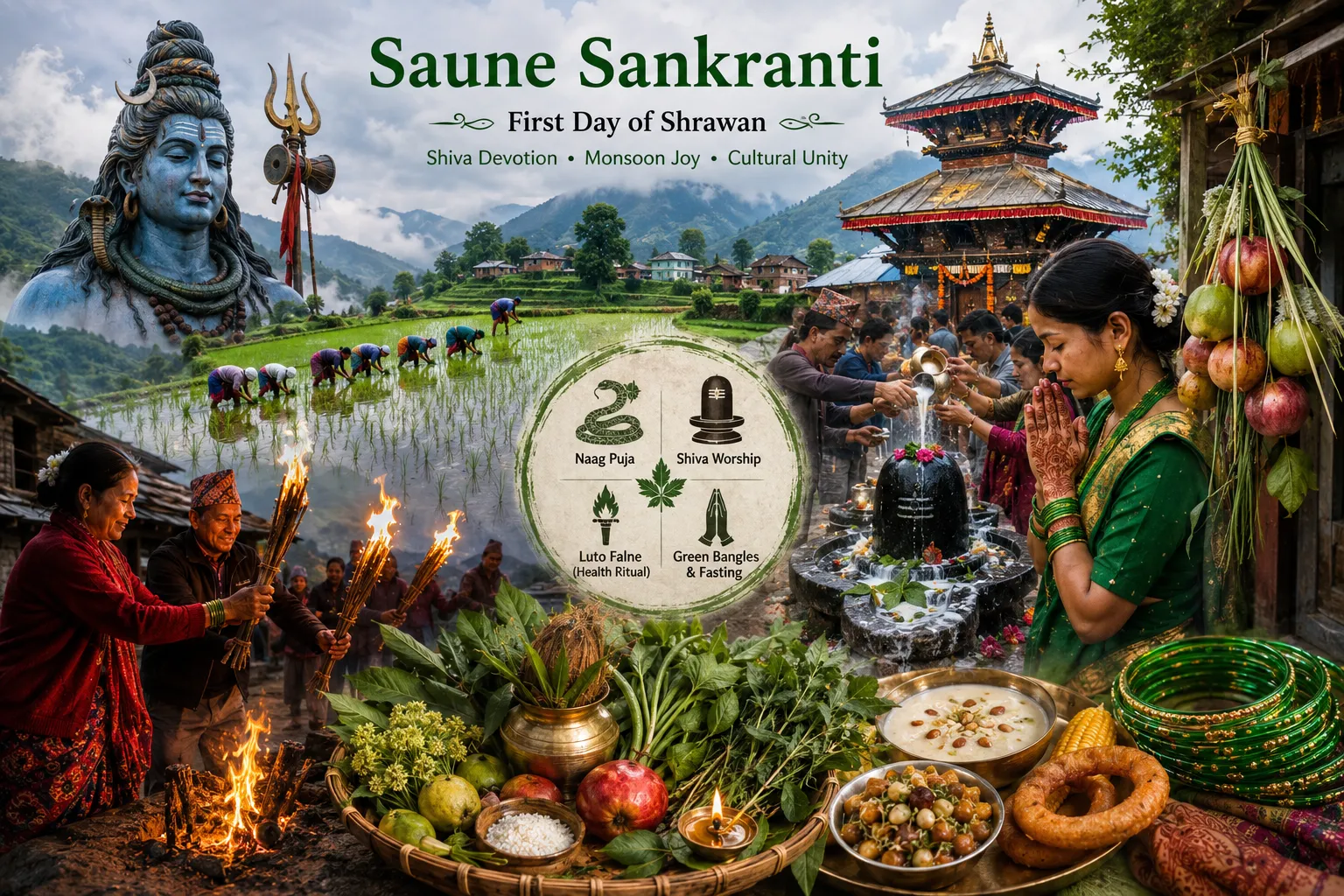
Every year, as the monsoon clouds gather over Nepal and the first heavy rains of Shrawan soak the terraced fields, the country observes one of its oldest and most layered festivals: Saune Sankranti.
Saune Sankranti is the first day of the Nepali month of Shrawan, observed when the sun exits Gemini (Mithun) and enters Cancer (Karkat) in the solar zodiac. The word Sankranti comes from Sanskrit, meaning "to move together" or "to cross over," and refers to the sun's passage from one zodiac sign to the next. Of the twelve Sankrantis in the Hindu calendar year, Shrawan Sankranti and Maghe Sankranti are considered the two most significant.
But Saune Sankranti is far more than an astronomical event. It is a day of profound religious devotion, a celebration of nature's renewal, a farmer's well-earned rest, and a doorway into the most festival-rich season of the Nepali year. It opens the month of Shrawan, a period draped in green, alive with the sound of temple bells, fragrant with incense, and dedicated with singular devotion to Lord Shiva.
The sun's journey across the sky is at the heart of Saune Sankranti.
Every year, on this day, Surya (the Sun God) completes his transit through the constellation of Gemini (Mithun Rashi) and enters Cancer (Karkat Rashi). This solar transition is not just a calendar event; it carries deep cosmological meaning.
The southward turn. From this day forward, the sun begins its southward movement, known as Dakshinayan. These six months, from Shrawan through Poush, are considered the night of the devas (gods), when divine energies turn inward, and the spiritual focus shifts toward ancestral rites, introspection, and devotion. The god Yama, lord of death and justice, presides over the southern direction, home to the realm of the ancestors (pitri loka). Dakshinayan is when the doorway to this realm is believed to open, which is why important ancestral rituals like pitri paksha (fortnight of the ancestors) and shraddha follow in the months after Saune Sankranti.
The contrast with Uttarayan. The northward journey of the sun, Uttarayan, begins at Maghe Sankranti and is considered the day of the gods, a time of outward action and new beginnings. Saune Sankranti and the Dakshinayan it ushers in are, by contrast, a time for turning inward: prayer, fasting, purification, and preparation. The opposite holds in the southern hemisphere, but for Nepal and the rest of the northern hemisphere, this day carries the weight of cosmic transition.
At a glance, the two halves of the year work like this:
Uttarayan (Maghe Sankranti to Ashadh): longer days, gods considered awake, favored for new ventures, marriages, and outward-facing practices
Dakshinayan (Saune Sankranti to Poush): longer nights, gods considered at rest, favored for prayer, fasting, purification, and ancestral rites
Shrawan is, above all, the month of Lord Shiva. No other deity is as closely associated with this season as the god of destruction and transformation.
The most important mythology tied to Saune Sankranti and the month of Shrawan comes from the ancient story of Samudra Manthan, the churning of the cosmic ocean.
The churning. According to the Puranas, during the Satya Yuga, the devas (gods) and asuras (demons) came together to churn the cosmic ocean (Kshira Sagar) in search of Amrita, the nectar of immortality. Mount Mandara served as the churning rod and Vasuki, the king of serpents, as the rope. As they churned, treasures emerged one after another: the celestial cow Kamadhenu, the divine horse Uchchaihshravas, the goddess Lakshmi, and the physician Dhanvantari. But before the Amrita could surface, a dreadful poison emerged first.
The poison and the sacrifice. This poison, Halahal or Kalkoot, was so virulent it threatened to destroy the entire universe. Gods and demons alike fled in terror as its heat began to consume creation. At this moment of crisis, Lord Shiva stepped forward, gathered the poison in his palm, and drank it all. Parvati, his consort, grasped his throat to stop the poison from reaching his stomach. It halted in his neck, turning it a deep blue, which is why Shiva is called Neelakantha, the blue-throated one.
Cooling the fire. The burning sensation was unbearable, so Shiva retreated to the Himalayan peaks, particularly to Gosainkunda in Nepal, where he created a glacial lake. The waters of the Ganga and the Himalayan springs became the source of his relief.
This mythology directly shapes the devotion of Shrawan. Throughout the month, devotees pour water, milk, and Ganga jal over the Shiva lingam in temples across Nepal, an act called Abhishek or Jalabhishek, offering coolness to the god who once absorbed the universe's poison. Every drop of water poured on the lingam in Shrawan is, in spirit, a gift of compassion to Neelakantha.
Each Monday of Shrawan, known as Saune Somvar, is considered especially sacred. Devotees observe fasts (vrat), visit Shiva temples, and offer belpatra (bilva leaves), dhatura (thorn apple), bhang, and white flowers, all believed to be dear to Shiva. The temple of Pashupatinath in Kathmandu sees thousands of devotees every Monday, and the air rings with the chant "Om Namah Shivaya" and the sound of temple bells.
A less visible but equally important aspect of Saune Sankranti is the worship of Naag Devatas, serpent deities.
In Nepali cosmology, snakes are not feared creatures but divine beings that reside in water sources such as ponds, rivers, wells, and springs. They are believed to be guardians of water, fertility, and the underground realm. During the monsoon, snakes emerge from their underground homes, and ancient communities read this as a sign that the serpent gods were awakening, their movement coinciding with the rains that bring life to the fields.
The worship of Naags on Saune Sankranti takes different forms across Nepal:
Households make offerings of milk, dubo grass, rice, incense, and flowers at serpent shrines
Kathmandu Valley sees special devotion at Nag Pokhari and other serpent ponds
Rural areas mark the day by cleaning wells and water sources, blending ecological wisdom with spiritual belief: keeping water pure is both practical and sacred
The association between Shiva and serpents deepens this connection. Shiva is often depicted with a cobra coiled around his neck, and the Naga deities are considered his devotees, making the month of Shrawan a time when both Shiva and the serpent guardians of water are honored together.
Shrawan is often called the month of women. From the very first day, Saune Sankranti, women across Nepal begin a month-long observance that is both devotional and celebratory.
The color of Shrawan is green, symbolizing the monsoon landscape: the lush green of rice paddies, the freshness of rain-washed leaves, and nature at its most fertile. It is also the color of life, renewal, and marital harmony. Across the month, women observe the season through several linked practices:
Green attire, wearing hariyo chura (green glass bangles), green pote (necklace beads), and green clothing
Mehendi, applying henna on hands and feet in intricate patterns; the deeper the color, the stronger the blessings of love and prosperity believed to follow
Saune Somvar Vrat, married women fasting on Mondays for the long life, health, and success of their husbands, while unmarried women observe the same fast, praying for a worthy life partner, recalling Parvati's own penance to win Shiva as her husband
Maiti Jane, daughters visiting their birth homes; in many Magar and Khas communities, married daughters are called home for a feast that strengthens family bonds, much like the spirit of Tihar's Bhai Tika
Parvati herself is said to have observed strict fasting during Shrawan, making the month an embodiment of feminine devotion and power, and these traditions remind everyone that festivals are not only about gods but about the people who matter.
Nepal is an agricultural country, and the rhythm of its festivals follows the rhythm of the soil.
The month of Asar (mid June to mid July) is the most labor-intensive period in the Nepali farming calendar. Farmers work from dawn to dusk planting rice seedlings in flooded terraces, often barefoot in ankle-deep mud, soaked by monsoon rain, a hardship captured in the Nepali proverb "Ropai ko mitho, dukha ko mitho": the sweetness of rice planting lies in its hardship.
By the time Shrawan 1 arrives, the planting is largely complete, and the fields are green with young rice shoots. The hardest work is done. Saune Sankranti is the farmer's reward: a day to wash off the mud, rest tired bodies, eat good food, and gather with family and community. In many villages, the day is marked with feasts, the sharing of seasonal delicacies, and the simple joy of sitting still while the rain falls on the roof.
Like all major Nepali festivals, Saune Sankranti has its own traditional foods:
Kheer, sweet rice pudding made with milk, sugar, and cardamom, is offered to deities first and then shared among family members
Kwati, a rich soup made from nine types of sprouted beans, is nutritious, warming, and perfectly suited to the rainy season
Roti and seasonal vegetable curries are simple, hearty meals that reflect the bounty of the monsoon harvest
Roasted corn, fresh from the fields and roasted over an open fire, a beloved seasonal treat
Sel roti, a traditional ring-shaped rice bread prepared for the occasion in some communities
Food on Saune Sankranti is not just about nourishment. It is about gratitude for the harvest, about sharing abundance, and about the comfort of eating together after weeks of hard labor.
The astronomical event of Saune Sankranti goes by another important name: Dakshinaayan Arambha, the beginning of the sun's southward movement.
In Hindu cosmology, the year is divided into two halves: Uttarayan, the northward journey of the sun from Maghe Sankranti to Ashadh, and Dakshinayan, the southward journey from Saune Sankranti to Poush. These are not merely astronomical concepts but carry deep spiritual meaning.
During Uttarayan, the days are longer, the sun is brighter, and the gods are said to be awake and active, making it the ideal time for new ventures, marriages, and outward-facing spiritual practices. During Dakshinayan, the nights grow longer, and the gods are said to rest. This is the time for inner work: prayer, meditation, fasting, and rituals for the ancestors. The twelve Sankrantis of the year include major festivals such as Nag Panchami, Raksha Bandhan, Janai Purnima, Krishna Janmashtami, Teej, Rishi Panchami, Indra Jatra, Dashain, and Tihar, all falling within the Dakshinayan period that begins with Saune Sankranti, the gate that opens into this entire festival season.
One of the most beautiful aspects of Saune Sankranti is that no single community owns it. Across Nepal's extraordinary cultural diversity, every group brings its own customs, beliefs, and practices to the same day.
|
Community |
How They Observe Saune Sankranti |
Unique Traditions |
|
Khas & Bahun-Chhetri (Hill Hindus) |
Shiva worship, ritual bath, green bangles, mehendi, and family gatherings |
Luto Falne Din torch ritual, "Luto Jaa!" chants, Dakshinayan observance |
|
Magar |
Family reunions, a special feast for married daughters |
Chhori Bolune tradition, local Luto Falne practices, ancestor prayers |
|
Tharu (Terai) |
Community festival known as Guriya Parwa |
Burning and beating the Gurhi effigy to drive away disease, a communal procession |
|
Kirat (Rai, Limbu, Sunuwar) |
Offer first seasonal fruits to ancestors and nature spirits |
Sisekpa Tangnam, hanging fruit garlands (chyongharu), harvest thanksgiving |
|
Newar |
Ritual bath, Shiva temple visits, Monday Jalabhishek |
Courtyard herb burning or protective plants, similar in spirit to Gathemangal |
|
Gurung |
Family gatherings and traditional meals |
Medicinal plant rituals, seasonal rest after rice planting |
|
Tamang |
Seasonal observance with family or monastery visits |
Some Hindu Tamangs wear green and visit Shiva temples; others follow Buddhist customs |
|
Sherpa & Himalayan Communities |
Quiet household prayers and seasonal observance |
Butter lamp offerings, high altitude adaptations of Luto Falne in some areas |
|
Dalit Communities |
Home worship, ritual bath, festive meals |
Private family celebrations, Luto Falne practiced in many hill communities |
|
Khas of Karnali (Jumla, Mugu, Kalikot) |
Grand celebration of Saune Sankranti and Luto Falne |
One torch per family member, hillsides illuminated, Deuda dance, public holiday in Karnali |
The sections below add what the table cannot: the texture, stories, and detail behind each community's version of the day.
Khas and Bahun-Chhetri communities anchor the day around three pillars: Shiva devotion, the Luto Falne health ritual, and the beginning of Dakshinayan. Families rise early for a ritual bath (snaan), visit Shiva temples such as Pashupatinath to perform Abhishek, and women begin their month-long wearing of green bangles and mehendi. Married daughters are invited home for feasts known as maiti jane, and in the evening, families observe Luto Falne Din, lighting medicinal torches and throwing them to the four directions while shouting "Luto Jaa!" This tradition is most vibrant in Karnali, especially Jumla, Mugu, Kalikot, and Dolpa, but appears in some form throughout the hills.
The Magar community places special emphasis on family reunion. The day is known as "Chhori Bolune," calling the daughter home, and married daughters and sisters return to their birth homes for a feast of kheer, kwati, and sel roti before carrying blessings and leftovers back to their husband's home. Magar elders also perform the Luto Falne ritual using medicinal plants specific to their local forest ecology, and their evening prayers blend Hindu elements with ancestral spirits (pitri) unique to Magar tradition.
The Tharu community of the Terai observes the day as Guriya Parwa, named after "Gurhi," an effigy representing disease and misfortune. Villagers build the effigy from straw and cloth, worship it briefly, then carry it in procession to the village edge, where participants whip it with banana stalks (chosen for their protective qualities in Tharu tradition) to symbolically drive illness away. It shares a deep philosophical kinship with Luto Falne Din: both are folk medicine wrapped in ritual, addressing the same monsoon health concerns, but Guriya Parwa is village-wide rather than household-based. Tharu women also wear green during Shrawan, and dishes like dhikri, bari, and fish curries mark the occasion.
The Kirat community (Rai, Limbu, Sunuwar) calls the day Sisekpa Tangnam or similar local names, and frames it as a harvest offering festival centered on ancestral deities (Mundhum) and nature spirits rather than Shiva. Families gather newly ripened fruit, peaches, pears, and lemons, thread it onto a string of green babiyo grass called "chyongharu," and hang it above the main door as a gift to the ancestors. In Limbu households, the family elder performs a brief shrine ritual in the Limbu language before the family shares a meal; Rai communities follow a similar practice, with added dances and songs in some areas. The underlying message: before eating the new harvest, offer it first to those who came before.
The Newar community of the Kathmandu Valley observes the day more quietly than festivals like Indra Jatra or Dashain, marking it with a ritual bath and visits to Pashupatinath for Jalabhishek, especially on Mondays. Some Newar households practice a modified Luto Falne, burning medicinal herbs in a small courtyard fire or simply placing protective plants at the threshold instead of throwing torches. The tradition is more common among Hindu Newar subgroups (Shrestha, Rajopadhyaya Brahmins) than among Buddhist Newars, whose own Gathemangal festival shares a similar concern with driving away malevolent forces through noise and fire.
The Gurung community, particularly in Kaski, Lamjung, and Manang, treats the day as a family gathering and the start of a rest period rather than an occasion for elaborate temple ritual. Gurung elders hold extensive knowledge of medicinal plants and choose them carefully for the evening fire, though as many Gurung families have converted to Buddhism or Christianity, the explicitly Hindu elements have receded in some households while the seasonal meaning endures.
The Tamang community, predominantly Buddhist, observes the day in a muted form, mostly as a seasonal marker that the rice is planted and calm has arrived. Hindu Tamang families may wear green bangles and visit Shiva temples, while Buddhist households mark it with a monastery visit or family time. Luto Falne is not widespread among Tamangs, though families near Khas neighbors have adopted parts of it.
Sherpa and Himalayan communities in Solukhumbu, Mustang, and Dolpa observe the day quietly, often cut off by monsoon rain and landslides. Families may offer butter lamps and incense at the household altar; the Buddhist emphasis means the Hindu elements of Saune Sankranti are secondary, though the seasonal transition is still acknowledged, and in Dolpa, where Buddhist and Hindu traditions mix, some families perform a high-altitude version of Luto Falne.
Dalit communities across Nepal, historically excluded from temples and mainstream ritual spaces, have observed the day more privately: a ritual bath, home-based worship, and special foods. The Luto Falne tradition is practiced in Dalit hill communities using the same plants and evening fire, and as caste-based discrimination has gradually decreased, participation in public temple visits and community celebrations has grown.
The Khas of Karnali (Jumla, Mugu, Kalikot) preserve the most dramatic form of Luto Falne. In Jumla, one torch is lit for every family member, and entire hillsides glow at dusk; in Mugu, families shout mock insults across to neighboring villages as part of the ritual; and in Jumla, the Deuda dance that follows transforms the health ritual into a celebration of community identity. For the Khas of Karnali, Saune Sankranti and Luto Falne Din are not two separate events but one integrated day blending Shiva devotion, practical health protection, community bonding, and cultural pride, recognized by the Karnali Province government's declaration of Shrawan 1 as a public holiday.
This diversity is what makes Saune Sankranti truly national. Whether through the Shiva temples of Kathmandu, the fruit offerings of Limbu homes, the Gurhi procession of Tharu villages, the rooftop fires of Jumla, or the quiet family meals of Tamang households, the same sun enters the same zodiac sign, and Nepal's many cultures each respond in their own voice.
Saune Sankranti and Luto Falne Din fall on the same day, Shrawan 1, and share the same calendar date, but they represent different dimensions of the same day.
While Saune Sankranti encompasses the full range of astronomical, religious, agricultural, and cultural meanings described above, Luto Falne Din focuses specifically on the health protection rituals of the evening. It is the practical, folk medicine dimension of the day, a tradition deeply rooted in the Khas communities of Karnali and western Nepal, where families light torches of medicinal plants and throw them to the four directions to symbolically drive away skin diseases brought by the monsoon.
The two are intimately connected. The same day that marks the sun's entry into Cancer and the beginning of Shiva's month also hosts one of Nepal's most unique public health rituals. To learn more about the specific practices, medicinal plants, and cultural significance of the evening fire ritual, read our dedicated article on Luto Falne Din.
Opens the sacred month of Shrawan, the most spiritually charged period in the Nepali calendar, dedicated to Lord Shiva
Marks the beginning of Dakshinayan, the sun's southward journey, a cosmologically significant transition that sets the tone for the next six months
Honors agriculture, giving farmers a well-deserved rest after the intense rice planting season of Asar
Celebrates women's devotion; the green bangles, mehendi, and Monday fasts of Shrawan are among the most visible and cherished traditions of Nepali womanhood
Connects multiple communities, from the Hindu mainstream to Kirat, Limbu, Tharu, and Khas cultures, each with its own thread in the same festival
Protects traditional ecological knowledge, from serpent worship that encourages water conservation to medicinal plants that form the basis of folk healing
Opens the festival season that follows: Nag Panchami, Raksha Bandhan, Janai Purnima, Teej, Krishnashtami, Dashain, and Tihar
As Nepal urbanizes and younger generations move to cities, some traditions of Saune Sankranti are fading. Elaborate water source cleaning, village-wide Naag worship, and the foraging of wild medicinal plants are becoming less common in urban households. Yet the core of the festival endures.
Women still wear green bangles. Shiva temples still fill with devotees on Mondays. The day is still a public holiday in Karnali Province and widely observed across the country. And in the hills and mountains, especially in the Karnali region, the evening fires of Luto Falne Din still flicker from rooftop to rooftop, carrying forward a tradition that connects the people to their land, their health, and each other.
Saune Sankranti is not the loudest festival in Nepal, but it may be the one that touches the deepest roots. It speaks of cosmic cycles and mud-stained feet, of serpent gods and green bangles, of poison swallowed to save the world, and of farmers resting after the planting is done. It is a festival for the whole person: body, mind, community, and spirit.
On the first day of Shrawan, when the sun steps into Cancer and the monsoon rain drums on every roof, Nepal briefly pauses. It is the pause before a long season of festivals. It is the breath before the chant. It is the moment the country remembers what it has always known: that the earth is sacred, that hard work deserves rest, and that the old ways still hold wisdom worth keeping.