
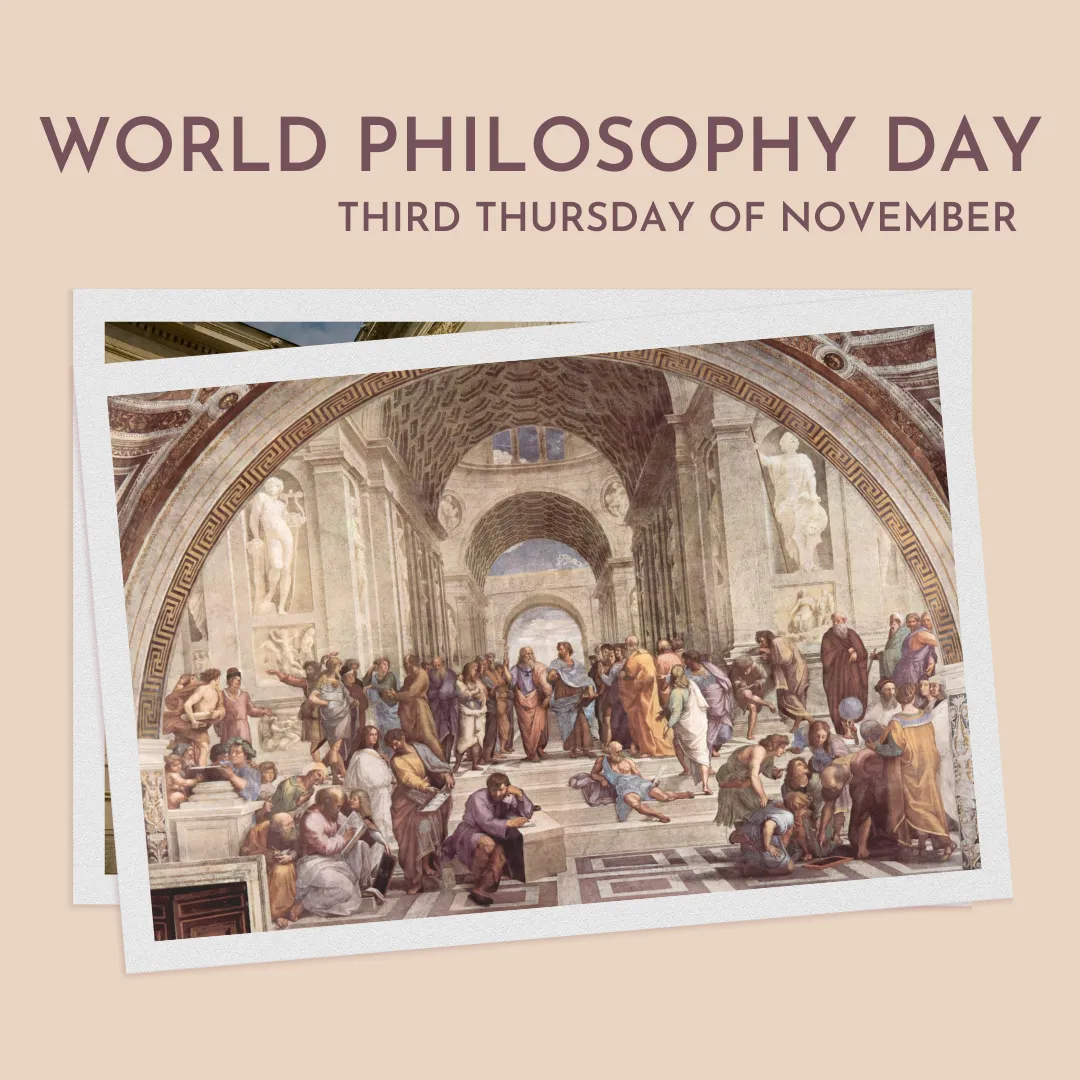
World Philosophy Day is observed every year on the Third Thursday of November. It is an international observance led by UNESCO to promote philosophy, critical thinking, and open dialogue across the world.
This day reminds people that philosophy is not just an academic subject. It is a practical tool that helps us think clearly, question wisely, and understand different viewpoints. In a fast-changing world filled with information and opinions, the ability to think deeply has never been more important.
World Philosophy Day encourages people of all ages to reflect on important issues such as justice, ethics, peace, human rights, and the future of humanity.
|
Aspect |
Details |
|
Official Name |
World Philosophy Day |
|
Observed On |
Third Thursday of November |
|
First Celebrated |
2002 |
|
Officially Adopted by UNESCO |
2005 |
|
Organized By |
UNESCO |
|
Type of Event |
International observance |
|
Purpose |
Promote philosophical thinking and dialogue |
|
Celebrated In |
Countries worldwide |
|
Main Focus |
Critical thinking, ethics, peace, and education |
World Philosophy Day is a global event that celebrates the value of philosophy in everyday life. It creates space for discussion, reflection, and respectful debate.
The word philosophy comes from the Greek and means love of wisdom. Since ancient times, philosophers have asked questions about truth, knowledge, morality, and human existence. Their ideas shaped science, politics, law, and education.
By marking this day each year, UNESCO highlights how philosophy continues to guide societies in dealing with modern challenges.
World Philosophy Day was first introduced by UNESCO in 2002. After several successful celebrations, it was officially proclaimed by the UNESCO General Conference in 2005.
UNESCO recognised that philosophy plays a central role in promoting critical thinking and intercultural dialogue. It helps people understand different cultures and respect diverse ideas.
The organisation believes that philosophy contributes to peace and sustainable development by encouraging thoughtful discussion instead of conflict.
The observance is not a public holiday, but it is widely celebrated in educational institutions, cultural centres, and communities worldwide.
World Philosophy Day is led by the United Nations Educational, Scientific and Cultural Organisation. UNESCO supports the day by:
Encouraging global participation
Organising conferences and discussions
Promoting philosophical education
Supporting youth engagement in dialogue
Highlighting the importance of freedom of thought
Although UNESCO coordinates the global vision, events are organised locally by universities, schools, NGOs, and cultural groups.
The United Nations supports the broader mission of promoting peace, education, and cultural understanding, which aligns with the goals of this observance.
World Philosophy Day is important because it strengthens essential life skills. Philosophy teaches people how to think clearly and analyse ideas before accepting them.
Here is why it matters:
It helps people question information and avoid misinformation.
Philosophy supports open discussions without anger or hostility.
It helps individuals reflect on right and wrong in personal and public life.
Freedom of thought and expression are core democratic values.
Young people learn reasoning skills that help them make informed decisions.
In today’s world, these skills are necessary for solving social, environmental, and political challenges.
Celebrations vary from country to country, but common activities include:
University lectures
School discussions
Student debates
Essay competitions
Community dialogues
Philosophy cafes
Roundtable conversations
Book exhibitions
Film screenings
Online seminars and webinars
Many institutions use this day to introduce philosophy to young learners and encourage curiosity.
Here are some notable recent themes:
2023 – Philosophical Reflection in a Multicultural World
2022 – The Human of the Future
2021 – Philosophy Facing Contemporary Challenges
2020 – Philosophy and Global Crises
2019 – Knowledge, Peace and Dialogue
2018 – The Value of Philosophy for Young Minds
2017 – Philosophical Thinking and Cultural Diversity
Over the years, World Philosophy Day has grown into a truly global event. It connects people from different backgrounds and traditions. By promoting intercultural dialogue, the observance helps reduce misunderstanding between communities. It also encourages academic freedom and independent thought. Philosophy creates a space where ideas can be examined calmly. This reduces conflict and builds mutual respect.
World Philosophy Day reminds us that thinking deeply is a strength, not a luxury. In an era when opinions spread rapidly, philosophy teaches patience, reflection, and a deeper understanding. By celebrating this day, individuals and communities reaffirm the importance of wisdom, reason, and respectful dialogue. These values help build peaceful and thoughtful societies.
Philosophy may begin with questions, but it leads to clarity. That is why World Philosophy Day remains important every year.