
|
Detail |
Information |
|
Date |
coincides with Saune Sankranti |
|
Also Falls On |
Saune Sankranti / Luto Falne Din / Dakshinaayan Arambha |
|
Observed In |
Western Terai of Nepal, Kailali, Kanchanpur, Bardiya, Banke, Dang |
|
Observing Communities |
The Tharu community (particularly Dangaura and Rana Tharu groups) |
|
Type of Event |
Indigenous cultural and agricultural festival |
|
Purpose |
Ward off crop pests, protect children's health, and celebrate sibling bonds |
|
Holiday Status |
Local holiday declared in some Terai municipalities |
|
Also Known As |
Gurahi Parba, Guria Parba, Guriya Parwa |
Quick Fact: Tharu Guriya Parwa is one of Nepal's most distinctive indigenous festivals. Girls handcraft cloth dolls called Guriya, which are ritually thrown away and struck with sticks by boys, a symbolic act to expel diseases, crop pests, and misfortune from the community. The festival is rooted in ancient Tharu animism and carries deep ecological wisdom about the role of dragonflies in protecting paddy fields.
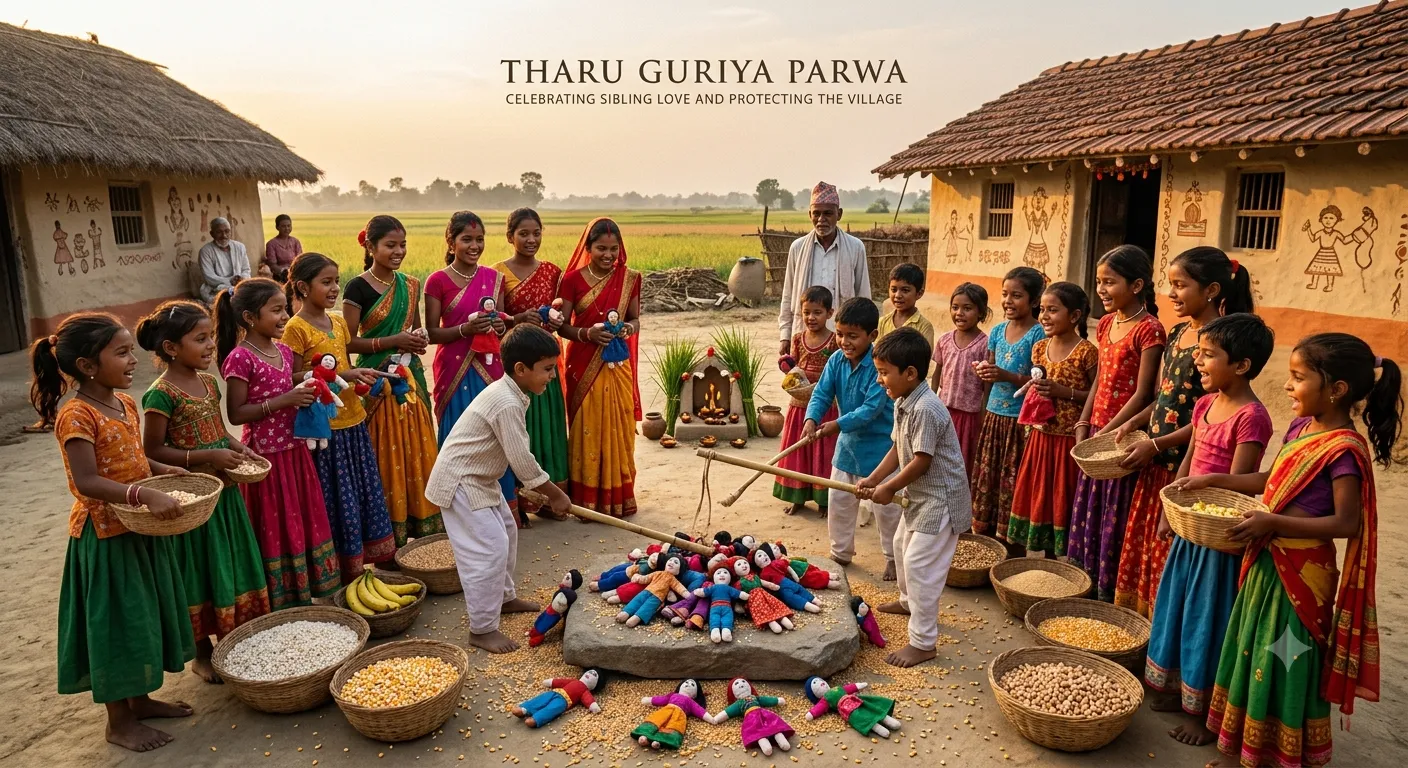
Picture a group of girls sitting together, knitting small cloth dolls from colorful scraps of fabric, laughing, singing folk songs in the Tharu language, weaving not just thread but memory into their work. By evening, the whole village gathers, and those same dolls are tossed away with chants and celebration.
That is Tharu Guriya Parwa. And it is far more than it appears.
Guriya Parwa, also called Gurahi Parba, is an annual festival celebrated by the Tharu community, one of Nepal's oldest indigenous groups, primarily living across the fertile Terai plains of the west. The festival falls on the first day of Shrawan, coinciding with Saune Sankranti, and marks the end of the monsoon, the very season that determines whether the rice harvest lives or dies.
At its heart, the festival is about protection. Protection of crops from insects. Protection of children from monsoon ailments. Protection of the community from forces both visible and invisible. And it achieves all of this through a cloth doll, a stick, a song, and the unshakeable bond between siblings.
The Tharu people are among the oldest inhabitants of Nepal's Terai region, with roots stretching back over 2,000 years. Long before large-scale migration from the hills, they lived deep within malaria-prone forests and fertile lowland plains, developing a self-sufficient way of life closely tied to the land, the rivers, and the monsoon.
Their traditions were shaped by that environment. They built homes from bamboo and mud. They farmed rice in waterlogged fields. And they developed rituals to make sense of and seek protection from the forces that threatened their survival: floods, disease, crop-eating insects, and the invisible spirits they believed inhabited the natural world.
Guriya Parwa grew from this world. Its origins lie in pre-Hindu animism, where dragonflies held a special place in Tharu belief. The dragonfly called gurahi in the Tharu language was seen as both a protector and a symbol of potential harm. On the one hand, it naturally preys on mosquitoes and crop-damaging insects. On the other hand, Tharu folklore sometimes viewed it as a carrier of disease and bad spirits. The festival's rituals were designed to invoke the dragonfly's protective energy while symbolically expelling the harm it represented.
An ancient Tharu myth captures this beautifully: a heavenly fairy, taking the form of a dragonfly, descends to earth and befriends a village girl. When the time comes for her to leave, the children prepare small dolls in her image. The boys strike the dolls with sticks, asking the fairy to carry away all diseases and sorrows as she departs. The festival reenacts this story every year, not as theatre, but as a living ritual that still holds meaning for thousands of families.
Over the centuries, the festival absorbed some Hindu influences, particularly through its overlap with Nag Panchami, but its core has remained Tharu. In the early 21st century, organized celebrations in districts like Kailali began reviving the festival with greater community involvement, with local governments declaring holidays and Tharu cultural societies taking an active role in preserving its traditions.
Why does this festival matter? The reasons are woven into nature, health, and community all at once.
To protect crops from monsoon pests. Shrawan is the rice-planting season. The fields are full of young seedlings, and insects are at their most threatening. Guriya Parwa ritually invokes protection for the paddy harvest, one of the community's most critical lifelines.
To safeguard children's health. The monsoon brings seasonal ailments, eye infections, fevers, skin rashes, and vomiting. The festival is traditionally believed to shield children from these illnesses, making it a form of communal health prayer.
To celebrate sibling love. Brothers strike the dolls thrown by their sisters in a gesture of shared action and protection. This ritual interaction between siblings is a core part of the festival's emotional meaning, similar in spirit to festivals like Tihar's Bhai Tika.
To expel disease and misfortune. The Asraina ceremony, the ritual disposal of the dolls, symbolically sends away all the bad things that could harm the village: insects, illness, and evil influences.
To preserve the Tharu identity. In a rapidly changing world, Guriya Parwa is an act of cultural memory. Participating in it is a way of saying we are still here, and this is still who we are.
The festival unfolds over the course of one day, but every step of it is meaningful.
Families clean their homes and yards, creating a purified space for the festival.
Young girls begin gathering colorful cloth scraps called chirkut to make the Guriya dolls.
Boys collect sticks (sota or korra) from bamboo, jute, or holy grass such as kush, which will be used during the rituals.
Elders and village leaders initiate preliminary blessings, sometimes tying sacred dubo grass knots as a protective ritual.
Everyone bathes early and wears clean clothes often in traditional Tharu attire.
Some families tie pieces of cloth to their doorways as a protective gesture against snakes, scorpions, and sorrows, especially meaningful in the monsoon-heavy Terai.
Girls sit together to craft the Guriya dolls, shaping paired male and female figures from the cloth scraps, hand-tied without modern tools.
As the dolls are finished, the girls swing them while singing traditional Tharu folk songs. One of the most well-known goes: "Gurhi ri gurhi roibo ki dhoibo / Pathgraka larka banaiburi gurhi" meaning: "Oh dragonfly, do you cry or weep / I make a baby of stone." These songs are lullabies to the spirit, asking it to carry away hardship.
The community gathers for a village procession, girls, boys, and elders moving together through the village in traditional dress.
At a central gathering point, the girls throw the dolls into the ground or toward a body of water. Boys then strike the dolls with their sticks, chanting "Deu Ghughri" (give dragonfly) and "Leu Ghughri" (take dragonfly), asking the dragonfly spirit to take away disease and leave health behind.
This moment, called Asraina, is the heart of the entire festival.
After Asraina, everyone shares prasad, a mix of puffed rice (bhuja), fried chickpeas, corn, fried beans (kohari), and oil-fried bread (bariya).
The rest of the evening is spent singing, dancing, and community togetherness.
It carries ancient ecological wisdom. Long before the concept of integrated pest management existed in textbooks, the Tharu were honoring the dragonfly for doing exactly that, naturally controlling the insects that destroy crops. Guriya Parwa is a festival built around real ecological knowledge.
It is one of Nepal's most distinct indigenous celebrations. Unlike festivals that are shared across many communities, Guriya Parwa is uniquely Tharu. It does not have a Hindu equivalent or parallel. It stands on its own.
It places children and women at the center. The girls are the makers. The dolls are their creation. The ritual disposal is led by the youth. This gives young Tharu girls a visible role of creative and cultural leadership that carries real weight.
It reinforces sibling bonds. The cooperative ritual between sisters and brothers, making and striking the dolls together, is a tangible act of shared love and protection between siblings.
It is a living form of cultural preservation. The Tharu have faced significant pressure from cultural assimilation over the decades, particularly after the opening of the Terai in the mid-20th century. Every year that Guriya Parwa is observed is a year that Tharu heritage survives.
To fully understand Guriya Parwa, it helps to understand the people who celebrate it.
The Tharu are often called the "people of the forest." They are the original inhabitants of the Terai, that long, flat strip of land between the Himalayan foothills and the Indian border that makes up Nepal's southern lowlands. Their districts, Chitwan, Bardiya, Kailali, Dang, Kanchanpur, are home to some of Nepal's most fertile farmland and most biodiverse wildlife.
They developed a way of life perfectly suited to that environment. Traditional Tharu homes are built from bamboo, mud, and thatch, naturally cool in summer, warm in winter. Their diet centers on rice, fish, wild vegetables, and lentils. Their medicine draws on forest herbs. Their spiritual life is a blend of Hinduism, animism, and indigenous belief, honoring both mainstream gods and local deities connected to forests, rivers, and ancestors.
Their cultural calendar is packed with celebrations: Maghi (their New Year), Jitiya (a women's fasting festival), Atwari Parba, and, of course, Guriya Parwa. Each festival is tied to the agricultural cycle, to nature, to the seasons. The Tharu do not celebrate for its own sake; they celebrate because the land demands it.
Guriya Parwa sits squarely within that tradition. It happens when the rice seedlings are most vulnerable. It calls on the dragonfly, a real, present insect in those waterlogged paddy fields, to protect the harvest. And it asks the community to come together and do what communities have always done best: face the unknown, together.
Tharu Guriya Parwa may not fill the streets of Kathmandu or command national headlines. But in the western Terai, on the first day of Shrawan, something genuinely remarkable happens. Families gather. Girls sing to cloth dolls. Boys swing sticks with purpose. Elders watch and remember. And a tradition thousands of years in the making continues to breathe.
That is what makes this festival worth knowing, worth celebrating, and worth protecting.
Nepal's cultural identity is not built by one community or one tradition. It is built by all of them together including the Tharu, and the small cloth doll they send away every monsoon season, carrying their sorrows with it.