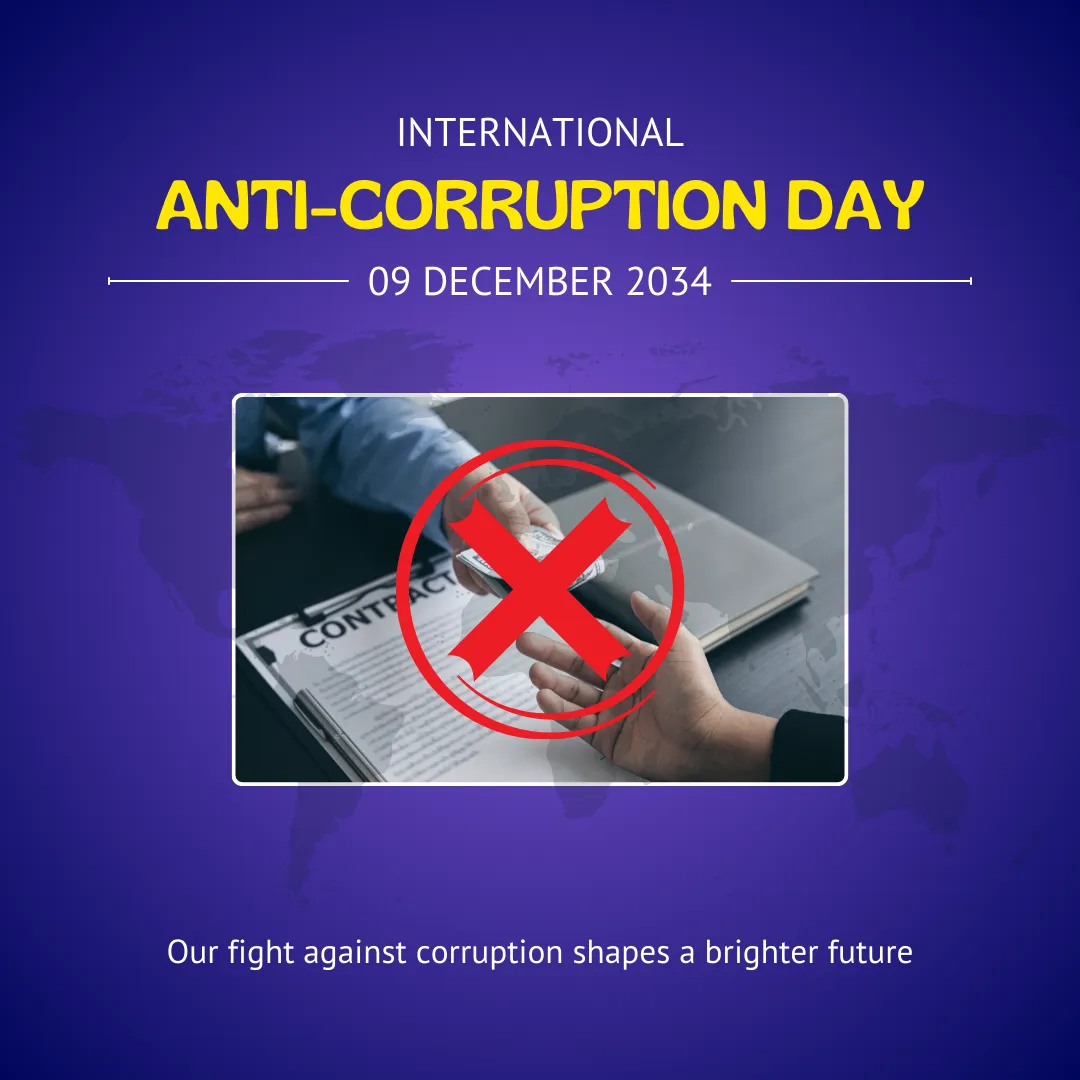
Corruption is one of the biggest challenges facing the world today. It affects governments, businesses, communities, and everyday people. When corruption exists, trust breaks down, public money is wasted, and development slows. To highlight this global issue and encourage action, the world observes International Anti-Corruption Day every year on December 9.
This day reminds us that corruption is not just a political problem; it is a social, economic, and moral issue. Everyone, from governments to ordinary citizens, has a role in stopping it.
|
Item |
Details |
|
Event Name |
International Anti-Corruption Day |
|
Date Observed |
December 9 (every year) |
|
Established By |
United Nations General Assembly |
|
First Observed |
2004 |
|
Linked Convention |
United Nations Convention Against Corruption (UNCAC) |
|
Main Purpose |
Raise awareness and promote action against corruption |
|
Global Hashtag |
#UnitedAgainstCorruption |
|
Holiday Status |
Not a Public Holiday |
International Anti-Corruption Day is a United Nations–recognized global observance that focuses on raising awareness about corruption and promoting integrity, transparency, and accountability across the world.
The date, December 9, marks the adoption of the United Nations Convention Against Corruption (UNCAC) in 2003. This convention is the first global legal agreement created to prevent corruption, punish corrupt practices, and encourage international cooperation.
Before the early 2000s, corruption was often treated as a domestic issue. However, as globalization increased, it became clear that corruption crosses borders. Money laundering, bribery, and abuse of power often involve multiple countries.
In response, the UN General Assembly adopted the United Nations Convention Against Corruption in October 2003. Shortly after, December 9 was officially declared International Anti-Corruption Day.
The first official observance took place in 2004, and since then, the day has been marked worldwide through campaigns, events, discussions, and policy commitments.
The United Nations plays a central role in global anti-corruption efforts. Its work focuses on prevention, law enforcement, education, and international cooperation.
Key UN roles include:
Monitoring the implementation of UNCAC by member states
Providing technical support to countries to strengthen anti-corruption laws
Encouraging asset recovery, so stolen public money can be returned
Promoting transparency and accountability in public institutions
The UN Office on Drugs and Crime (UNODC) acts as the main body supporting countries in applying anti-corruption measures.
Corruption affects every country, rich or poor. Its impact goes far beyond illegal payments.
Weakens democracy and the rule of law
Increases poverty and inequality
Reduces the quality of public services like health and education
Discourages foreign investment
Erodes public trust in institutions
Because of these effects, fighting corruption is essential for sustainable development, human rights, and economic growth.
The observance has several clear goals:
Raise Awareness
Help people understand what corruption is and why it harms society.
Promote Accountability
Encourage governments and institutions to act responsibly and transparently.
Support the UNCAC
Push countries to fully implement anti-corruption laws and policies.
Encourage Public Participation
Remind individuals that their actions and voices matter.
Strengthen Global Cooperation
Promote cross-border efforts to prevent and punish corruption.
Each year, the UN highlights a theme to focus attention on a specific aspect of corruption.
Some notable past themes include:
|
Year(s) |
Theme / Campaign Message |
|
2023 |
UNCAC at 20: Uniting the World Against Corruption |
|
2022–2023 |
UNCAC at 20 (anniversary focus) |
|
2021 |
Your Right, Your Role: Say No to Corruption |
|
2020 |
Recover with Integrity |
|
2019–2018 |
United Against Corruption |
|
2017–2016 |
United Against Corruption for Development, Peace and Security |
|
2015–2014 |
Break the Corruption Chain |
These themes help keep the conversation relevant and action-oriented.
Around the world, this day is marked through:
Public awareness campaigns
Educational programs in schools and universities
Workshops, seminars, and conferences
Social media campaigns and discussions
Art, posters, and cultural events
Government announcements and policy renewals
Many organizations use the day to launch new transparency initiatives or publish anti-corruption reports.
Fighting corruption requires effort at every level of society.
Refuse to give or accept bribes
Report corruption through legal channels
Support honest businesses and leaders
Stay informed and educate others
Practice integrity in daily life
Enforce strong anti-corruption laws
Protect whistleblowers
Improve transparency in public spending
Use digital systems to reduce human interference
Conduct regular audits
Fully implement UNCAC commitments
Strengthen independent courts and watchdogs
Cooperate across borders to track illegal money
Promote open data and freedom of information
Anti-corruption efforts directly support the UN Sustainable Development Goals, especially:
SDG 16: Peace, Justice, and Strong Institutions
SDG 10: Reduced Inequalities
SDG 8: Decent Work and Economic Growth
Without controlling corruption, long-term development is impossible.
International Anti-Corruption Day is a powerful reminder that corruption is not inevitable. It can be reduced and prevented through awareness, strong laws, ethical leadership, and public participation.
By observing this day, the world sends a clear message: integrity matters. Whether as citizens, professionals, students, or leaders, everyone has a role in building a fairer, more transparent future.
Fighting corruption is not a one-day effort, but December 9 gives the world a moment to unite, reflect, and act.