
|
Category |
Details |
|
Also Known As |
Luto Phalne Din, Kandarak Puja |
|
Falls On |
Shrawan 1, the same day as Saune Sankranti |
|
Duration |
One-day festival, observed at sunset |
|
Observed In |
Across Nepal, with special significance in Karnali Province (Jumla, Mugu, Kalikot, Dolpa) and western hill districts |
|
Observing Communities |
Khas communities, mountain dwellers, and Hindus across Nepal's hilly regions |
|
Type of Event |
Seasonal health protection festival, folk medicine ritual |
|
Purpose |
To protect families from monsoon-related skin diseases through ritual fire ceremonies, medicinal plant fumigation, and the symbolic expulsion of the demon Kandarak |
|
Holiday Status |
Not an official national public holiday; observed as a local holiday in parts of Karnali Province |
|
First Observed In |
Ancient times, rooted in the Khas cultural heritage and pre-Hindu folk medicine traditions |
Quick Fact: "Luto" refers to scabies and similar skin conditions that become widespread during the monsoon season. The ritual involves lighting torches made from specific medicinal plants, throwing them in four directions while chanting "Luto Jaa!" (go away, scabies), and creating loud noises with traditional instruments to drive away disease-carrying spirits. In Jumla, one torch is lit for each family member, and entire hillsides glow with fire at dusk.
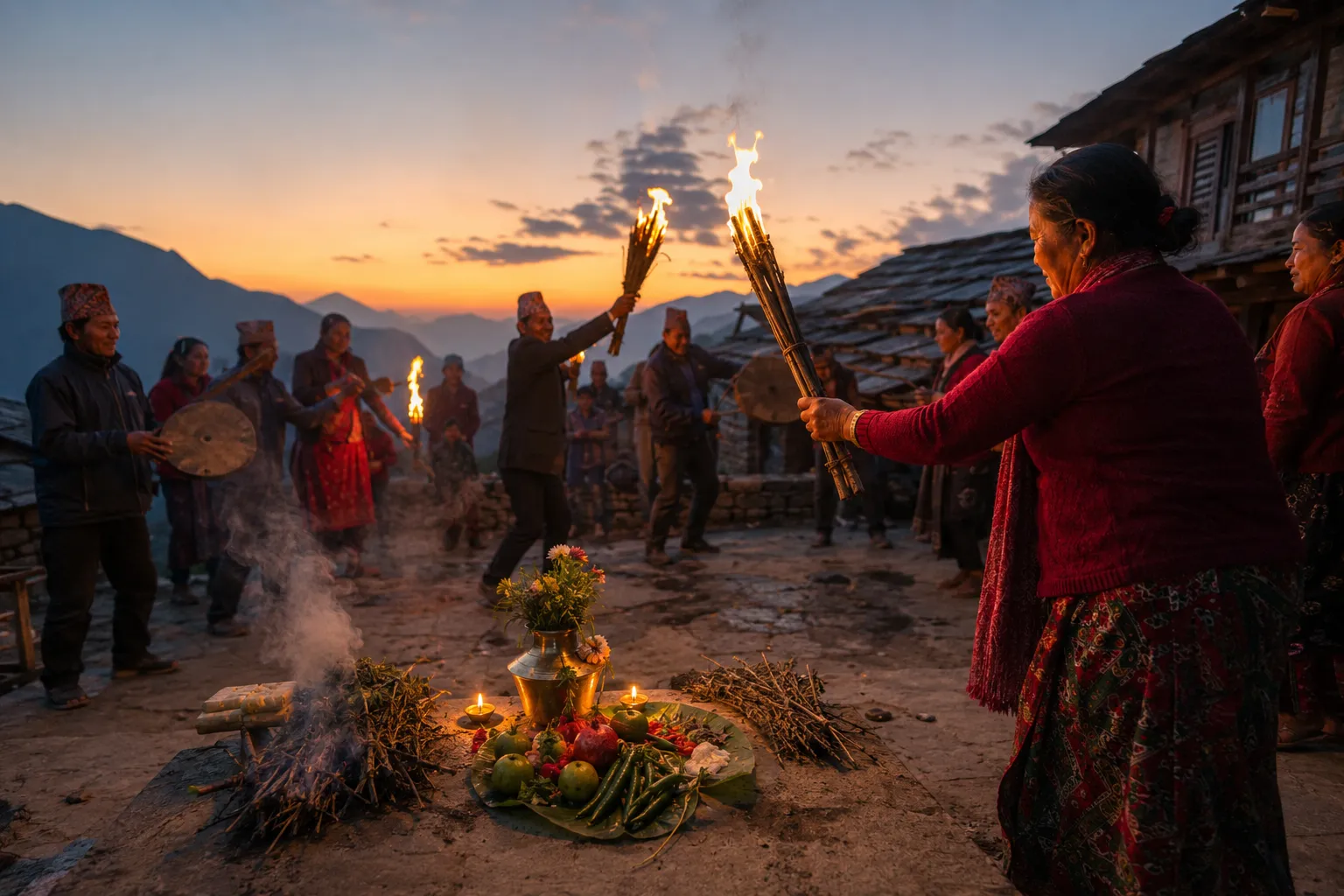
Luto Falne Din, literally "the day of casting off scabies," is among the most distinctive and visually striking folk festivals of Nepal. Celebrated on the evening of Shrawan 1, the same day as Saune Sankranti, this tradition transforms villages into landscapes of fire, sound, and communal purpose.
At its heart, Luto Falne Din is a health protection ritual. After a month of intensive rice planting (Ropai) in the month of Asar, farmers have spent weeks working barefoot in muddy water, soaked by monsoon rain. Skin diseases such as scabies (luto), ringworm (dad), rashes, and fungal infections are common consequences of this prolonged exposure to mud and moisture. Luto Falne Din is the traditional response: a community-wide ritual of cleansing, fumigation, and spiritual protection that addresses real physical needs through culturally meaningful practices.
The name comes from two words: "Luto" (scabies or a mange-like skin disease) and "Falne" (to throw away or cast off). Combined, the festival is a declaration: today, we throw away the sickness. Today, we protect our families.
The festival is most vibrantly observed in the Karnali region of western Nepal, particularly Jumla, Mugu, Kalikot, and Dolpa, where it is rooted in the ancient traditions of the Khas people, the original Indo-Aryan inhabitants of the region. Practices vary from village to village, but fire, medicinal plants, noise, and the collective will to push illness away remain constant across geography.
Understanding the name "Luto Falne Din" starts with understanding "luto" itself.
Luto is the Nepali word for scabies, a contagious skin condition caused by the Sarcoptes scabiei mite. It causes intense itching, particularly at night, and leads to rashes, sores, and secondary infections from scratching. In the humid, wet conditions of the Nepali monsoon, scabies spreads easily through close contact, shared clothing, and prolonged exposure to moisture, making it an annual health burden for farming communities working barefoot in flooded rice paddies.
The word also carries a broader meaning: "luto" can refer to any monsoon-associated skin ailment, ringworm, eczema, fungal rashes, prickly heat, and general dermatitis. The festival addresses all of these together.
"Falne" comes from the Nepali verb "fālnu" (to throw, to cast away). The festival is a physical, performed rejection of disease. It is not passive prayer but active expulsion: throwing burning torches, beating noise-making instruments, shouting into the dusk, and slamming doors against the forces of illness.
The origins of Luto Falne Din lie deep in the pre-modern history of Nepal's mid-western hills, among the Khas people of the Karnali region.
The Khas civilization, centered around the ancient city of Sinja in present-day Jumla, was one of the most influential cultural and political forces in the Himalayan region between the 11th and 14th centuries. The Khas language evolved into modern Nepali, and many of Nepal's founding cultural traditions trace their roots to this region.
In the Khas worldview, health and spirituality were inseparable. The monsoon season brought not only life-giving rain but real, predictable health challenges, and communities developed ritual responses through the cultural tools available to them: fire, herbal medicine, community gathering, and the invocation of protective deities. Luto Falne Din emerged from this crucible, a folk medical practice wrapped in spiritual ceremony.
Central to Luto Falne Din is the figure of Kandarak, also called the night wandering demon or the deity of itching diseases.
The name Kandarak derives from the Sanskrit word "kandu," meaning "to itch." In Nepali folk tradition, Kandarak is the supernatural being responsible for scabies, rashes, and skin ailments, a rakshasa (demon) who roams at night, afflicting people with itching and discomfort.
The ritual of Luto Falne Din is, in its spiritual dimension, a negotiation with Kandarak. Families worship him, offering lamps, water urns (kalash), and fruit, then symbolically banish him from the home. The worship honors his power; the expulsion reclaims the family's health. This dual approach, propitiation followed by expulsion, is characteristic of many Nepali folk traditions.
The traditional mantra recited during the ritual includes:
"Kandarak suradhisha, grihana dipamuttamam / Saralendhanasambhutam, mamarishtam vinashaya"
"Kandarak ratrichara, lutadibhayanashana / Ulkamimam prakshipami, mastu lutabhayam mama"
("Kandarak, lord of the deities, accept this excellent lamp made from pinewood fuel, destroy my afflictions.
Kandarak, night wanderer, destroyer of the fear of scabies, I throw this torch; may the fear of scabies not remain for me.")
One of the most remarkable aspects of Luto Falne Din is its sophisticated use of medicinal plants. The tradition preserves detailed knowledge of local ethnobotany: families gather specific plants from forests and hillsides in the afternoon, each chosen for known antifungal, antibacterial, or skin healing properties.
Kagbhalayo (Rhus javanica / Rhus insignis), a tree whose bark and leaves have strong antifungal and astringent properties, is traditionally used for skin infections and wounds; its burning smoke is believed to purify the air
Kukurdaino (Smilax microphylla), a climbing shrub with medicinal roots and leaves known for blood purifying and anti-inflammatory qualities; its smoke is considered particularly effective against skin ailments
Lutejhar / Lute Saro, a medicinal herb whose name itself connects it to the treatment of lute, is sought for its antifungal properties
Pani Amala / Pani Saro (Phyllanthus emblica and related species), high in vitamin C and antimicrobial compounds, grows near water sources and is valued for its cooling, healing qualities
Kurilo (Asparagus racemosus), known in Ayurveda as Shatavari, a powerful adaptogen and skin healer, burned for its purifying smoke
Titepati (Artemisia indica), mugwort, one of Nepal's most widely used medicinal plants, with strong antimicrobial, antifungal, and insecticidal properties that are released effectively when burned
Sisnu (Urtica dioica), stinging nettle, valued for its anti-inflammatory and antimicrobial properties, is included in torch bundles for its medicinal smoke
Kagati (lemon), Amba (mango), Nashpati (pear), Anar (pomegranate), fruits offered to Kandarak during worship and placed in the ritual space, representing the first harvest of the season and believed to carry protective qualities
Dhasingre, a local medicinal herb included for its specific skin healing qualities
The choice of these plants is not arbitrary. Each has documented medicinal properties, and burning them creates a fumigation effect that can kill or repel insects, bacteria, and fungi in the immediate environment. What appears as a purely spiritual ritual is, in its practical dimension, an ancient form of public health intervention using fire to disperse antimicrobial smoke through the household and its surroundings.
The observance unfolds through the afternoon and evening, following a sequence passed down through generations.
Afternoon: gathering and preparation. From early afternoon, three tasks happen in parallel across the household:
Plant collection. Family members, often led by elders or children, venture into nearby forests and hillsides to gather the required plants, an act of traditional education in itself, as children learn to identify kagbhalayo, kukurdaino, lutejhar, titepati, and other species by sight, smell, and traditional name.
Torch making. The collected plants are sorted and tied into bundles, and thin bamboo stems, known locally as "dhyangro" or "mutha," are prepared as torches.
Yard preparation. The front yard or courtyard is cleaned; in many traditions, part of the yard is smeared with cow or ox dung, a traditional disinfectant, and two small dung balls are shaped with cucumber flowers placed on them. A taro leaf (karkalo ko paat) is laid nearby with offerings of green chili, peach, figs, and corn.
As dusk approaches, the family gathers and the ritual proceeds in sequence:
Worship of the Kalash and Ganesh. A water urn (kalash) is set up and worshipped alongside Ganesh, the remover of obstacles, established in the courtyard or at the threshold of the home.
Kandarak Puja. Offerings of collected fruits, flowers, and medicinal plants are made to Kandarak. Lamps (diyo) are lit in his honor, and family members bow and recite the traditional mantra asking for the removal of illness.
Lighting the torches. Two bundles of thin bamboo stems are taken to the kitchen hearth and lit from the cooking fire, the same fire that sustains the household. The symbolic connection matters: the fire that cooks the family's food is also the fire that protects their health. The burning torches are then carried back to the courtyard.
Medicinal plant fumigation. Herbs like titepati, kurilo, and other collected plants are mixed with ghee (clarified butter) and burned. The fragrant, medicinal smoke drifts through the courtyard and into the home, the practical fumigation component of the ritual.
Throwing the torches, the central act. Family members take the burning torches and throw them, one by one, outward in all four directions: east, west, north, and south, shouting "Luto Jaa! Luto Jaa!" (go away, scabies) and "Luto Laija! Luto Laija!" (take the scabies away). In some villages, neighboring families shout across to each other, exchanging mock insults as they throw, a competitive spirit that adds energy and communal participation.
Making noise, the sound barrier. As the torches fly, everyone joins in creating as much noise as possible:
beating nanglo (large bamboo winnowing trays) like drums
blowing conch shells (shankha) and ringing bells (ghanti)
clanging kitchen plates, pots, and lids together
playing dhimay and damaha drums, in communities that have them
In some regions, firecrackers or blank gunshots
The noise serves a dual purpose: spiritually, it drives away Kandarak and any malevolent forces near the home; practically, the loud sounds and vibrations are believed to dislodge insects, pests, and even some airborne pathogens from the immediate environment. Cultural expert Jagaman Gurung has described the noise-making as a form of sound therapy.
Closing the doors. After the torches are thrown and the noise reaches its peak, the house's main door is firmly shut for a short time, symbolizing that the disease has been expelled and must not be allowed back in. When the door reopens, the family is considered purified and protected.
Final protection. A bundle of medicinal plants, typically including asparagus and other herbs, is tucked under the roof or placed above the main door as a protective charm for the year ahead.
In Jumla district, the historic heart of the Khas civilization, Luto Falne Din takes on its most dramatic form.
As the sun sets on Shrawan 1, one torch is prepared for each member of the family, from the youngest child to the eldest grandparent, each lit from the kitchen fire. Family members climb to their rooftops or stand in their courtyards holding their torches, and at a signal, the village erupts: hundreds of torches blaze across the hillside at once, each thrown outward by its bearer. The rooftops and courtyards of Jumla glow simultaneously, a spectacle of fire and community that has been described as a festival of lights in its own right.
Following the fire ritual, the village gathers for the Deuda dance, a traditional Khas dance in which locals of all ages join hands in large circles, singing and dancing in sync to tunes passed down through generations. The dance reinforces community bonds and collective identity, turning the health protection ritual into a celebration of life itself.
In the Mugu district, the practice is equally vivid. Karna Bahadur Aidi, an elder from Chhayanath Rara Municipality, describes how families light their torches simultaneously across the entire district headquarters, shouting wishes for health. The ritual has adapted to modern times; families living in houses with concrete roofs now light their torches in courtyards or verandas instead, but the essential practice endures.
Luto Falne Din is often described simply as tradition, but it carries sophisticated practical wisdom, working through four parallel mechanisms:
Antimicrobial smoke. The medicinal plants burned in the ritual contain documented antimicrobial compounds. Titepati (Artemisia indica), for example, produces artemisinin and other volatile oils with proven antifungal, antibacterial, and insecticidal properties, which disperse through smoke and create a fumigation effect that can reduce pathogen loads in the immediate environment.
Fire and dung sanitation. Heat and smoke from burning bamboo and medicinal plants can kill surface-level fungi and bacteria in the courtyard and home entrance areas, while smearing the yard with cow dung, which contains beneficial microorganisms that outcompete harmful ones, adds another layer of ecological sanitation.
Vibration and noise. Beating nanglos, blowing conch shells, and ringing bells produce vibrations that may disturb insects, rodents, and other disease vectors. Cultural experts have noted similar practices in agricultural communities worldwide, where loud sounds are used to protect crops and homes.
Knowledge transmission. The foraging and identification of medicinal plants pass ethnobotanical knowledge from one generation to the next. Children learn to recognize healing plants by name and appearance, a form of practical education that has sustained community health for centuries without written manuals.
Historian Dinesh Raj Panta has observed that the tradition connects nature and the divine to human life, underscoring the importance of health in human life. The ritual is, in essence, a cultural technology for public health, combining fire, sanitation, herbal fumigation, community solidarity, and psychological reassurance into a single, repeatable practice.
While the core elements of Luto Falne Din remain consistent, the festival takes unique forms across different communities:
|
Region |
Distinctive Feature |
|
Jumla |
Simultaneous lighting of one torch per family member from rooftops, followed by the Deuda dance and community feasting |
|
Mugu |
Villagers light torches while exchanging playful insults with neighboring villages; banter is an essential part of the ritual |
|
Kalikot and Dolpa |
Emphasis on medicinal plant gathering, with extensive foraging expeditions into high-altitude forests and a wider plant variety due to rich biodiversity |
|
Surkhet and Dailekh |
Household rituals are more private, centered on the immediate family, but neighborhood coordination in timing is preserved |
|
Eastern Nepal (Kirat communities) |
The Luto Falne ritual is not observed, but Saune Sankranti is marked as Sisekpa Tangnam, sharing similar concerns with seasonal health and first fruit offerings |
|
Tharu community |
The Guriya Parwa, observed on the same day, involves creating an effigy of disease and banishing it from the village, a parallel health protection practice |
Luto Falne Din faces real challenges in modern Nepal. Urbanization, migration to cities and abroad, the availability of modern medicine, and the erosion of traditional knowledge have all contributed to its decline.
Cultural expert Jagaman Gurung notes that the tradition he remembers from his childhood in western Nepal, with elaborate preparations, village-wide participation, and specific knowledge of medicinal plants, is much less vibrant today. In Kathmandu and other cities, many young Nepalis have never observed Luto Falne Din or know it only as a phrase. The generation that can identify kagbhalayo, kukurdaino, and lutejhar by sight is diminishing, and as traditional knowledge fades, so does the biodiversity it once protected: the very plants once sought for their healing properties are now less valued and less preserved.
Yet there are signs of revival:
Documentation. Cultural organizations and local governments in Karnali Province have begun documenting the tradition and promoting it as intangible cultural heritage.
Official recognition. The Karnali Province government has declared a public holiday on Shrawan 1, recognizing both Saune Sankranti and Luto Falne Din as officially significant days.
Tourism. In Jumla, tourism initiatives now highlight the Luto Falne celebration as a unique cultural experience, offering visitors the chance to witness the rooftop fires and Deuda dances.
These efforts represent more than nostalgia. They recognize what Luto Falne Din embodies: a community's accumulated wisdom about health, ecology, and collective well-being, expressed through a practice that is simultaneously practical, spiritual, and beautiful.
Luto Falne Din and Saune Sankranti fall on the same day, Shrawan 1, but they are distinct in emphasis.
Saune Sankranti is the broader festival: it encompasses the astronomical event of the sun's transition into Cancer, the beginning of Dakshinayan, the religious observances dedicated to Lord Shiva, the traditions of women wearing green bangles and observing Monday fasts, the farmers' rest after the rice planting, and the gathering of the family for feasts.
Luto Falne Din is the practical health dimension of that same day, the evening ritual that addresses the physical consequences of the agricultural month that came before: the skin ailments caused by mud, water, and monsoon humidity. It is folk medicine in ceremonial form.
They belong together, and neither fully makes sense without the other. The same sunrise that brings the sacred month of Shrawan also brings the sunset of the torches. To understand Saune Sankranti is to understand the cosmic and religious frame; to understand Luto Falne Din is to understand the embodied, practical, health-giving heart of the day. Read our full article on Saune Sankranti to explore the astronomical and religious dimensions of this sacred day.
Preserves traditional ethnobotanical knowledge; the identification and use of medicinal plants is passed down through direct experience
Represents a practical health intervention embedded in spiritual ritual, an ancient form of community public health
Strengthens community bonds; the simultaneous lighting, shared shouting, and collective dancing create social cohesion
Marks the seasonal transition, the shift from the planting season to the monsoon proper is acknowledged and honored
Provides psychological reassurance, addressing real anxieties about health in a culturally meaningful way
Celebrates Khas cultural heritage, one of the most distinctive traditions of Nepal's Karnali region
Demonstrates ecological wisdom; the plants used, the fire practices, and the noise making all serve practical purposes beyond the symbolic
Luto Falne Din is a living reminder that festivals can be more than celebration; they can be medicine, education, community, and heritage all at once. In every torch thrown at dusk on Shrawan 1, there is a thousand-year-old wisdom: that health is communal, that nature heals, and that a village that shouts together stays together.