| Date | Bhadra Krishna Saptami (August 19) |
| Duration | One-day celebration |
| Observance | Regional and Community |
| Celebrated in | Nepal, India, and Hindu communities worldwide |
| Observing Communities | Hindi speakers, Rama devotees, scholars, and general Hindu community |
| Type of Event | Religious and Cultural |
| Purpose of Event | To honor the birth anniversary of Saint Tulasidas and celebrate his monumental contribution to Hindi devotional literature, particularly the Ramcharitmanas. |
| Holiday Status | Not official in Nepal; recognized in some states of India |
| First Observed in | Since 1623 CE onwards (after Tulasidas's passing) |
Quick Fact: Tulasidas (1532–1623) composed the Ramcharitmanas entirely in Awadhi, a vernacular language, making the sacred story of Lord Rama accessible to common people for the first time. His famous work contains over 10,000 verses and remains one of the most widely read and recited religious texts in the Hindu world today.
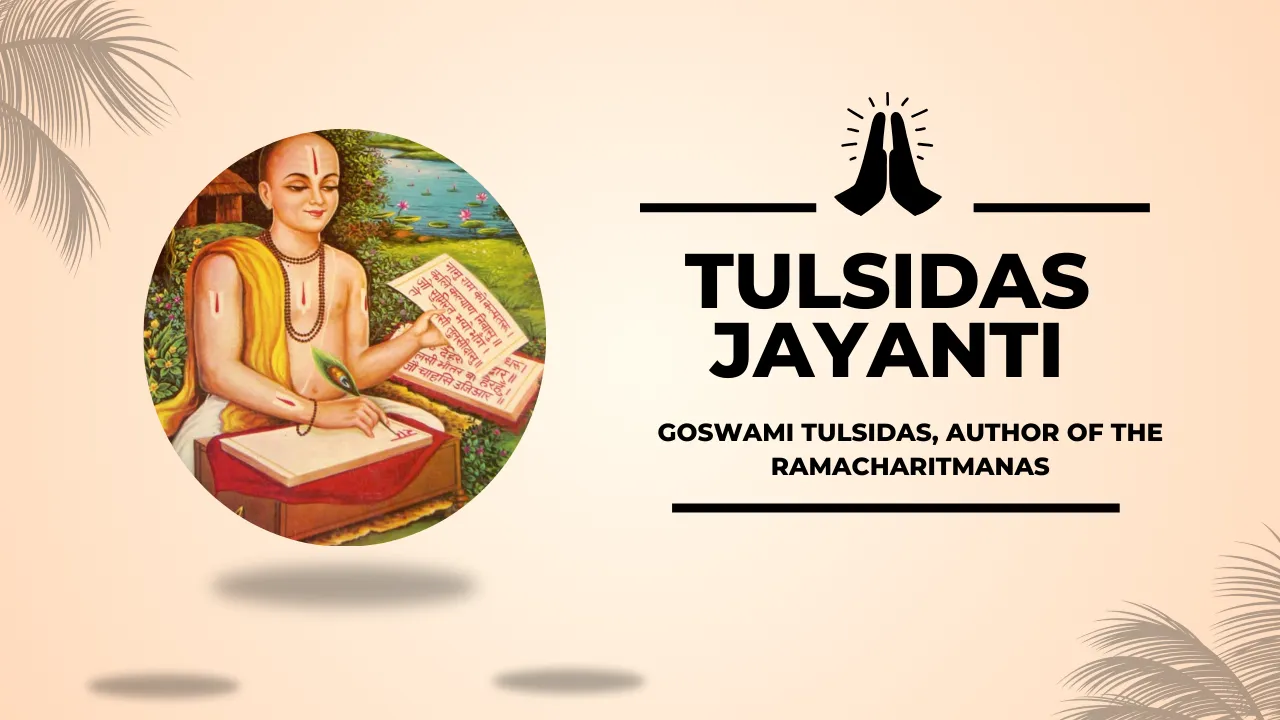
Tulasidas Jayanti marks the birth anniversary of Goswami Tulasidas, one of the greatest saint-poets of medieval India. Celebrated on the Saptami (seventh day) of the dark fortnight of Bhadra month, this occasion honors the poet whose devotional works transformed the landscape of Hindu religious thought and vernacular literature. His masterpiece, the Ramcharitmanas, brought the epic tale of Lord Rama into the hearts and homes of millions across the Indian subcontinent.
Tulasidas (1532–1623) was a legendary Hindi poet and saint born in Rajapur, Uttar Pradesh, India. A devoted disciple of the Rama tradition, he composed multiple works including the Ramcharitmanas, Hanuman Chalisa, Vinaya Patrika, and Kavitavali. Born into a Brahmin family, he devoted his entire life to literature, philosophy, and spirituality. His Ramcharitmanas retells the Valmiki Ramayana in Awadhi language, making the story of Lord Rama accessible to people who could not read Sanskrit. Tulasidas is regarded as one of the most influential figures in Hindi literature, with his works forming the devotional foundation for millions of Hindu households even today.
This celebration is observed to:
Honor the birth anniversary of Saint Tulasidas and celebrate his life of devotion.
Celebrate his monumental contributions to Hindi literature and Hindu theology.
Promote devotion to Lord Rama through recitation of his literary works.
Inspire spiritual seekers through his exemplary life and timeless teachings.
This occasion is marked through:
Recitation and group reading of the Ramcharitmanas, especially beloved Dohas (couplets).
Puja and prayers at temples dedicated to Lord Rama and in households.
Religious assemblies, spiritual discourses, and satsang gatherings.
Distribution of blessed food (Prasad) and sweets among community members.
Group singing of devotional bhajans and hymns related to Lord Rama and Tulasidas's compositions.
This celebration is significant for several reasons:
It celebrates the transformation of vernacular literature through devotional poetry in Hindu tradition.
It reinforces Rama devotion across India and Nepal through the living power of Tulasidas's works.
It commemorates a literary genius whose spiritual achievement shaped Hindu culture for centuries.
It promotes religious education and cultural consciousness in Hindu communities.
His Hanuman Chalisa remains among the most universally recited prayers in the Hindu world.
Tulasidas Jayanti is a celebration of spiritual literature's transformative power. Through his poetry and devotion, Tulasidas bridged the sacred with the everyday, making the divine accessible to every heart. His words continue to guide, inspire, and uplift countless lives across generations, making his Jayanti a day of profound gratitude and spiritual reflection.