
| Date | Ashad Shukla Purnima (July 29) |
| Duration | One-day celebration |
| Observance | National and Regional |
| Celebrated in | Nepal, India, and Hindu communities worldwide |
| Observing Communities | Hindus, spiritual seekers, scholars, and devotees of Vedic knowledge |
| Type of Event | Religious and Spiritual |
| Purpose of Event | To celebrate the birth anniversary of Maharishi Vyasa, the legendary sage who compiled the Vedas, authored the Mahabharata and the Puranas, and established the foundations of Hindu scriptural tradition. |
| Holiday Status | Recognized holiday in India; not an official public holiday in Nepal |
| First Observed in | Thousands of years ago (based on ancient Puranic and Vedic texts) |
Quick Fact: Maharishi Vyasa is credited with one of the most extraordinary intellectual achievements in human history: dividing the single primordial Veda into the four Vedas (Rigveda, Samaveda, Yajurveda, and Atharvaveda), authoring all 18 major Puranas, composing the 100,000-verse Mahabharata (the world's longest epic poem), and writing the Brahmasutras. His full name was Krishna Dvaipayana Vyasa, and he is considered a Chiranjeevi (immortal) in Hindu tradition.
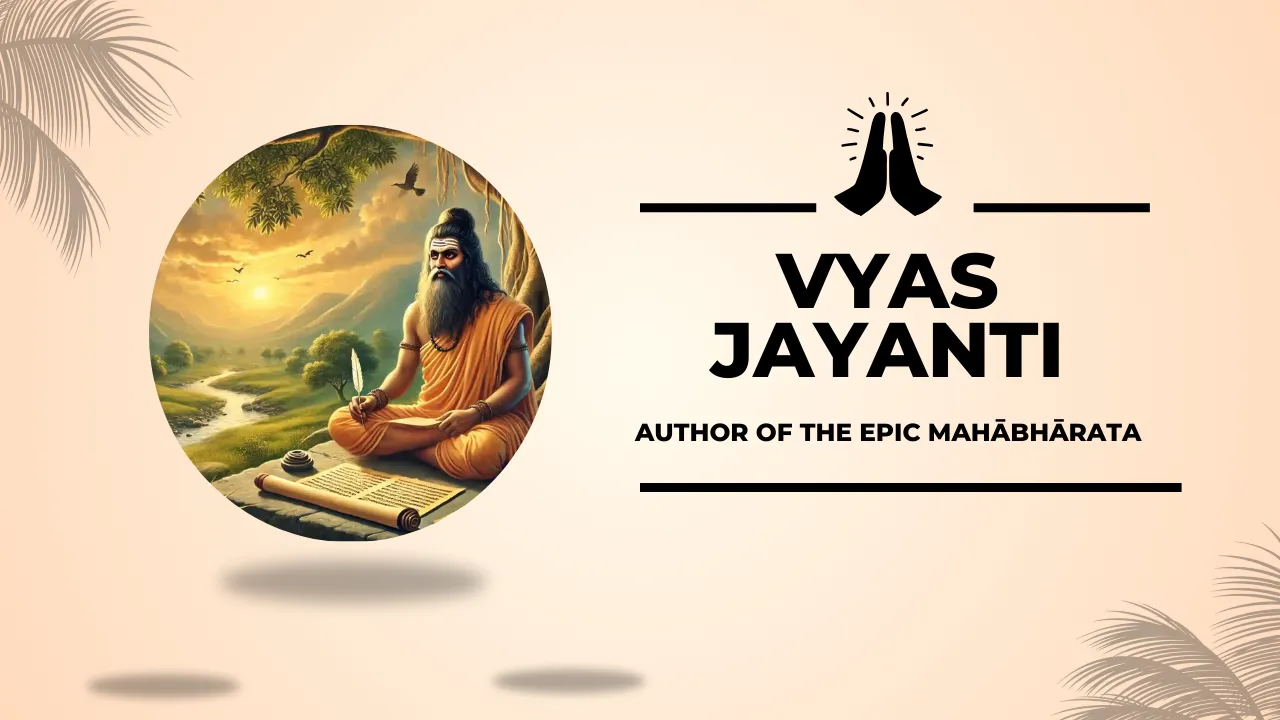
Vyas Jayanti, also celebrated as Guru Purnima, marks the birth anniversary of Maharishi Vyasa, one of the greatest sages in Hindu tradition and the compiler of the Vedas and author of the Mahabharata. Observed on the full moon day (Purnima) of the Ashad month, this auspicious occasion celebrates not only the birth of an extraordinary sage but also the entire tradition of spiritual knowledge, the guru-disciple relationship, and the gift of sacred wisdom that Vyasa bequeathed to humanity.
Maharishi Vyasa (also known as Krishna Dvaipayana or Veda Vyasa) is one of the most revered and legendary sages in Hindu tradition. According to Hindu scripture, he was born on the full moon day of Ashad to sage Parashara and Satyavati, the daughter of a fisherman. He is credited with compiling the four Vedas, authoring all 18 major Puranas including the Bhagavata Purana, composing the 100,000-verse Mahabharata (the longest epic poem in world literature), and writing the Brahmasutras. The name "Vyasa" itself means "compiler" or "arranger." His literary and philosophical contribution forms the bedrock of Hindu religious and cultural identity. The full moon of Ashad is considered his birth anniversary and is observed as Guru Purnima—a day to honor all gurus (spiritual teachers) in the tradition that Vyasa himself embodied as the ultimate teacher of humanity.
This celebration is observed to:
Honor the birth anniversary of Maharishi Vyasa and his immeasurable contribution to human knowledge.
Celebrate his foundational contributions to Hindu scriptural and philosophical knowledge.
Promote and deepen the guru-disciple relationship as a vehicle of spiritual knowledge and wisdom.
Encourage dedicated study of Vedic literature, sacred texts, and spiritual teachings.
This celebration is marked through:
Guru Puja, formal worship and honoring of spiritual teachers and mentors on this auspicious day.
Recitation of Vyasa's works, especially selections from the Mahabharata and Bhagavata Purana.
Offering of flowers, fruits, and dakshina (gifts) to gurus and spiritual teachers as an act of reverence.
Temple visits, devotional prayers, and spiritual discourses at religious institutions.
Educational programs, seminars, and scholarly events honoring the Vedic knowledge tradition.
This celebration is significant because:
It celebrates the very foundation of Hindu scriptural knowledge and the entire Vedic tradition.
It emphasizes the sacred and irreplaceable guru-disciple tradition in Hindu and yogic spirituality.
It reinforces the supreme value of education, wisdom, and spiritual guidance in human life.
It is widely observed by scholars, spiritual seekers, yoga practitioners, and general devotees worldwide.
It stands as one of the most important and universally observed days in the Hindu spiritual calendar.
Vyas Jayanti is a celebration of the boundless power of wisdom and the sacred bond between teacher and student. In honoring Maharishi Vyasa on his birth anniversary, devotees acknowledge the debt humanity owes to the great sages who preserved and transmitted the light of spiritual knowledge through the ages—a light that continues to illuminate the path for seekers even today.