Ganatantra Diwas is Nepal's Republic Day. It falls on Jestha 15 every year in the Bikram Sambat calendar, which usually lands on 28 or 29 May in the Gregorian calendar. The day marks a single decision made in a hall in Kathmandu in 2065 BS, when elected members of the Constituent Assembly voted to end 240 years of Shah rule and turn Nepal into a federal democratic republic.
It is not a religious festival. There is no puja, no fasting and no family ritual attached to it. It is a civic day, and the way Nepal observes it says a lot about how recent the change still feels. The oldest Nepalis alive today were born under a king. The youngest voters have never lived under one.
|
Detail |
Information |
|
Nepali Name |
गणतन्त्र दिवस |
|
English Name |
Republic Day of Nepal |
|
Date in Bikram Sambat |
Jestha 15, every year |
|
Usual Gregorian Date |
28 or 29 May |
|
Declared On |
Jestha 15, 2065 BS (28 May 2008) |
|
Type of Day |
National civic observance |
|
Public Holiday |
Yes, it is on the Government of Nepal public holiday list |
|
Main Venue |
Army Pavilion (Sainik Manch), Tundikhel, Kathmandu |
|
Presided Over By |
The President of Nepal as Head of State |
|
Duration |
Officially observed across three days, Jestha 14 to Jestha 16 |
|
Number of Years Observed |
The 19th Republic Day fell in 2083 BS |
|
Bikram Sambat Date |
Day |
Gregorian Date |
Republic Day |
|
Jestha 15, 2083 BS |
Friday |
29 May 2026 |
19th Republic Day |
|
Jestha 15, 2084 BS |
Saturday |
29 May 2027 |
20th Republic Day |
|
Jestha 15, 2085 BS |
Sunday |
29 May 2028 |
21st Republic Day |
The Gregorian date shifts by a day now and then because the Bikram Sambat months do not have a fixed length. Jestha 15 itself never moves. If you want the exact conversion for any year, check the Jestha page of the Digital Patro Nepali calendar.
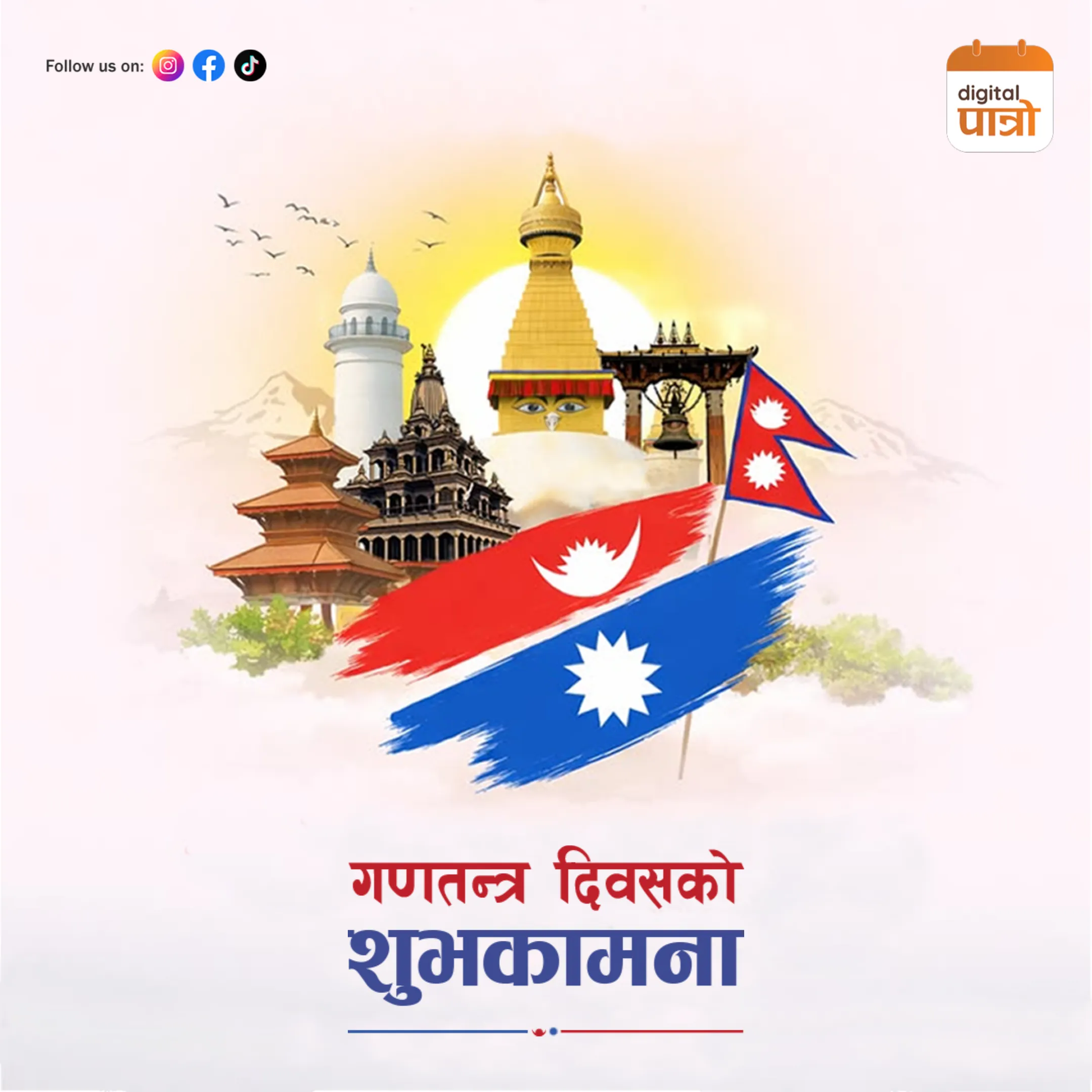
Want to share wishes with your friends, family, or on social media using a post like the one above? Create a personalized post for free in seconds using our post generator. Your text, your Style.
The first sitting of Nepal's first Constituent Assembly opened on Jestha 15, 2065 BS, which was 28 May 2008. The Assembly had 601 seats. The sitting was chaired by Kul Bahadur Gurung, the oldest member present, following the convention that the senior-most member presides until a chair is elected.
The single item that mattered that night was a proposal moved on behalf of the government led by Prime Minister Girija Prasad Koirala. The proposal asked the Assembly to implement the republic that Nepal's interim parliament had already agreed to in principle five months earlier.
The vote was taken late at night, close to midnight. Of the 564 members present, 560 voted in favour, and 4 voted against. The four votes against came from the Rastriya Prajatantra Party Nepal, the one party in the Assembly that had campaigned openly to keep the monarchy.
With that vote, Nepal stopped being the world's last Hindu kingdom. The office of the king was abolished. The Shah dynasty, which had ruled since Prithvi Narayan Shah unified the hill states in 1825 BS, ended after roughly 240 years.
Because the vote was taken so close to midnight, some international news reports carry 29 May 2008 as the date. In Nepal, the date is fixed by the Nepali calendar, and Jestha 15 is the date that counts.
Ganatantra Diwas did not come out of nowhere. It sits at the end of a long chain of events, and most of that chain runs through only three years.
King Gyanendra dismissed the elected government, took direct executive power, cut phone lines, put political leaders under house arrest and declared a state of emergency. He said he needed the power to defeat the Maoist insurgency. In practice, the move united everyone who had been fighting each other, because now they had one common opponent.
The seven parliamentary parties and the Communist Party of Nepal (Maoist) signed an understanding in New Delhi. The parties agreed to work together to end the king's direct rule, and the Maoists agreed to enter mainstream politics and accept a Constituent Assembly election. This document is the hinge on which everything after it turns.
A 19-day general strike shut the country down. Crowds outside Kathmandu's Ring Road grew larger every day, and by the third week the protests were too big for the security forces to contain. On the night of Baisakh 11, the king announced the reinstatement of the House of Representatives that had been dissolved in 2059. This day is remembered separately as Loktantra Diwas.
The reinstated House stripped the king of almost every power he had left. It took the Nepal Army out of royal command and renamed it, ended the king's immunity, removed his tax exemptions, cut the palace budget, and declared Nepal a secular state. After this proclamation, the king was still on the throne, but he had nothing left to do from it.
Signed by Girija Prasad Koirala and Pushpa Kamal Dahal, this ended the ten-year armed conflict that had killed more than 17,000 people. It set out arms management, cantonments for Maoist combatants and a timeline for the Constituent Assembly election.
The interim legislature amended the Interim Constitution to declare Nepal a Federal Democratic Republic. Crucially, it wrote in that the declaration would take effect only when the first meeting of the elected Constituent Assembly implemented it. That is why the vote had to wait until Jestha 15, 2065.
Nepal voted. The Maoists emerged as the largest party, which surprised most observers. The Assembly that came out of this vote is the one that abolished the monarchy seven weeks later.
The declaration was the headline, but a country does not switch systems in one night. A short sequence of steps completed the change.
Gyanendra Shah was given 15 days to leave Narayanhiti Palace. He held a press conference and left on 11 June 2008, moving to Nagarjuna Palace on the edge of Kathmandu. He handed over the crown and the royal sceptre to the state and said he accepted the decision of the Constituent Assembly.
The crown itself, which carried emeralds, diamonds, rubies, pearls and a plume of bird of paradise feathers, became state property.
Narayanhiti Palace was converted into the Narayanhiti Palace Museum and opened to the public on 26 February 2009 by Prime Minister Pushpa Kamal Dahal. Anyone can now buy a ticket and walk through the rooms where the royal family lived. For many Nepalis, that walk is the moment the republic feels real.
The Constituent Assembly elected Dr Ram Baran Yadav as Nepal's first President on 21 July 2008. He was sworn in on 23 July 2008 and served until 29 October 2015.
The system that the 2065 declaration promised was not fully written down until the Constitution of Nepal was promulgated on 3 Ashoj 2072 BS (20 September 2015). That constitution gave Nepal its seven provinces and its three-tier structure of federal, provincial and local government.
This is the single most common confusion in Nepal's calendar, and it is worth being exact about it. Nepal has three separate political anniversaries, and they mark three different things.
Marks the fall of the Rana regime in 2007 BS (1951) and the return of the Shah king to real power with a promise of democracy. This is the oldest of the three. It is a public holiday.
Marks the success of Jana Andolan II in 2063 BS (2006), when the king reinstated parliament and stepped back from direct rule. Nepal was still a kingdom on this day. It is observed as a national day, but it is not on the general public holiday list.
Marks the abolition of the monarchy itself in 2065 BS (2008) and the creation of the federal democratic republic. This is the newest of the three, and it is a public holiday.
A simple way to hold them apart: Prajatantra ended Rana rule, Loktantra ended royal rule, Ganatantra ended the monarchy.
The main national function is held at the Army Pavilion, known as Sainik Manch, at Tundikhel in Kathmandu. The President of Nepal attends as Head of State, along with the Vice President, the Prime Minister, the Speaker, the Chief Justice, ministers, chiefs of the security forces and the diplomatic corps.
The national flag is hoisted, and the national anthem Sayaun Thunga Phulka is played
The Nepal Army, Armed Police Force and Nepal Police present drill and precision parades
Military bands, police bands, women's contingents and the Metropolitan Traffic Police Division perform
Cultural troupes present regional dance forms such as Maruni and Kaura
Army helicopters fly over the pavilion, sometimes trailing a Republic Day banner and showering flower petals
The President delivers a message to the nation
The government normally spreads the observance across three days, Jestha 14, 15 and 16. Committees are formed at federal, provincial and local level, so the day is not only a Kathmandu event.
Provincial capitals hold their own flag hoisting and parade functions with the Chief Minister and Province Chief present
Public buildings, government offices, ward offices and major streets are lit up in the evening
Schools and campuses run essay competitions, quiz contests, speech competitions and art contests on the theme of the republic
Political parties hold rallies, corner meetings and assemblies
Memorial programmes honour the people killed during Jana Andolan II and during the ten-year conflict
Newspapers publish special supplements and television channels run panel discussions on how the republic is performing
Local governments hand out honours to conflict victims and to families of those declared martyrs
Ganatantra Diwas appears on the Government of Nepal public holiday list published each year by the Ministry of Home Affairs. In 2082 BS it was listed as a full public holiday on Jestha 15, which fell on 29 May 2025.
There is some confusion online because Nepal trimmed its public holiday list in 2075 BS after complaints from the private sector that the country was losing too many working days. Several days were dropped or downgraded in that round, and some reference sites still carry the older information. Republic Day survived the cut and is still a gazetted holiday.
Loktantra Diwas is the one that is easy to mix up here. Baishakh 11 is marked as a national day but is not on the general public holiday list, which is exactly why so many people assume Republic Day was dropped too.
Banks, government offices, schools and most private offices close on Jestha 15. Public transport runs. Shops in tourist areas stay open.
An honest page about Ganatantra Diwas has to say that the day is debated, because it is.
Supporters of the republic point to what changed. Nepal is now secular rather than officially Hindu. It is federal, with seven provinces and 753 local governments that hold their own budgets and elections. Groups that were locked out of power for two centuries, including Madhesi, Janajati, Dalit and women representatives, hold reserved and elected seats they did not have before. The ten-year armed conflict ended and did not restart.
Critics point to delivery. Governments have changed often. Corruption cases keep surfacing. Young Nepalis leave in very large numbers for work abroad. Some argue that the cost of running three tiers of government is high for the size of the economy.
Out of that frustration, a pro-monarchy current has come back into public view. Rallies calling for the restoration of a Hindu monarchy drew large crowds in Kathmandu in 2023 and again in 2025. A demonstration at Tinkune on 28 March 2025 turned violent, with two deaths, more than a hundred injuries and a curfew imposed in the Koteshwor, Tinkune and Sinamangal areas. Gyanendra Shah, now a private citizen, released a video message in February 2025 that supporters read as encouragement.
None of this has changed the constitutional position. Nepal remains a federal democratic republic, and Jestha 15 remains on the calendar. But it does explain why the tone of Republic Day speeches has shifted from celebration towards defence of the system.
Ganatantra - republic, a state where the head of state is elected rather than inherited
Loktantra - democracy in the sense of full people's rule, the word that came into use during Jana Andolan II
Prajatantra - the older word for democracy, used in the 2007 BS and 2046 BS movements, literally rule with subjects
Sanghiya Loktantrik Ganatantra Nepal - Federal Democratic Republic of Nepal, the country's full name
Samvidhan Sabha - Constituent Assembly, the elected body that wrote the constitution and abolished the monarchy
Jana Andolan - people's movement
Sahid - martyr, used for those killed in the movements and the conflict
Rastrapati - President, the Head of State
Sainik Manch - the Army Pavilion at Tundikhel where the main function is held
When is Ganatantra Diwas celebrated?
Ganatantra Diwas is celebrated on Jestha 15 every year. In the Gregorian calendar, this falls on 28 or 29 May depending on the year. In 2083 BS, it falls on 29 May 2026.
Why is Ganatantra Diwas celebrated on Jestha 15?
Because that is the day in 2065 BS when the first meeting of Nepal's Constituent Assembly voted to abolish the monarchy and declare Nepal a federal democratic republic. The date is fixed to the Nepali calendar, not to the English one.
Is Ganatantra Diwas a public holiday in Nepal?
Yes. It appears on the Government of Nepal public holiday list published by the Ministry of Home Affairs. Banks, government offices and schools close.
How many years has Nepal been a republic?
The 18th Republic Day was observed in 2082 BS, which corresponds to May 2025. The republic was declared in 2065 BS.
Who declared Nepal a republic?
The first Constituent Assembly of Nepal was elected on 28 Chaitra 2064 BS. The proposal was moved on behalf of the government led by Prime Minister Girija Prasad Koirala, and the first sitting was chaired by Kul Bahadur Gurung as the oldest member.
What was the vote count when Nepal became a republic?
Of 564 members present, 560 voted in favour, and 4 voted against. The four opposing votes came from the Rastriya Prajatantra Party Nepal.
How long did the monarchy last in Nepal?
About 240 years, counting from the unification campaign of Prithvi Narayan Shah in 1825 BS to the declaration of the republic in 2065 BS.
Who was the last king of Nepal?
Gyanendra Bir Bikram Shah Dev. He left Narayanhiti Palace on 11 June 2008 and now lives as a private citizen in Nepal.
Who was Nepal's first President?
Dr Ram Baran Yadav. He was elected by the Constituent Assembly on 21 July 2008, sworn in on 23 July 2008, and served until 29 October 2015.
What is the difference between Ganatantra Diwas and Loktantra Diwas?
Loktantra Diwas on Baishakh 11 marks the success of Jana Andolan II in 2063 BS, when the king reinstated parliament. Nepal was still a kingdom that day. Ganatantra Diwas on Jestha 15 marks the abolition of the monarchy two years later in 2065 BS.
What is the difference between Ganatantra Diwas and Prajatantra Diwas?
Prajatantra Diwas on Falgun 7 marks the end of Rana rule in 2007 BS. Ganatantra Diwas on Jestha 15 marks the end of the monarchy in 2065 BS. They are 58 years apart.
Where is the main Republic Day function held?
At the Army Pavilion, Sainik Manch, at Tundikhel in Kathmandu, in the presence of the President of Nepal.
Is Ganatantra Diwas a religious festival?
No. It is a civic and political observance with no religious ritual attached to it.
What happened to Narayanhiti Palace after the republic was declared?
It was converted into the Narayanhiti Palace Museum and opened to the public on 26 February 2009. Visitors can tour the royal residence and the throne room.
Did the republic come with a new constitution straight away?
No. The republic was declared in 2065 BS, but the Constitution of Nepal was only promulgated on 3 Ashoj 2072 BS, which is 20 September 2015. The first Constituent Assembly was dissolved in 2069 BS without producing a constitution, and a second one had to be elected.
How is Ganatantra Diwas wished in Nepali?
Common greetings include गणतन्त्र दिवसको हार्दिक शुभकामना and गणतन्त्र दिवसको उपलक्ष्यमा हार्दिक मंगलमय शुभकामना.