
|
Detail |
Information |
|
Date |
Amavasya falling on Monday |
|
Duration |
Single-day observance |
|
Observance |
Religious and spiritual tradition |
|
Celebrated In |
Across Nepal and Hindu communities in India and worldwide |
|
Observing Communities |
Hindu households, especially Shiva devotees, married women, and ancestor worshippers |
|
Type of Event |
A rare auspicious tithi is considered equal in merit to a solar eclipse |
|
Purpose of Event |
To earn spiritual merit through silent bathing, peepal tree worship, oil lamp donation, and charitable acts on the rare convergence of Monday and the New Moon |
|
Holiday Status |
Not an official public holiday in Nepal |
|
First Observed In |
Ancient Vedic period (referenced in Hindu scriptures, including the Skanda Purana) |
|
Also Known As |
Somvati Amavasya |
Quick Fact: Sombare Aunshi occurs when Sombar (Monday) and Aunshi (the New Moon day, Amavasya) fall on the same date. Because Monday returns every 7 days and the New Moon every 29.5 days, their alignment is rare, happening only once or twice a year at most. Hindu scriptures place its merit on par with a solar eclipse: any bath, donation, or Shraddha performed on this day is said to yield inexhaustible spiritual fruit. Waking before dawn and bathing in silence without speaking a single word is believed to earn merit equal to donating a thousand cows.
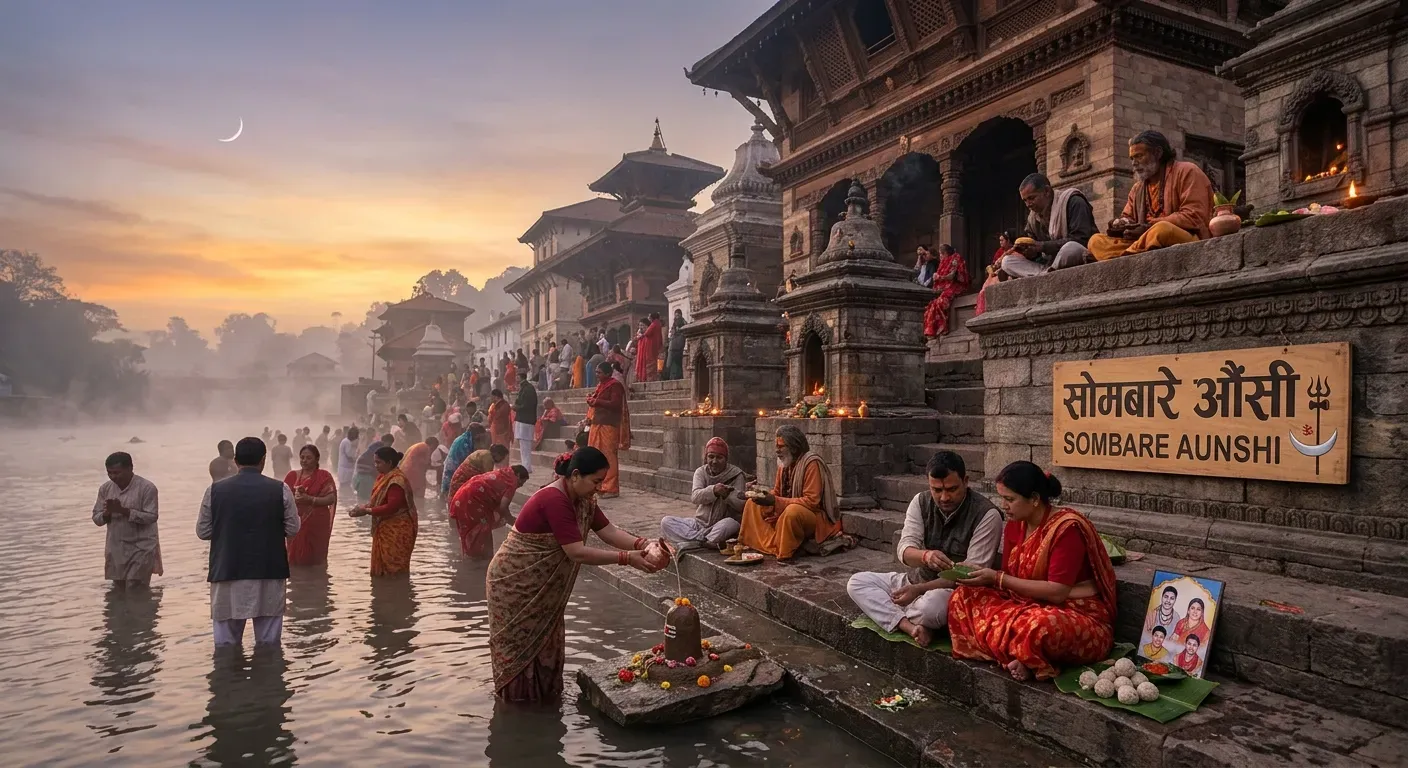
Two things happen every month without fail in the Nepali calendar. Monday comes around every seven days, and the New Moon arrives every 29 and a half days. They run on entirely different cycles, crossing paths only by coincidence, and that coincidence, when it happens, is called Sombare Aunshi.
It does not feel like a major festival from the outside. No public processions, no national holiday. But step near a river, a sacred pond, or a peepal tree on a Sombare Aunshi morning, and you will find people there who have been awake since before dawn, bathing in silence, lips sealed, carrying oil lamps to place at tree roots. They are not marking a holiday. They are seizing what Hindu tradition considers one of the rarest and most merit-filled moments on the entire calendar.
The name carries its meaning directly. Soma is the Sanskrit word for the Moon, and Monday Sombar in Nepali is the Moon's own day, also sacred to Lord Shiva, who bears the crescent moon on his head. Aunshi means the New Moon, the night the moon disappears entirely from the sky. When these two converge, both Shiva and the lunar cycle are at their most present, and Hindu tradition recognizes that convergence as especially charged. Ancient scriptures, including the verse "Amavasya tu somena saptami bhanuna saha", explicitly group Somvati Amavasya with solar and lunar eclipse days as tithis where all acts of bathing, donation, and Shraddha carry undiminishing, inexhaustible merit.
Tradition holds that Sombare Aunshi was extraordinarily rare in earlier ages, but that with the arrival of Kali Yuga, its frequency increased, understood as a divine gift, giving more people across more lifetimes a chance to earn the merit once reserved for the rarest of cosmic moments. The Mahabharata echoes this: it is said that even the great characters of the epic were unable, in their entire lifetimes, to observe a single Sombare Aunshi. In Nepal, the day carries a particular historical weight since the earthquake of Poush 18, 2046 BS (January 2, 1990) struck on a Sombare Aunshi when seven planets were aligned in a single zodiac sign, an event that deepened the day's association with powerful celestial convergence.
This rare tithi is observed for several interconnected reasons:
To earn the merit of an eclipse without the eclipse, scriptures rank Somvati Amavasya alongside solar eclipse days for spiritual merit, making it one of the most powerful regular opportunities for bathing, donation, and Shraddha in the Nepali Hindu calendar.
To worship Lord Vishnu and Lakshmi at the peepal tree on this day, Lord Vishnu is believed to take his seat with goddess Lakshmi at the base of the peepal tree. Devotees visit to honor this divine presence directly.
To perform Shraddha for ancestors, Amavasya is traditionally the time for honoring departed souls, and Sombare Aunshi amplifies that ritual, making ancestral offerings especially potent.
To complete or fulfill the Sombare Aunshi vrat tradition prescribes observing this vrat for 12 full years, or at a minimum 12 consecutive Sombare Aunshis, to receive its complete spiritual benefit.
To practice silence and self-discipline as devotion, the silent morning bath is not just a ritual step; it is an act of inner control that mirrors the stillness of the moonless sky.
The rituals of Sombare Aunshi are precise and carry deep meaning in their sequence:
Silent early morning bath devotees rise before sunrise and bathe in a river, pond, or sacred water source without speaking a single word. This silent bath is described in scripture as equivalent in merit to donating a thousand cows.
Worship of Vishnu-Lakshmi at the peepal tree after bathing, devotees go to a peepal (Ashwattha) tree and worship Lord Vishnu and Lakshmi at its roots with the Sankalpa mantra, followed by a 16-step shodashopachara puja.
Dip Dan oil lamp donation lamps are lit and placed at the base of the peepal tree, and water is offered to its roots as acts of devotion and purification.
Circumambulation (Parikrama), the peepal tree is circled 108 times while offering one fruit per round. Those unable to complete 108 rounds may do 54, 28, 10, or, at a minimum, 4 rounds, each still carrying spiritual merit.
Tying a sacred thread, a colorful thread is wound 108 times around the trunk of the peepal tree as a mark of devotion and vow.
Aarti and Pushpanjali, the worship concludes with Aarti (waving of lamps) and Pushpanjali (offering of flowers), completing the full ritual cycle.
Shraddha for ancestors. Amavasya, being the traditional day for ancestral rites, many families also perform Shraddha prayers and offer tarpan (water libation) for departed relatives.
The weight of this day in Nepali Hindu life comes from several layers:
It is one of the rarest tithis in the calendar, unlike fixed festivals, Sombare Aunshi cannot be predicted years in advance. Each occurrence feels earned, not scheduled, which deepens the sense of reverence when it arrives.
It combines the power of two sacred forces. Monday carries the energy of Lord Shiva and the Moon; Amavasya amplifies ancestral connection and spiritual introspection. Their union creates a moment where both currents are at their peak simultaneously.
The silent bath is one of the most accessible spiritual acts in Hinduism, with no elaborate preparation and no priest required. Just rising before dawn, staying silent, and bathing. The simplicity is the point. Tradition makes the reward extraordinary merit of a thousand cow donations precisely to show that intent matters more than expense.
It keeps ancestral memory alive on a day when the sky is darkest, families turn toward those who are no longer here. Sombare Aunshi is one of the most powerful Shraddha days of the year, reinforcing the connection between the living and the departed.
It underscores the depth of the Nepali lunisolar calendar that a day earns its significance not from a fixed date but from two celestial bodies independently following their own cycles and occasionally, briefly, meeting is a beautiful reminder of how the Bikram Sambat calendar reads the sky rather than just counting days.
Some days on the Nepali calendar are circled in red and known months in advance. Sombare Aunshi is not one of them. It arrives quietly, once or twice a year, whenever Monday and the New Moon happen to find each other. And for those who wake before the sun, bathe in silence, and walk to the peepal tree with a lamp in hand, that quiet, unannounced convergence is more than enough.