
Kija Puja 2083 falls on Kartik 25. That is Wednesday, 11 November 2026.
Kija means younger brother in Nepal Bhasa. Kija Puja is the worship of the brother, and it is the Newar form of what the rest of Nepal calls Bhai Tika.
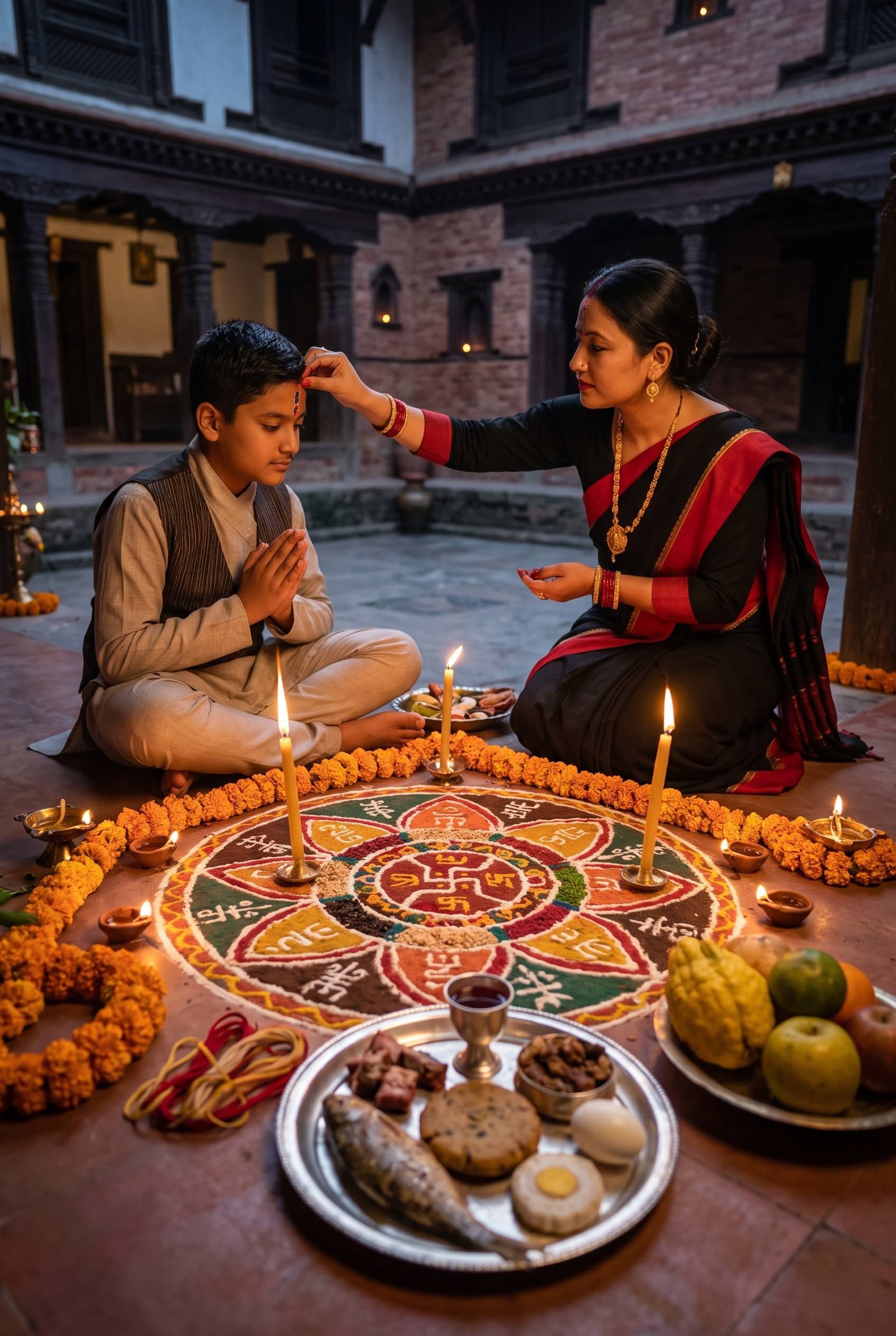
Same day, same tithi, same reason. But a Newar household does it differently, and the differences are not cosmetic. A mandala is drawn on the floor for the brother, the way one is drawn for every person on Mha Puja the day before. He is given a long wick, a sacred thread, a basket of fruit, and a five-item Sagan in which every item stands for an element.
This page covers the Newar observance. For the seven coloured tika, the oil circle, and the Yamaraj story that the day shares across Nepal, see Bhai Tika.
| Attribute | Description |
| Nepal Bhasa name | Kija Puja (किजा पूजा) |
| What kija means | Younger brother |
| Known elsewhere as | Bhai Tika |
| Tithi | Kartik Shukla Dwitiya |
| Date in 2083 BS | Kartik 25, Wednesday 11 November 2026 |
| Which day of Swanti | The fifth and last |
| Kept by | Newar families |
| Centre of the ritual | A mandala drawn for the brother, as on Mha Puja |
| Given to the brother | Khelu itaah, kwakha, tahsibwa and the Sagan |
| The day before | Mha Puja and the Nepal Sambat new year |
| Public holiday | Yes, inside the Tihar holiday block |
Kartik 25, 2083. That is Wednesday 11 November 2026.
Kija Puja falls on Kartik Shukla Dwitiya, the second day of the bright fortnight of Kartik, which is the fifth and final day of the festival.
| Bikram Sambat | Nepali Date | English Date | Day |
| 2082 | Kartik 6 | 23 October 2025 | Thursday |
| 2083 | Kartik 25 | 11 November 2026 | Wednesday |
| 2084 | Kartik 14 | 31 October 2027 | Sunday |
| 2085 | Mangsir 3 | 18 November 2028 | Saturday |
The date moved nineteen days later in the Nepali calendar this year because of Adhik Jyeshtha Maas, the extra lunar month that ran from 17 May to 15 June 2026.
Newar households do not call the festival Tihar. They call it Swanti, and it runs for five days with its own name for each one.
| Day | Nepal Bhasa Name | What it Honours |
| 1 | Kwah Puja | The crow |
| 2 | Khicha Puja | The dog |
| 3 | Sa Puja | The cow, with Laxmi Puja the same day |
| 4 | Mha Puja | The self, with the Nepal Sambat new year |
| 5 | Kija Puja | The brother |
The names follow the same sequence as the wider festival, but the emphasis differs. Of the five, Newar households keep Laxmi Puja, Mha Puja and Kija Puja as the three central days, and those three run back to back at the end.
That ordering is worth noticing. The day before a Newar sister worships her brother, the whole family has sat in a row and worshipped **themselves**. Kija Puja follows Mha Puja and uses the same ritual grammar.
If you know Bhai Tika, here is what changes in a Newar house.
This is the main difference. On Kija Puja, a mandala is drawn on the floor for the brother, built the same way as the mandaps drawn for everyone on Mha Puja the day before.
He sits behind it, and the mandala is worshipped along with him. So the brother is not simply receiving a tika. He is being given the same treatment the whole household gave itself twenty-four hours earlier.
Bimiro and all kinds of fruit are placed on the mandala.
The sister gives her brother a khelu itaah (खेलु इता:), the extra-long burning wick.
It is the same object used in Mha Puja and it carries the same meaning: a long life, and light given outward rather than kept. Here it is given specifically from sister to brother.
A kwakha (क्वखा), the sacred thread, is given to the brother.
A basket of fruit is presented, including **tahsibwa (त:सिब्व)**, the citron, which stands for long life and good fortune.
The Sagan is the auspicious set of food, and in the Newar tradition it is five items, each standing for an element.
| Item | Element |
| Wine | Light |
| Meat | Earth |
| Fish | Water |
| Lentil cake | Air |
| Egg | Sky |
That mapping is the part most people do not know. The Sagan is not simply a nice plate of festival food. It is a set of five things chosen to stand for the five elements, handed over together, which is why the items do not vary and why all five are present even when the portions are small.
Everything underneath is the same, and it is worth saying so plainly.
The tithi is the same, Kartik Shukla Dwitiya. The story is the same: Yamaraj staying with his sister Yamuna, and the boon that whoever takes tika from a sister's hand will not be taken by death until the oil dries and the makhamali withers. The purpose is the same: a sister asking for her brother's long life, and a brother answering with a gift and a blessing.
Newar households give tika, garland, and oil as well. The mandala, the itaah, the kwakha and the five item Sagan are added on top of that, not instead of it.
For the sahit, the seven colours, the oil circle, and the Yamaraj story in full, see Bhai Tika.
| Day | Newar Name | Also Known As | Nepali Date | English Date |
| 1 | Kwah Puja | Kaag Tihar | Kartik 21 | Saturday 7 November 2026 |
| 2 | Khicha Puja | Kukur Tihar, with Laxmi Puja this year | Kartik 22 | Sunday 8 November 2026 |
| 3 | Sa Puja | Gai Goru Puja | Kartik 23 | Monday 9 November 2026 |
| 4 | Mha Puja | With Nepal Sambat 1147 and Govardhan Puja | Kartik 24 | Tuesday 10 November 2026 |
| 5 | Kija Puja | Bhai Tika | Kartik 25 | Wednesday 11 November 2026 |
Kartik 25 in 2083 also carries Mahaguru Falgunanda Jayanti, a holiday for followers of the Kirat religion.
When is Kija Puja 2083?
Kartik 25, 2083, which is Wednesday, 11 November 2026.
What does Kija Puja mean?
Kija means younger brother in Nepal Bhasa, and puja means worship. Kija Puja is the worship of the brother.
Is Kija Puja the same as Bhai Tika?
It is the same day, the same tithi, and the same reason. Kija Puja is the Newar form of it, and a Newar household adds a mandala, a khelu itaah, a kwakha thread, a basket of fruit, and a five-item Sagan to what is done elsewhere.
Which day of the festival is Kija Puja?
The fifth and last.
What is Swanti?
The Newar name for Tihar. It runs five days: Kwah Puja for the crow, Khicha Puja for the dog, Sa Puja for the cow, Mha Puja for the self, and Kija Puja for the brother.
Which three days do Newar households keep most fully?
Laxmi Puja, Mha Puja, and Kija Puja, which run back-to-back at the end of Swanti.
What is drawn on the floor for Kija Puja?
A mandala for the brother, made the same way as the mandaps drawn for every family member on Mha Puja the day before. Bimiro and other fruit are placed on it.
What is a khelu itaah?
The extra long burning wick. It stands for a long life and for giving light outward. The sister gives one to her brother, and it is the same object used in Mha Puja.
What is kwakha?
The sacred thread given to the brother during the ritual.
What is tahsibwa?
The citron fruit, presented in a basket, standing for long life and good fortune.
What is in the Newar Sagan?
Five items, each standing for an element: wine for light, meat for earth, fish for water, lentil cake for air, and egg for sky.
Why are there five items in the Sagan?
Because each one stands for one of the five elements. That is why the set does not vary and why all five are present even in small portions.
Does Kija Puja use the seven coloured tika?
Newar households give tika, garland and oil like everyone else, with the Newar additions on top. For the seven colours, the oil circle and the sahit, see the Bhai Tika page.
What is the story behind the day?
Yamaraj, the god of death, stayed with his sister Yamuna through the five days. On the last day, she worshipped him, and he granted that whoever takes tika from a sister's hand on this day will not be taken by death until the oil line dries and the makhamali flower withers.
What happens the day before Kija Puja?
Mha Puja, the worship of the self, and the start of the Nepal Sambat new year.
Is Kija Puja a public holiday?
Yes. In 2083, it falls on Kartik 25, inside the Tihar holiday block that runs Kartik 22 to Kartik 26.
What else falls on Kartik 25 in 2083?
Bhai Tika, which is the same observance under its wider name, and Mahaguru Falgunanda Jayanti, a holiday for followers of the Kirat religion.
Which Nepal Sambat year began this Swanti?
Nepal Sambat 1147, which began on Kartik 24, the day before Kija Puja.