
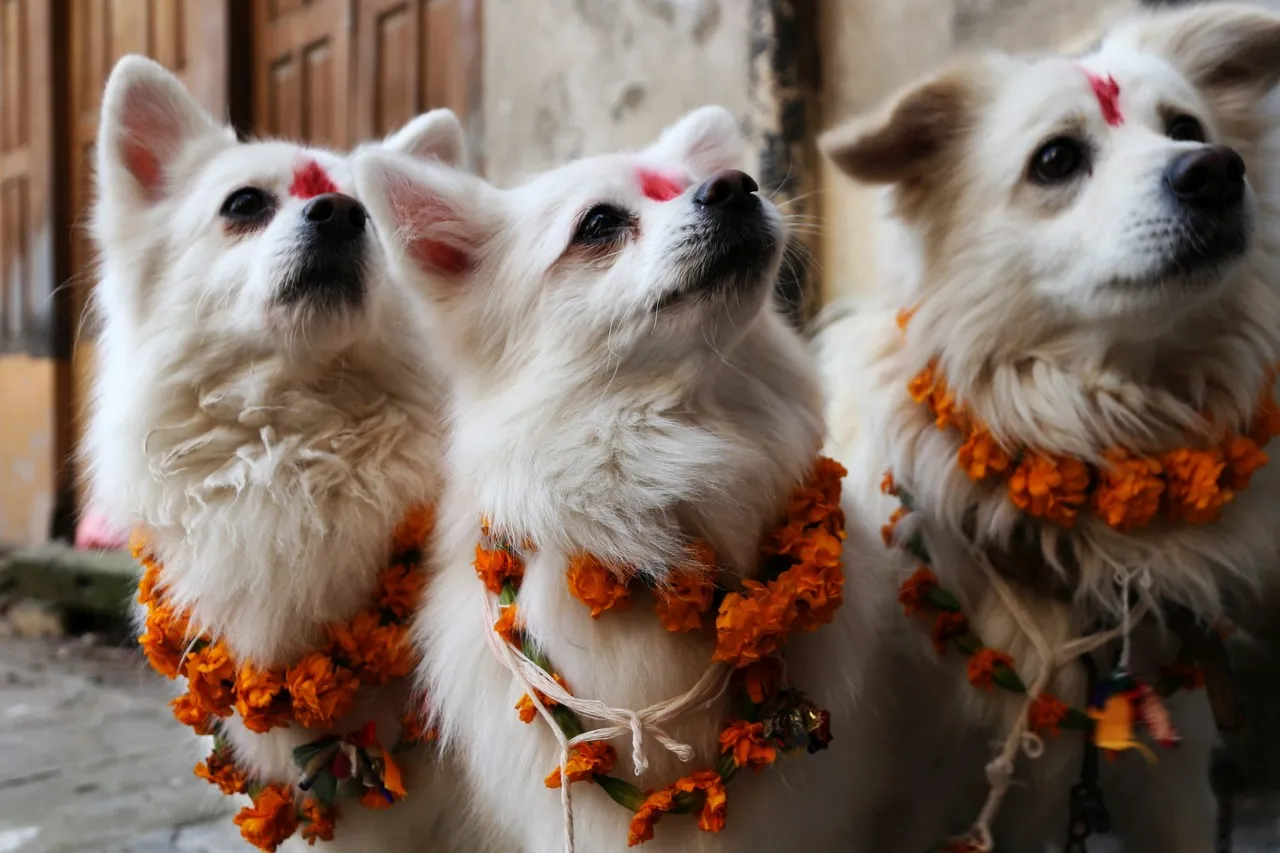
Kukur Tihar 2083 falls on Kartik 22. That is Sunday, 8 November 2026.
For one day in Kartik, the dog stops being an animal that lives around the house and becomes a guest in it. A red tika goes on its forehead. A marigold garland goes around its neck. A plate of good food is put down in front of it, and for that day nobody chases it away from the door.
It happens to house dogs, to guard dogs, to police dogs and to street dogs. A Nepali child will garland the family dog in the morning and then go out with a handful of leftover sel roti looking for the dogs on the corner. That is the part of the festival foreigners find hardest to believe, and it is the part Nepalis think least remarkable.
In Nepali the day is कुकुर तिहार. It is the second day of Tihar, and it falls on Kartik Krishna Chaturdashi.
|
Nepali name |
कुकुर तिहार (Kukur Tihar) |
|
Also called |
Kukur Puja, the dog festival |
|
Tithi |
Kartik Krishna Chaturdashi |
|
Date in 2083 BS |
Kartik 22, Sunday 8 November 2026 |
|
Which day of Tihar |
The second |
|
What is given |
Red tika, a marigold garland, and a plate of good food |
|
Who receives it |
House dogs, guard dogs, police dogs and street dogs alike |
|
Why the dog |
It guards the gate of Yama, the god of death |
|
Also on this day |
Narak Chaturdashi, and in 2083 also Laxmi Puja |
|
Public holiday |
In 2083, it falls on the first day of the Tihar holiday block |
Kartik 22, 2083. That is Sunday, 8 November 2026.
Normally Kukur Tihar has a day of its own, sitting between Kaag Tihar and Laxmi Puja. In 2083, it does not.
Digital Patro's calendar marks Kukur Tihar, Narak Chaturdashi and Laxmi Puja all on Kartik 22. That happens when the Chaturdashi and Aunsi tithis fall across the same sunrise, and the festival compresses.
In practice, the day splits in two. The dogs are worshipped in the morning and through the daytime. The house is then cleaned and lit, and Laxmi is worshipped in the evening at the announced sahit. Two festivals, one date, and a busy household in between.
If you are planning anything around Tihar this year, do not assume Kukur Tihar has its own separate day.
|
Bikram Sambat |
Nepali date |
English date |
Day |
|---|---|---|---|
|
2082 |
Kartik 3 |
20 October 2025 |
Monday |
|
2083 |
Kartik 22 |
8 November 2026 |
Sunday |
The gap is larger than usual because of Adhik Jyeshtha Maas, the extra lunar month in 2083, which pushed festivals after it about nineteen days later instead of eleven days earlier.
There are three things, and they are the same three things everywhere in the country.
A red tika is put on the dog's forehead, the same way a person receives one. It marks the dog as having been worshipped, and for the rest of the day people who see it know the household has done its puja.
A garland of marigold, called a malla, goes around the dog's neck. Marigold is the flower of Tihar, and it is everywhere in Kartik, grown in pots on roofs and sold in heaps at every junction in the weeks before the festival.
The garland is the image that travels. It is the reason photographs of Kukur Tihar end up in newspapers on the other side of the world.
Then the dog is fed, properly and generously. Meat, eggs, milk, sel roti, whatever the house has and would serve a guest.
This is the part that matters most to the dog, and arguably the part that matters most in the ritual. The tika and the garland are the acknowledgement. The food is the thanks.
The dog is not being thanked only for being loyal. There is a specific reason it holds this position in the festival, and it goes back a long way.
Tihar is also called Yamapanchak, the five days of Yama, the god of death. Each of the first days honours a creature connected to him. The crow is his messenger, so Kaag Tihar opens the festival. The dog guards his gate, so Kukur Tihar follows.
In the Rigveda, in the section known as the Yamasukta, two dogs guard the entrance to Yama's realm. They are named Sharvara, which means spotted or variegated, and Shyama, which means dark. They are the children of Sarama.
They are described as four-eyed, and the dead have to get past them before Yama will judge them.
In Nepal, the belief that follows from this is direct and practical. The dog is Yamaraj's messenger and Dharmaraj's gatekeeper. Honour the dog in this life, and when you arrive at that gate after death, the dog at it will show you the way through rather than block it.
That is what a household is doing when it garlands a dog on Kartik. It is not only saying thank you. It is making an arrangement.
There is a second connection. The dog is the vahana of Bhairav, the fierce form of Shiva.
This matters in Nepal more than it might elsewhere, because Bhairav is everywhere in the Kathmandu Valley. Kaal Bhairav stands in Kathmandu Durbar Square; Bhairav temples and masks are all over the old towns, and Bhairav is carried in jatras through the year. His mount being a dog puts the animal inside the everyday religious landscape of the country, not just in an old text.
At the end of the epic, Yudhishthira makes the final journey towards heaven. One by one, his brothers and Draupadi fall on the way. A dog that has followed him the whole distance keeps walking beside him, and it is the only one left when he reaches the gate.
He is told he may enter, but the dog may not. He refuses. He says he will not abandon a creature that has been loyal to him, even for heaven.
The dog then reveals itself. It has been a god in disguise all along, and the whole thing was a test of his character. He passes it, and the gate opens.
It is a story about loyalty running in both directions. The dog was loyal to the man, and the man had to prove he would be loyal back.
Kukur Tihar is not the only thing happening on this tithi. Narak Chaturdashi falls on the same day.
Narak means hell. The day is about cleansing and about avoiding that destination. The observances are a ritual bath and deep daan, the offering of lamps, which is why the lamps of Tihar are already appearing on this night before Laxmi Puja proper.
The two observances sit together naturally. One honours the dogs at the gate of the god of death. The other asks that when you reach that gate, you are sent the right way. They are the same concern approached from two directions.
The best-known public Kukur Tihar in the country is not in a temple. It is at the Central Police Dog Training Centre.
Every year the Nepal Police hold a formal Kukur Tihar for the trained dogs used in crime control and investigation. The dogs are worshipped, garlanded, given tika and fed their favourite food, in a ceremony that is open to photographers and widely covered.
It has become the image of the day. A working dog in a marigold garland, sitting beside a uniformed handler, is on the front of Nepali newspapers every Kartik.
The Nepal Army and other security agencies hold their own versions for their dog units as well.
This is the part of Kukur Tihar that is genuinely unusual, and it is worth being clear about what does and does not happen.
Nepal has a large street dog population. Most of the year these animals are ignored, chased off, or worse. On this one day, a great many of them are garlanded and fed by people who have no relationship with them at all.
Children go out with food. Shopkeepers put plates down outside. Animal welfare organisations in Kathmandu, Pokhara and other cities run feeding drives, vaccination and sterilisation camps, and use the day to get attention for work they do all year.
Nobody in Nepal would claim this fixes anything. A street dog that is garlanded on Kartik 22 is still a street dog on Kartik 23. But the day does two things. It puts the animals in front of people, and it makes the point, once a year and in public, that they are not outside the moral circle.
Kukur Tihar has had more international coverage than almost any other Nepali observance.
The reason is straightforward. Most countries have no ritual at all for thanking an animal, and very few have one that extends to strays. Photographs of garlanded street dogs travel easily and need no explanation, and they get picked up by international media and animal welfare organisations every year.
There is a small irony in this. Inside Nepal, Kukur Tihar is a quiet, ordinary morning in a five-day festival, and the big day is the Laxmi Puja that follows it. Outside Nepal, it is the day people have heard of.
A few practical points, because a lot of the food people offer is not good for the animal receiving it.
Skip the sweets. Chocolate is toxic to dogs. Heavily sweetened and heavily spiced food is not good for them either, so mithai and masala-rich leftovers are a poor choice even though they are what is in the house during Tihar.
Good things to give. Plain meat, eggs, milk, curd, plain rice, and plain sel roti are all fine and all festive enough.
Watch the garland. Dogs chew. A garland left on an unsupervised dog can end up eaten, so take it off once the photographs are done.
Go easy with the tika. Use a small amount, keep it away from the eyes and nose, and do not press a frightened animal.
Approach street dogs carefully. A dog that does not know you may be nervous, especially in a crowd of children. Put the food down and let it come to you rather than reaching over its head to garland it first.
Remember the noise. Tihar means firecrackers, and dogs find them distressing. If you have a dog at home, give it a quiet room on Laxmi Puja night. Honouring a dog in the morning and terrifying it after dark is not much of a festival for the dog.
|
Day |
What it is |
Nepali date |
English date |
|---|---|---|---|
|
Before |
Dhanteras and Dhanvantari Jayanti |
Kartik 20 to 21 |
6 to 7 November 2026 |
|
1 |
Kaag Tihar, the crow |
Kartik 21 |
Saturday 7 November 2026 |
|
2 and 3 |
Kukur Tihar, Narak Chaturdashi and Laxmi Puja |
Kartik 22 |
Sunday 8 November 2026 |
|
3 |
Gai Goru Puja |
Kartik 23 |
Monday 9 November 2026 |
|
4 |
Govardhan Puja, Mha Puja, Nepal Sambat 1147 begins |
Kartik 24 |
Tuesday 10 November 2026 |
|
5 |
Bhai Tika |
Kartik 25 |
Wednesday 11 November 2026 |
|
After |
Tihar holiday |
Kartik 26 |
Thursday 12 November 2026 |
The order is worth noticing. The crow, the dog, the cow, and the ox are all honoured before any person is. Bhai Tika, the only day about people, comes last.
When is Kukur Tihar 2083?
Kartik 22, 2083, which is Sunday, 8 November 2026.
Why is Kukur Tihar on the same day as Laxmi Puja this year?
Because the Chaturdashi and Aunsi tithis fall across the same sunrise in 2083, which compresses the festival. Digital Patro's calendar marks Kukur Tihar, Narak Chaturdashi, and Laxmi Puja all on Kartik 22.
Which day of Tihar is Kukur Tihar?
The second. It comes after Kaag Tihar and before Gai Goru Puja.
Which tithi does it fall on?
Kartik Krishna Chaturdashi.
What is done on Kukur Tihar?
Dogs are given a red tika on the forehead, a marigold garland around the neck, and a plate of good food.
Why are dogs worshipped in Nepal?
Because the dog guards the gate of Yama, the god of death. In the Rigveda, two four-eyed dogs named Sharvara and Shyama guard the entrance to Yama's realm. Honouring the dog in this life is believed to ease your passage through that gate after death.
Who are Sharvara and Shyama?
The two dogs that guard the entrance to Yama's realm, described in the Yamasukta section of the Rigveda. Sharvara means spotted, and Shyama means dark. They are the children of Sarama, and they are described as four-eyed.
Is the dog connected to any other god?
Yes. The dog is the vahana, or mount, of Bhairav, the fierce form of Shiva. This is a strong connection in the Kathmandu Valley, where Bhairav is worshipped widely.
Do the police celebrate Kukur Tihar?
Yes. The Nepal Police hold a formal ceremony at the Central Police Dog Training Centre for the trained dogs used in crime control and investigation. They are worshipped, garlanded, and fed their favourite food, and it is the most photographed Kukur Tihar in the country.
What is Narak Chaturdashi?
It falls on the same tithi as Kukur Tihar. Narak means hell, and the day is about cleansing and about avoiding that destination. It is observed with a ritual bath and with deep daan, the offering of lamps.
What should I not feed a dog on Kukur Tihar?
Chocolate, which is toxic to dogs, and heavily sweetened or heavily spiced food. Mithai and masala-rich leftovers are a poor choice even though they are what is around during Tihar.
What is safe to feed them?
Plain meat, eggs, milk, curd, plain rice, and plain sel roti.
Should I leave the garland on the dog?
No. Take it off once the photographs are done, because a dog left alone with a garland is likely to chew and swallow it.
How do I do this with a street dog I do not know?
Put the food down first and let the dog come to you. Do not reach over its head to garland it before it is comfortable, and do not force a frightened animal.
What about firecrackers?
Dogs find them distressing. If you have a dog at home, give it a quiet room on Laxmi Puja night.
Why is Kukur Tihar famous outside Nepal?
Because very few cultures have a ritual for thanking an animal, and almost none extend it to strays. Images of garlanded street dogs need no explanation and are picked up by international media every year.
Is Kukur Tihar a public holiday?
In 2083, it falls on Kartik 22, which is the first day of the Tihar holiday block running Kartik 22 to Kartik 26.
Why is Tihar called Yamapanchak?
Because the five days are connected to Yama, the god of death. The crow is his messenger, the dog guards his gate, and the last day, Bhai Tika, comes from Yamaraj visiting his sister Yamuna.
When is Kaag Tihar 2083?
Kartik 21, Saturday, 7 November 2026, the day before.
When is Bhai Tika 2083?
Kartik 25, Wednesday, 11 November 2026.