Bijaya Dashami 2083 falls on Wednesday, Kartik 4 (21 October 2026),
This is the tenth day of Dashain and the biggest day in the Nepali year. It is the day elders put red tika on your forehead and jamara behind your ear, and bless you.
Everything in the nine days before this leads up to it. The jamara was sown on Ghatasthapana, ten days earlier. The house was cleaned. People travelled home from every district and from abroad. All of it is for this one morning.
In Nepali, the day is called विजया दशमी. Most people simply call it टीका, the tika day.
|
Nepali name |
विजया दशमी (Bijaya Dashami) |
|
Also called |
Dashain Tika, Dashami, Vijayadashami |
|
Newar name |
Mohani, or Mohani Nakha |
|
Tithi |
Ashwin Shukla Dashami |
|
Date in 2083 BS |
Kartik 4, Wednesday 21 October 2026 |
|
Which day of Dashain |
Day 10 of 15 |
|
Tika time |
A fixed saita announced every year by the Nepal Panchanga Nirnayak Vikas Samiti |
|
What the tika is made of |
Uncooked rice, curd and red abir or sindoor |
|
What is given |
Tika, jamara, a blessing, and dakshina from elders |
|
Who gives it |
Elders to those younger than them. Never the other way round |
|
Tika window |
From this day until Kojagrat Purnima, about five more days |
|
Public holiday |
Yes. Part of the Dashain holiday block, Asoj 31 to Kartik 6 |
|
Also on this day |
Devi Visarjan |
|
Dashain ends |
Kojagrat Purnima, Kartik 9, Monday, 26 October 2026 |
Kartik 4, 2083. That is Wednesday, 21 October 2026.
Two things to note about this year.
That is because of Adhik Jyeshtha Maas, an extra lunar month that ran from 17 May to 15 June 2026. In a normal year, festivals come about eleven days earlier than the year before. In a year with an extra month, they come about nineteen days later instead. So this year the date moved in the opposite direction to what most people expect.
|
Bikram Sambat |
Nepali date |
English date |
Day |
|
2081 |
Asoj 26 |
12 October 2024 |
Saturday |
|
2082 |
Asoj 16 |
2 October 2025 |
Thursday |
|
2083 |
Kartik 4 |
21 October 2026 |
Wednesday |
Tika is not given whenever the family is ready. It starts at a fixed moment.
The Nepal Panchanga Nirnayak Vikas Samiti announces the tika saita every year. It goes out on the news and the radio, and the whole country works to it. Families sit down before it, and the eldest person in the house gives the first tika at that moment.
This is the part people get wrong. The saita is not a fixed hour. It moves.
|
Bikram Sambat |
Tika date |
Saita |
|
2078 |
Asoj 29 |
10:02 in the morning |
|
2081 |
Asoj 26 |
11:36 in the morning |
|
2082 |
Asoj 16 |
11:53 in the morning |
|
2083 |
Kartik 4 |
Time/Shait: 10:26 AM |
Between 2078 and 2082, the saita moved by almost two hours. You cannot plan this year's tika around last year's.
Check Digital Patro on the morning of Kartik 4 for the 2083 saita.
Nepalis abroad do not use the Kathmandu time. A separate tika saita is worked out for each country, because the auspicious moment falls at a different local hour depending on where you are.
Every year the almanac publishers and the news put out a country-by-country list covering India, the Gulf states, Malaysia, Korea, Japan, Australia, the United Kingdom, Europe, the United States and Canada. If you are giving tika outside Nepal, use your own country's time and not Nepal's.
Most families cannot get everyone in one room at one minute. That is normal, and it is allowed.
The saita is when tika starts. After that, it continues all day, and then for several more days. Nobody is doing it wrong by arriving in the afternoon.
The Dashain tika is red, and it is made fresh at home on the day.
|
Item |
Nepali name |
What it does |
|
Uncooked rice |
अक्षता (akshata) |
The body of the tika. Whole grains, not broken |
|
Curd |
दही (dahi) |
Binds it and makes it stick |
|
Red powder |
अबिर or सिन्दूर |
Gives it the colour |
The three are mixed in a plate until the rice turns red and holds together. That plate is the tika thali, and it sits at the centre of the day.
Alongside the tika mixture, a full thali usually carries:
The jamara, cut that morning
A lit oil lamp
Flowers, often marigold
Fruit, sweets and sagun
Money for dakshina
A coconut
Sometimes a small mirror, so you can see the tika after it is given
The tika goes on the forehead, between the eyebrows and slightly up. The elder presses it on with the thumb while saying the blessing.
A note on a common mistake. You will sometimes see the Dashain tika described as seven coloured. It is not. The Dashain tika is red. The only widely used tika of a different colour in Nepal is the black Mohani tika of the Newar community, described further down this page.
While giving tika, elders say a Sanskrit blessing. Most households use one of these two.
This is the one used most often. It asks for the qualities of figures from the epics.
> आयुर्द्रोणसुते श्रियं दशरथे शत्रुक्षयं राघवे।
> ऐश्वर्यं नहुषे गतिश्च पवने मानं च दुर्योधने॥
> शौर्यं शान्तनवे बलं हलधरे सत्यं च कुन्तीसुते।
> विज्ञानं विदुरे भवतु भवतां कीर्तिश्च नारायणे॥
|
Asked for |
Like whom |
|
Long life |
Ashwatthama, son of Drona |
|
Wealth |
King Dasharatha |
|
Defeat of enemies |
Rama |
|
Prosperity |
Nahusha |
|
Speed |
Pawan, the wind |
|
Honour |
Duryodhana |
|
Courage |
Bhishma, son of Shantanu |
|
Strength |
Balaram, the plough bearer |
|
Truthfulness |
Yudhishthira, son of Kunti |
|
Knowledge |
Vidura |
|
Fame |
Narayan |
Read together, it is a wish that the person receiving tika carries the best quality of each of these figures through the year.
Many families use this one when giving tika to women and girls, since it calls on the goddess directly.
> ॐ जयन्ती मङ्गला काली भद्रकाली कपालिनी।
> दुर्गा क्षमा शिवा धात्री स्वाहा स्वधा नमोऽस्तु ते॥
It names forms of Durga: victory, auspiciousness, Kali, Bhadrakali, Kapalini, Durga, forgiveness, Shiva, the sustainer.
You will see small differences in spelling and wording between families, books, and districts. Some say सत्यं च कुन्तीसुते and some say दानं च कुन्तीसुते. Both are in circulation.
Nobody has to say it perfectly for the tika to count, and plenty of families simply say their blessing in Nepali, in their own words, naming what they want for that person.
Jamara is the pale yellow sprout of barley and maize that has been growing in the Dashain Ghar since Ghatasthapana.
It was sown on day one on a bed of damp sand. It was kept in a dark room for ten days, which is why it is yellow and not green. It was watered every day and worshipped every day.
In the morning, it is cut or pulled, and it goes with the tika. Men and boys usually get it behind the ear. Women often have it tucked into the hair.
Families who have extra give it away. Households with a good crop of jamara share it with neighbours, friends and relatives who did not grow their own. Shops sell it too, for people living in flats who had no room for a Dashain Ghar.
Families who have extra give it away. Households with a good crop of jamara share it with neighbours, friends and relatives who did not grow their own. Shops sell it too, for people living in flats who had no room for a Dashain Ghar.
People wear the jamara for the rest of the day and often keep it after that. It gets tucked above a doorway, into a shop shutter, behind a vehicle mirror, or into a wallet, and stays there until it dries out.
At the end of the festival, the jamara, along with the kalash water and the flowers, is given to flowing water. That is part of Devi Visarjan, which falls on this same day, when the goddess who has been living in the Dashain Ghar for ten days is formally sent off.
Jamara is not one of the fulpati plants. The nine plants of the Nawapatrika arrive on Fulpati, day seven. Jamara has its own day, day one, and its own job, this one.
Along with the tika and jamara, elders give dakshina. Usually this is money.
There is no fixed amount. It depends on the family and on what people can afford. What matters is the direction. It goes from the elder to the younger, the same way the blessing does.
For children, this is the best part of Dashain. Most Nepali children spend the day keeping count of what they collected at each house, and the totals get compared afterwards.
This is also why new notes matter. Nepal Rastra Bank puts fresh notes into circulation before Dashain every year specifically so that people have clean money to give as dakshina. Bank counters and exchange points get long queues in the days before tika, and the amounts involved run into billions of rupees.
The rule is simple. Tika goes downward, from older to younger. It never goes the other way.
So in practice:
You receive tika from your parents, grandparents, uncles, aunts, and older siblings.
You give tika to your children, nieces, nephews, and younger siblings and cousins.
Your spouse's elders give you tika too.
The eldest person in the house gives the first tika of the day, at the saita.
This is why tika takes days rather than hours. You have to go to every elder's house. People move from home to home across the valley or across districts, collecting tika from each side of the family.
A married daughter usually receives tika at her husband's house first, then goes to her maiti, her parents' home, in the days after. In many families, the maiti visit is the part people look forward to most.
There is no tika between equals. Two cousins of the same age do not give each other tika. They greet each other and move on.
This is the question that comes up in every family, and it is rarely explained properly.
A household in jutho or sutak, that is, ritual impurity from a death or a birth, does not take part in the tika. The family does not give tika, does not receive it, and does not do the household worship until the mourning period is finished.
|
Who died |
How long the restriction lasts |
|
Mother, father or husband |
One year |
|
Wife |
Three months |
|
Brother or son |
Forty-five days |
|
Relatives within seven generations (sapindi) |
One month |
|
More distant relations |
One to three days |
So a family that lost a parent during the year does not do tika at all during Dashain. Relatives and neighbours still visit, but they come to sit with the family rather than to give tika.
A birth in the house brings sutak. The mother has it for about thirty days. Others in the household have it for about ten days. During that period, the same restriction applies.
The household resumes normal worship only after the purification rites are done.
Ask the eldest person in your family or your family priest. The rules vary by community and by how closely related you are, and a neighbour's answer is not always your answer.
Tika does not stop at the end of Bijaya Dashami.
It continues until Kojagrat Purnima, the full moon that closes Dashain. In 2083, it falls on Kartik 8 and Kartik 9, which are 25 and 26 October 2026.
This is a practical arrangement. Families are spread out. Some people cannot travel on the day itself. Anyone who could not get to their elders on Kartik 4 has about five more days to do it.
Offices and banks reopen on Kartik 7, so most of the visiting happens on Kartik 5 and 6 while the holiday is still running.
Two stories sit behind the day. Both are about the same thing.
Mahishasura was a demon who had a boon that no man and no god could kill him. He took the form of a buffalo and could not be beaten, and he drove the gods out.
The gods put their powers together and created Durga, who was neither man nor god. She fought him for nine nights. On the tenth day she killed him.
Those nine nights are Navaratri, the nine days of Dashain before this one. The tenth day, the day of the victory, is Bijaya Dashami. Bijaya means victory. Dashami means the tenth.
In the other story, Rama defeated Ravana, the demon king of Lanka, and brought back Sita. Rama worshipped Durga before the battle and won on the tenth day.
This is the version that dominates in Madhesh and across India, where the day is called Dussehra and effigies of Ravana are burned in the evening.
Both stories say the same thing. Good wins over evil, and it takes time and effort to get there.
When an elder puts the tika on you, they are passing that victory on. The blessing is for strength, long life, and protection through the year ahead.
That is the reason people travel across the country for a mark on the forehead. It is not the mark. It is the person giving it, and the fact that they are still there to give it.
Bijaya Dashami is not the same festival everywhere in Nepal, and the clearest difference is in the Kathmandu Valley.
For Newar communities, the festival is called Mohani, or Mohani Nakha. It runs over the same days, but it is built around the family's own lineage deity and around Taleju Bhawani, the goddess of the old Malla kings.
The Mohani tika is black, not red.
It is made from soot. For nine days, an oil lamp is kept burning in an earthen vessel in the worship room, and the smoke collects as a black deposit. On Mohani, that soot is what goes on the forehead of family members.
The name itself points to it. Mohani carries the sense of enchanting or drawing someone under your influence, and the black tika is understood to carry that power.
This is the one widely used tika in Nepal that is not red, which is worth knowing if you see photographs from Bhaktapur or Patan and wonder why the tika looks different.
Mohani has a public side that Dashain elsewhere does not.
Paya, the sword procession, goes through the old towns, with participants carrying khadga, the curved ceremonial swords. Patan has the Mahalaxmi Paya. Bhaktapur has the Khadga Jatra.
In Bhaktapur, Mohani is not considered complete until the Khadga Jatra finishes at Taleju at midnight.
Bhaktapur is also home to the Nawa Durga masked dances, among the best-known masked dance traditions in Nepal. During Mohani, all the Nawa Durga deities are worshipped, and the dancers take on the forms of the goddess and move through the town.
Dashain is not observed in the same way, or at all, by every community in Nepal. Several Janajati groups keep their own festivals in this season instead, and some do not mark Dashain. Tharu, Magar, Gurung, Rai and Limbu families each have their own practices around the period.
If the tika day means something different in your community, that is part of the picture, not an exception to it.
The President receives tika and jamara at Sheetal Niwas from the chief priest of the Dashain Ghar at Hanuman Dhoka, at the auspicious hour.
The President receives tika and jamara at Sheetal Niwas from the chief priest of the Dashain Ghar at Hanuman Dhoka, at the auspicious hour.
After that, the gates open and the President gives tika to the public. Ministers, officials, the diplomatic corps and ordinary people queue for it. The former King also gives tika to the public at his residence, and long queues form there too.
This used to be the King's role. The monarchy ended in 2008, and the ceremony carried on, with the head of state in the same place. It sits alongside the twenty-one-gun salute on Fulpati as one of the royal observances that simply transferred to the republic.
People often associate Dashain with animal sacrifice and place it on the tika day. That is not where it belongs.
The sacrifices happen earlier, on Maha Ashtami and Maha Navami, days eight and nine. Kalratri, the night of Ashtami, is the heaviest of these, and the Kot Puja at Hanuman Dhoka takes place on Navami.
By the time Bijaya Dashami arrives, that part of the festival is over. Dashami is a day of tika, blessings, visiting, and eating.
It is also worth saying that the practice has been shrinking. A growing number of Nepali households now mark Ashtami and Navami without sacrifice, offering coconut, pumpkin, sugarcane, or fruit instead.
Feasting. This is the biggest meal of the year in most Nepali homes. Meat, sel roti, and whatever the household has saved up for. Prices climb through the week before Dashain in every market in the country.
New clothes. Children and often the whole family wear new clothes on this day. In many households, this is the one guaranteed new outfit of the year.
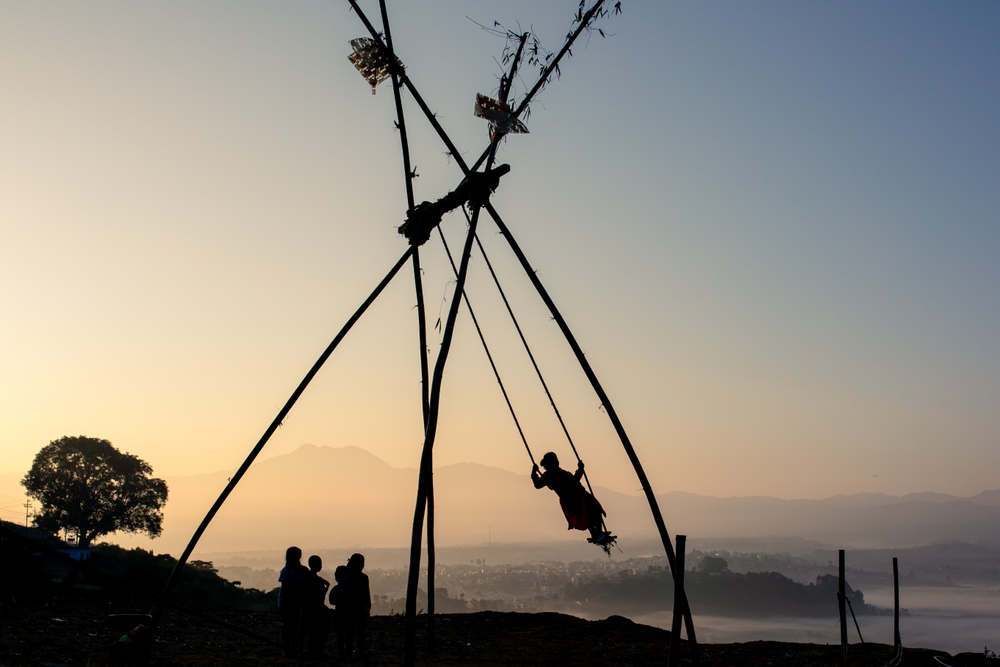
Linge ping. The tall bamboo swing put up in villages and neighbourhoods before Dashain. Children queue for it all through the festival. Tradition says it should stay up through Tihar and come down after, and that everyone should leave the ground at least once during Dashain.
Kites. Kite flying belongs to this season. The common explanation is that the kites carry a message to the gods to stop the monsoon rain.
Cards. Families play cards through the holiday. It is one of the few times of year when it is done openly and nobody minds.
Visiting. From this day until Kojagrat Purnima, the roads are full of people going between houses.
Dashain is the largest spending event in the Nepali year, and it shapes the whole economy around it.
Festival allowance. Government offices and most private employers pay a chadparva kharcha, a festival allowance, before Dashain. The usual benchmark is one month's salary. For many households, this is what the whole festival is paid for.
Remittance peak. Money sent home by Nepalis working abroad rises sharply in the weeks before Dashain, and it arrives in time for tika.
New notes. Nepal Rastra Bank releases fresh notes for dakshina, and exchange counters run queues for days.
Share of the year's spending. Reported estimates put Dashain at close to a third of annual household spending for many Nepali families, covering clothes, meat, travel and gifts in a single fortnight.
This is why the festival allowance arriving late is a real news story in Nepal every year, and why any delay in salaries in the weeks before Dashain causes genuine hardship.
|
Day |
What it is |
Nepali date |
English date |
|
1 |
Ghatasthapana, Navaratri begins |
Asoj 25 |
Sunday 11 October 2026 |
|
2 to 6 |
Navaratri days, working days |
Asoj 26 to 30 |
12 to 16 October |
|
7 |
Fulpati, Dashain holiday begins |
Asoj 31 |
Saturday 17 October 2026 |
|
8 |
Kalratri and Maha Ashtami Vrata |
Kartik 1 |
Sunday 18 October 2026 |
|
8 |
Dashain Bida |
Kartik 2 |
Monday 19 October 2026 |
|
9 |
Maha Navami |
Kartik 3 |
Tuesday 20 October 2026 |
|
10 |
Bijaya Dashami, tika and jamara |
Kartik 4 |
Wednesday 21 October 2026 |
|
11 |
Papankusha Ekadashi, tika continues |
Kartik 5 |
Thursday 22 October 2026 |
|
12 to 14 |
Tika continues |
Kartik 6 to 8 |
23 to 25 October |
|
15 |
Kojagrat Purnima, Dashain ends |
Kartik 9 |
Monday 26 October 2026 |
Yes. It sits inside the main Dashain holiday block, which in 2083 runs from Asoj 31 to Kartik 6, that is, Fulpati through Dwadashi.
Government offices, banks and schools are closed for that whole stretch. Many private businesses close for longer. Offices reopen on Kartik 7, Thursday 22 October 2026.
Ghatasthapana on Asoj 25 is also a public holiday on its own, but the days between it and Fulpati, Asoj 26 to 30, are normal working days.
Bijaya Dashami and Dussehra fall on the same tithi, Ashwin Shukla Dashami. What happens on the day is different.
|
Nepal |
Most of India |
|
|
Name |
Bijaya Dashami |
Dussehra, Vijayadashami |
|
Main ritual |
Tika and jamara from elders |
Burning of Ravana effigies |
|
Central story |
Durga and Mahishasura |
Rama and Ravana |
|
Length of festival |
Fifteen days, ending at Kojagrat Purnima |
Usually ends on this day |
|
Jamara |
Central to the day |
Not part of it |
The dates can also differ by a day, because Nepali and Indian panchangas sometimes read the tithi boundary differently. For a Nepali household, the Nepali calendar date and the announced Nepali saita are the ones that apply.
In Madhesh, both patterns run together. Households give tika, and Ram Lila performances and Ravana effigy burnings take place in the evening.
When is Bijaya Dashami 2083?
Kartik 4, 2083. That is Wednesday, 21 October 2026.
What time is the Dashain tika in 2083?
At the time announced by the Nepal Panchanga Nirnayak Vikas Samiti for Kartik 4. The time changes every year. It was 11:36 in the morning in 2081 and 11:53 in 2082. Check Digital Patro on the morning of Kartik 4 for this year's time/Shait: 10:26 AM.
What if I miss the tika saita?
Nothing is lost. The saita is when tika starts. It continues all day, and then for about five more days until Kojagrat Purnima.
What is the tika saita in my country?
A separate saita is worked out for each country, because the auspicious moment falls at a different local hour. If you are abroad, use your own country's published time, not Nepal's.
Which day of Dashain is Bijaya Dashami?
The tenth day. It comes after Maha Navami and before the last five days of the festival.
What does Bijaya Dashami mean?
Bijaya means victory, and Dashami means the tenth day. It marks Durga's victory over Mahishasura on the tenth day after nine nights of battle.
What is the Dashain tika made of?
Uncooked rice, curd, and red abir or sindoor, mixed in a plate on the day.
Is the Dashain tika seven coloured?
No. It is red. The only widely used tika of another colour in Nepal is the black Mohani tika of the Newar community.
What is a tika thali?
The plate holding everything needed for the ritual: the tika mixture, jamara, a lamp, flowers, fruit, sweets, dakshina money and usually a coconut.
What is the Dashain tika mantra?
Most families use आयुर्द्रोणसुते श्रियं दशरथे शत्रुक्षयं राघवे, which asks for long life, wealth, courage, strength, truthfulness, knowledge and fame. For women and girls many families use ॐ जयन्ती मङ्गला काली भद्रकाली कपालिनी instead, which calls on the goddess directly.
Do you have to say the mantra in Sanskrit?
No. Many families say the blessing in Nepali, in their own words, and wording varies from house to house.
Who gives tika to whom?
Elders give tika to those younger than them, and never the other way round. The eldest person in the house gives the first tika at the saita.
Can I give tika to someone older than me?
No. Tika goes only downward, from older to younger. People of the same age do not give each other tika.
Who cannot take tika?
A household in jutho or sutak, that is mourning after a death or the period after a birth, does not give or receive tika. After the death of a mother, father, or husband, the restriction lasts a year, so that family does not do tika that Dashain at all.
How long is the restriction after a death?
One year for a mother, father, or husband. Three months for a wife. Forty-five days for a brother or son. About a month for relatives within seven generations. One to three days for distant relations. Ask your family elder or priest, because it varies by community.
Does a birth in the family stop tika?
Yes. Sutak from a birth lasts about thirty days for the mother and about ten days for others in the household.
What is jamara?
The pale yellow barley and maize sprout sown on Ghatasthapana, day one of Dashain. It grows for ten days in a dark room and is given with the tika on this day.
Why is jamara yellow?
Because it is grown without sunlight, it cannot turn green. That is done on purpose.
What do you do with the jamara afterwards?
Most people keep it, tucked above a door, in a shop shutter, behind a vehicle mirror, or in a wallet, until it dries. At the end of the festival, it goes to flowing water along with the kalash water and flowers.
What is dakshina?
The money elders give along with the tika and the blessing. There is no fixed amount.
Why do people want new notes for Dashain?
Because dakshina is better given in clean notes. Nepal Rastra Bank releases fresh notes before Dashain each year for this reason, and exchange counters get long queues.
How long can you receive tika?
Until Kojagrat Purnima, about five days after Bijaya Dashami. In 2083, that means up to Kartik 9, Monday, 26 October 2026.
Where does a married daughter receive tika?
Usually at her husband's house first, then at her maiti, her parents' home, in the days after.
Why is Dashain celebrated?
For Durga's victory over the demon Mahishasura after nine nights of battle, and for Rama's victory over Ravana. Both stand for good winning over evil.
Is animal sacrifice done on Bijaya Dashami?
No. The sacrifices belong to Maha Ashtami and Maha Navami, days eight and nine. By Dashami, that part of the festival is over.
What is Mohani?
The Newar name for the festival. It is built around the family lineage deity, Taleju Bhawani, and its tika is black rather than red.
Why is the Newar tika black?
It is made from soot collected over nine days from an oil lamp kept burning in an earthen vessel in the worship room.
What is Khadga Jatra?
A sword procession held in Bhaktapur during Mohani. In Bhaktapur, the festival is not considered complete until the Khadga Jatra finishes at Taleju at midnight. Patan has a similar procession called the Mahalaxmi Paya.
Is Bijaya Dashami a public holiday?
Yes. In 2083, the Dashain holiday runs from Asoj 31 to Kartik 6, and offices reopen on Kartik 7, Thursday, 22 October 2026.
Where does the President give tika?
At Sheetal Niwas. The President first receives tika from the chief priest of the Dashain Ghar at Hanuman Dhoka, then opens the gates and gives tika to the public. The former King also gives tika to the public at his residence.
What is Devi Visarjan?
It falls on the same day. It is the formal sending off of the goddess who has been worshipped in the Dashain Ghar since Ghatasthapana, and it is when the kalash and jamara are released to flowing water.
When is Ghatasthapana 2083?
Asoj 25, Sunday, 11 October 2026, ten days before tika.
When does Dashain end in 2083?
At Kojagrat Purnima, Kartik 9, Monday, 26 October 2026.
Why is Dashain in two Nepali months this year?
Because Dashain follows lunar tithis, not the Nepali solar months. In 2083, it starts in Asoj and its main days fall in Kartik.
Why is Dashain so late in 2026?
Because of Adhik Jyeshtha Maas, an extra lunar month that ran from 17 May to 15 June 2026. Festivals after it moved about nineteen days later instead of eleven days earlier.
Is Bijaya Dashami the same as Dussehra?
It is the same tithi. What happens differs. In Nepal, the day is about tika and jamara from elders. In most of India, it is about burning Ravana effigies, and the festival ends there rather than continuing for five more days.