
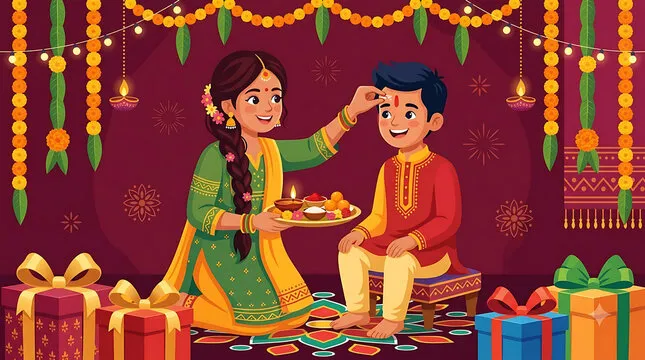
Bhai Tika 2083 falls on Kartik 25, Wednesday, 11 November 2026, the fifth and final day of Tihar.
Bhai Tika is the main day of Tihar, so many people simply call it Tihar or Tihar ko Tika (तिहारको टीका). When someone says they are "going home for Tihar", it is usually Bhai Tika they mean.
Bhai Tika (भाइटीका) is the day Nepal celebrates brothers and sisters. A sister seats her brother, pours a circle of oil and water around him and puts a five- or seven-coloured tika on his forehead. She then places a makhamali garland around his neck and feeds him sel roti, fruit and sweets. Her prayer is simple: that her brother lives a long, healthy life. He then gives her tika in return, along with a gift and his blessing.
The day comes from the story of Yamaraj, the god of death, and his sister Yamuna. That story is why oil and makhamali flowers are at the heart of the ritual.
For many families, this is the most important day of the year to be together. Buses out of the cities fill up, married sisters and brothers visit each other's homes, and Nepalis abroad gather by video call or at community events. Newar families celebrate the same day as Kija Puja, and in India it is known as Bhai Dooj.
This page has everything you need for the day: the date and sahit, the samagri list, a step-by-step puja vidhi, the meaning of the colours, the stories behind Bhai Tika, Deusi and Bhailo, gift ideas and wishes.
|
Nepali name |
भाइटीका |
|
Date in 2083 BS |
Kartik 25, Wednesday, 11 November 2026 |
|
Tithi |
Kartik Shukla Dwitiya (Yama Dwitiya) |
|
Day of Tihar |
Fifth and last |
|
Other names |
Tihar, Tihar ko Tika (तिहारको टीका), Kija Puja (Newar), Yama Dwitiya, Bhai Dooj (India) |
|
Who takes part |
Brothers and sisters, cousins, and anyone who takes a brother or sister by choice |
|
Main ritual |
Oil and water circle, five or seven coloured tika, makhamali garland, sagun |
|
Linked to |
Yamaraj, god of death, and his sister Yamuna |
|
Sahit 2083 |
Not announced yet; see below |
|
Public holiday |
Yes |
Bhai Tika falls on Kartik Shukla Dwitiya, the second day of the bright half of the month of Kartik. In 2083 BS, that day is Kartik 25, Wednesday, 11 November 2026.
Because it follows the moon, the date changes every year.
|
Year (BS) |
Nepali date |
English date |
Sahit |
|
2081 |
Kartik 18 |
Sunday 3 November 2024 |
11:37 AM |
|
2082 |
Kartik 6 |
Thursday 23 October 2025 |
11:39 AM |
|
2083 |
Kartik 25 |
Wednesday 11 November 2026 |
Not announced yet |
2083 had an extra lunar month, Adhik Jestha (17 May to 15 June 2026). Festivals after it moved about 19 days later than last year. That is why Bhai Tika falls on Kartik 25 this year, compared with Kartik 6 last year.
You can check any BS or AD date with our date converter, or see the full month on the Kartik 2083 calendar.
Tihar 2083 runs from Kartik 20 to Kartik 25 (6 to 11 November 2026), with an extra holiday on Kartik 26. Bhai Tika is the last day of the festival.
|
Nepali date |
English date |
What falls on the day |
|
Kartik 20 |
Friday 6 November |
Dhanteras, Yamadeepdan begins |
|
Kartik 21 |
Saturday 7 November |
Kag Tihar, Dhanwantari Jayanti |
|
Kartik 22 |
Sunday 8 November |
|
|
Kartik 23 |
Monday 9 November |
|
|
Kartik 24 |
Tuesday 10 November |
|
|
Kartik 25 |
Wednesday 11 November |
Bhai Tika, Kija Puja, Mahaguru Falgunanda Jayanti |
|
Kartik 26 |
Thursday 12 November |
The 2083 sahit for the Tihar tika has not been announced yet. The Nepal Panchanga Nirnayak Bikas Samiti announces it a few days before Bhai Tika. We will add it to this page and the Digital Patro app as soon as it is out.
For reference, the sahit was 11:39 AM in 2082 and 11:37 AM in 2081. Both fell in the late morning. The 2082 time was the Abhijit muhurta, the auspicious window around midday.
No. The Panchanga committee has said that tika can be given at any time during the day. The exact minute matters most for formal events, such as the President receiving tika. For a family at home, giving tika later in the day is completely fine.
If you live abroad, use the time published for your own city. Do not convert Nepal's time.
Nepali panchanga committees publish separate tika times for cities in many countries, including Australia, the UK, the USA, Canada, Japan, Korea and the Gulf. Each time is worked out for that city, so it is not the same as Nepal's time moved by the time difference.
Most Nepali families abroad keep the same date as Nepal and simply use their local sahit.
Bhai Tika comes from the story of Yamaraj, the god of death, and his sister Yamuna. A second, Kirat version tells of King Bali Hang and his sister Jamuna. Both stories end the same way: a sister's puja protects her brother from death.
Yamuna had long invited her brother Yamaraj to visit her. During the five days of Tihar he finally came. On the last day, Yamuna worshipped him, put tika on his forehead, gave him a garland and fed him.
Pleased, Yamaraj gave her a blessing: anyone who receives tika from their sister on this day will not die until the oil circle dries and the makhamali flower wilts.
That is why the oil circle and the makhamali garland are at the centre of Bhai Tika. Oil dries slowly, and makhamali does not wilt for a long time.
It is also why the five days of Tihar are called Yamapanchak (यमपञ्चक), the five days of Yama.
The second story comes from Nepal itself. It is told about Bali Hang, a Kirat king, and his sister Jamuna. In the Limbu language, hang means king. Jamuna is the everyday Nepali form of the name Yamuna.
The king falls ill. Bali Hang became seriously ill, and it looked as though he would not recover. His sister Jamuna stayed at his side and cared for him day and night.
Yama's messengers arrive. Yamaraj, the god of death, sent his messengers to the king. In this story, they came as crows and dogs, which is why the first two days of Tihar honour the crow (Kag Tihar) and the dog (Kukur Tihar).
Jamuna asks for time. When Yamaraj himself came to take Bali Hang, Jamuna did not argue or fight. She asked him to wait until Panchami, the day of Bhai Tika, so that she could finish a puja for her brother. Yamaraj agreed.
The puja. On that day, Jamuna performed a full puja for her brother. She also worshipped Yamaraj himself, so that he was properly honoured. She put tika on Bali Hang's forehead, sprinkled water around him, and put a garland of makhamali flowers around his neck.
Her three conditions. Then she asked Yamaraj for one promise. He could not take her brother until:
Some tellings say mustard oil in place of water. This is the oil circle that sisters still pour today.
Yamaraj is outwitted. Yamaraj agreed, thinking he would only have to wait a few days. He sent his messengers again and again to check on the flowers. But the makhamali did not wilt. A year passed, and Bhai Tika came round again, and Jamuna gave her brother a fresh tika and a fresh garland.
In the end, Yamaraj accepted that he had lost Bali Hang's soul to his sister's love and determination. He gave the king a long life.
|
Part of Bhai Tika today |
Where it comes from in the story |
|
The makhamali garland |
The flower that never wilted, so Yamaraj could never claim the king |
|
The oil and water circle |
The water (or oil) that had to dry before death could come |
|
The tika on the forehead |
The tika that had to fade first |
|
The crow and dog days of Tihar |
Yama's messengers in the story |
|
Doing it again every year |
Jamuna renewed the tika each Bhai Tika, so the promise never ran out |
The two stories are told side by side in Nepal, and most families know both. In each one, a sister's love and a well-done puja protect her brother from death.
The name Bali also appears in the history of Deusi and Bhailo, covered further down this page.
You need tika colours, mustard oil, water, flowers for the garland, walnuts, bimiro, and the sagun. Here is the full list and what each item is for.
|
Item |
Nepali |
What it is for |
|
Five or seven tika colours |
पञ्चरंगी / सप्तरंगी टीका |
The tika on the brother's forehead |
|
Mustard oil |
तोरीको तेल |
The protective circle and oil for the brother's head |
|
Water in a kalash or jug |
पानी |
Poured with the oil to make the circle |
|
Curd |
दही |
Given as sagun |
|
Akshata, sandalwood, flowers |
अक्षता, चन्दन, फूल |
For the puja |
|
Flower |
Nepali |
Why it is used |
|
Globe amaranth |
मखमली (also called सुपारी फूल) |
It does not wilt; a wish for a long life |
|
Marigold |
सयपत्री |
Its colour lasts, and it blooms at Tihar time |
|
Bermuda grass |
दुबो |
It stays green |
|
Chrysanthemum (optional) |
गोदावरी |
Added to the garland in some homes |
• Sel roti, arsa or anarsa
• Fruit and sweets
• A masala packet of dry fruits, nuts and spices
• A gift for your sibling
The puja starts with Ganesh and the door, then the oil and water circle, then the tika, the garland, and the sagun. Customs change from family to family, so follow your own elders where they differ.
1. Invite your brother the day before. Traditionally, sisters invite their brothers with paan and supari.
2. Bathe in the morning and do not eat before the tika. Both brother and sister usually wait to eat until the tika is done.
3. Worship the diyo, kalash and Ganesh. Many families also worship the Ashta Chiranjeevi, the eight immortals, as a prayer for long life. Some also worship Yamaraj, Yamuna and Chitragupta, who keeps Yama's records.
4. Worship the bimiro.
5. Worship at the door. Worship Yamaraj at the main door and break a walnut (okhar) there, often with a stone from the grinding stone (lohoro). This is done to block death's path into the house.
6. Seat your brother. In most homes, the brother sits facing east, and the sister faces west.
7. Make the oil and water circle. Pour a thin line of oil and water around your brother, going round seven times. Try not to break the flow.
8. Put oil on his head. Rub a little mustard oil into his hair.
9. Give curd as sagun.
10. Put on the tika. The colours and how to apply them are explained in the next section.
11. Put on the garland of makhamali, sayapatri and dubo.
12. Give the sagun and food. Sel roti, fruit, sweets, and the masala packet. Some sisters also give a dhaka topi.
13. Your brother gives tika back. He puts tika on you, gives you dakshina (money) or a gift, and blesses you.
14. Eat together. The Bhai Tika meal is the last big meal of Tihar.
Both are correct. Scripture asks for a five-coloured tika (पञ्चरंगी टीका), and most homes today use a seven-coloured tika (सप्तरंगी टीका). What matters most is that the tika is put on with care and a prayer for your sibling's long life.
These are the five colours named in scripture. Prof. Dr. Ramchandra Gautam, former chair of the Nepal Panchanga Nirnayak Bikas Samiti, has said that these are the colours scripture asks for.
|
Colour |
Nepali |
What it stands for |
|
White |
सेतो |
Peace (शान्ति) and a pure heart |
|
Red |
रातो |
Good fortune and auspiciousness (मंगल) |
|
Green |
हरियो |
Good sense and wisdom (सद्बुद्धि) |
|
Yellow |
पहेँलो |
Long life (दीर्घायु) |
|
Blue |
नीलो |
Good health (निरोगी) |
Scholars explain the colours in slightly different ways. Prof. Mukunda Raj Aryal, for example, links red with good fortune and courage, green with removing obstacles, yellow with protection from harm and illness, and blue with fame. The idea behind all of them is the same: each colour is a wish for your brother or sister.
The seven-colour tika adds two more colours to the five. Ready-made sets usually add orange (सुन्तला) and violet (बैजनी), and some lists include black instead. The seven are meant to look like a rainbow, a wish for a full and colourful life.
The seven-colour tika is believed to have started in the Terai and later spread across Nepal. Some scholars point out that scripture does not mention seven colours. Even so, Prof. Dr. Madhav Prasad Bhattarai, a panchanga expert, has said that five or seven colours are both fine. In the past, five were used mostly because seven colours were hard to find. Today, seven-colour sets are sold in every market before Tihar.
Most families now buy ready-made tika colours from the market, sold in small sets of powder or paste. If you buy powder, mix each colour with a little water to make a thick paste.
The white base is traditionally made from rice paste (चामलको लेदो). In the past, the colours came from nature:
• White from ground rice
• Green from crushed grass
• Yellow from sayapatri (marigold) flowers
• Black from soot from the oil lamp
1. Put on the white base first. Draw a straight, upright line (ठाडो) on the forehead, from between the eyebrows upward.
2. Add the other colours on top of the white. Dab them on as small dots or short stripes, one colour at a time.
3. Use your finger, a thin stick or a small brush. A stick or brush gives neater dots.
4. Keep the tika long and upright. The finished tika is a tall, colourful strip on the forehead.
Some families still use an old method: they hold a banana leaf with a cut-out pattern against the forehead, dab the colours through it, then lift the leaf away.
No. Scripture does not set an order for the colours. The only rule elders and panchanga experts commonly give is to start with white. After that, families follow their own habit, and many simply go in rainbow order.
Customs differ across Nepal. In some communities, the tika is given using only yellow and crimson, with red mixed into rice paste on top. Newar families add their own rituals to Kija Puja. Whatever colours your family uses are the right ones for you.
Cheap market colours can contain chemicals that irritate the skin, especially on children.
• Buy colours marked as skin-safe or herbal where you can.
• Try a little on the hand first if someone has sensitive skin.
• To take the tika off at night, wipe it with a little oil first, then wash with soap and water.
The Dashain tika is red, made from rice, curd and abir, and it is given by elders on Bijaya Dashami. The many-coloured tika belongs only to Bhai Tika.
The sagun is the special food a sister gives her brother after the tika. It usually includes curd, sel roti, sweets, fruit, and a masala packet.
Sel roti is the best-known Tihar food. It is a ring of sweet rice-flour batter fried in oil. Families make it in large batches from Laxmi Puja onward and put it on the Bhai Tika plate.
The masala packet usually holds walnuts, cashews, raisins, dried fruit, cloves, cardamom, and supari. One popular explanation is that it began as a snack for the road. In the past, brothers often walked a long way to reach a married sister's home, and the packet fed them on the way back.
Brothers usually give their sisters money (dakshina) or a gift. Sisters give the tika, the garland, the sagun, and often a small gift of their own.
• Clothes, such as a sari, kurta or shawl
• Jewellery or a watch
• Cash in a nice envelope
• Something she has wanted for a while: a book, a bag or a gadget
• A Dhaka topi
• Clothes or a wallet
• A gift hamper of dry fruits and sweets
The size of the gift doesn't matter. Being together on the day is what counts.
You can still celebrate Bhai Tika. You can take tika from a cousin, choose a brother or sister for life, share tika with a sibling of the same gender, or go to the Balgopaleshwar Temple at Rani Pokhari.
• Cousins: Tika from a cousin, such as a maternal uncle's daughter or a paternal aunt's daughter, is fully accepted.
• A brother or sister by choice: Many people take a mitini or dharma brother or sister and give each other tika every year.
• Sister to sister, brother to brother: More and more siblings without a brother or sister now give tika to each other.
The Balgopaleshwar Temple stands on a small island in the middle of Rani Pokhari in Kathmandu. It opens to the public only on Bhai Tika, once a year.
People who have no brother or sister come here to worship and receive tika. The temple is reached by a single bridge, and the queue usually starts early in the morning.
The temple was badly damaged in the 2015 (2072 BS) earthquake. After more than five years of rebuilding, it reopened for Bhai Tika in 2020 (2077 BS).
If you live abroad, use your city's sahit, keep Nepal's date, and celebrate with family by video call or with your local Nepali community.
• By video call: Many families do the tika over video, with each person putting tika on themselves while the other watches.
• Send it ahead: Some sisters post tika colours, a makhamali garland, and a masala packet a few weeks early.
• With the community: Nepali associations in many countries hold Tihar and Bhai Tika events. They are a good option if you have no family nearby.
Kija Puja (किजा पूजा) is the Newar name for Bhai Tika. Kija means younger brother in Nepal Bhasa.
Newar families also draw a mandala for the brother, the same way they do for Mha Puja the day before. They give him a long wick, a sacred thread and a Newar sagan. You can read the full ritual on our Kija Puja page.
Note for Bhaktapur: In 2082, Bhaktapur held Kija Puja on Kartik 5, one day before the rest of Nepal, on the advice of local priests. If you live in Bhaktapur, check the local date with your priest.
Bhai Tika and Bhai Dooj fall on the same tithi and share the story of Yamaraj and Yamuna. In 2026, both fall on Wednesday, 11 November. The way the day is celebrated is different.
|
|
Bhai Tika (Nepal) |
Bhai Dooj (India) |
|
Other names |
Kija Puja |
Yama Dwitiya, Bhai Phonta (Bengal), Bhau Beej (Maharashtra) |
|
Tika |
Five or seven colours |
Usually a single red tilak |
|
Oil and water circle |
Yes, seven rounds |
Not usually |
|
Makhamali garland |
Yes |
Not usually |
|
Time |
National sahit from the Panchanga Committee |
A muhurat, often in the afternoon |
|
Place in the festival |
Last day of Tihar |
Last day of Diwali |
Deusi and Bhailo are the songs that groups sing from house to house during Tihar. They start on Laxmi Puja night and carry on until Bhai Tika, when the singing ends for the year.
|
|
Bhailo (भैलो) |
Deusi (देउसी) |
|
Starts |
Laxmi Puja night (Kartik 22 in 2083) |
The next day, Kartik Shukla Pratipada, with Govardhan Puja (Kartik 24 in 2083) |
|
Traditionally sung by |
Girls and women |
Boys and men |
|
Refrain |
"...भैलो" at the end of each line |
"देउसी रे" after each line |
|
Ends |
Bhai Tika night |
Bhai Tika night |
Today, mixed groups of boys and girls are normal, and many groups sing both.
1. The group arrives at the door with singers, dancers, and often a madal, guitar, or speaker.
2. The lead singer calls out a line, and the group answers with the refrain. In Deusi, everyone replies "देउसी रे!" In Bhailo, a well-known traditional line is "हे औँसीको बारो, गाई तिहारो भैलो".
3. The lead singer makes up verses on the spot, often about the household, to ask for a generous gift and to make people laugh.
4. The family gives a gift, usually money, rice, sel roti, fruit, and sweets on a plate.
5. The group gives a blessing (आशिष) for wealth, health and happiness in the house, then moves on to the next door.
No one knows for certain how Deusi and Bhailo began. There are four main accounts. All of them involve a king named Bali.
Mahabali was a generous demon king. Lord Vishnu, in his Vamana form, sent him down to the underworld (पाताल). Because of his generosity, Bali was allowed to return to earth once a year, during the five days of Tihar (Yamapanchak).
People light lamps to welcome him, and Deusi songs still tell the story of King Bali and Vishnu. In this account, the singing celebrates Bali's generosity, which is why the singers ask for gifts.
This account places the start of Deusi and Bhailo in the medieval kingdom of Jumla, after the fall of the Khas empire in western Nepal. Some historians date King Bali's rule to around the late 14th century. According to cultural expert Jagaman Gurung, Bali was a local boy whom a Kashmiri pilgrim named Chandannath declared king. His line became known as the Kalyal dynasty, after the village of Kallai.
At that time, temple servants known as Devdas and Devdasi were kept at temples. On Laxmi Puja, King Bali gave them the right to go from house to house asking for gifts, and he ordered that they be treated with respect and given generously.
• The Devdasi, the women, sang Bhailo on Laxmi Puja night.
• The Devdas, the men, went out the next day singing Deusi.
• In this telling, the chant "Deusi re" comes from "Devdas re", the call they used to announce their arrival.
Another version of this story says King Bali used the songs to collect money and supplies for war. There is no official record to prove either version.
Karnali still keeps its own form of the tradition, the Puse Bhailo. Its songs describe the old Sinja kingdom, with its places, products and rulers, so they work almost like a historical record.
In the Magar account, the tradition began with Balihang Rana Magar, a 14th-century king who united small Magar states around present-day Palpa.
It was foretold that Balihang would die. To save him, his people kept lamps burning and sang through the night until death turned back. In the Magar language, "phailo" (फाइलो) means "we saved", and the celebration of his survival is said to have become Bhailo.
This links back to the Kirat story of Bhai Tika told above, where King Bali Hang's sister also keeps death away.
The meanings of the words are debated too:
• Bhailo is often traced to bhalo (भलो), meaning good wishes.
• Deusi has several suggested roots: deu (give) plus sire; Dev plus Asur (god and demon); Devdas re; or Dev Shri Ram.
None of these has been proved. They are all part of the tradition's story.
• For a good cause: Many groups now sing to raise money for a local club, school, temple, sports team, or someone in need. In 2082, a police team in Gandaki even raised money for a motorcycle by playing Deusi and Bhailo.
• Abroad: Nepali communities in the USA, UK, Australia, the Gulf and elsewhere now hold Deusi-Bhailo programmes. Gifts are often given in dollars or pounds.
• Night-time limits: Local administrations often set an end time. In 2082 it was 8 PM in Udayapur, 9 PM in Rupandehi and Bhaktapur, and 10 PM in Khotang. Check your District Administration Office's notice for 2083.
• Tell households beforehand where you can, and keep the volume down late at night.
• Don't block roads or force people to give.
• Accept whatever is given with a blessing. A small gift is not a reason to be rude.
• Finish by the time your local administration sets.
Here are some short wishes you can send to your brother or sister. To make a Bhai Tika card or post with your own name or logo, use the Digital Patro Post Generator.
• मखमली फूलजस्तै कहिल्यै नओइलाओस् हाम्रो माया। भाइटीकाको हार्दिक शुभकामना!
• निधारको सप्तरंगी टीकाजस्तै तिम्रो जीवन सधैँ रंगीन होस्। भाइटीकाको शुभकामना!
• तेलको धारो कहिल्यै नसुकोस्, मेरो दाइ/भाइको आयु लामो होस्। भाइटीकाको हार्दिक मंगलमय शुभकामना!
• मेरी प्यारी दिदी/बहिनी, तिम्रो हरेक दिन खुसीले भरियोस्। भाइटीकाको शुभकामना!
• टाढा भए पनि मन नजिकै छ। यो भाइटीकामा मेरो माया र आशीर्वाद तिमीसम्म पुगोस्।
• सबैमा तिहार तथा भाइटीकाको हार्दिक मंगलमय शुभकामना!
• Happy Bhai Tika! May your life be as colourful as the tika on your forehead.
• To my sister, my first friend and my biggest support: Happy Bhai Tika!
• May our bond stay fresh like the makhamali, today and always. Happy Bhai Tika, brother!
• Miles apart, but my love reaches you today. Happy Bhai Tika!
• Happy Tihar and Bhai Tika to you and your family!
Yes, Bhai Tika is a public holiday in Nepal, and it falls within the Tihar holiday. In 2083, the Tihar public holidays run from Kartik 22 to Kartik 26 (8 to 12 November 2026).
Kartik 21 is a Saturday, so most offices will be closed for six days in a row. Government offices, banks and schools reopen on Kartik 27, Friday 13 November 2026.
Four days after Bhai Tika comes Chhath Parva, on Kartik 29, Sunday 15 November 2026. See all public holidays on our holiday list.
What is Bhai Tika in English?
Bhai Tika means "brother's tika". It is often explained in English as the brothers and sisters' day of Tihar. In Nepali, it is written भाइटीका.
Is Bhai Tika the same as Tihar?
Bhai Tika is the last and most important day of Tihar, the five-day festival. That is why many people use the two names for the same day, and the tika given on it is called Tihar ko Tika. Tihar itself also includes Kag Tihar, Kukur Tihar, Laxmi Puja, and Govardhan Puja.
Where is Bhai Tika done, at the sister's home or the brother's?
Either works. Unmarried siblings usually do it at the family home. When a sister is married, the brother often goes to her home, although many married sisters travel back to their parents' house so all the siblings can be together.
Is there a special mantra for Bhai Tika?
There is no single mantra that every family uses. Priests may say Yama Dwitiya prayers during the puja. At home, most sisters simply pray for their brother's long life, health, and success while putting on the tika.
Can sisters give Bhai Tika to each other?
Yes. Sisters without a brother, and brothers without a sister, often give tika to each other. It is now a common and accepted practice.
Can a brother give tika to his sister first?
Usually, the sister gives tika first, because the ritual is her prayer for her brother. The brother then gives tika back with dakshina or a gift.
What should I do if I miss the sahit?
Just give the tika later in the day. The sahit is the best time, not the only time.
When is Bhai Tika 2084 (2027)?
Nepal's official 2084 calendar has not been published yet. Indian panchangs place Bhai Dooj 2027 on 30 or 31 October 2027, so Bhai Tika 2084 is likely to be around the end of October 2027. We will add the confirmed date when the Panchanga Committee releases it.
Is Bhai Tika celebrated in India?
Yes, as Bhai Dooj. Nepali-speaking communities in Sikkim, Darjeeling, and the rest of India also celebrate it as Bhai Tika, with the multi-coloured tika and the makhamali garland.