Nepal Sambat 1147 begins on Kartik 24. That is Tuesday, 10 November 2026.
This is the day most people know as the Newari New Year.
Nepal keeps more new years than almost any country. Baisakh 1 starts the Bikram Sambat year. The first of January starts the Gregorian one. Losar, Maghe Sankranti, and several others each start a year for somebody.
Nepal Sambat is the one that belongs to the country itself. It takes its name from Nepal, and it has been counting without a break since 879 AD.
It falls in the middle of Tihar, on the fourth day, and it arrives with Mha Puja, which is the Newar New Year observance and one of the most unusual rituals in South Asia.
|
Name |
Nepal Sambat (नेपाल सम्वत्) |
|
Also known as |
The Newari New Year |
|
Year beginning |
1147 |
|
New year day |
Kartik Shukla Pratipada |
|
Date in 2083 BS |
Kartik 24, Tuesday 10 November 2026 |
|
Era began |
20 October 879 AD |
|
Traditionally founded by |
Sankhadhar Sakhwa, a merchant of Marutol, Kathmandu |
|
Reigning king at the time |
Raghavadeva |
|
Calendar type |
Lunisolar, 353 to 355 days, with a leap month every third year |
|
First month |
Kachhalā |
|
Observed with |
Mha Puja, processions and cultural programmes |
|
Also on this day in 2083 |
Govardhan Puja, Hali Tihar, Goru Puja |
|
Public holiday |
Yes, it falls inside the Tihar holiday block |
Kartik 24, 2083. That is Tuesday, 10 November 2026.
The new year always falls on Kartik Shukla Pratipada, the first day of the bright fortnight of Kartik. In the Tihar sequence, that is the fourth day, the one after Laxmi Puja and Gai Goru Puja.
So Nepal Sambat does not get a quiet day of its own. It arrives in the middle of the busiest week in the Nepali year, sharing its date with Govardhan Puja and Hali Tihar, and falling inside the Tihar public holiday that runs Kartik 22 to Kartik 26.
This year the date is later than usual because of Adhik Jyeshtha Maas, the extra lunar month that ran from 17 May to 15 June 2026, which pushed the festivals after it about nineteen days later rather than eleven days earlier.
Nepal Sambat carries the name of the country itself. That is the first thing to know about it, and it is a large part of why the calendar means what it does to people here. The era is called Nepal Sambat because it was understood to belong to Nepal Mandal and to everyone living in it.
It was in official use for roughly 890 years, from 879 to 1769. That is a long unbroken run for any system of counting time, and it covers the whole Malla period in the Kathmandu Valley.
Nepal Sambat is lunisolar. It follows the moon for its months and corrects itself against the sun so that the seasons do not drift.
A normal year runs 353 to 355 days. Because that falls short of a solar year, an extra month is inserted roughly every third year, which pushes those years out to 383 to 385 days. It is the same correction the Nepali lunar festivals use, and it is why Adhik Jyeshtha Maas moved Dashain and Tihar so far this year.
|
# |
Month |
Note |
|---|---|---|
|
1 |
Kachhalā |
The new year begins here, at Kartik Shukla Pratipada |
|
2 |
Thinlā |
|
|
3 |
Pwanhelā |
|
|
4 |
Silā |
|
|
5 |
Chilā |
|
|
6 |
Chaulā |
|
|
7 |
Bachhalā |
|
|
8 |
Tachhalā |
|
|
9 |
Dilā |
|
|
10 |
Gunlā |
The Buddhist holy month, observed across the Kathmandu Valley |
|
11 |
Yanlā |
|
|
12 |
Kaulā |
These names are still in daily use in Newar communities, and Gunlā in particular is widely known well beyond them, because the month brings processions, music and temple visits across the Valley.
The traditional account is the reason the calendar exists and the reason people still celebrate it.
Sankhadhar Sakhwa was a merchant living at Marutol in Kathmandu. He dealt in gold.
In the story, he learned that sand from a particular spot by the Bishnumati River carried gold, and by working it he came into a large fortune. What he did with it is the point of the story. Rather than keep it, he took the money and paid off the debts of everyone in the country.
An era was started to mark the day that happened, on Kartik Shukla Pratipada, and that is the calendar Nepal still counts by. A stone image of him was placed at the southern gate of Pashupatinath.
Strip away the gold and the detail, and what is being commemorated is a debt jubilee. A whole population released from what it owed, on one day, and a calendar restarted from zero to mark it.
Two things about that are worth sitting with. The era is dated from an act of generosity rather than from a victory or an accession. And the person credited with it is an ordinary merchant, not a ruler. A country that counts its years from that day is saying something about what it values.
It is worth being straight about this. The historicity of Sankhadhar Sakhwa is debated among historians, and the origins of the era are not settled.
What is not in doubt is that the era began on 20 October 879 AD, during the reign of King Raghavadeva, and that it has been counted continuously ever since. What is uncertain is whether the debt story is the historical cause of it or a tradition that attached to it later.
Both things can be held at once. The date is firm. The story is the one Nepal has chosen to remember, and it has been shaping how the country sees itself for over a thousand years.
Nepal Sambat did not survive the last two and a half centuries untouched. Its history since 1769 is a large part of why the new year is now a cultural and political event rather than just a date.
When the Malla period ended and Prithvi Narayan Shah's conquest brought the Kathmandu Valley under Gorkha rule, Nepal Sambat stopped being the official calendar. The administration moved to other eras.
Under Prime Minister Chandra Shumsher, Bikram Sambat superseded Saka Sambat as the official calendar of the state, and the sidelining of Nepal Sambat was formalised. Bikram Sambat is still the calendar the government runs on today.
This is the remarkable part. Removed from government use for well over two centuries, Nepal Sambat continued anyway.
Newar households kept counting in it. Religious calendars kept using it. Its month names stayed in use, Gunlā stayed on the Valley's calendar, and the new year kept being marked. It survived as a living calendar rather than a historical curiosity, which is why it could be picked back up when the politics changed.
In 1999, on Mansir 2, 2056 BS, the government declared Sankhadhar Sakhwa a Rastriya Vibhuti, a national luminary. He was the first person given that status by a democratic government in Nepal.
In the years after 2006, Nepal Sambat became part of the wider argument about whose history the state represented. The government recognised it as a national calendar, announced during the premiership of Pushpa Kamal Dahal, and in October 2011 a further government decision moved to bring it into use as the national calendar.
In practice, the country still runs on Bikram Sambat. Nepal Sambat has recognition and standing, but not day-to-day administrative use.
The same day carries Mha Puja, and it is the observance most people actually take part in.
Mha means body. Mha Puja means worship of the body, or worship of the self. It is the Newar New Year ritual, kept by Newar families of both Hindu and Buddhist tradition.
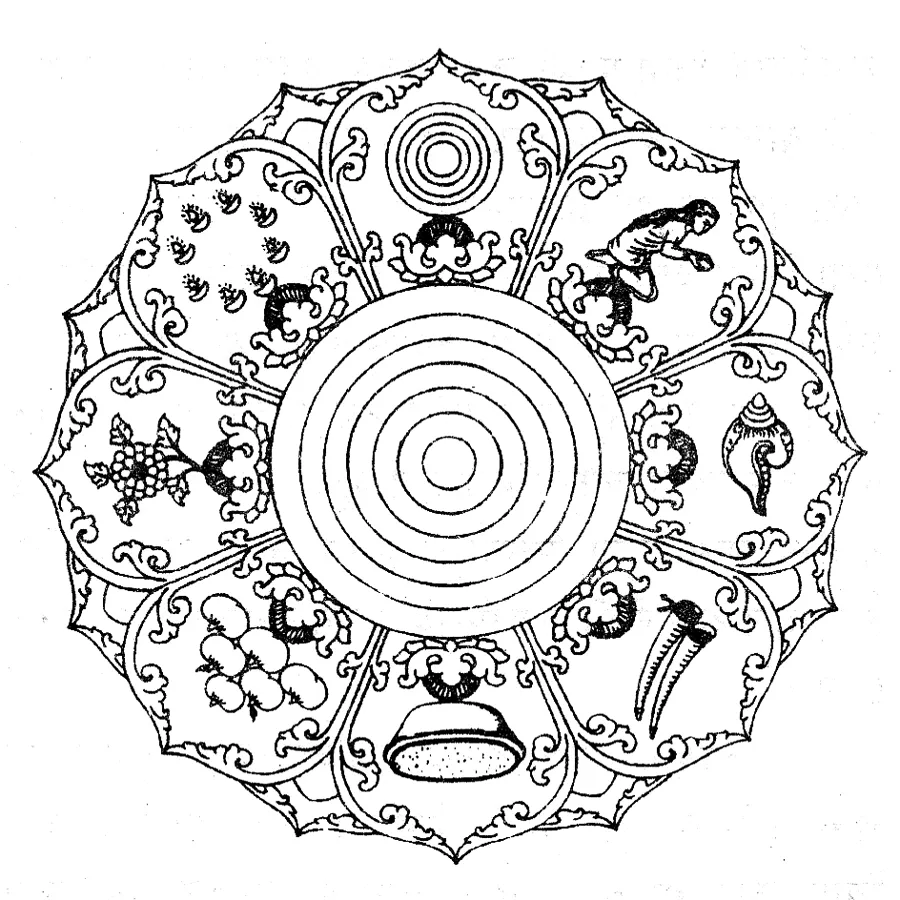
The mandala, or mandap, is the centre of the whole ritual, and one is drawn for every person who will sit down. It is made on the floor as a sand painting, and the materials are ordinary kitchen and household things.
The usual build goes like this:
|
Step |
What is used |
|---|---|
|
The outline |
Powdered limestone, or rice flour, often in two colours such as abir red and orange |
|
The shape |
An eight-petalled lotus inside a circle, the circle marked out with water |
|
The centre |
A small circle drawn with mustard oil |
|
The rings |
Concentric rings of red rice, black lentil, black soybean, unhusked rice and puffed rice |
In Newar households the mandala is called a marang, and making them is a family job that starts well before anyone sits down. A house with eight people needs eight mandaps, drawn side by side in a row on a cleaned floor.
Beside each mandap sits an itaa, and specifically the khelu itaah, an extra-long wick.
It is not there to light the room. The long wick stands for a long life, and for giving out light and fragrance to others rather than keeping it. Each person worships their own itaa with akshata and flowers, then places it in the middle of their mandap, resting on a walnut or on a mutimari bread.
Keeping your itaa burning through the ritual matters to the people sitting there.
What a household needs on the day:
The family sits in a row on the floor, usually in order of age, each person behind their own mandap.
The Nakin, the senior-most woman of the house, leads it. She applies sinha to each person's forehead and hands out akshata, fruit, and the sacred thread. Each mandap is worshipped in turn, with food, thread, coloured paste, incense, lit wicks and flowers.
The ritual closes with Sagan Biyegu.
A clay pot of dhau, curd, is brought round, and each person takes a dab and puts it on their temple. Then comes the Sagan set itself: boiled egg, smoked fish and rice wine, with the wine refilled three times.
After that, the family eats, and the feast usually runs long.
Mha Puja points inward. The person sitting behind the mandala is the one being honoured, and that is what makes it stand out.
The reasoning behind it is that the self is what has to be cared for and made clean first. If the self is in good order, the rest follows, and the gods are satisfied too. Starting the new year by purifying and honouring each member of the family is the Newar way of setting the year up properly.
It is also, quietly, a family headcount. Everyone sits down in one room, in order, once a year, and each person is worshipped individually. Who is in the row, and who is not, is felt by everybody there.
Three other things share this date in 2083.
Govardhan Puja. The worship of Govardhan Hill, marked by making a small hill of cow dung and worshipping it. It comes from the story of Krishna lifting Govardhan to shelter the villagers from Indra's rain.
Goru Puja. The ox is worshipped, the fourth animal of Tihar after the crow, the dog, and the cow.
Hali Tihar. The ploughman's day, when farmers worship the ox and the plough together. It is the agricultural half of the same observance.
So Kartik 24 is a dense day. A Newar family in Kathmandu will be doing Mha Puja and marking the new year, while a farming household in the hills will be worshipping the oxen it ploughs with, and both are on the same date.
Beyond Mha Puja in the home, Nepal Sambat has a public face that has grown a lot in the last twenty years.
Processions and rallies run through Kathmandu, Lalitpur and Bhaktapur, with traditional Newar music, masked dance and costume. Cultural organisations hold programmes. There are speeches, and the day carries an explicit message about indigenous identity and about the place of Newar history inside the national story.
Greetings go out in Nepal Bhasa. The standard one is Nhu Dan Ya Bhintuna, meaning best wishes for the new year.
Schools, cultural bodies and local governments in the Valley hold their own events, and in recent years the day has been marked by Nepali communities abroad as well.
Nepal runs on more than one calendar at once, and it helps to see them side by side.
|
Nepal Sambat |
Bikram Sambat |
Gregorian |
|
|---|---|---|---|
|
Current year in late 2026 |
1147 |
2083 |
2026 |
|
New year falls |
Kartik Shukla Pratipada, during Tihar |
Baisakh 1, mid-April |
1 January |
|
Type |
Lunisolar |
Solar, with lunar months tracked alongside |
Solar |
|
Began |
879 AD |
57 BC |
1582 AD |
|
Official in Nepal |
879 to 1769, recognised again from 2008 |
Official since 1903 |
Used internationally |
Nepal Sambat runs about 879 years behind the Gregorian year. Bikram Sambat runs about 57 years ahead of it. These two gaps get mixed up constantly, so it is worth holding the difference: 2026 AD is 2083 BS and 1147 NS.
|
Day |
What it is |
Nepali date |
English date |
|---|---|---|---|
|
1 |
Kaag Tihar |
Kartik 21 |
Saturday 7 November 2026 |
|
2 and 3 |
Kukur Tihar, Narak Chaturdashi and Laxmi Puja |
Kartik 22 |
Sunday 8 November 2026 |
|
3 |
Gai Goru Puja |
Kartik 23 |
Monday 9 November 2026 |
|
4 |
Nepal Sambat 1147, Mha Puja, Govardhan Puja, Hali Tihar |
Kartik 24 |
Tuesday 10 November 2026 |
|
5 |
Bhai Tika |
Kartik 25 |
Wednesday 11 November 2026 |
|
After |
Tihar holiday |
Kartik 26 |
Thursday 12 November 2026 |
When does Nepal Sambat 1147 begin?
On Kartik 24, 2083, which is Tuesday, 10 November 2026.
What day does the Nepal Sambat new year always fall on?
Kartik Shukla Pratipada, the first day of the bright fortnight of Kartik. It is the fourth day of Tihar.
What is Nepal Sambat?
Nepal's own calendar era, begun in 879 AD. It takes its name from the country itself, and it has been counted continuously ever since.
When did Nepal Sambat begin?
On 20 October 879 AD, during the reign of King Raghavadeva.
Who founded Nepal Sambat?
By tradition, Sankhadhar Sakhwa, a gold merchant of Marutol in Kathmandu, is said to have paid off the debts of everyone in the country. Historians debate whether he was a historical figure, though the starting date of the era itself is not in doubt.
What is the Sankhadhar Sakhwa story?
He learned that sand by the Bishnumati River carried gold and made a fortune from it. Instead of keeping it, he used it to clear the debts of the whole population, and a new era started from that day.
Was Sankhadhar Sakhwa given any official honour?
Yes. In 1999, on Mansir 2, 2056 BS, the government declared him a Rastriya Vibhuti, a national luminary. He was the first person given that status by a democratic government in Nepal.
How does the Nepal Sambat calendar work?
It is lunisolar. A normal year runs 353 to 355 days, and an extra month is added roughly every third year, making those years 383 to 385 days, so the calendar does not drift out of step with the seasons.
What are the Nepal Sambat months?
Kachhalā, Thinlā, Pwanhelā, Silā, Chilā, Chaulā, Bachhalā, Tachhalā, Dilā, Gunlā, Yanlā and Kaulā. The year starts with Kachhalā. Gunlā is the Buddhist holy month.
How far behind the English year is Nepal Sambat?
About 879 years. In late 2026, the Nepal Sambat year is 1147. Do not confuse this with Bikram Sambat, which runs about 57 years ahead of the English year.
Is Nepal Sambat still official?
It was the official calendar from 879 to 1769. It was given national recognition again in the years after 2006, and a government decision in October 2011 moved to bring it into use as the national calendar. In day-to-day administration, Nepal still runs on Bikram Sambat.
Why did it stop being official?
Official use ended in 1769, when the Malla period ended, and the Kathmandu Valley came under Gorkha rule. In 1903, under Prime Minister Chandra Shumsher, Bikram Sambat became the official calendar of the state.
How did it survive?
Newar households, religious calendars, and cultural life kept using it throughout the whole period it was out of official use. Its month names stayed in circulation and the new year kept being marked, so it remained a living calendar rather than a historical record.
Is Nepal Sambat the same as the Newari New Year?
Yes. Nepal Sambat is the calendar era, and its new year day, Kartik Shukla Pratipada, is what most people call the Newari New Year. Mha Puja is the ritual held on it.
What is Mha Puja?
The Newar New Year ritual is held on the same day. Mha means body, so Mha Puja is worship of the self. Each family member sits before a mandala drawn for them on the floor, and each person is worshipped in turn.
How do you make a Mha Puja mandap?
It is drawn on the floor as a sandpainting, one per person. The outline is made with powdered limestone or rice flour, often in two colours. The shape is an eight-petalled lotus inside a circle marked out with water. A small circle is drawn at the centre with mustard oil, surrounded by concentric rings of red rice, black lentil, black soybean, unhusked rice and puffed rice.
What is the mandap called in Newari?
Marang.
What is the itaa in Mha Puja?
A wick, and specifically the khelu itaah, an extra-long one. It stands for a long life and for giving light out to others. Each person worships their own and places it in the middle of their mandap, resting on a walnut or a mutimari.
What samagri do you need for Mha Puja?
Limestone powder or rice flour, coloured powders, mustard oil, and the five grains for the mandap rings. Then a long wick per person, walnuts or mutimari to stand them on, kwakha thread, sinha tika made of curd, rice and sindoor, fruit including tahsibwa citron, flowers, incense and akshata. For the Sagan, you need boiled egg, smoked fish, meat, ginger, garlic, curd and rice wine.
What is sinha?
The tika used in Mha Puja, made from curd, rice, and sindoor.
Who is the Nakin?
The senior-most woman of the household, who leads Mha Puja.
What is the Sagan at the end of Mha Puja?
Sagan Biyegu. A clay pot of dhau, curd, is passed round and each person dabs some on their temple. Then boiled egg, smoked fish and rice wine are served, with the wine refilled three times.
Why do Newars worship themselves?
Because the self is understood to be what must be cared for and purified first. If the self is in good order, the rest of life follows. It is a way of setting the new year up properly, person by person.
Who leads Mha Puja?
Usually the eldest woman of the house.
What else falls on the same day?
Govardhan Puja, Goru Puja, and Hali Tihar. Kartik 24 is the fourth day of Tihar.
How do you wish someone a happy Nepal Sambat?
Nhu Dan Ya Bhintuna, in Nepal Bhasa, meaning best wishes for the new year.
Where is the new year celebrated publicly?
Processions and cultural programmes run in Kathmandu, Lalitpur and Bhaktapur, with traditional Newar music, masked dance and costume. Nepali communities abroad mark it as well.
Is it a public holiday?
In 2083, it falls on Kartik 24, inside the Tihar holiday block that runs Kartik 22 to Kartik 26.
How many new years does Nepal have?
Several. Baisakh 1 starts the Bikram Sambat year, 1 January starts the Gregorian year, Nepal Sambat starts during Tihar, and Losar, Maghe Sankranti, and other observances each begin a year for different communities.
When is Bhai Tika 2083?
Kartik 25, Wednesday, 11 November 2026, the day after Nepal Sambat begins.