
Mha Puja 2083 falls on Kartik 24. That is Tuesday, 10 November 2026.
Mha means body. Puja means worship. Mha Puja is the worship of your own self, and it is held once a year, on the fourth day of Tihar, in Newar homes across the Kathmandu Valley and wherever Newar families live.
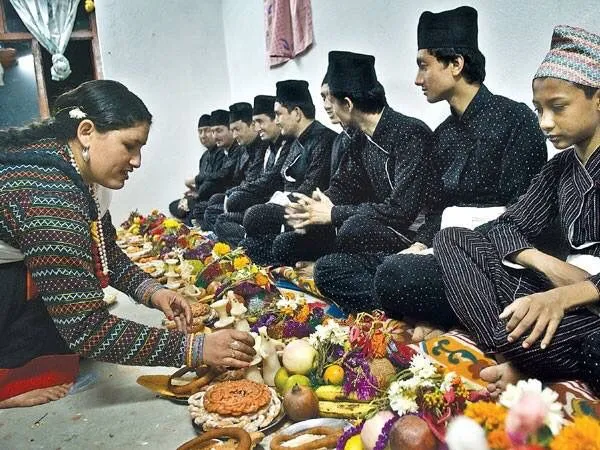
The whole family sits down on the floor in one room. In front of each person, a mandap is drawn, one for each, nobody left out. Then each person is worshipped in turn, by name, in their own right.
It is the ritual of the Nepal Sambat new year, which begins the same day, and for most Newar families it is the heart of Tihar rather than a side observance.
|
Nepali name |
म्ह पूजा (Mha Puja) |
|
What it means |
Worship of the body, or worship of the self |
|
Tithi |
Kartik Shukla Pratipada |
|
Date in 2083 BS |
Kartik 24, Tuesday 10 November 2026 |
|
Which day of Tihar |
The fourth |
|
Kept by |
Newar families, both Hindu and Buddhist |
|
Also on this day |
Nepal Sambat 1147 begins, Govardhan Puja, Goru Puja, Hali Tihar |
|
Who leads it |
The Nakin, the senior-most woman of the house |
|
Centre of the ritual |
A mandap drawn on the floor for every family member |
|
Ends with |
Sagan, and a long family feast |
|
Public holiday |
Yes, it falls inside the Tihar holiday block |
Kartik 24, 2083. That is Tuesday, 10 November 2026.
Mha Puja always falls on Kartik Shukla Pratipada, the first day of the bright fortnight of Kartik. In the Tihar sequence, that is the fourth day after Laxmi Puja and Gai Goru Puja, and the day before Bhai Tika.
|
Bikram Sambat |
Nepali date |
English date |
Day |
|---|---|---|---|
|
2082 |
Kartik 5 |
22 October 2025 |
Wednesday |
|
2083 |
Kartik 24 |
10 November 2026 |
Tuesday |
The date is later than usual this year because of Adhik Jyeshtha Maas, the extra lunar month that ran from 17 May to 15 June 2026 and pushed the festivals after it about nineteen days later.
Mha Puja points inward. The person sitting behind the mandap is the one being honoured.
The reasoning is that the self is what has to be cared for and made clean first. If the self is in good order, everything built on it holds up, and a year begun by putting each person right is a year begun properly.
There is a second thing happening underneath. Everyone in the house gets a mandap, and everyone gets the same one. The eldest and the youngest, the earner and the child, are worshipped in identical terms on the same floor. Once a year the household is levelled, deliberately.
It is also, quietly, a family headcount. Everyone sits in one row, in order, once a year. Who is in the row and who is not is felt by everybody there.
The mandap, also called the mandala, is the centre of the whole ritual, and one is drawn for every person who will sit down. A house with eight people needs eight mandaps, side by side in a row on a cleaned floor.
It is made on the floor as a sand painting, from ordinary kitchen and household materials.
|
Layer |
What is used |
|---|---|
|
The outline |
Powdered limestone, or rice flour, often in two colours such as abir red and orange |
|
The shape |
An eight-petalled lotus inside a circle, the circle marked out with water |
|
The centre |
A small circle drawn with mustard oil |
|
The rings |
Concentric rings of red rice, black lentil, black soybean, unhusked rice and puffed rice |
In Newar households the mandap is called a marang. Drawing them is a family job that starts well before anyone sits down, and in most houses it is the part the children help with and remember.
Beside each mandap sits an itaa, a wick, and specifically the khelu itaah, an extra-long one.
It is not there to light the room. The long wick stands for a long life, and for giving light and fragrance outward rather than keeping it to yourself.
Each person worships their own itaa with akshata and flowers, then places it in the middle of their own mandap, resting on a walnut or on a mutimari bread.
Keeping your itaa burning through the ritual matters to the people sitting there, and how it burns is noticed.
What a household needs on the day.
For the mandap
For each person
For the Sagan and the feast
Before. The day starts with a bath. The house is cleaned, the floor where the family will sit is washed, and the mandaps are drawn.
Sitting down. The family sits in a row on the floor, usually in order of age, each person behind their own mandap.
The Nakin leads. The Nakin, the senior-most woman of the household, runs the ritual. She puts sinha on each person's forehead, and hands out akshata, fruit and the kwakha thread to each of them by hand.
Each mandap is worshipped. Offerings go onto every mandap in turn: ritual food, thread, coloured paste, incense, lit wicks and flowers. The person behind it receives the worship along with it.
The itaa is placed. Each person worships their own long wick and sets it in the middle of their mandap.
The ritual closes with Sagan Biyegu, the giving of the Sagan.
A clay pot of dhau, curd, is brought round, and each person takes a dab and puts it on their temple.
Then the Sagan set itself is served: boiled egg, smoked fish and rice wine, with the wine refilled three times.
After that, the family eats, and the feast usually runs long into the night. Newar festival food is the point of the evening, and this is one of the bigger meals of the Newar year.
The two belong to the same day and are related to each other.
Nepal Sambat is Nepal's own calendar era, counting since 879 AD. Its new year falls on Kartik Shukla Pratipada, which is why Mha Puja and the Nepal Sambat new year are always on the same date. In 2083, the year turning is Nepal Sambat 1147.
By tradition, the era was begun by Sankhadhar Sakhwa, a merchant of Marutol in Kathmandu, who is said to have paid off the debts of the whole population. Historians debate whether he was a historical figure, though the starting date of the era is not in doubt.
So the day carries two things at once. Nepal Sambat is the public, civic half, marked with processions and cultural programmes. Mha Puja is the private half, done on the floor of the house with the family sitting in a row.
The greeting for the day is Nhu Dan Ya Bhintuna, best wishes for the new year.
Govardhan Puja. A small hill of cow dung is made and worshipped, from the story of Krishna lifting Govardhan hill to shelter the villagers from Indra's rain.
Goru Puja. The ox is worshipped, the fourth animal of Tihar after the crow, the dog, and the cow.
Hali Tihar. The ploughman's day, when the ox and the plough are worshipped together.
So on one date, a Newar family in Kathmandu is drawing mandaps on the floor while a farming household in the hills is garlanding the oxen it ploughs with.
|
Day |
What it is |
Nepali date |
English date |
|---|---|---|---|
|
1 |
Kaag Tihar |
Kartik 21 |
Saturday 7 November 2026 |
|
2 and 3 |
Kukur Tihar, Narak Chaturdashi and Laxmi Puja |
Kartik 22 |
Sunday 8 November 2026 |
|
3 |
Gai Goru Puja |
Kartik 23 |
Monday 9 November 2026 |
|
4 |
Mha Puja, Nepal Sambat 1147, Govardhan Puja, Hali Tihar |
Kartik 24 |
Tuesday 10 November 2026 |
|
5 |
Bhai Tika |
Kartik 25 |
Wednesday 11 November 2026 |
|
After |
Tihar holiday |
Kartik 26 |
Thursday 12 November 2026 |
When is Mha Puja 2083?
Kartik 24, 2083, which is Tuesday, 10 November 2026.
What does Mha Puja mean?
Mha means body, and puja means worship. Mha Puja is the worship of one's own self.
Which day of Tihar is Mha Puja?
The fourth, after Laxmi Puja and Gai Goru Puja and before Bhai Tika.
Which tithi does it fall on?
Kartik Shukla Pratipada, the first day of the bright fortnight of Kartik.
Who observes Mha Puja?
Newar families, both Hindu and Buddhist.
Why do Newars worship themselves?
Because the self is understood to be what must be cared for and made clean first. If the self is in good order, the rest of life holds up. Starting the year by putting each person right is the point of it.
How do you make a Mha Puja mandap?
It is drawn on the floor as a sand painting, one per person. The outline is made with powdered limestone or rice flour, often in two colours. The shape is an eight-petalled lotus inside a circle marked out with water. A small circle is drawn at the centre with mustard oil, surrounded by concentric rings of red rice, black lentil, black soybean, unhusked rice and puffed rice.
What is the mandap called in Newari?
Marang.
How many mandaps do you need?
One for every family member taking part. A house of eight people draws eight.
What is the itaa?
A wick, and specifically the khelu itaah, an extra-long one. It stands for a long life and for giving light outward to others. Each person worships their own and places it in the middle of their mandap, resting on a walnut or a mutimari.
What samagri is needed for Mha Puja?
For the mandap: limestone powder or rice flour, coloured powders, mustard oil, water, and the five grains for the rings. For each person: a long wick, a walnut or mutimari, kwakha thread, sinha tika, akshata, flowers, incense, and fruit, including tahsibwa citron. For the Sagan: boiled egg, smoked fish, meat, ginger, garlic, curd and rice wine.
What is sinha?
The tika used in Mha Puja, made from curd, rice, and sindoor.
Who leads Mha Puja?
The Nakin, the senior-most woman of the household.
What is tahsibwa?
The citron fruit given during the ritual. It stands for long life and good fortune.
What is the Sagan?
Sagan Biyegu closes the ritual. A clay pot of dhau, curd, is passed round and each person dabs some on their temple. Then boiled egg, smoked fish, and rice wine are served, with the wine refilled three times.
What food is eaten on Mha Puja?
The Sagan set, followed by a long family feast of Newar festival food including wo, the lentil cake, and bara.
Is Mha Puja the same as the Nepal Sambat new year?
They fall on the same day and belong together. Nepal Sambat is the calendar era whose new year begins that day. Mha Puja is the family ritual held on it.
Which Nepal Sambat year begins in 2083?
Nepal Sambat 1147 begins on Kartik 24, Tuesday, 10 November 2026.
How do you greet someone on this day?
Nhu Dan Ya Bhintuna, in Nepal Bhasa, meaning best wishes for the new year.
Is Mha Puja a public holiday?
In 2083, it falls on Kartik 24, inside the Tihar holiday block that runs Kartik 22 to Kartik 26.
What else falls on the same day?
Nepal Sambat 1147 begins, and Govardhan Puja, Goru Puja, and Hali Tihar are all marked.
When is Bhai Tika 2083?
Kartik 25, Wednesday, 11 November 2026, the day after.