
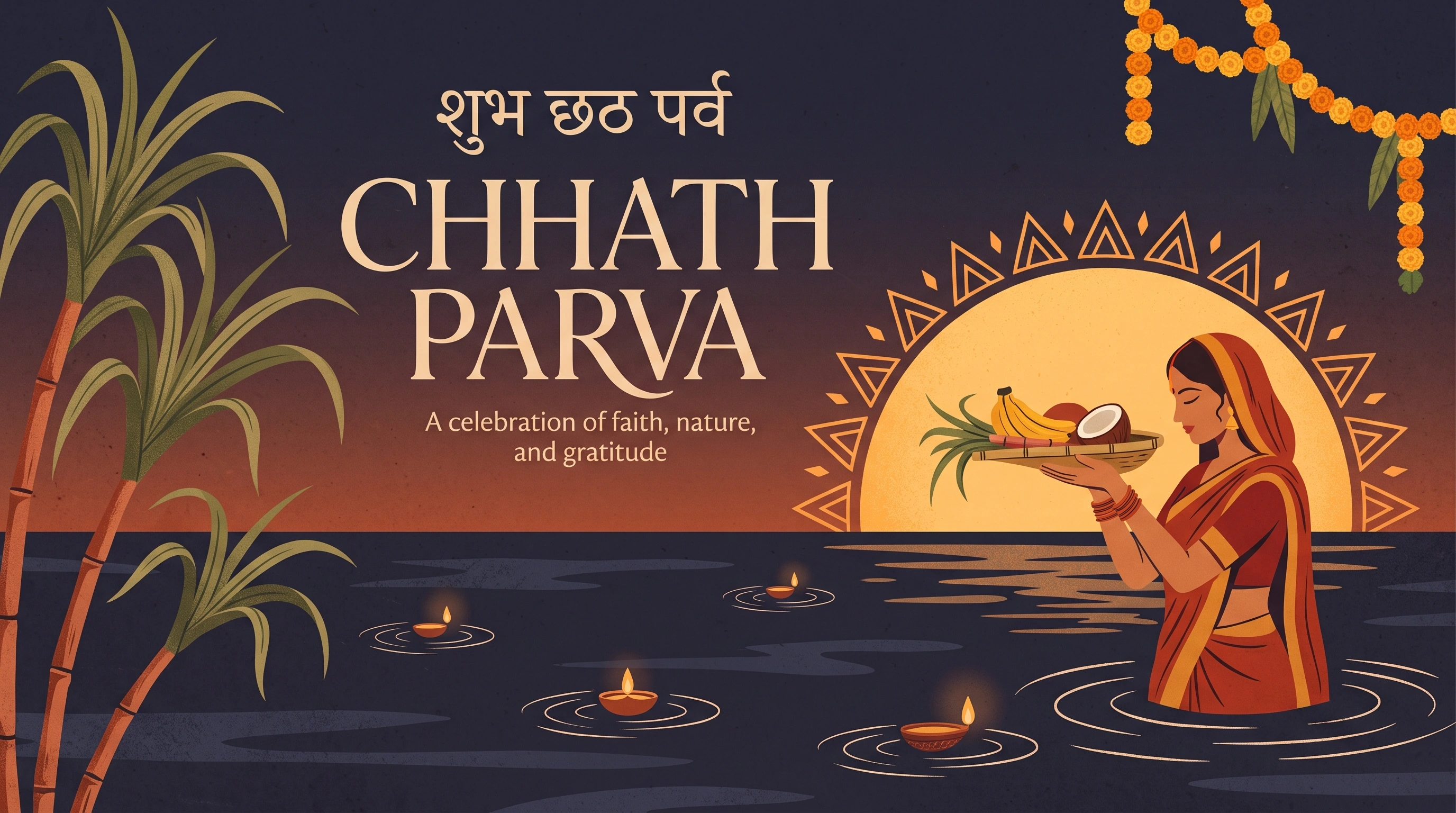
Chhath Parva 2083 runs from Kartik 27 to Kartik 30. The main day, Sandhya Arghya, is Sunday, 15 November 2026.
Chhath is a festival of the sun. Over four days, the people observing it bathe in a river, cook a strict prasad in a sealed kitchen, fast for thirty-six hours without food or water, and stand waist-deep in cold water twice: once as the sun goes down, and again as it comes back up.
No priest is in the middle of it. No temple is required, no idol, and no intermediary. A person stands in a river holding a bamboo tray of fruit up to the sun. That is the festival.
It is the great festival of Madhesh and the Tarai; it has been a national public holiday in Nepal since 2046 BS, and it begins two days after Tihar closes.
In Nepali the festival is छठ पर्व.
|
Attribute |
Details |
|---|---|
|
Nepali name |
छठ पर्व (Chhath Parva) |
|
Also called |
Chhath Puja, Surya Shashthi, Dala Chhath, Chhathi Maiya Puja |
|
What Chhath means |
Sixth, from the Shashthi tithi it peaks on |
|
Length |
Four days |
|
Dates in 2083 BS |
Kartik 27 to Kartik 30 (Nov 13, 2026 to Nov 16, 2026) |
|
Main day |
Sandhya Arghya, Kartik 29 (Nov 15, 2026) |
|
Worshipped |
Surya, the sun, and Chhathi Maiya |
|
Chhathi Maiya, also known as |
Shashthi Devi, the sixth form of Prakriti, sister of Surya |
|
The fast |
Nirjala, no food and no water, about 36 hours |
|
Kept by |
Parvaitin, mostly women, and men also keep it |
|
Carried in |
Daura, dagara, and soop, all of bamboo |
|
Signature prasad |
Thekua |
|
Where |
Madhesh, and the Koshi, Bagmati, Gandaki and Lumbini provinces |
|
Public holiday in Nepal |
Yes, since 2046 BS |
The four days run from Kartik 27 to Kartik 30. The main evening, Sandhya Arghya, is Kartik 29, Sunday 15 November 2026.
Chhath is fixed to tithis in the bright fortnight of Kartik, and it takes its name from the sixth one.
|
Day |
Name |
Tithi |
Nepali Date |
English Date |
|---|---|---|---|---|
|
1 |
Nahay Khay |
Kartik Shukla Chaturthi |
Kartik 27 |
Nov 13, 2026 |
|
2 |
Kharna, also Rasiaav Roti or Lohanda |
Kartik Shukla Panchami |
Kartik 28 |
Nov 14, 2026 |
|
3 |
Sandhya Arghya |
Kartik Shukla Shashthi |
Kartik 29 |
Nov 15, 2026 |
|
4 |
Usha Arghya |
Kartik Shukla Saptami |
Kartik 30 |
Nov 16, 2026 |
Digital Patro's calendar marks Chhath Parva on Kartik 29, the main day. The three days around it are part of the same festival, and a household will have been in it since Kartik 27.
Chhath begins two days after Bhai Tika closes Tihar on Kartik 25. For families in Madhesh and the Tarai, the two run almost back to back, and the shopping and cleaning for Chhath begins while Tihar is still going.
Surya, the sun, is the centre of it. Not a statue of the sun and not a temple to it, but the sun itself, in the sky, at the moment it touches the horizon.
Surya is honoured as what gives life, health and energy. Chhath is the plainest version of that idea anywhere in the Nepali year. The thing that keeps everything alive is right there, visible, and people stand in a river and thank it directly.
Chhathi Maiya, also called Chhath Mata, is worshipped alongside him, and she is the one the fast is really kept for.
She is identified with Shashthi Devi, said to have arisen from the sixth aspect of Prakriti, the fundamental nature of creation, which is where the name comes from. She is also described as the sixth form of Parvati, and as Surya's sister. Across regions she carries other names, including Ranbey Maya, Sabita Mai and Ranbey Thakur.
What she is asked for is specific. Shashthi Devi is the goddess of childbirth and of children, the one invoked on the sixth day after a birth, which is the chhathi ceremony. On Chhath she is asked for the health and long life of children, and for protection from illness.
That is why so much of Chhath is a mother fasting for her children, and why the vow tends to pass from mother to daughter.
Several accounts are told, and they do not compete so much as layer. Sun worship itself is very old, and these are the stories people attach to it.
The best known account credits Karna, son of Surya, in the Mahabharata.
Karna is said to have stood waist deep in water for hours every day offering arghya to his father the sun. He ruled Anga Desh, around present day Bhagalpur, and the tradition holds that he made the practice regular there, which is how it took root in the region that is now Bihar and the Nepali Tarai.
Another account has Draupadi and the Pandavas keeping the sun worship, for the health of the family and to restore what they had lost.
This is the story that explains Chhathi Maiya rather than the sun.
King Priyavrat had no children. The sage Kashyap gave him blessed kheer, and a son was born, but the child was stillborn. As the king grieved, a goddess appeared and revealed herself as Shashthi Devi, daughter of Brahma. She restored the child to life, and promised that whoever worshipped her would be granted children and their protection.
The kheer, the blessing for children, and the goddess being called the sixth are all still in the festival.
A local tradition at Munger holds that Sita performed Chhath there after returning from Lanka, and that the festival begins with her.
Nahay means to bathe. Khay means to eat.
The person keeping the fast bathes in a river or water body, the house is cleaned thoroughly, and Surya is worshipped. Then they eat one pure vegetarian meal. The standard set is chana dal, pumpkin curry, and rice, cooked without onion or garlic, usually on a separate earthen or mud stove kept only for Chhath.
From this day, the kitchen is effectively sealed. What is cooked, where, on what fire, and who may touch it are all controlled, and that control does not relax until the festival ends.
The whole of day two is a fast, broken only after sunset.
In the evening the rasiaav is cooked: a kheer of rice and jaggery, traditionally made with sugarcane juice, and importantly without salt and without sugar. It is served with roti. The Nepali phrase for it is alino rasiaav roti, saltless rasiaav and roti.
It is offered to Chhathi Maiya first. Then the person keeping the fast eats it alone and in silence. The rest of the household leaves the room, and no noise is made while she eats. When she has finished, the prasad is given out to family, neighbours and anyone who comes.
The thirty-six-hour fast begins the moment that meal ends. It runs through all of day three, through the night, and ends only after the sunrise offering on day four.
This is the main day and the image everyone knows.
Through the day, the prasad is made, above all the thekua. In the afternoon, the family walks to the ghat carrying the loaded baskets. At the water, as the sun goes down, the person keeping the fast stands in the river and raises the soop to the setting sun.
They stay in the water. It is November, the water is cold, and the offering is held up until the sun is gone.
After the evening arghya, many households return home for Kosi bharna. Many families then spend the night at the ghat, singing.
Before dawn, everyone is back at the water.
The same offering is made again, this time to the rising sun. When it is done, the fast is broken, often with a little ginger and water first; the prasad is shared out, and the festival ends.
The nirjala vrat is what makes Chhath what it is. Nirjala means without water.
From the end of the Kharna meal on day two until after the sunrise offering on day four, the person keeping it takes no food and no water at all. That is roughly thirty-six hours, and it includes standing in a river twice, once in the evening cold and once before dawn.
The people who keep it are called parvaitin, or vrati. Most are women, and in many families the same woman keeps it every year for decades. Men keep it too, and the number doing so has grown.
It is widely regarded as the hardest fast kept anywhere in the Nepali calendar, and nobody who keeps it treats it lightly.
This is one of the most striking parts of Chhath, and the part outsiders most often miss, because it happens at home rather than at the ghat.
Kosi bharna is done on the evening of Sandhya Arghya, after returning from the water, in the courtyard or on the roof.
Five to seven stalks of sugarcane are tied together at the top to make a canopy, a small mandap. Inside it, a clay elephant is placed, with a kalash set on it, and lamps are lit around and inside. A red cloth holding thekua, fruit, arkapat leaves, and kerav is tied above.
Lamps are lit in the mandap, and the family sits with it.
It is not done by everyone every year. Kosi bharna is kept as a thanksgiving by a household whose wish, a mannat, has been granted. A child born, an illness survived, something asked for and received. Doing it in pairs is held to be especially auspicious.
So a courtyard with a lit sugarcane canopy in it on Chhath night is a household saying that something it asked for came true.
The offering travels in bamboo, and the vessels have their own names and rules.
|
Vessel |
Description |
|---|---|
|
Soop |
The winnowing tray the offering is raised to the sun in |
|
Daura |
The larger bamboo basket holding the puja items, fruit, and prasad |
|
Dagara |
The flat bamboo tray, used alongside the soop |
Two things about them matter.
They are carried on the head. The baskets are held up above everyone on the walk to the ghat, so that nothing can touch or contaminate what is inside.
A male member of the household carries the daura. In Nepali practice, a man of the family carries the loaded daura on his head from the house to the Chhath ghat. It is one of the clearest ways the whole household is drawn into a fast only one person is keeping.
Everything is bamboo, handmade and bought new. The Chhath season is the biggest trade of the year for the Dom and other traditional basket-making families who make them.
Everything offered is made at home by hand, in a kitchen kept ritually clean. Nothing from a shop goes into the soop.
Here’s the completed and polished table with the missing details filled in.
| Item | Note |
|---|---|
| Thekua | The signature Chhath sweet, made from wheat flour, jaggery or sugar, and ghee. The dough is pressed into carved wooden moulds and fried. |
| Kasar | Balls made from ground rice flour and jaggery, traditionally prepared as an offering. |
| Khajuria, tikri, rice laddu | Other traditional homemade sweets prepared for Chhath Puja. |
| Sugarcane | Whole stalks carried to the ghat and often arranged upright around the offerings. |
| Coconut | Whole coconuts offered as part of the puja, symbolising purity and devotion. |
| Banana, sweet lime, and seasonal fruit | Fresh, whole fruits selected for the offerings. They are traditionally handled and prepared by the household observing the fast. |
| Diyo, incense, vermilion, new cloth | Ritual essentials used during worship, including oil lamps, incense sticks, vermilion powder (sindoor), and new cloth for the offerings or पूजा arrangements. |
Thekua is made in bulk through day three, usually by several women working together, and the wooden moulds are often older than the people using them. It is the thing sent to relatives and neighbours afterwards, and for a lot of people it is the taste that means Chhath.
The person keeping the fast wears new clothes, and traditionally unstitched or simply stitched cloth: a plain sari for women, a dhoti for men, usually yellow or red.
Married women keeping the fast apply sindoor from the nose to the hairline, in a long unbroken line rather than a dot. It is one of the sixteen adornments, the solah shringar, and it is worn as a mark of marriage and as a prayer for the husband's long life. The long form is particular to Chhath and to the region, and it is one of the visual signatures of the festival.
Chhath has its own body of songs, and they are not background music. There is a song for nearly every stage: for cleaning the house, for grinding the wheat, for making the thekua, for walking to the ghat, for standing in the water, for the return.
They are sung in Bhojpuri and Maithili, mostly by women, mostly unaccompanied, and their subject is ordinary and direct. A daughter's maita and her husband's house, a wish for a child, a prayer for the family's peace, a complaint addressed to Chhathi Maiya herself.
The voice most associated with them is Sharda Sinha, known as Bihar Kokila. Her Chhath geet, including Kelwa ke paat par ugelan Suruj Mal jhake jhuke, became the sound of the festival across Bihar, the Tarai and the diaspora, to the point that people say Chhath has arrived when her songs start playing after Dashain. She died on 5 November 2024, aged 72.
There is one thing about Chhath worth pausing on, because it is the heart of the festival.
Most ritual involving the sun is aimed at the rising one. Chhath offers arghya to the setting sun first, on the main evening, and to the rising sun only the next morning.
Thanking something as it goes, before thanking it when it returns, is a deliberate order. It is the reason day three rather than day four is the main day, and it is the image that represents the festival: people standing chest deep in cold water, arms raised, facing a sun that is already half gone.
This is the part of Chhath's story that belongs specifically to Nepal.
Before 2046 BS, Chhath was kept in limited parts of the Tarai. It was a regional observance of Madhesh and the Mithila belt, and it barely registered in the hills.
Since 2046 BS, the government has given it a public holiday, and in the decades since it has taken a national shape. It is now observed across Koshi, Bagmati, Gandaki, Lumbini and Madhesh provinces, and it is routinely described as one of Nepal's largest festivals.
That shift tracks a wider one. Chhath's rise from a regional festival to a national holiday runs alongside the growing political and cultural weight of Madhesh in national life, and its ghats have become one of the more visible places where that is expressed.
Its heartland is Mithila, the Maithili-speaking region of the eastern and central Tarai, and Janakpur is its most visible centre, where the ponds and ghats fill for as far as you can see.
The Kathmandu Valley is now one of the biggest Chhath sites in the country. Ghats are built on the Bagmati, at Guheshwori, and at ponds including Rani Pokhari and Kamal Pokhari. Municipalities clean, light, and police them beforehand, and the crowds run into the tens of thousands. For the many Madhesi families living and working in the Valley, the Kathmandu ghat is where Chhath now happens.
It is also kept across the border in Bihar, Uttar Pradesh and Jharkhand, and by Nepali and Indian communities abroad.
Chhath is kept more strictly than almost anything else in the calendar, and the rules are about purity rather than scale.
| What | Nepali date | English date |
|---|---|---|
| Laxmi Puja | Kartik 22 | Sunday, 8 November 2026 |
| Mha Puja and Nepal Sambat 1147 | Kartik 24 | Tuesday, 10 November 2026 |
| Bhai Tika, Tihar ends | Kartik 25 | Wednesday, 11 November 2026 |
| Chhath begins, Nahay Khay | Kartik 27 | Friday, 13 November 2026 |
| Kharna | Kartik 28 | Saturday, 14 November 2026 |
| Sandhya Arghya, the main day, and Kosi Bharna | Kartik 29 | Sunday, 15 November 2026 |
| Usha Arghya, Chhath ends | Kartik 30 | Monday, 16 November 2026 |
When is Chhath 2083?
The four days run from Kartik 27 to Kartik 30, which is 13 to 16 November 2026. The main day, Sandhya Arghya, is Kartik 29, Sunday 15 November 2026.
How many days is Chhath?
Four. Nahay Khay, Kharna, Sandhya Arghya, and Usha Arghya.
What does the word Chhath mean?
Sixth. It refers to the Shashthi tithi, the sixth day of the bright fortnight of Kartik, on which the festival peaks. It is also why the goddess is Chhathi Maiya.
Which day is the main day?
The third, Sandhya Arghya, when the offering is made to the setting sun.
Which tithis do the four days fall on?
Nahay Khay on Kartik Shukla Chaturthi, Kharna on Panchami, Sandhya Arghya on Shashthi, and Usha Arghya on Saptami.
Who is worshipped on Chhath?
Surya, the sun, and Chhathi Maiya.
Who is Chhathi Maiya?
She is identified with Shashthi Devi, said to have arisen from the sixth aspect of Prakriti, and is described as the sixth form of Parvati and as Surya's sister. She is the goddess of childbirth and of children, the same goddess invoked at the chhathi ceremony on the sixth day after a birth.
What is Chhathi Maiya asked for?
The health, long life, and protection of children, and the well-being of the family.
What are the other names for Chhathi Maiya?
Chhath Mata, Shashthi Devi, and regionally Ranbey Maya, Sabita Mai, and Ranbey Thakur.
How did Chhath begin?
Several accounts are told. The best-known credits Karna, son of Surya, who stood waist-deep in water offering arghya daily in Anga Desh, around present-day Bhagalpur. Others credit Draupadi and the Pandavas, or King Priyavrat, whose stillborn son was restored by Shashthi Devi. A local tradition at Munger holds that Sita performed Chhath there after returning from Lanka.
What is the Priyavrat story?
King Priyavrat was childless. The sage Kashyap gave him blessed kheer, and a son was born, but he was stillborn. A goddess appeared, revealed herself as Shashthi Devi, daughter of Brahma, restored the child, and promised children and their protection to whoever worshipped her.
What is Nahay Khay?
Day one. Nahay means to bathe, and khay means to eat. The person keeping the fast bathes in a river, the house is cleaned, and they eat one pure vegetarian meal, usually chana dal, pumpkin curry, and rice, cooked without onion or garlic.
What is Kharna?
Day two. A full day fast, broken after sunset with rasiaav, a kheer of rice and jaggery traditionally made with sugarcane juice and no salt or sugar, served with roti. It is offered to Chhathi Maiya first.
Why does the vrati eat the Kharna meal alone?
It is eaten in silence, with the rest of the household leaving the room and no noise made. After she has finished, the prasad is distributed to family and neighbours.
When does the 36-hour fast start?
The moment the Kharna meal ends on day two. It runs until after the sunrise offering on day four.
Is the fast really without water?
Yes. It is a nirjala vrat, meaning no food and no water at all for the whole period.
Who keeps the fast?
The parvaitin, or vrati. Most are women, often the same woman in a family year after year, and men keep it too.
How is the fast broken?
After the Usha Arghya on day four, often with a little ginger and water first, then the prasad.
What is arghya?
The offering raised to the sun while standing in water. It is made to the setting sun on day three and to the rising sun on day four.
Why is the setting sun worshipped first?
Because Chhath thanks the sun as it goes before thanking it when it returns. It is one of the few observances that honours the setting sun, and it is why day three rather than day four is the main day.
What is Kosi bharna?
A thanksgiving done at home on the evening of Sandhya Arghya, in the courtyard or on the roof. Five to seven sugarcane stalks are tied into a canopy, a clay elephant is placed inside with a kalash on it, a red cloth of thekua, fruit, arkapat and kerav is tied above, and lamps are lit.
Does everyone do Kosi bharna?
No. It is kept as a thanksgiving by a household whose wish, a mannat, has been granted, such as a child born or an illness survived. Doing it in pairs is held to be especially auspicious.
What is a soop?
The bamboo winnowing tray the offering is raised to the sun in.
What is the difference between a soop, a daura and a dagara?
The soop is the winnowing tray used for the arghya. The daura is the larger bamboo basket holding the puja items, fruit and prasad. The dagara is the flat bamboo tray used alongside the soop.
Who carries the daura to the ghat?
A male member of the household carries it on his head from the house to the Chhath ghat.
Why are the baskets carried on the head?
So that nothing can touch or contaminate what is inside. They are held above everyone on the walk to the water.
What goes in the soop?
Thekua, kasar, khajuria, tikri, rice laddu, sugarcane, coconut, banana, sweet lime and seasonal fruit, with a lamp, incense and vermilion.
What is thekua?
The signature Chhath sweet, made from wheat flour, jaggery or sugar and ghee, pressed in a carved wooden mould and fried. It is made at home in bulk on day three and shared widely afterwards.
Can Chhath prasad be bought from a shop?
No. It is made at home by hand in a kitchen kept ritually clean, and that is part of the observance.
What does the vrati wear?
New clothes, traditionally unstitched or simply stitched, a plain sari for women or a dhoti for men, usually yellow or red.
Why do women apply sindoor from the nose to the hairline?
It is one of the sixteen adornments and is worn as a mark of marriage and a prayer for the husband's long life. The long unbroken line is particular to Chhath and to the region.
What are Chhath geet?
The songs of the festival, sung in Bhojpuri and Maithili, mostly by women and mostly unaccompanied. There is a song for nearly every stage, from cleaning the house and grinding the wheat to standing in the water.
Who is Sharda Sinha?
The folk singer known as Bihar Kokila, whose Chhath geet, including Kelwa ke paat par ugelan Suruj Mal jhake jhuke, became the sound of the festival across Bihar, the Tarai and the diaspora. She died on 5 November 2024, aged 72.
What rules are kept during Chhath?
The kitchen is set apart from Nahay Khay, often with a separate mud stove. No onion, garlic, meat, or alcohol in the house. The prasad is touched only by those who have bathed and changed. Nothing shop-bought goes into the offering. Many sleep on the floor rather than a bed.
What is dandvat pranam?
Prostrating full length repeatedly along the road to the ghat, kept by some as a vow.
Is Chhath a public holiday in Nepal?
Yes. The government has given a public holiday for Chhath since 2046 BS.
Was Chhath always a national festival in Nepal?
No. Before 2046 BS, it was kept in limited parts of the Tarai. Since then, it has taken a national shape and is now observed across the Koshi, Bagmati, Gandaki, Lumbini and Madhesh provinces.
Where is Chhath celebrated in Nepal?
Its heartland is Mithila, with Janakpur as the most visible centre. It is now celebrated across five provinces, and the Kathmandu Valley is one of the largest Chhath sites in the country.
Where is Chhath celebrated in Kathmandu?
At ghats on the Bagmati, at Guheshwori, and at ponds including Rani Pokhari and Kamal Pokhari.
How soon after Tihar is Chhath?
It begins two days after Bhai Tika closes Tihar. In 2083, Bhai Tika is Kartik 25, and Chhath begins on Kartik 27.
Is Chhath celebrated outside Nepal?
Yes, in Bihar, Uttar Pradesh, and Jharkhand, and by Nepali and Indian communities abroad.
Do you need a priest for Chhath?
No. There is no priest in the ritual, and no temple is required. The person keeping the fast makes the offering directly to the sun.
Is there a Chhath in spring as well?
Yes. A smaller observance called Chaiti Chhath is kept in the month of Chaitra, on the same tithis of the bright fortnight. The Kartik Chhath is the larger and better known of the two.