
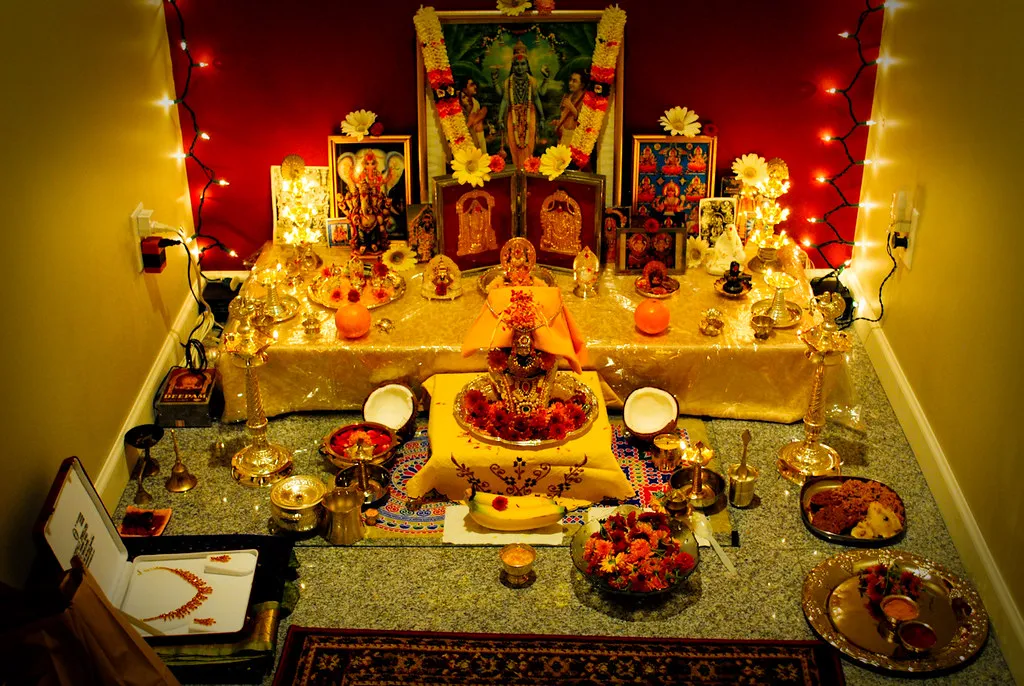
Laxmi Puja 2083 falls on Kartik 22. That is Sunday, 8 November 2026.
It is the main night of Tihar. Goddess Laxmi, who brings wealth, is worshipped after dark, and every house in the country is lit from the gate to the back room.
The lighting is not decoration. Laxmi Puja falls on Aunsi, the new moon, the darkest night of that fortnight. The belief is that Laxmi walks from house to house on this night and enters the one that is clean and lit, and passes by the one that is dark or dirty. So people scrub the house for days, then light every corner of it and leave the door open.
In Nepali, the day is लक्ष्मी पूजा. Many people call the whole evening Tihar ko mukhya din, the main day of Tihar.
|
Nepali name |
लक्ष्मी पूजा (Laxmi Puja) |
|
Tithi |
Kartik Krishna Aunsi, the new moon |
|
Date in 2083 BS |
Kartik 22, Sunday, 8 November 2026 |
|
Which day of Tihar |
The main day, third in the sequence |
|
Time of the puja |
In the evening, after sunset, at the announced sahit |
|
How the sahit is set |
Where Pradosh Kaal overlaps the fixed Vrishabha Lagna |
|
Goddess |
Laxmi, goddess of wealth, with Ganesh worshipped alongside |
|
Also on this day in 2083 |
Kukur Tihar, Narak Chaturdashi, Sukharatri, and the birth anniversary of Laxmi Prasad Devkota |
|
Sung on this night |
Bhailo |
|
Public holiday |
Yes. Part of the Tihar holiday block, Kartik 22 to Kartik 26 |
|
Tihar is also called |
Yamapanchak, the five days of Yama |
Kartik 22, 2083. That is Sunday, 8 November 2026.
In a normal year, Tihar runs over five separate dates. In 2083, two of them land together.
Digital Patro's calendar marks Kukur Tihar, Narak Chaturdashi and Laxmi Puja all on Kartik 22. That happens when the Chaturdashi and Aunsi tithis fall across the same sunrise, which compresses the festival.
So this year, dogs are garlanded in the morning, and Laxmi is worshipped the same evening, in the same house, on the same date. If you are planning around Tihar, do not assume Kukur Tihar has its own day this year.
|
Bikram Sambat |
Nepali date |
English date |
Day |
|---|---|---|---|
|
2082 |
Kartik 3 |
20 October 2025 |
Monday |
|
2083 |
Kartik 22 |
8 November 2026 |
Sunday |
The gap between the two is large because of Adhik Jyeshtha Maas, the extra lunar month that ran from 17 May to 15 June 2026. Festivals after it moved about nineteen days later instead of the usual eleven days earlier.
This is the part most people search for, and it is worth understanding rather than just reading off a number.
Laxmi Puja is an evening puja. It is not done in the morning and not at midday. The sahit falls after sunset, and it is worked out fresh every year.
Two windows have to overlap.
Pradosh Kaal. The period of roughly two and a half hours after sunset. This is the auspicious stretch for the evening worship.
Sthir Lagna, the fixed ascendant. For Laxmi Puja, this is Vrishabha Lagna, the Taurus ascendant. A fixed sign is used because Laxmi is asked to settle and stay, not to visit and move on.
The sahit is where the two overlap. That is the window the Nepal Panchanga Nirnayak Vikas Samiti publishes.
To make it concrete, here is how the three windows sat in 2082:
|
Window |
Time |
|---|---|
|
Pradosh Kaal |
5:46 pm to 8:18 pm |
|
Vrishabha Lagna |
7:08 pm to 9:03 pm |
|
Published sahit |
7:08 pm to 8:18 pm |
The sahit was the overlap, one hour and ten minutes long.
Sunset moves. The lagna timings move. So the overlap moves with them, and it can be longer in one year and shorter in another.
That is why last year is useless this year, and why you should check Digital Patro on the day for the 2083 sahit.
Most families try to start inside the sahit. If you cannot, the puja is still done in the evening, after dark, on the same day. The window is the best time, not the only allowed time.
Clean the whole house. This starts days ahead. Cupboards, corners, the roof, the yard. The point is not tidiness for guests. The belief is that Laxmi will not enter a dirty house, so the cleaning is part of the ritual.
Whitewash and repair. Many households paint or patch the outside walls in the week before Tihar.
Buy the samagri. Markets are heaving from Kaag Tihar onward.
Lay the path. A strip of red mud (rato mato) is laid from the main gate or door, through the house, to the puja room. On it, small footprints are drawn leading inward. Those are Laxmi's footprints, showing her the way in. Some households use rangoli or coloured powder instead, or alongside.
Set up the puja place. In the puja room, set the kalash, the diyo, and an image or idol of Laxmi with Ganesh. Ganesh is worshipped first, as he is in most Hindu rituals.
Light the house. After sunset, oil lamps go along every window ledge, doorway, stair, and wall. Electric lights, candles and string lights are used too. Nothing should be left dark.
At the sahit, the family gathers at the puja place and offers:
|
Offering |
Note |
|---|---|
|
Money and jewellery |
Placed before the goddess and worshipped, then taken back |
|
Paddy and rice |
Dhan and chamal, standing for the harvest |
|
Fruit and sweets |
Whatever the household has |
|
Sel roti |
The Tihar bread |
|
Flower garlands |
Marigold and makhamali |
|
Incense and lamps |
Lit through the puja |
Business households also worship their account books, cash boxes, safes and ledgers on this night. Shops and offices do their own Laxmi Puja before closing, and many treat it as the start of the business year.
After the puja, Bhailo begins. Groups go house to house singing, and are given money, sel roti, and fruit at each door. Bhailo is traditionally sung by girls on Laxmi Puja night. Deusi, sung by boys, comes the following night.
Money collected during Bhailo and Deusi often goes to a shared purpose, a local club, a temple repair, a school fund, or a picnic.
This is where Laxmi Puja stops being just a puja and becomes part of Nepal's history.
Laxmi is the goddess of wealth, fortune, and prosperity, and the consort of Vishnu.
The best-known account of her origin is the Samudra Manthan, the churning of the ocean. Gods and demons churned the ocean together to bring up amrit, the nectar of immortality. Many things rose out of it during the churning, and Laxmi was one of them. She chose Vishnu.
What matters for this festival is what she represents. Laxmi is not only money. She covers the harvest, the health of the household, cattle, food stores, and good fortune generally. That is why paddy and rice sit on the puja plate next to the cash.
Lighting the house on the darkest night of the fortnight is the whole idea of the festival. The lamps are not decoration added to a puja. They are the puja.
Yamaraj is the god of death. The belief is that for these five days, from Kartik Krishna Trayodashi to Kartik Shukla Dwitiya, Yamaraj sets aside his work and stays as a guest at the house of his sister Yamuna, who gives him tika.
That is the origin of Bhai Tika, the last day of Tihar, when sisters give tika to brothers. The whole five-day festival is framed as this visit.
It also explains the order of the days. The crow is Yama's messenger, so Kaag Tihar opens the festival. The dog guards Yama's gate, so Kukur Tihar follows.
There is a second story running through Tihar, and it belongs to Deusi and Bhailo.
Bali Raja was a powerful demon king. Vishnu took the Vaman avatar, the dwarf, and pushed him down out of his kingdom. But Bali was given one thing in return: the right to rule the earth for five days each year, from Kartik Krishna Trayodashi to Kartik Shukla Dwitiya.
Those are exactly the five days of Tihar. So the singing at the door, the visiting, the collecting and giving, all of it happens during Bali Raja's short annual reign.
There is a second view, and it is a Nepali one worth knowing.
Some hold that the Bali Raja named in Deusi songs is not the mythological demon king at all, but a real king of Sinja in Jumla, around the fifteenth century. In that reading, Deusi is not an imported story. It is a memory of a Karnali king, carried in a song that people still sing at doors every Kartik without knowing whose name they are saying.
Both accounts are in circulation. The song is the same either way.
Tihar carries Nepal's own calendar inside it.
Nepal Sambat, the national calendar, begins on Kartik Shukla Pratipada, which in 2083 is Kartik 24, two days after Laxmi Puja. That day is also Mha Puja.
The calendar was started in 879 AD by Sankhadhar Sakhwa, a merchant who is said to have cleared the debts of everyone in the country. It is the only calendar named after a country rather than a ruler or a religion.
It was in official use for about 890 years, from 879 to 1769 AD. The Government of Nepal restored it as a national calendar in 2007, after 238 years out of official use.
In 2083, Nepal Sambat 1147 begins on Kartik 24, Tuesday, 10 November 2026.
On that same day, Newar households perform Mha Puja, which means worship of the self, or body worship.
Every member of the family sits in a row, and a mandala is drawn for each person. The idea is that the self is what has to be cared for and purified first, and that if the self is well, everything else follows.
It is one of the few rituals anywhere in which a person is the object of worship rather than a deity, and it is the Newar New Year celebration.
Shopkeepers and traders worship their ledgers, cash boxes, and safes on this night. In the older Newar merchant tradition of the Kathmandu Valley, the trading year was tied to this point of the calendar, which is also why Nepal Sambat begins here rather than in Baisakh.
For many businesses, the days around Laxmi Puja are still when old accounts are closed, and new books are opened.
Because his birth is tied to the festival rather than to a fixed date, his birth anniversary moves with Laxmi Puja each year. In 2083, Digital Patro's calendar marks it on Kartik 22, the same day.
|
Day |
What it is |
Nepali date |
English date |
|---|---|---|---|
|
Before |
Dhanteras and Dhanvantari Jayanti |
Kartik 20 to 21 |
6 to 7 November 2026 |
|
1 |
Kaag Tihar, the crow |
Kartik 21 |
Saturday 7 November 2026 |
|
2 and 3 |
Kukur Tihar, Narak Chaturdashi and Laxmi Puja |
Kartik 22 |
Sunday 8 November 2026 |
|
3 |
Gai Goru Puja, Tihar holiday |
Kartik 23 |
Monday 9 November 2026 |
|
4 |
Govardhan Puja, Mha Puja, Hali Tihar, Nepal Sambat 1147 begins |
Kartik 24 |
Tuesday 10 November 2026 |
|
5 |
Bhai Tika, Kija Puja |
Kartik 25 |
Wednesday 11 November 2026 |
|
After |
Tihar holiday |
Kartik 26 |
Thursday 12 November 2026 |
|
Later |
Chhath Parva |
Kartik 29 |
Sunday 15 November 2026 |
Note that Kartik 25 is also Mahaguru Falgunanda Jayanti, a holiday for those following the Kirat religion.
|
Nepal |
Most of India |
|
|---|---|---|
|
Festival name |
Tihar, or Yamapanchak |
Diwali, or Deepawali |
|
Length |
Five days |
Usually five days, with different emphasis |
|
Main day |
Laxmi Puja on Aunsi |
Laxmi Puja on Aunsi |
|
Animals honoured |
Crow, dog, cow and ox each get a day |
Not a central feature |
|
Singing at doors |
Bhailo and Deusi |
Not a central feature |
|
Last day |
Bhai Tika, sisters to brothers |
Bhai Dooj, similar |
|
Calendar link |
Nepal Sambat new year on day four |
None |
The animal days and the Deusi Bhailo tradition are what make Tihar distinctly Nepali. The crow, dog, cow and ox are worshipped before any human is, and that sequence does not exist in the Indian festival.
Do not leave any corner dark. The whole house is lit, including store rooms and stairwells.
Do not sweep rubbish out after dark. Many households hold that sweeping things out of the house on Laxmi Puja night sends the goddess out with them. The cleaning is done before, not during.
Leave the door open or unlocked during the puja, at least symbolically, so that Laxmi can enter.
Do not let the lamps go out early. Many families keep at least one lamp burning through the night.
Money is worshipped, not spent. The cash placed on the puja plate is offered, blessed, and then kept. Many people keep a note from the Laxmi Puja plate in their wallet through the year.
Gambling. Card playing is widespread through Tihar, as it is through Dashain. It is one of the few times of the year it happens openly.
Yes. In 2083, the Tihar public holiday runs from Kartik 22 to Kartik 26, that is Sunday 8 November to Thursday 12 November 2026.
Laxmi Puja on Kartik 22 is the first day of that block. Government offices, banks and schools are closed through to Kartik 26.
Markets, however, run right up to the evening of Laxmi Puja, because this is one of the heaviest retail nights of the Nepali year.
When is Laxmi Puja 2083?
Kartik 22, 2083. That is Sunday, 8 November 2026.
What is the Laxmi Puja sahit in 2083?
It is published by the Nepal Panchanga Nirnayak Vikas Samiti closer to the day, and it changes every year. Check Digital Patro on Kartik 22 for this year's window.
How is the Laxmi Puja sahit worked out?
It is the overlap between Pradosh Kaal, the roughly two and a half hours after sunset, and Vrishabha Lagna, the fixed Taurus ascendant. In 2082, that overlap ran from 7:08 pm to 8:18 pm.
Why is Laxmi Puja done in the evening and not the morning?
Because it belongs to Pradosh Kaal, the period after sunset. It falls on the new moon, the darkest night of the fortnight, and the lighting of the house is the heart of the ritual.
Why is Vrishabha Lagna used?
Vrishabha is a fixed sign. Laxmi is asked to settle in the house and stay, so a fixed ascendant is chosen rather than a moving one.
What if I miss the sahit?
Do the puja in the evening of the same day, after dark. The sahit is the best window, not the only permitted time.
Which tithi does Laxmi Puja fall on?
Kartik Krishna Aunsi, the new moon of the dark fortnight of Kartik.
Which day of Tihar is Laxmi Puja?
It is the main day, third in the usual sequence. In 2083, it shares its date with Kukur Tihar.
Why are Kukur Tihar and Laxmi Puja on the same day in 2083?
Because the Chaturdashi and Aunsi tithis fall across the same sunrise this year, which compresses the festival. Digital Patro's calendar marks Kukur Tihar, Narak Chaturdashi and Laxmi Puja all on Kartik 22.
What samagri do I need for Laxmi Puja?
A kalash, a diyo and oil, an image of Laxmi with Ganesh, red mud for the path, rice and paddy, flowers such as marigold and makhamali, fruit, sweets, sel roti, incense, and money or jewellery to place before the goddess.
Why is red mud laid from the door?
It marks the path for Laxmi to walk into the house. Small footprints are drawn on it leading inward, from the gate to the puja room.
Why is Ganesh worshipped along with Laxmi?
Ganesh is worshipped first in most Hindu rituals, as the remover of obstacles. On this night the two are set up and worshipped together.
Why do people light so many lamps?
Because Laxmi Puja falls on the darkest night of the fortnight, and the belief is that Laxmi enters a house that is clean and lit and passes by one that is dark.
Should I sweep the house on Laxmi Puja night?
The cleaning is done before the puja, not during. Many households hold that sweeping rubbish out after dark on this night sends the goddess out with it.
What is Bhailo?
The song sung house to house on Laxmi Puja night, traditionally by girls. Households give money, sel roti and fruit at the door. Deusi, sung by boys, follows the next night.
Where does Deusi Bhailo come from?
It is tied to Bali Raja, who was given the right to rule the earth for five days each year, from Kartik Krishna Trayodashi to Kartik Shukla Dwitiya. Those are the five days of Tihar. Some scholars hold that the Bali Raja in Deusi songs is not the mythological king but a real fifteenth-century king of Sinja in Jumla.
Why is Tihar called Yamapanchak?
Because for these five days Yamaraj, the god of death, is said to set his work aside and stay as a guest at his sister Yamuna's house, where she gives him tika. That is the origin of Bhai Tika on the last day.
Why are the crow and dog worshipped before Laxmi?
The crow is Yama's messenger, so Kaag Tihar opens the festival. The dog guards Yama's gate, so Kukur Tihar follows. The animals of Yama come before the goddess of wealth.
Where does Laxmi come from?
The best-known account is the Samudra Manthan, the churning of the ocean by gods and demons. Laxmi rose from the ocean during the churning and chose Vishnu.
Is Laxmi only the goddess of money?
No. She covers the harvest, cattle, food stores, health of the household, and good fortune generally. That is why paddy and rice are placed on the puja plate alongside the cash.
Do businesses do their own Laxmi Puja?
Yes. Shops and offices worship their account books, cash boxes and safes on this night, and many treat it as the start of their business year.
When does Nepal Sambat begin in 2083?
Nepal Sambat 1147 begins on Kartik 24, Tuesday, 10 November 2026, two days after Laxmi Puja.
What is Nepal Sambat?
Nepal's own calendar, started in 879 AD by the merchant Sankhadhar Sakhwa, who is said to have cleared the debts of everyone in the country. It is the only calendar named after a country rather than a ruler or a religion. It was in official use for about 890 years and was restored as a national calendar in 2007.
What is Mha Puja?
The Newar ritual on the Nepal Sambat New Year, meaning worship of the self. Each family member sits before a mandala drawn for them. It is one of the few rituals in which the person, not a deity, is the object of worship.
Why is Laxmi Prasad Devkota's birthday near Laxmi Puja?
Because he was born on Laxmi Puja night, on Kartik 27, 1966 BS, at Dillibazar in Kathmandu, and was named for the goddess. His birth anniversary moves with the festival each year.
Is Laxmi Puja a public holiday?
Yes. In 2083, the Tihar holiday runs from Kartik 22 to Kartik 26, that is 8 to 12 November 2026.
Is Laxmi Puja the same as Diwali?
It is the same night and the same goddess. In Nepal, it sits inside Tihar, which also gives a day each to the crow, dog, cow and ox, and has Deusi and Bhailo sung at doors. Those parts are not in the Indian festival.
When is Bhai Tika 2083?
Kartik 25, Wednesday, 11 November 2026.
When is Chhath 2083?
Kartik 29, Sunday, 15 November 2026, about a week after Laxmi Puja.
Why is Tihar so late in 2026?
Because of Adhik Jyeshtha Maas, an extra lunar month that ran from 17 May to 15 June 2026. Festivals after it moved about nineteen days later instead of eleven days earlier.