|
Detail |
Information |
|
Date |
Amavasya (New Moon) |
|
Duration |
One-day conclusion marking the end of a ~30-day intercalary month |
|
Observance |
Religious and calendrical tradition |
|
Celebrated In |
Across Nepal and Hindu communities in India and worldwide |
|
Observing Communities |
Hindu households broadly, especially Vaishnav, Brahmin, and Chhetri families |
|
Type of Event |
Sacred conclusion ritual, end of the Purushottam Maas cycle |
|
Purpose of Event |
To formally close the Adhikmas period through final prayers, Udyapan ceremonies, and acts of charity, and to resume all auspicious activities that were suspended for the month |
|
Holiday Status |
Not an official public holiday in Nepal |
|
First Observed In |
Ancient Vedic period (documented in the Padma Purana and Brihannaradiya Purana) |
|
Also Coincides With |
Mithun Sankranti, Sombare Aunshi, Matsyanarayan Mela Samapti (2083) |
Every few years, the Nepali calendar quietly stretches itself by one full month. No grand announcement, no public holiday. Just an extra set of 29 or 30 days slipped between two regular months, a lunar correction that has been keeping Nepal's calendar honest for centuries. That extra month is Adhikmas. And the day it formally ends is Adhikmas Samapti.
Samapti means completion, and that word captures the spirit of this day well. It is not simply a date on the calendar. It is a conscious, deliberate close, a moment when devotees who observed vows, made donations, and deepened their Vishnu worship throughout the month bring those commitments to their proper end. For families across Nepal who have been waiting patiently to schedule a wedding or a Bratabandha, Samapti is the day the door finally opens again.
The astronomical logic behind Adhikmas is precise. The solar year has approximately 365 days, while the lunar year runs about 354 days, a gap of roughly 11 days annually. Left uncorrected, this gap would shift lunar months completely out of season within a few decades. To prevent this, Hindu astronomers devised the system of Adhikmas: when a lunar month passes without a single Surya Sankranti (the Sun's transit into a new zodiac sign), that month is declared extra and assigned to repeat. It carries the name of the month that follows it.
Mythology gave this extra month its soul. According to the Padma Purana, all 12 regular months had presiding deities, but Adhikmas had none; it was shunned as Malamas (the impure month). Humiliated, it sought refuge with Lord Vishnu. Moved by its sorrow, Vishnu adopted the month as his own and gave it his name: Purushottam Maas. From that day forward, the once-rejected month became the most spiritually potent period for Vishnu devotion, a time when charity and worship yield multiplied merit, and when Lord Vishnu is believed to be directly present over every act of devotion.
This day of conclusion serves clear purposes for Hindu households in Nepal:
To formally close vows made during Purushottam Maas, any devotee who observed fasts, recited scriptures, or made spiritual commitments during the month performs the Udyapan ceremony on or before Samapti, sealing the merit of those vows.
To complete the final acts of daan punya (charity), the closing day is considered especially powerful for offerings, donations to Brahmin priests, and feeding the needy, as these carry the amplified spiritual merit of the entire Purushottam Maas.
To mark the end of all ritual restrictions, marriages, Bratabandha, housewarming ceremonies, and other auspicious activities that were paused for the month are formally permitted to resume after Samapti.
To conclude the Matsyanarayan Mela, in Kathmandu Valley, the great fair at Matsyanarayan Temple in Kirtipur, which draws millions of devotees throughout Adhikmas, officially concludes on the same day.
To reaffirm the lunisolar harmony of the Nepali calendar, Samapti is the moment the extra month dissolves back into regular time, and the Nij (regular) Jyeshtha month begins.
The closing of Adhikmas follows a series of devotional and domestic rituals:
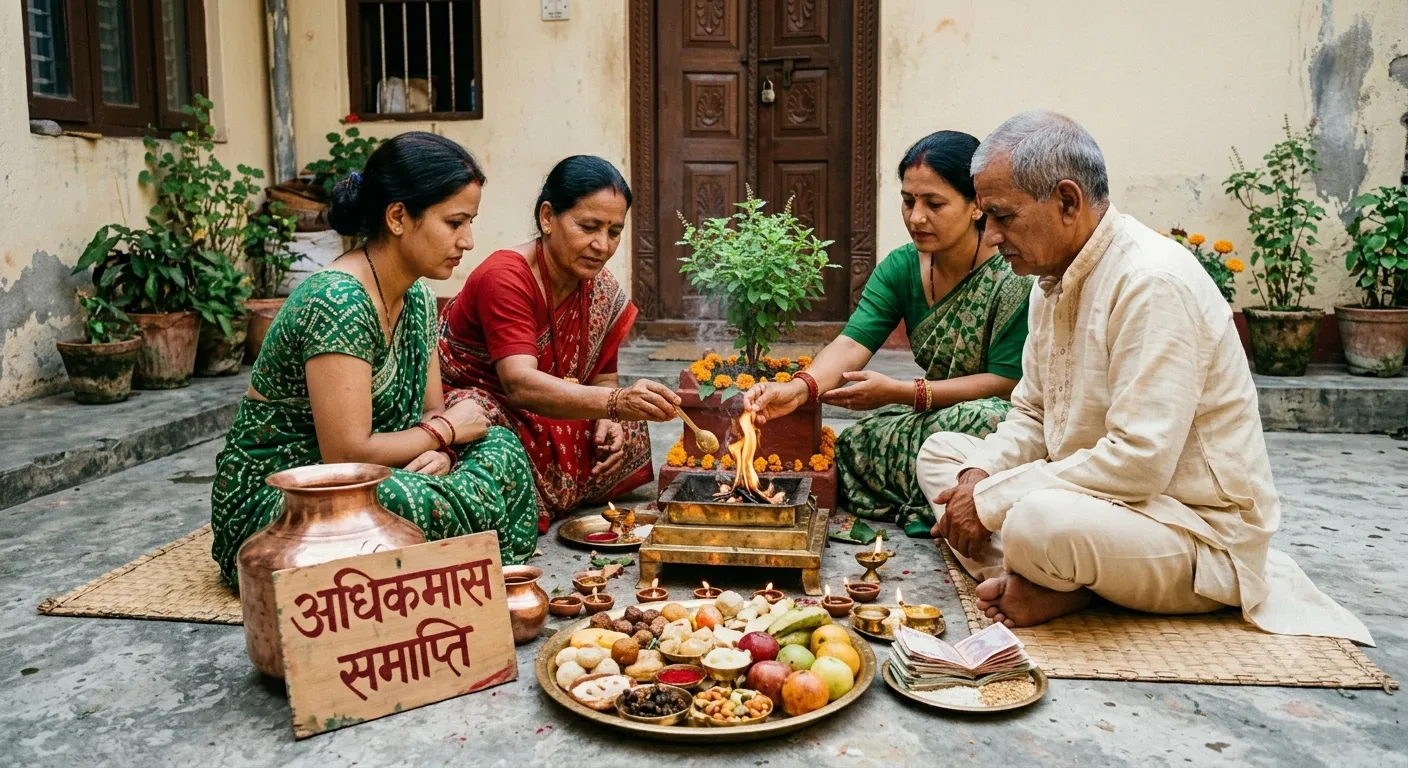
Udyapan ceremony, the formal conclusion of any vow taken during Purushottam Maas. Devotees rise before sunrise, take a sacred bath (Shuddhi Snan), sit before Lord Vishnu or a Shaligram, and formally declare the completion of their month-long commitment.
Final acts of charity, food grains, clothing, water vessels (Kamandalus), and dakshina are offered to Brahmin priests and the needy. Feeding Brahmins (Brahmin Bhojan) is considered especially meritorious on this closing day.
Malpuwa offering, following traditional custom, Malpuwa (a sweet deep-fried delicacy) is offered to Lord Purushottam and shared with family, relatives, sons-in-law, daughters, and priests as a festive conclusion to the month.
Pilgrimage to Matsyanarayan, final visits to the Matsyanarayan (Machhenarayan) Temple in Kirtipur mark the closing of the great Adhikmas fair. Devotees come to pay last respects to Vishnu in his Matsya (fish) avatar before the month concludes.
Recitation of Purushottam Maas Mahatmya, the scriptural narrative of Adhikmas, is recited or listened to as a final act of devotion, completing the month's spiritual cycle with gratitude.
Samapti is more than a calendar correction. Its significance runs deep:
It preserves the integrity of Nepal's lunisolar calendar, without the periodic insertion and formal conclusion of Adhikmas, the Nepali Patro's festivals, harvests, and seasonal rituals would gradually drift out of alignment with the natural year.
It unlocks a month's worth of deferred life events for families who have been waiting to hold weddings, Bratabandha ceremonies, or other rites of passage. Samapti is a moment of real practical relief and celebration.
It completes a rare spiritual window, Purushottam Maas comes only once every ~32 months. Samapti is the final opportunity within that window to accumulate the amplified merit that Vishnu is said to grant during this period. Missing Samapti is believed to leave a vow technically incomplete.
It honors the redemption story at the heart of Adhikmas; the once-despised Malamas were given dignity, a name, and divine guardianship. Samapti echoes that story: something irregular and overlooked is treated with full ritual respect and given a proper, meaningful close.
It strengthens community and family bonds. The sharing of Malpuwa, the gathering at Matsyanarayan, and the lifting of restrictions together create a shared collective moment that marks the end of an unusual period and the beginning of regular life again.
Adhikmas Samapti is not a spectacular day. There are no public fireworks, no national procession. But in the quiet act of completing a vow, offering a final plate of Malpuwa, and walking home from Matsyanarayan Temple knowing the calendar has been set right again, there is a deep satisfaction that is very Nepali. The extra month came, it was honored, and now it is complete. The regular world resumes, a little more spiritually aligned than before.