
|
Detail |
Information |
|
Date |
Shashthi tithi, Jyeshtha Shukla Paksha |
|
Duration |
Single-day celebration and fast |
|
Observance |
Religious, cultural, and environmental traditions |
|
Celebrated In |
Nepal, especially Kathmandu Valley, and Hindu communities across India and worldwide |
|
Observing Communities |
Hindu households broadly, the Newar community observes it as Sithi Nakha |
|
Type of Event |
Birth anniversary of Lord Kartikeya, also Nepal's ancient pre-monsoon water festival |
|
Purpose of Event |
To celebrate the birth of Lord Kumar Kartikeya and honor his victory over evil, Newar communities simultaneously clean water sources and complete the Diwali Puja before the monsoon begins |
|
Holiday Status |
Not an official public holiday in Nepal |
|
First Observed In |
Ancient Vedic period (detailed in the Skanda Purana) |
|
Also Known As |
Kumar Shashthi, Kumar Jayanti, Skanda Shashthi, Sithi Nakha (Newar), Sithinakh |
Quick Fact: Kumarsasthi is the only festival in Nepal's calendar that is simultaneously a divine birthday celebration and a community water conservation day. For broader Hindu households, it is Kumar Jayanti, the birth anniversary of Lord Kartikeya, the six-faced, peacock-riding son of Shiva. For the Newar community, the same day is Sithi Nakha, the annual occasion for cleaning wells, stone spouts, and ponds before the monsoon arrives. Two traditions, one tithi.
Most deities in the Hindu pantheon are ancient and remote. Kumar Kartikeya is neither. He was born in crisis, trained for war, and sent into battle as a child. When the gods were being crushed by the demon Tarakasura and had no one left to protect them, it was a young, six-faced warrior on a peacock who turned everything around. Kumarsasthi is the day that victory is remembered, and in Nepal, it is remembered in two very different but equally beautiful ways.
For Hindu families, it is a day of fasting, worship, and gratitude to the commander of the celestial army. For the Newar communities of the Kathmandu Valley, it is Sithi Nakha, the day every well is cleaned, every stone spout is scrubbed, and the valley prepares its water sources for the coming monsoon. Both observances fall on the same Shashthi tithi, and together they make Kumarsasthi one of the most layered festivals on the Nepali calendar.
According to the Skanda Purana, Kumar Kartikeya was born out of a cosmic necessity. The demon Tarakasura had grown so powerful that the gods themselves were driven from their thrones. Ancient prophecy declared that only Shiva's son could defeat him, but Shiva was deep in meditation, unreachable. When Agni (the Fire God), disguised as a mendicant, intervened, Shiva's divine energy eventually passed through the sacred River Ganga. From those holy waters, Kumar was born a child of fire, river, and divine will. This is why one of his names is Gangasut (son of Ganga). Raised by Shiva and Parvati, trained in the arts of war, Kumar grew into a six-faced (Shanmukha) warrior who rode a peacock into battle, led the Deva army, and destroyed Tarakasura completely. Indra was restored to his throne, and the gods returned to their rightful places.
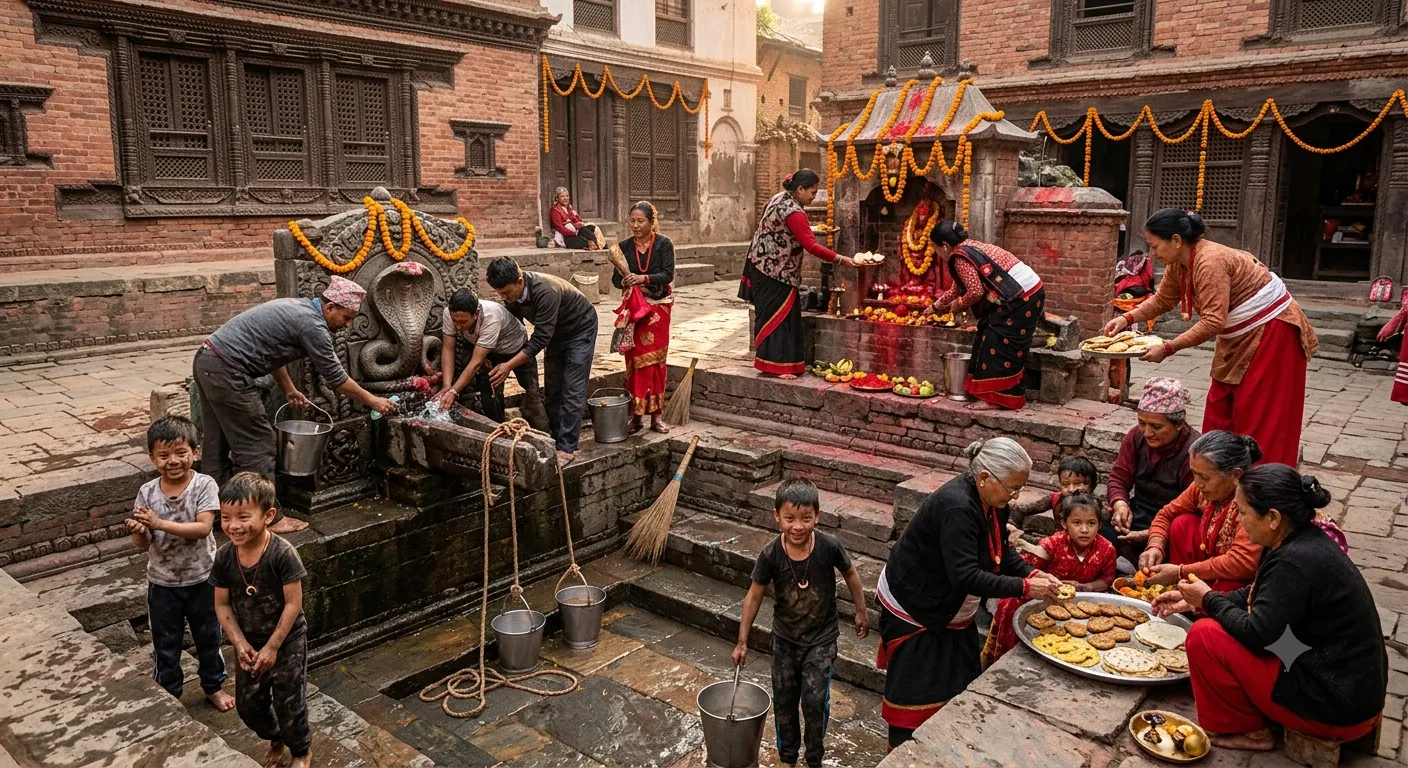
In Nepal's Kathmandu Valley, the Newar community adds a second layer of meaning to this day through Sithi Nakha. The word Sithi comes from the Sanskrit Shashthi (sixth), and Nakha means festival in Nepal Bhasa, so Sithi Nakha is simply the festival of the sixth day. But its purpose is deeply practical: falling just before the monsoon rains arrive, it is the ideal moment to clean wells, ponds, and stone water spouts (hiti) while water levels are at their lowest. Ancient belief holds that the Nagas, serpent deities who rule the water sources, temporarily leave their abodes at this time for their own ancestral worship, leaving the wells open for human tending. Historically, cleaning these sources by Sithi Nakha was not optional: community members who failed to complete their assigned section faced formal punishment.
This day is observed for reasons that span the divine and the deeply practical:
To celebrate the birth of Lord Kartikeya, Kumarsasthi is Kumar Jayanti, the annual birthday of the Deva Senapati (commander of the gods). Devotees worship him to honor his courage, his victory over evil, and his role as the eternal protector of dharma.
To seek protection from evil and illness, Kumar is the destroyer of demonic forces. Worshipping him on his birthday is believed to remove negativity, strengthen inner resolve, and ward off the ailments that come with the monsoon season.
To complete the Dewali Puja for the Newar community, Kumarsasthi is the final day of Dewali, the elaborate multi-day worship of family and ancestral deities (Digu Deya). All clan members must complete their offerings to their lineage gods by this day.
To clean and protect water sources before the monsoon, the Sithi Nakha tradition ensures that every community well, stone spout, and pond is cleared of silt, sediment, and debris before the rains arrive and water levels rise again. This is an ancient public health practice built into a festival.
To mark the seasonal transition, Sithi Nakha signals the close of the dry season and the beginning of the agricultural planting cycle. It is the last major festival before the intensity of monsoon farming begins.
The day carries distinct but complementary rituals across communities:
Fasting (Vrat) Hindu devotees observe a strict fast from sunrise, abstaining from food and water until the evening prayers at a Kartikeya temple are complete. Some observe a six-day fast leading up to Kumarsasthi itself.
Worship of Lord Kumar, the deity, is performed with sandalwood paste, kumkum (vermillion), turmeric, rose water, incense, ghee lamps, fresh flowers, and fruits. Aarti is performed with camphor, and naivedya (food offerings of fruits and sweets) is placed before the deity.
Chanting sacred hymns, devotees recite the Skanda Sashti Kavacham and the Subramaniya Bhujangam, hymns believed to invite Kumar's divine protection against disease, danger, and evil.
Drawing the six-petalled lotus in Newar households, the ground outside the main door is cleaned with red mud and cow dung, and a red circle is drawn. Inside it, a six-petalled lotus is sketched, representing Kumar's six faces, each face standing for a divine quality: spreading light, removing ignorance, blessing followers, protecting sacred rituals, sharing self-knowledge, and defeating evil.
Offering six-fold food inside the lotus circle, six kinds of cakes, six kinds of bread, and seasonal grains are placed as offerings. The main Newar dishes prepared are Bara (lentil pancakes made from six types of pulses) and Chatamari (rice flour crepes), offered first to Kumar and then consumed by the family.
Cleaning water sources, Newar community members enter wells, clean stone spouts, and clear ponds of silt and debris. Mica found in the valley soil is tossed into the wells as an offering to the Nagas who reside there.
Installing peacock figures in the Kathmandu Valley, small peacock-shaped huts or carvings are kept inside homes, representing Kumar's vehicle. Tradition holds that a peacock figure in the home brings prosperity and prevents evil spirits from entering.
It keeps alive the story of a god born to protect. Kumar Kartikeya was not born for personal glory. He came into being because the world needed a protector. Kumarsasthi reminds devotees that strength and courage are not only personal virtues, but they are responsibilities.
It is Nepal's oldest community water day, long before modern concepts of environmental conservation. Sithi Nakha embedded water-source maintenance into religious duty. Experts have suggested it deserves recognition as a national water festival, since clean water is a concern for all communities, not just the Newar.
The six-faced form carries layered meaning; each of Kumar's six faces (Shanmukha) serves a distinct divine purpose. Worshipping all six on his birthday is a reminder that protection, wisdom, and righteousness have many dimensions, and no single face of virtue is enough on its own.
It bridges community and ecology; few festivals in Nepal naturally merge the devotional with the practical. The act of cleaning a well before worship is not preparation for the ritual; it is the ritual. Service to the water source is itself an act of devotion.
It marks the closing of one seasonal chapter and the opening of another. Sithi Nakha is the last major festival before the monsoon begins. Homes are cleaned, water sources are restored, ancestral duties are fulfilled, and the community stands ready for the agricultural season ahead.
The peacock connection runs deeper than symbolizing the peacock, Kumar's vehicle, has long been associated with rain prediction in Nepali folk tradition. Its display before the monsoon is not incidental; the bird's dancing was read as a sign of approaching rains. Kumar's association with the peacock makes him, in essence, Nepal's original rain deity.
Kumarsasthi is a day that arrives quietly but carries a great deal. A warrior god is born from fire and a river. A six-year-old boy defeats a demon that full-grown gods could not. And down in the valley, before the rains come, someone is climbing into a well to clean it before the water rises. Both acts, the worship and the scrubbing, are the same thing. Both are ways of taking care of what matters.