
|
Fact |
Detail |
|
Date |
17 June every year |
|
Started in |
1995, after the UN declaration in 1994 |
|
Established by |
United Nations General Assembly |
|
Type of Event |
International Awareness Day |
|
Lead agency |
UN Convention to Combat Desertification (UNCCD) |
|
Land affected |
About 40% of the global land is degraded |
|
Goal by 2030 |
Restore 1.5 billion hectares of degraded land |
|
Key link |
Sustainable land use, water security, and climate resilience |
|
Holiday Status |
Not a Public Holiday |
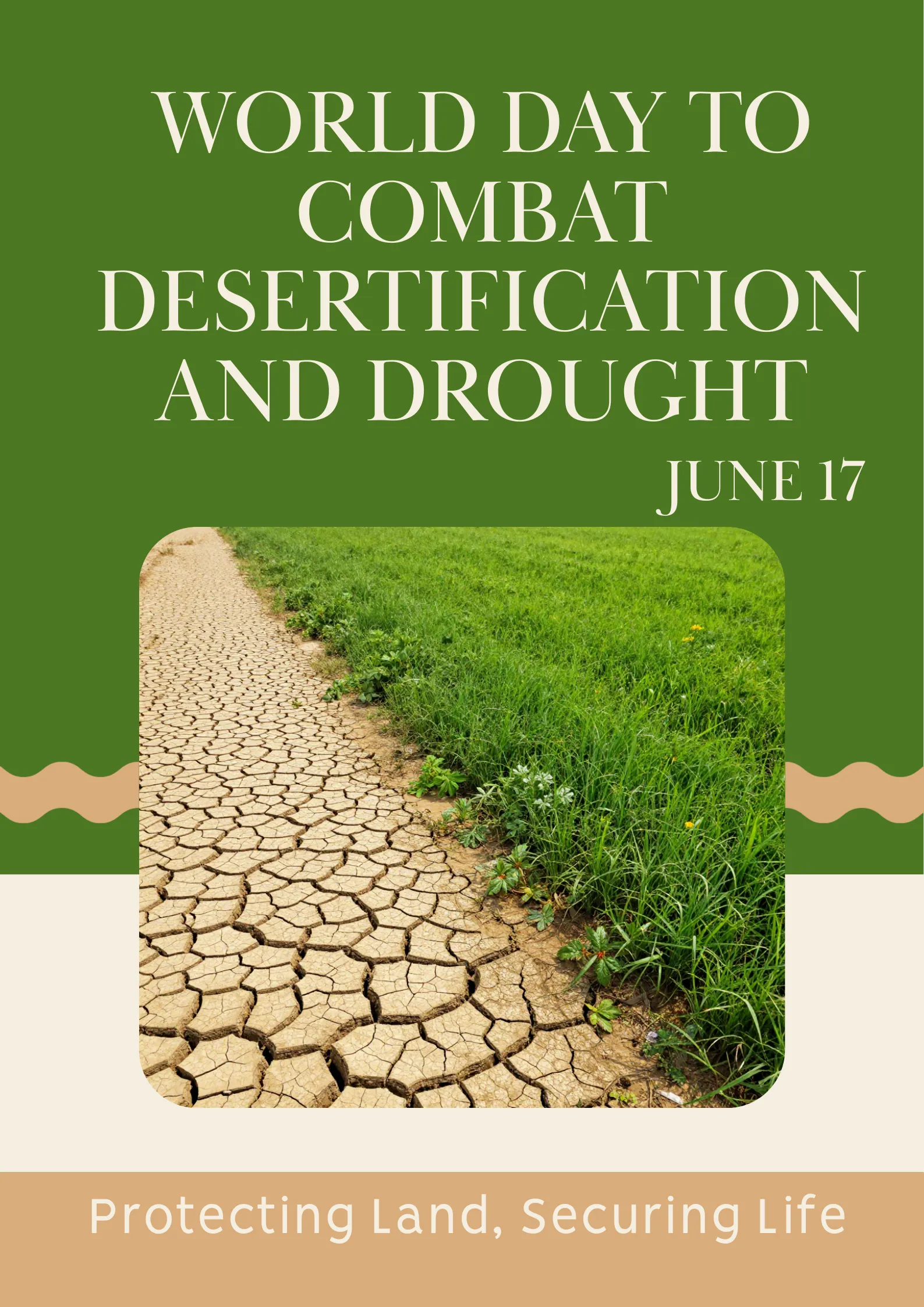
Every year, millions of hectares of land are lost to desertification, leaving communities struggling with food shortages, water scarcity, and poverty. On 17 June, the world comes together to observe World Day to Combat Desertification and Drought, a day dedicated to raising awareness about the dangers of land degradation and the urgent need to protect and restore our soils. This day is not just about numbers and reports; it’s about real people, fragile ecosystems, and the future of our planet. From farmers in drylands to cities facing water stress, desertification, and drought affects us all. By learning about these challenges and taking action, we can help ensure a sustainable and resilient world.
Desertification refers to the process by which fertile land becomes dry and less productive over time, especially in drylands. Human activities, from overgrazing and deforestation to unsustainable farming, make healthy soil turn barren.
Drought is a long period without enough rain that limits water for people, plants, and animals. These issues reduce crop yields, force families to move, and make communities poorer.
The need to fight desertification was first recognized at the 1992 United Nations Earth Summit, where leaders agreed that land degradation was a global threat. In response:
In 1994, the United Nations General Assembly adopted Resolution A/RES/49/115 and created the United Nations Convention to Combat Desertification (UNCCD).
The same resolution declared 17 June as World Day to Combat Desertification and Drought.
The day has been observed annually since 1995 to encourage global action.
The UNCCD is the only international treaty focused on sustainable land management and the recovery of degraded soil. Its work brings together governments, scientists, and communities to protect land.
Healthy land supports life in many ways:
Food and water: Most of the world’s food and water depend on healthy soil.
Climate resilience: Soil stores carbon and helps cool the planet.
Biodiversity: Diverse ecosystems flourish on rich land.
Jobs and economy: Half of the global gross domestic product (GDP) relies on nature and land.
When soil degrades, crop yields fall, food becomes more expensive, water shortages grow, and many people lose their way of life. These effects are especially strong in dry regions and poor communities.
The United Nations plays a major role in promoting this day and fighting desertification:
UNCCD leads global planning and coordination to reduce land degradation.
UN agencies work with countries to adopt better land practices and policies.
The UN Secretary‑General and other leaders release messages each year to encourage action.
The observance links to the UN Decade on Ecosystem Restoration (2021–2030), emphasizing land recovery worldwide.
More than 130 countries have pledged to reach land degradation neutrality by 2030, meaning land should be kept healthy or improved over time.
Each year, a theme guides the global message for the day and highlights specific issues or solutions.
|
Year |
Theme |
|
2025 |
Restore the land, Unlock the opportunities |
|
2024 |
United for Land Our Legacy Our Future |
|
2023 |
(Various global themes addressing drought and solutions) |
|
2022 |
(Speech focuses on rising from drought together) |
Past observances have focused on themes like land value, climate links, migration and poverty, and soil health. These themes help shape public campaigns and policy priorities.
World Day to Combat Desertification and Drought is marked by many activities aimed at education and action:
Public awareness events and talks at schools, universities, and communities.
Workshops for farmers on sustainable land practices.
Government and UN events that bring together experts and leaders.
Social media campaigns with hashtags like #DesertificationAndDrought and #17June.
These events help people learn how every action, from planting trees to saving water, can help protect land.
Several programs show how action can make a difference:
The Great Green Wall Initiative in Africa aims to restore millions of hectares of degraded land.
Countries host global events to showcase local land restoration and share best practices.
Such efforts reduce soil loss, protect water resources, and improve local jobs and food security.
Even small steps matter:
Plant trees and protect vegetation.
Use water wisely and support local water‑saving projects.
Support policies that protect farmers and promote sustainable farming.
Learn and share with friends about how land and drought affect our future.
World Day to Combat Desertification and Drought is more than a date on the calendar; it’s a call to action. Healthy land is the foundation of life, providing food, water, and livelihoods for billions of people. Every tree planted, every drop of water conserved, and every effort to support sustainable farming contribute to a brighter future. This 17 June, let’s not just observe the day, let’s act. Join communities, governments, and organizations worldwide in restoring degraded lands, fighting drought, and securing a healthier planet for generations to come. Together, our actions can turn dry soil into thriving land and hope into lasting change.