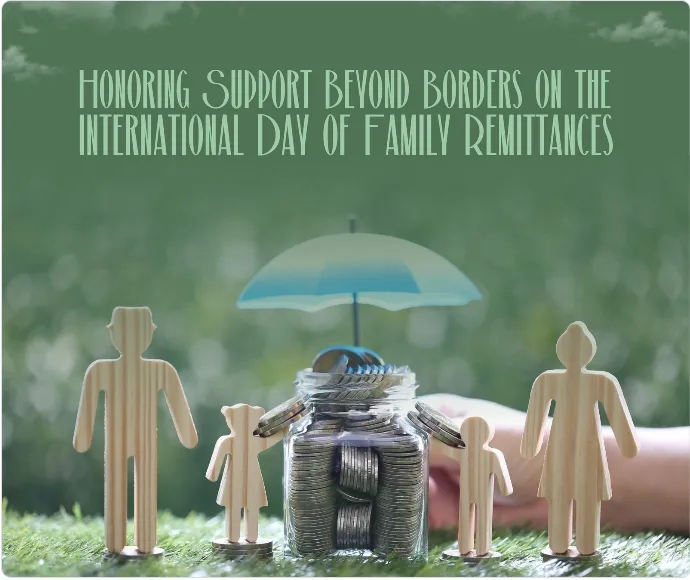
There is an international day for almost everything. This one is different for Nepal because Nepal is one of the countries it was written for.
The International Day of Family Remittances falls on 16 June every year. It recognises more than 200 million people working outside their own country who send part of what they earn back to their families, and the roughly 800 million family members who live on that money.
In Nepal, the numbers are not abstract. Remittances were worth Rs 1.723 trillion in fiscal year 2081/82 and made up 28.6 percent of the country's entire GDP. There is no other single flow of money in the Nepali economy that comes close. Every school fee, hospital bill, land purchase and roof slab in a large share of Nepali households is paid for by someone who is not in the room.
That is what this day is about. Not aid, not investment, not policy. Money sent home by one family member to another, in small amounts, month after month.
|
Detail |
Information |
|
Date |
16 June, every year |
|
Full Name |
International Day of Family Remittances (IDFR) |
|
Proposed by |
International Fund for Agricultural Development (IFAD), a specialised agency of the United Nations |
|
First Observed |
2015, adopted by the IFAD Governing Council |
|
Universally Adopted |
12 June 2018, when the United Nations General Assembly unanimously adopted Resolution A/RES/72/281 |
|
People It Recognises |
More than 200 million migrant workers |
|
People It Affects |
Around 800 million family members in origin countries |
|
Linked Global Forum |
Global Forum on Remittances, Investment and Development (GFRID), whose summit is held around this day |
|
Public Holiday |
No. It is an awareness and advocacy day |
|
Nepal Relevance |
Remittances accounted for 28.6% of Nepal's GDP in FY 2081/82 |
A family remittance is a personal, private transfer. One person sends money they earned abroad to a household in their country of origin. It is not charity, not foreign aid, and not a loan. It is a household's own income, earned in one place and spent in another.
The typical remittance is a few hundred dollars, sent every month or every two months. The global total is enormous only because there are so many of them.
Aid passes through governments and agencies. Foreign investment goes to companies. Remittances land in the hands of a mother, a wife, a father, or a sibling and are spent on the things the household decides matter.
When a disaster or an economic shock hits the country of origin, remittances usually increase rather than decrease. Migrants send more when their families need more. This happened in Nepal after the 2072 BS earthquake and again through the pandemic period, and it is one of the strongest arguments used by IFAD for taking remittances seriously as a development flow.
The International Fund for Agricultural Development proposed the International Day of Family Remittances, and it was adopted by IFAD's Governing Council. IFAD, not a bank or a payments body, is the agency that carries this file, because a very large share of remittance flows to rural households in developing countries, and IFAD's mandate is rural poverty.
The day was observed by IFAD, the Global Forum on Remittances, national governments, central banks, money transfer operators, migrant associations and diaspora groups, but without formal United Nations status.
The United Nations General Assembly unanimously adopted resolution A/RES/72/281, making 16 June an official United Nations observance. The resolution invited all member states, United Nations bodies and other stakeholders to observe the day and encouraged them to work towards cheaper, safer remittance channels.
The date was chosen to fall in the middle of the year and to align with the international discussions on migration and development that were running at the time, including the process that led to the Global Compact for Safe, Orderly and Regular Migration adopted later in 2018. It is not tied to any single historical event, which is why the day has no anniversary story attached to it.
The clearest numbers come from the World Bank's migration and development briefs and from IFAD.
Remittances to low- and middle-income countries reached about 685 billion United States dollars in 2024, the highest annual figure recorded
That total is larger than foreign direct investment and official development assistance to those countries combined
India is the largest single recipient, receiving about 129.1 billion dollars in 2024, roughly 14.3 percent of the global total, the highest share any country has recorded since 2000
More than 200 million migrant workers send money, supporting around 800 million family members
Roughly one in nine people in the world benefits directly from remittances
About half of all remittance money goes to rural areas, which is why IFAD is the agency that owns this day
Remittances are estimated to be spent roughly 75 percent on immediate needs, food, housing, medical bills, school fees and debt, with the remaining quarter available for savings or investment
That last figure is the one IFAD builds its campaign on. If even part of the remaining quarter can be moved into savings, insurance or productive investment, the effect on origin countries would be very large.
Sending money across a border costs money. The person paying that cost is usually a worker on a low wage, sending a small amount.
Sustainable Development Goal target 10.c commits the world to reducing the average transaction cost of migrant remittances to less than 3 percent by 2030, and to eliminating remittance corridors with costs higher than 5 percent.
The world is not on track. The global average cost of sending 200 dollars has been sitting above 6 percent for years, more than double the target. In the most expensive corridors, mostly in sub-Saharan Africa and in small island states, costs are far higher.
The cost has several parts, and only the first one is visible.
The upfront fee charged by the operator
The exchange rate margin, which is the difference between the rate you are given and the real mid-market rate, and which is often larger than the fee itself
Correspondent banking charges deducted along the way
Cash out charges at the receiving end
The exchange rate margin is where most people lose money without noticing. A transfer advertised as zero fee is very rarely free.
Every percentage point saved on the cost of sending is money that arrives in a household rather than staying with an intermediary. On global flows of the size described above, moving the average from 6 percent to 3 percent would put tens of billions of dollars a year into the hands of families instead of into fees.
Nepal is among the most remittance-dependent economies in the world, and this section is what makes this page useful to a Nepali reader rather than a copy of a global press release.
Remittance inflow in fiscal year 2081/82 reached a record Rs 1.723 trillion
That was 28.6 percent of Nepal's GDP, the highest share recorded since 2072/73
The inflow grew by about 19.2 percent over the previous fiscal year
The share had fallen to around 20 percent by 2078/79 before recovering strongly from 2080/81 onwards
The Department of Foreign Employment issued 839,266 labour permits in fiscal year 2081/82, of which 744,811 went to men and 94,455 to women
Over roughly the last five years, more than 3.5 million labour permits have been issued
The main destination countries are the United Arab Emirates, Saudi Arabia, Qatar, Kuwait and Malaysia, with Romania, Japan, South Korea, Croatia and Bahrain rising fast
These figures exclude India entirely, because Nepal and India have an open border and no permit is required, which means a very large migrant population and a very large money flow are simply not captured in official numbers
Household survey evidence in Nepal is consistent year after year. The largest shares of remittance income go to daily consumption, repayment of loans taken to fund the migration itself, education, health care, and house construction. A smaller share goes into land purchase, and a much smaller share into business or financial savings.
This is often written up as a criticism, as though households are spending badly. That framing is unfair. A household that has just paid off a 60 percent annual interest loan taken to buy a plane ticket and an agent fee has made an excellent investment decision. The problem is not what families choose. The problem is that the migration itself is financed by debt.
This is the part of the story that the celebratory version of this day tends to skip. A worker leaving for the Gulf or Malaysia frequently pays fees far above the legal limit, financed by borrowing at high interest against land or gold. Nepal has a free visa, free ticket policy for several destinations, and its enforcement has been patchy for years. The result is that a worker can spend the first year abroad clearing the debt that got them there, and only start actually remitting in year two.
Thousands of Nepali workers have died abroad since foreign employment began at scale, and the bodies come back through Tribhuvan International Airport regularly enough that the figure is tracked publicly. Workplace accidents, heat, cardiac events described as natural causes, and suicide all feature. Injury and permanent disability affect many more. The Foreign Employment Board runs a welfare fund financed by worker contributions that provides compensation to families, and its adequacy is debated every year.
Any honest page about the International Day of Family Remittances in a Nepali context has to hold both facts at once. The money is transformative, and the way it is earned costs lives.
Money should come into Nepal through a bank or through a remittance company licensed by Nepal Rastra Bank. The large licensed operators include IME, Prabhu Money Transfer, City Express and Western Union among others, alongside the banks themselves.
Sending through a licensed channel means the transaction is recorded, the receiver has legal recourse if something goes wrong, the money counts in the national reserves, and the sender's family is not exposed to an unregulated intermediary.
Hundi, also called hawala, is the informal transfer system in which a sender hands cash to an agent abroad and a counterpart agent pays out the equivalent in Nepal, with no money actually crossing the border. It is fast, it is often slightly cheaper, and it is illegal in Nepal.
The risks are real, and they fall on the sender's family, not on the agent.
There is no legal recourse. If the payout does not arrive, there is nobody to complain to
The same networks are used for smuggling, gold trade, tax evasion and money laundering, which means an ordinary worker's transfer can be caught up in a criminal investigation
The money never enters Nepal's foreign exchange reserves, which weakens the currency position that every Nepali household depends on
Bank account holders receiving unexplained cash deposits can face account freezes and questions
Nepal Rastra Bank and the government have repeatedly campaigned against hundi, and the fact that they need to keep campaigning tells you how much volume still moves that way.
Compare the total cost, not the advertised fee. Take the amount your family will receive in rupees and divide by the amount you sent. That is your real rate
Check the mid-market rate for the day before you send, so you can see the margin you are being charged
Larger, less frequent transfers usually cost less per rupee than small frequent ones, though this has to be balanced against what the household actually needs each month
Bank-to-bank and mobile wallet transfers are usually cheaper than cash-to-cash
Ask about promotional rates during festival periods, as Nepali operators commonly run better rates around Dashain and Tihar
Nepal Rastra Bank has introduced measures aimed at pulling remittance money into the formal savings system, including permitting higher interest on deposits opened with remittance income and issuing foreign employment savings bonds, the Bideshi Rojgar Bachat Patra, aimed specifically at migrant workers. Uptake of the bonds has historically been low, largely because information does not reach workers before they leave. A migrant worker or their family should ask their bank directly about current remittance-linked deposit products.
IFAD and the United Nations publish statements, data releases and reports
The Global Forum on Remittances, Investment and Development holds its summit around this date, bringing together central banks, regulators, payment companies, development agencies and diaspora organisations
Central banks and financial regulators announce measures on transfer costs and financial inclusion
Money transfer operators run fee promotions, which is marketing but does deliver a real saving for whoever sends that week
Migrant worker associations and diaspora groups hold events, panels and cultural programmes
Nepal Rastra Bank, the Ministry of Labour, Employment and Social Security, and the Foreign Employment Board hold programmes and issue data
Remittance companies run campaigns, discounted rates and prize schemes
Migrant rights organisations use the day to press on recruitment costs, worker deaths, insurance claims and the free visa-free ticket policy
Media publish features on migrant families and on the economy's dependence on remittance income
Financial literacy sessions are held for the families who receive the money, which is arguably the highest value activity of the whole day
Send through a legal channel and tell others to do the same
Compare rates properly once a year rather than staying with the first operator you used
If you receive remittances, put even a small fixed portion into a savings account or an insurance product before it enters household spending
Talk to a departing worker in your own family about what they are being charged and what the legal limit is
When is the International Day of Family Remittances?
→ 16 June, every year. The date is fixed and does not move.
Who created the International Day of Family Remittances?
→ The International Fund for Agricultural Development, IFAD, a specialised agency of the United Nations. It was first observed in 2015 after adoption by IFAD's Governing Council.
When did the United Nations officially recognise the day?
→ On 12 June 2018, when the General Assembly unanimously adopted resolution A/RES/72/281.
How many people does this day represent?
→ More than 200 million migrant workers who send money home, supporting around 800 million family members in their countries of origin.
How much money is sent in remittances every year?
→ Remittances to low- and middle-income countries reached about 685 billion United States dollars in 2024, the highest figure recorded. That total is larger than foreign direct investment and official development assistance to those countries combined.
How important are remittances to Nepal?
→ Extremely. Remittances reached Rs 1.723 trillion in fiscal year 2081/82, equal to 28.6 percent of Nepal's GDP, a share not seen since 2072/73.
How many Nepalis go abroad for work each year?
→ The Department of Foreign Employment issued 839,266 labour permits in fiscal year 2081/82. That figure excludes migration to India, which requires no permit because of the open border, so the real number of Nepalis working abroad is considerably higher.
Which countries do most Nepali migrant workers go to?
→ The United Arab Emirates, Saudi Arabia, Qatar, Kuwait and Malaysia account for the largest numbers, with Romania, Japan, South Korea, Croatia and Bahrain growing quickly.
What is the SDG target on remittance costs?
→ Sustainable Development Goal target 10.c commits to reducing the average cost of sending remittances to below 3 percent by 2030 and to eliminating corridors with costs above 5 percent. The global average has been running above 6 percent, so the target is not on track.
What is hundi and is it legal in Nepal?
→ Hundi, also called hawala, is an informal transfer network in which cash is handed to an agent abroad and paid out by a counterpart in Nepal without money crossing the border. It is illegal in Nepal, offers no legal recourse if the payout fails, and keeps the money out of the country's foreign exchange reserves.
What is the cheapest way to send money to Nepal?
→ Compare the amount actually received in rupees against the amount sent, rather than looking only at the advertised fee, because the exchange rate margin is usually the higher cost. Bank-to-bank and wallet transfers through Nepal Rastra Bank-licensed operators are generally cheaper than cash-to-cash, and larger, less frequent transfers cost less per rupee.
Is the International Day of Family Remittances a public holiday?
→ No. It is an awareness and advocacy day and is not a public holiday in Nepal or anywhere else.
Why does IFAD lead this day rather than a bank or a payments organisation?
→ Because roughly half of all remittance money goes to rural households in developing countries, and IFAD's mandate is rural development and rural poverty. The day is framed as a development issue, not a payments industry issue.
What is GFRID?
→ The Global Forum on Remittances, Investment and Development, a process bringing together central banks, regulators, payment providers, development agencies and diaspora groups. Its summit is held around the International Day of Family Remittances.
Do remittances go up or down during a crisis?
→ They usually go up. Migrants send more when their families need more, which makes remittances counter-cyclical and more reliable than aid or investment during a shock. This was visible in Nepal after the 2072 BS earthquake and again through the pandemic period.