
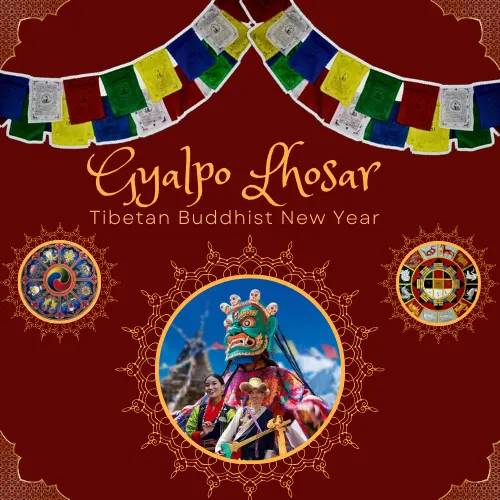
Gyalpo Lhosar (གཡལ་པོ་ལྷོ་སར་) — "King's New Year" — is the most sacred celebration in the Tibetan Buddhist calendar.
Date:Falgun 6
Where: Sherpa communities across Nepal's Himalayan regions
What: A 3-day festival of prayer, community, and spiritual renewal
Gyalpo Lhosar translates to "King's New Year" in Tibetan, distinguishing it from other Lhosar celebrations observed by different Tibetan Buddhist groups. It is the lunar new year according to the Tibetan calendar system, which differs from both the Gregorian calendar and the Hindu lunar calendar used in many parts of Nepal.
The festival is called "Gyalpo" specifically because it marks the new year celebrated by the Sherpa people of Nepal and Bhutan, who follow the Tibetan Buddhist tradition. The term "Lhosar" (ལྷོ་སར་) literally means "new year" in Tibetan—"Lho" meaning new and "Sar" meaning year.
Key Characteristics:
Duration: Three days of intensive celebration
Spiritual Focus: Buddhist prayers, meditation, and rituals
Community Emphasis: Strengthening family and community bonds
Calendar System: Follows the Tibetan lunar calendar (different from the Gregorian year)
Geographic Reach: Celebrated across Nepal's mountain regions, particularly in:
Solukhumbu District (Sherpa heartland)
Sankhuwasabha
Kathmandu Valley
Darjeeling region (India)
Parts of Bhutan
| Category | Details |
|---|---|
| Duration | 3 days |
| Calendar | Tibetan lunar |
| Primary Communities | Sherpa, Bhutia, Tibetan Buddhists |
| Main Locations | Solukhumbu, Kathmandu, Darjeeling |
| Focus | Spiritual renewal, family bonds, cultural pride |
| Holiday Status | Public Holiday |
Solukhumbu District (The Sherpa Heartland)
Namche Bazaar — main trading town with large celebrations
Tengboche Monastery — elaborate 3-day festivities
Thamo Monastery — ancient ceremonies
Junbesi — traditional Sherpa village
Kathmandu Valley (Urban Celebrations)
Boudhanath Stupa — massive public gatherings
Swayambhunath Stupa — sacred Buddhist site
Sherpa neighborhoods — community feasts
Sankhuwasabha District — Makalu region, intimate family celebrations
The origins of Gyalpo Lhosar trace back to pre-Buddhist Tibetan traditions that were later integrated with Buddhist philosophy and practices. The festival's history spans over a thousand years, making it one of the oldest continuously celebrated festivals in the Himalayan Buddhist world.
Before Buddhism arrived in Tibet in the 7th century, Lhosar was a new year celebration in the Tibetan calendar system. The festival was rooted in ancient astronomical observations and agricultural cycles that governed life in the high-altitude Himalayan regions. Tibetan communities tracked seasons and years through a sophisticated lunar calendar system, and Lhosar marked the most important transition point in this calendar.
When Buddhism spread across Tibet and the Himalayan regions, particularly through the teachings of Padmasambhava (Guru Rinpoche) in the 8th century, the festival was seamlessly integrated into Buddhist practice. Rather than replacing Lhosar, Buddhist traditions enriched it with spiritual dimensions. Monks began incorporating extensive prayer ceremonies, butter lamp offerings, and purification rituals into the celebration.
As Sherpa communities migrated to the Nepal Himalayan regions—particularly Solukhumbu District and surrounding areas—they carried Gyalpo Lhosar traditions with them. Over centuries, the celebration evolved to reflect the unique geography, spiritual practices, and community strucerpa people.
Today's Gyalpo Lhosar represents a beautiful synthesis of:
Ancient Tibetan astronomical traditions
Buddhist spiritual practices
Sherpa community values
Himalayan cultural heritage
To understand Gyalpo Lhosar, it's essential to understand the Tibetan lunar calendar upon which it's based. The Tibetan calendar system is fundamentally different from both the Gregorian calendar and the Hindu lunar calendar.
Basic Structure:
The Tibetan year consists of 12 lunar months
Each month is approximately 29.5 days (the lunar cycle)
7 leap months are added every 19 years to synchronize with solar cycles
Years are named according to a 12-animal cycle (similar to the Chinese zodiac but with different animals)
Months are also named according to seasonal and celestial associations
Year Naming Cycle:
The Tibetan calendar uses a 12-animal cycle to name years:
Mouse/Rat
Ox
Tiger
Rabbit/Hare
Dragon
Snake
Horse
Goat/Sheep
Monkey
Bird/Rooster
Dog
Pig
Gyalpo Lhosar Date Variations:
Because the Tibetan calendar is lunar-based, Gyalpo Lhosar falls on different dates in the Gregorian calendar each year. It typically occurs between late January and late March, depending on the lunar cycle.
Gyalpo Lhosar is far more than a cultural celebration; it is a profoundly spiritual occasion rooted in Buddhist philosophy and practice.
Renewal and Purification:
At its core, Lhosar represents spiritual renewal. The new year marks a fresh beginning—a time when practitioners renew their Buddhist vows and dedicate themselves to spiritual practice. It is a moment of purification, where past mistakes are acknowledged and released, and new intentions are set for the year ahead.
Interconnectedness:
Lhosar celebrates the interconnectedness of all beings. The festival reinforces Buddhist teachings on compassion (karuna), loving-kindness (metta), and the interdependence of all existence. Community gatherings during Lhosar embody these principles as families and entire communities come together in shared celebration.
Karmic Renewal:
From a Buddhist perspective, Lhosar is an auspicious time to generate positive karma. Actions taken during this sacred period are believed to carry multiple times the spiritual merit. Many Buddhists intensify their meditation practices, make offerings to monasteries, and engage in acts of charity during Lhosar.
For Sherpa communities, Gyalpo Lhosar is a powerful expression of cultural identity. In a rapidly modernizing world, the festival serves as an anchor to ancestral traditions, values, and spiritual lineage. Celebrating Lhosar is a way of saying: "We are Sherpa. We are Buddhists. We are part of a living tradition that spans centuries."
The festival strengthens:
Community bonds: Families gather, often traveling from distant places to be together
Cultural pride: Young people learn traditions from elders
Spiritual connection: Practitioners deepen their Buddhist faith
Heritage preservation: Traditions are passed down through generations
The Sherpa people have historically lived in high-altitude mountain environments where survival depends on careful observation of natural cycles and spiritual harmony with the environment. Lhosar celebrates this deep connection between human communities and the natural world. Prayer flags placed on mountain peaks during Lhosar send blessings to all beings, reflecting the belief that mountains are sacred spaces connecting earth and heaven.
Before Dawn:
Family prayers at household shrines
Light the first butter lamps of the new year
Elders bless younger family members
Morning Rituals:
Monastery pilgrimages
Community prayer services with monks
Fresh intentions set for the year ahead
The Guthuk Tradition: Special dumpling soup eaten first, with symbolic fillings that supposedly reveal your nature for the year:
| Finding | Meaning |
|---|---|
| White clay | Purity needed |
| Chili pepper | You're the "gossip." |
| Salt | Hard work ahead |
| Sugar | Sweetness & joy |
| Barley | Prosperity |
| Wool | Long life |
At Monasteries:
Elaborate ritual dances by monks
Lhosar masked dances (Tsechu)
Hundreds of butter lamps lit
Community feasts
In Towns & Villages:
People wear the traditional Sherpa dress
Singing, dancing, feasting
Young people gather to socialize
Cultural programs with traditional music
Blessing Exchange:
"Tashi Delek" (ཀ་རབ་དགེ་) — "May auspiciousness prevail for you."
Morning: Final prayers, donations to monasteries, acts of charity
Afternoon: Pilgrimages to sacred mountains, installation of new prayer flags, prayers carried by wind to all beings
Evening: Spiritual closure, renewed commitments, community solidarity
A special noodle soup with 9-21 dumplings, each containing symbolic fillings. Playful family tradition where what you find in your dumpling supposedly reveals something about your character or the year ahead.
What's Inside:
| Filling | Meaning |
|---|---|
| Flour & butter | Ordinary person |
| White clay | Need for purification |
| Chili | Gossip or sharp tongues |
| Salt | Hardworking people |
| Sugar | Kind & sweet people |
| Barley | Prosperity |
| Wool | Long life |
| Mustard | Bravery |
| Coins | Wealth |
Colorful flags inscribed with Buddhist prayers and mantras are installed on mountain peaks during Lhosar.
The Five Colors:
| Color | Meaning |
|---|---|
| Blue | Sky & space |
| White | Clouds & air |
| Red | Fire & protection |
| Green | Water & harmony |
| Yellow | Earth & grounding |
As the wind blows through the flags, prayers are believed to be carried to all beings across the Himalayan region and beyond.
Small clay lamps filled with butter and a wick, lit in monasteries, homes, and shrines during Lhosar.
What They Symbolize:
Light of wisdom dispelling darkness
Each lamp represents a prayer or intention
Different purposes: honoring the deceased, gratitude, prayers for all beings, and spiritual intentions
Visual Impact: Hundreds of butter lamps lit together create spectacular displays of flickering light in monasteries.
Many Sherpa people wear traditional clothing during celebrations, especially on Day 2.
Traditional Dress Elements:
| Item | Description |
|---|---|
| Chuba | Long, thick woolen robe (men & women) |
| Pangden | Striped apron (women, shows marital status) |
| Jewelry | Silver with turquoise & coral |
| Hat | Distinctive traditional Sherpa design |
Significance: Honoring ancestral heritage and cultural pride.
Families prepare elaborate meals with special dishes that may take weeks to prepare.
Traditional Foods:
Guthuk — Symbolic dumpling soup
Losar Bread (Togay) — Fried dough shaped like victory banners
Momo — Dumplings with various fillings
Thukpa — Hearty noodle soups with meat and vegetables
Chang — Traditional barley or rice beer
Butter Tea — Staple hot drink (served continuously!)
Sweetmeats — Traditional desserts
What It Represents: Gratitude for survival, community bonding, spiritual offerings (shared with the altar first), and knowledge transmission between generations.
Location: Solukhumbu District (3,860 meters / 12,670 feet)
What Happens:
Elaborate 3-day ceremonies
Lhosar masked dances by monks
Thousands of butter lamps lit
Large community feasts
Accessible by trekking from Namche Bazaar
Best For: Most important Sherpa monastery; most authentic experience
Location: Solukhumbu District (17th century, one of the oldest Sherpa monasteries)
What Happens:
Traditional ceremonies (ancient practices)
Intimate community gatherings
Prayer flag installation
Sacred fire ceremony (Tsenshug)
Best For: Most authentic traditional practices
Location: Kathmandu Valley (one of the world's largest Buddhist stupas)
What Happens:
Thousands of participants
Continuous circumambulation (walking clockwise)
Prayer ceremonies by monks
Cultural programs & performances
Tourist-friendly environment
Best For: Easy airport access, diverse community, world-class accommodations
Location: Hilltop overlooking Kathmandu (ancient Buddhist shrine)
What Happens:
Prayer ceremonies & rituals
Community gatherings
Panoramic valley views during celebrations
Best For: Historic site with stunning views
| Year | Dates |
|---|---|
| 2026 | February 24–26 |
| 2027 | February 14–16 |
| 2028 | February 2–4 |
| 2029 | February 21–23 |
Note: Dates change yearly because the Tibetan calendar is lunar-based (follows moon cycles, not a fixed solar calendar)
Arrive: 1-2 days before (experience preparations)
Stay: Full 3 days (core celebration)
Recommended Total: 5-7 days (with acclimatization)