Jitiya Parva 2083 falls on Asoj 18, which is Sunday, 4 October 2026. The festival runs across three days, from Asoj 17 to Asoj 19, and the fast itself is kept on the middle day.
Jitiya, also called Jiutiya and known in Sanskrit as Jivitputrika Vrat, is one of the hardest fasts anyone in Nepal keeps. Mothers go a full day and a full night without food and without a single sip of water, and they do it for one reason: the long life of their children. There is no feast at the centre of this festival, no procession, no jatra. There is a small clay figure on a leaf, a story told out loud, a night of singing, and a very long wait for morning.
It is observed across the Tarai and Madhesh, most of all by Maithili and Tharu women, and in the Indian states of Bihar, Jharkhand, Uttar Pradesh, and West Bengal. In Nepal, it is a public holiday for women employees who observe it.
|
Nepali name |
जितिया पर्व (Jitiya Parva) |
|
Also called |
Jiutiya, Jitiya Pawani, Jivitputrika Vrat (जीवित्पुत्रिका व्रत), Khar Jitiya |
|
Tithi |
Ashwin Krishna Ashtami, with Saptami before and Navami after |
|
Date in 2083 BS |
Asoj 18, Sunday 4 October 2026 |
|
The three days |
Asoj 17, 18 and 19 (3, 4 and 5 October 2026) |
|
Kept by |
Mothers, mainly married women, for their children |
|
The fast |
Nirjala, meaning no food and no water, through a full day and night |
|
Presiding figure |
Jimutvahana, worshipped as Jitbahan or Jitmahan |
|
Main communities |
Maithili, Tharu, Bhojpuri and Awadhi-speaking families of the Tarai and Madhesh |
|
Main districts |
Dhanusha, Mahottari, Siraha, Saptari, Sarlahi, Rautahat, Bara, Parsa, Chitwan, Nawalparasi, Dang, Banke, Bardiya, Kailali, Kanchanpur, Morang, Sunsari, Jhapa |
The main day, the day of the nirjala fast, is Asoj 18, 2083 BS, which is Sunday, 4 October 2026.
The three days run like this:
|
Day |
Nepali date |
English date |
Tithi |
What happens |
|
Day 1 |
Asoj 17 |
Saturday 3 October 2026 |
Saptami |
Nahai Khai, or Laha Khaeke. Bathing and the last full meal |
|
Day 2 |
Asoj 18 |
Sunday 4 October 2026 |
Ashtami |
Khar Din. The nirjala fast and the night vigil |
|
Day 3 |
Asoj 19 |
Monday 5 October 2026 |
Navami |
Paran. The fast is broken |
Jitiya is fixed to a tithi, not to a date. It falls on the Ashtami of the waning fortnight of Ashwin, and the tithi is set by the position of the moon, not by the calendar month. So the festival lands on a different Nepali date and a different English date every year.
Most years it moves about eleven days earlier than the year before. But once every two or three years an extra lunar month, called adhik maas, is inserted to bring the lunar and solar years back into line. In those years, the festival jumps forward by about nineteen days instead.
2026 is one of those years. Adhik Jyeshtha Maas fell from 17 May to 15 June 2026, which is why Jitiya moved from 15 September in 2025 all the way to 4 October in 2026, a swing of nineteen days in the wrong direction from what people expect. If you remembered roughly when Jitiya was last year and assumed it would be a bit earlier this year, you would be three weeks off.
|
Bikram Sambat |
Nepali date |
English date |
Day |
|
2080 |
Asoj 20 |
6 October 2023 |
Friday |
|
2081 |
Asoj 9 |
25 September 2024 |
Wednesday |
|
2082 |
Bhadra 30 |
15 September 2025 |
Monday |
|
2083 |
Asoj 18 |
4 October 2026 |
Sunday |
If you look at an Indian panchang for 2026, you will probably see Jivitputrika Vrat listed on Saturday 3 October. Nepal's calendar and the Government of Nepal's holiday list both say Asoj 18, Sunday 4 October.
Neither is a mistake. The Ashtami tithi does not begin and end at midnight. It runs across parts of two English days, and different traditions decide differently which of those two days carries the vrat, depending on where the tithi sits relative to sunrise. Some years the two traditions agree, as they did in 2081 when both placed Jitiya on 25 September 2024. Some years they are a day apart, as in 2082 and again in 2083.
If you are in Nepal, follow the Nepali date. The holiday, the local priest's timing, and the community programmes all run on Asoj 18. If your family has always followed a particular panchang or a particular purohit, follow that, because Jitiya is kept household by household and a one-day difference between neighbours is normal in the Tarai.
Jitiya belongs to the plains. It is kept across the Tarai and Madhesh by Maithili, Tharu, Bhojpuri and Awadhi-speaking families, and it continues across the open border into Bihar, Jharkhand, eastern Uttar Pradesh and parts of West Bengal.
Within Nepal, the two largest groups are:
Maithili families of Mithila. Dhanusha, Mahottari, Siraha, Saptari, Sarlahi, Rautahat and the surrounding districts, with Janakpur as the cultural centre. The Mithila form of the vrat is the most elaborate, with a formal vow-taking, the recitation of the Jimutvahana story, and the worship of Jitbahan.
Tharu families across the whole Tarai. From Jhapa, Morang and Sunsari in the east, through Chitwan and Nawalparasi in the centre, to Dang, Banke, Bardiya, Kailali and Kanchanpur in the west. Tharu Jitiya has its own ritual vocabulary, its own names for the three days, and its own dance.
It is also kept now by families who have moved to Kathmandu, Pokhara and the hill towns, and by Nepali families abroad. Tharu organisations hold large public Jitiya programmes in Kathmandu, with traditional dress, Jhamta dancing and community feasting at the end.
One point worth being clear about. Jitiya is usually described as a fast for sons, and the name Jivitputrika does literally mean "the daughter's son who lives." In practice, most families today keep it for all their children, and many mothers say so plainly. Some keep it for their husband's well-being too.
There are two stories, and most families know both. They sit side by side rather than competing, and in Mithila and in Tharu villages the second one is often the more vivid.
Jimutvahana was a Gandharva prince, generous to a fault, who gave up his own kingdom rather than fight for it and went to live in the forest with his father.
One day he came upon an old woman weeping by a riverbank. She told him that her family belonged to the Naga people, and that long ago the Nagas had made a bargain with Garuda, the great eagle, to stop him hunting them without limit. The bargain was that each day one Naga would be offered to Garuda on a particular rock. That day the lot had fallen on her only son, Shankhachuda.
Jimutvahana told her to go home. He wrapped himself in the red cloth used to mark the offering and lay down on the rock in the boy's place.
Garuda came, seized him and carried him up, and only then noticed something wrong. The offering was not struggling. It was not afraid. It was smiling. Garuda set him down and demanded to know who he was. When Jimutvahana explained, Garuda was so shaken by the willingness of a stranger to die for someone else's child that he gave up the practice entirely and brought amrit, the nectar of life, to heal Jimutvahana and to restore the Nagas who had already been taken.
That is why the vrat carries his name. Mothers worship Jimutvahana as Jitbahan or Jitmahan, because he is the one who put himself between a mother and the loss of her son.
The second story is shorter, and it is the one that explains the two clay figures on the puja plate.
A kite, or eagle, and a jackal once watched women keeping the Jitiya vrat and decided to keep it too. They were reborn afterwards as two sisters in a Brahmin household. The kite sister kept the vrat properly, with full faith and a full fast. The jackal sister could not hold out. Hunger got the better of her, and she ate in secret while pretending to fast.
The children of the sister who kept the vrat honestly lived. The children of the sister who broke it did not.
This story is not really about punishment, and families do not tell it that way. It is about the fact that the fast only counts if it is complete, which is exactly the point being made to a woman who has another twelve hours to go without water. It is also why clay or dough figures of a chil and a siyar, a kite and a jackal, are placed beside Jimutvahana and worshipped along with him. In Jharkhand, women leave food out on riverbanks for jackals and kites on the first day.
The first day is for bathing and for the last proper meal.
Women bathe early, ideally in a river, pond, or the village ghat, and in many families the whole group goes together before sunrise. Offerings are made to the departed of the household, because Jitiya usually falls inside the Sohra Shraddha fortnight and the two observances are held together naturally rather than separately.
Then comes the food, and it is deliberately substantial, because nothing more will be eaten for well over a day. In Mithila, the day's food is called Dar. Typical items are marua roti, flatbread made from finger millet flour, eaten with fish or with a simple vegetable, along with sathi chiura and dahi, and in many households the sour pulp of amott, dried mango.
In Tharu households, the first day is called Laha Khaeke. Part of the day is given to Tel Khari, in which mustard oil, pina, which is the oil cake left after pressing, and sakkhar, unrefined sugar, are offered on the broad leaves of the ghiraula, the sponge gourd. Yellow clay is mixed and used for the ritual hair washing.
Late at night, after the household has gone quiet, comes othgan, the last mouthful of food and the last sip of water before the fast begins. Many families set an alarm for it. From that moment, nothing passes the lips until the paran on the third day.
This is the day the festival is named for, and in 2083 it is Sunday 4 October.
The fast is nirjala. Not a light fast, not a fruit fast, not a fast with water. Nothing at all, through the whole day, through the night, and often into the following morning. Depending on when othgan was taken and when the tithi ends, women commonly go somewhere between twenty-four and thirty-six hours without water. In a Tarai October, that is not a small thing.
The puja is done at a clean spot in the courtyard or beside the household shrine. A small figure of Jimutvahana is made from kusha grass or clay and placed on a leaf, with the clay kite and jackal beside him. Flowers, rice, curd, sweets, and the season's fruit are offered. The Jimutvahana katha is read or told aloud, usually by the oldest woman in the house, and the younger women listen while they sit with their own hunger.
Then the day fills up with each other. Women gather in groups, in courtyards or at the village ghat, and sing jitiya geet, the songs of the festival, which run from devotional to teasing to frankly funny. Tharu women dress in their traditional clothes and dance the Jhamta, a group dance done in a ring, and sing Phool Lorhoni, the song sung before the leaves are plucked for the puja. Many women wear a jitiya, a small gold or silver pendant kept for this vrat and often handed down.
The singing is not decoration. It is how a group of women who have had nothing to drink since the night before get each other through the afternoon and then through the night. Most households keep an all-night vigil.
On the third day, once the Ashtami tithi has ended and the prescribed time has come, the fast is broken. This is paran, and it is not a free-for-all. The first food is specific.
Noni saag, made from jute leaves, and marua roti are the classic paran foods in Mithila and across the Tarai. Rice and a light curry follow. The choice is practical as much as ritual, since a stomach that has had nothing for a day and a half is not ready for rich food, and both dishes are soft, bitter, and easy.
Prasad is distributed, children are blessed, and in many families the brothers of the house invite their married sisters home during this period. Tharu communities hold the larger feast and dance programmes on this day, which is when a Jitiya gathering looks like a celebration from the outside.
In 2083 BS, Jitiya Parva on Asoj 18 falls on the same day as Nawami Shraddha, and the whole three-day span sits inside the Sohra Shraddha fortnight, the sixteen days when Hindu families offer shraddha to their departed.
That overlap is not a coincidence of the calendar this year. Ashwin Krishna Ashtami is inside Pitri Paksha by definition, so Jitiya always falls in the shraddha fortnight. What changes from year to year is which Shraddha day it lands on.
And the day it lands on in 2083 makes the overlap unusually striking. Nawami Shraddha, also called Matri Navami, is the day of Pitri Paksha dedicated to the departed women of the family, above all to mothers and grandmothers. On the ninth day, the offerings are made specifically for them.
So on Asoj 18, 2083, in the same household on the same morning, shraddha is offered to the mothers who are gone, and a fast is begun by the mothers who are here, for the children who are still in front of them. Living mothers go without water for their children, on the day set aside to feed the mothers who are no longer there.
Nobody plans it that way. It falls out of the calendar. But it is the reason Jitiya does not feel like a celebration from the inside, and it is why the offerings to the departed on day one are part of the festival rather than a separate errand.
If your family observes shraddha, check with your purohit before Asoj 17, because the shraddha timings and the vrat timings both need to be fitted into the same two mornings.
Jitiya arrives in a crowded stretch of the Nepali year. In 2083 BS:
So Jitiya lands exactly one week before Dashain begins. For a Tarai household, that means the hardest fast of the year is kept while the house is already being cleaned and the Dashain shopping is already underway. It is one of the reasons the paran feast on day three often runs straight into Dashain preparation.
Jitiya asks more of the body than almost any other vrat in Nepal, and it is usually kept in October heat in the plains.
A few things families already do, worth saying out loud:
In Nepali
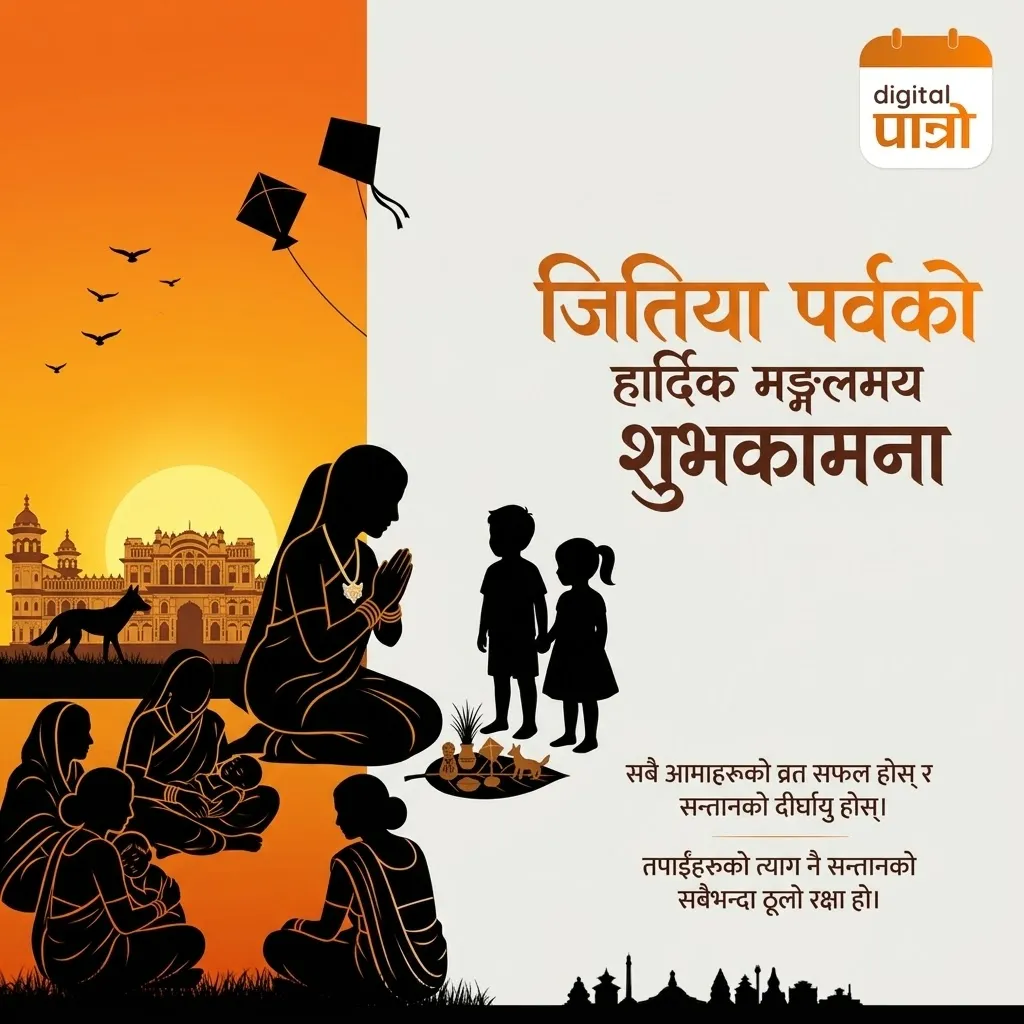
> जितिया पर्वको हार्दिक मङ्गलमय शुभकामना। सबै आमाहरूको व्रत सफल होस् र सन्तानको दीर्घायु होस्।
> निर्जला व्रत बस्नुभएका सम्पूर्ण आमाहरूलाई नमन। तपाईंहरूको त्याग नै सन्तानको सबैभन्दा ठूलो रक्षा हो।
> जितिया पर्वको अवसरमा सम्पूर्ण दिदीबहिनीहरूमा हार्दिक शुभकामना व्यक्त गर्दछौं।
In Maithili
> जितिया पाबनिक हार्दिक शुभकामना। अहाँ सभक संतानक दीर्घायु आ सुख-समृद्धिक कामना।
In English
> Warm wishes on Jitiya Parva. May every mother's fast be answered and every child be granted a long life.
> To everyone keeping the nirjala vrat today, our respect. Few things are harder and few are given more freely.
Digital Patro's post generator has festival templates you can edit with your own photo or logo if you want to publish a Jitiya greeting for your family, school, office or organisation.
What is Jitiya Parva?
Jitiya, also called Jivitputrika Vrat or Jiutiya, is a three-day festival in which mothers keep a complete fast without food or water for the long life and well-being of their children. It is observed mainly by Maithili and Tharu communities of Nepal's Tarai and Madhesh.
When is Jitiya in 2083 BS?
The main fasting day is Asoj 18, Sunday, 4 October 2026. The three days run from Asoj 17 to Asoj 19, which is 3 to 5 October 2026.
Why is Jitiya on a different date every year?
Because it is fixed to a tithi, Ashwin Krishna Ashtami, not to a calendar date. Lunar dates shift against the English calendar each year, usually moving about eleven days earlier, and jumping forward by about nineteen days in years with an extra lunar month.
Why did Jitiya move so far in 2026?
Because an extra lunar month, Adhik Jyeshtha Maas, fell from 17 May to 15 June 2026. Every lunar festival after it moved roughly nineteen days later instead of eleven days earlier. Jitiya went from 15 September 2025 to 4 October 2026.
Some websites say Jitiya 2026 is on 3 October. Which is right?
Both dates come from the same tithi. The Ashtami tithi runs across parts of two English days, and Nepali and Indian panchangas resolve which day carries the vrat differently. Nepal's calendar and the Government of Nepal's holiday list place Jitiya Parva on Asoj 18, Sunday 4 October 2026. In Nepal, follow that date, or follow your family's own purohit.
Is Jitiya a public holiday in Nepal?
Yes, but a conditional one. It is on the 2083 BS holiday list as a holiday for women employees who observe the festival. It is not a general holiday, so offices, banks, and schools stay open.
Who keeps the Jitiya fast?
Mothers, usually married women, keep it for their children. Some keep it for their husband's well-being as well. Women who are pregnant, breastfeeding, unwell, elderly, or on medication are traditionally excused from the full form, and a relative may keep it on their behalf.
Is Jitiya only for sons?
The name Jivitputrika refers to sons, and the vrat was historically kept for sons. Most families today keep it for all their children, sons and daughters alike, and say so openly.
What does nirjala mean?
Nirjala means without water. It is the strictest form of Hindu fasting, with no food and no liquid of any kind for the whole period.
How long does the Jitiya fast last?
From othgan, the last food and water taken late on the first night, until paran on the third morning. In practice, that is usually between twenty-four and thirty-six hours.
What are the three days of Jitiya called?
Day one is Nahai Khai, called Laha Khaeke in Tharu households. Day two is the fasting day, called Khar Din. Day three is Paran, when the fast is broken.
What food is eaten on Jitiya?
On the first day, marua roti made from finger millet with fish or vegetables, sathi chiura with dahi, and amott. The fast is broken on the third day with noni saag made from jute leaves and marua roti.
Who is Jimutvahana?
A Gandharva prince who offered himself to the eagle Garuda in place of a Naga woman's only son. Garuda was so moved that he stopped taking the Nagas and revived those already lost. Mothers worship him as Jitbahan or Jitmahan, and the vrat is named for him.
What is the story of the kite and the jackal?
A kite and a jackal kept the vrat and were reborn as two sisters. The sister who kept the fast honestly saw her children live, and the one who broke it in secret did not. Clay figures of a kite and a jackal are worshipped alongside Jimutvahana because of this story.
Which communities in Nepal observe Jitiya?
Maithili, Tharu, Bhojpuri and Awadhi-speaking families across the Tarai and Madhesh. Tharu women observe it right across the country, from Jhapa and Morang in the east through Chitwan and Nawalparasi to Dang, Bardiya, Kailali and Kanchanpur in the west.
Is Jitiya a Newar festival?
No. Jitiya is a Tarai and Madhesh festival, observed mainly by Maithili and Tharu communities and by families of Bihar, Jharkhand and eastern Uttar Pradesh.
What is the Jhamta dance?
A Tharu group dance performed by women in a ring during Jitiya, danced on the fasting day itself along with the singing of Tharu folk songs.
Is Jitiya connected to shraddha?
Yes. Ashwin Krishna Ashtami falls inside the Sohra Shraddha fortnight, so Jitiya always sits within Pitri Paksha. In 2083 BS, the main day falls on Nawami Shraddha, the day dedicated to the departed mothers and grandmothers of the family.
Is Jitiya the same as Chhath?
No, although both are Tarai and Madhesh festivals with demanding fasts kept mainly by women. Chhath is held in Kartik, is dedicated to the Sun and Chhathi Maiya, and centres on river ghats. Jitiya is held in Ashwin, is dedicated to Jimutvahana, and is kept at home for children's long life.
Is Jitiya observed in India too?
Yes, widely, in Bihar, Jharkhand, eastern Uttar Pradesh, and West Bengal, where it is usually called Jivitputrika or Jiutiya. In Jharkhand, some communities extend the observance to eight days.