Sambidhan Diwas (संविधान दिवस), or Constitution Day, falls on Asoj 3 every year. In 2083 BS, that is Saturday, 19 September 2026. It is a public holiday across Nepal, and it is also observed as Rastriya Diwas, the National Day.
The day marks Asoj 3, 2072 BS, when President Ram Baran Yadav signed and promulgated the Constitution of Nepal. Nepal had been trying to produce a constitution written by its own elected representatives since 2007 BS, which is 1951 in the Gregorian calendar. Every attempt in between was either handed down from above, cut short, or overtaken by events. Asoj 3, 2072 was the day that the sixty-five-year wait ended.
That is the short version. The longer version is worth knowing, because Constitution Day is one of the few national days in Nepal where the thing being celebrated is a document most people have never actually opened. This page explains what is inside it, where it came from, why the English date keeps moving, how the day is observed, and the honest arguments for and against it.
|
Nepali name |
संविधान दिवस (Sambidhan Diwas) |
|
Also called |
Constitution Day, Rastriya Diwas (राष्ट्रिय दिवस), National Day |
|
Nepali date |
Asoj 3 (आश्विन ३), fixed every year |
|
Date in 2083 BS |
Saturday, 19 September 2026 |
|
What it marks |
Promulgation of the Constitution of Nepal on Asoj 3, 2072 BS (20 September 2015) |
|
Signed by |
Ram Baran Yadav, the first President of Nepal |
|
Written by |
The second Constituent Assembly, elected in 2070 BS (2013) |
|
First observed |
Asoj 3, 2073 BS (2016) |
|
In 2083 BS, this is the |
11th Constitution Day |
|
Public holiday |
Yes, nationwide, for government and most private offices, banks and schools |
|
Also on this date in 2083 |
Radha Janmotsav, Gorakhkali Puja |
|
Main national ceremony |
Sainik Manch, Tundikhel, Kathmandu, with the President as chief guest |
Sambidhan Diwas 2083 BS falls on Saturday, 19 September 2026.
The Nepali date never changes. It is Asoj 3 every single year, the same way Christmas is always 25 December. What changes is the English date it lands on.
The Bikram Sambat calendar and the Gregorian calendar count months differently. Bikram Sambat month lengths are set by the sun's movement through the zodiac signs, so Baisakh, Jestha, Ashadh, and the rest can be 29, 30, 31, or 32 days long, and the lengths are not the same from one year to the next. The Gregorian calendar uses fixed month lengths with a leap day every four years.
Put those two systems side by side, and the same Bikram Sambat date drifts by a day or two against the Gregorian calendar. For Asoj 3, the drift is small and predictable. It lands on 18, 19, or 20 September, and 19 September is the most common.
|
Bikram Sambat (BS) |
Gregorian date (AD) |
Day |
Note |
|
Asoj 3, 2072 |
20 September 2015 |
Sunday |
Constitution promulgated |
|
Asoj 3, 2073 |
19 September 2016 |
Monday |
First Constitution Day |
|
Asoj 3, 2080 |
20 September 2023 |
Wednesday |
8th |
|
Asoj 3, 2081 |
19 September 2024 |
Thursday |
9th |
|
Asoj 3, 2082 |
19 September 2025 |
Friday |
10th |
|
Asoj 3, 2083 |
19 September 2026 |
Saturday |
11th |
|
Asoj 3, 2084 |
19 September 2027 |
Sunday |
12th |
|
Asoj 3, 2085 |
18 September 2028 |
Monday |
13th |
|
Asoj 3, 2086 |
19 September 2029 |
Wednesday |
14th |
This is the most common confusion about the day, and both answers you see online are half right.
The Constitution was promulgated on 20 September 2015. That is the historical fact, and it is the date used in international coverage, in foreign government statements, and in most English-language references.
Constitution Day is observed on Asoj 3. That is the Nepali date of the promulgation, and it is the date the government, the calendar, and the holiday list use. In most years, Asoj 3 falls on 19 September, which is why the holiday shows up as 19 September far more often than 20 September.
Neither date is wrong. They are the same day counted in two calendars. If you are writing an exam answer, the safe formulation is: promulgated on Asoj 3, 2072 BS, equivalent to 20 September 2015, and observed every year on Asoj 3.
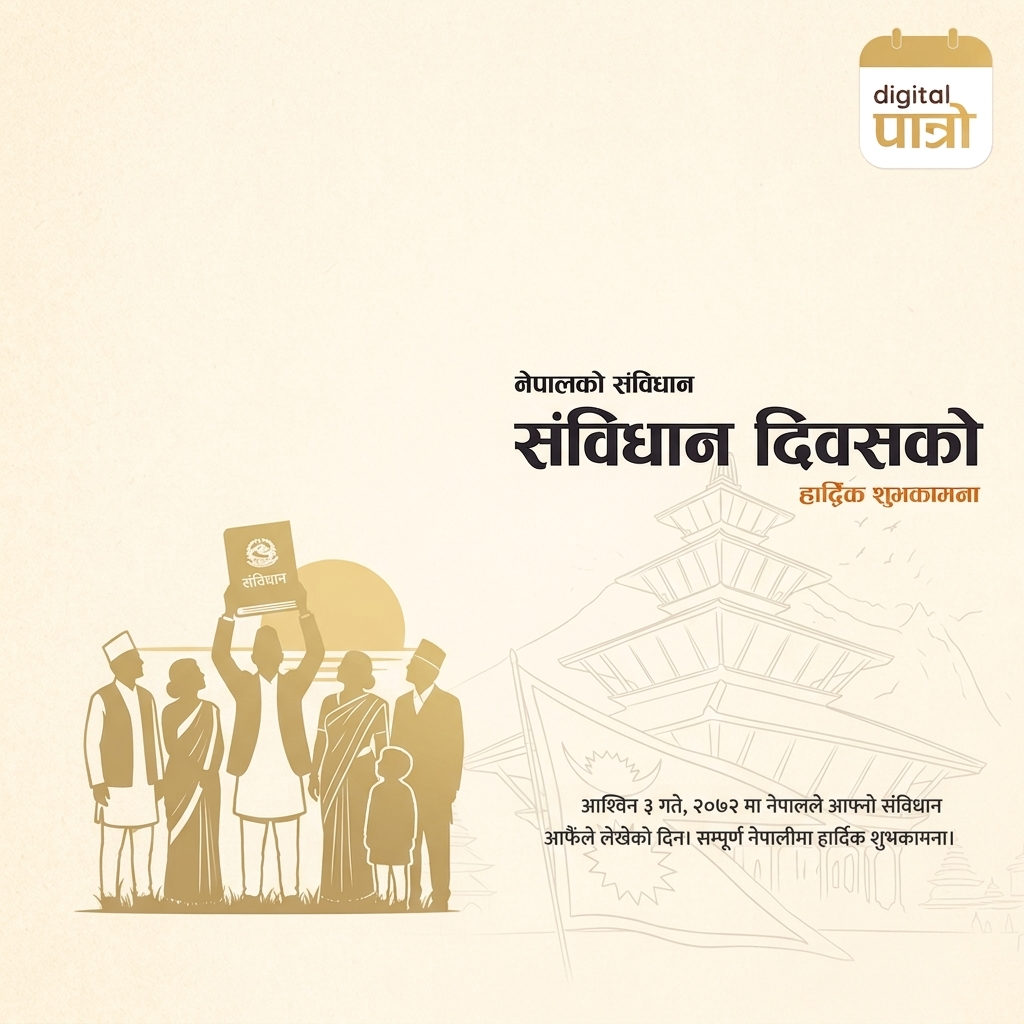
Yes. Asoj 3 is on the Government of Nepal's official public holiday list. Government offices, banks, courts, schools, and most private offices are closed. Public transport runs, and shops open normally. In Kathmandu, the roads around Tundikhel are restricted in the morning for the main ceremony. Not everyone can attend the celebrations in person. For those who cannot, create and share a Sambidhan Diwas post can be a simple way to mark the occasion and remind others of its significance.
It is also the only day in the Nepali calendar that carries the title Rastriya Diwas, National Day. When the constitution was promulgated, the same day was declared the country's national day, which is why official messages usually say "संविधान दिवस तथा राष्ट्रिय दिवस," Constitution Day and National Day together.
On the evening of Sunday, 20 September 2015, in the Constituent Assembly building at New Baneshwar in Kathmandu, President Ram Baran Yadav signed five copies of a document titled नेपालको संविधान, the Constitution of Nepal, and declared it in force.
Four days earlier, on 16 September, the Constituent Assembly had put the constitution bill to a vote. Of the 598 members, 507 voted in favour, and 25 voted against. The rest did not vote, and fifty-seven members from Madhes-based parties boycotted the process entirely. Chairman Subas Chandra Nembang conducted the vote. Sushil Koirala was Prime Minister.
The moment the President finished speaking, the Constituent Assembly stopped being a constitution-writing body and converted itself into the Legislature Parliament, exactly as the new constitution's own transitional provisions instructed. Nepal went, in a single evening, from a country operating under an interim arrangement to a country operating under a constitution it had written itself.
Outside, crowds filled the streets around the assembly building, and fireworks went up over Kathmandu. In the southern plains on the same night, protests against the constitution were continuing, and they would get worse before they got better. Both of those things are part of the day's history, and a page about Constitution Day that reports only the fireworks is not telling the whole story.
Nepal has had seven constitutions. The 2015 one is the seventh, and it is the first written by a body the people elected for that purpose. Understanding the six before it is the fastest way to understand why the seventh is celebrated.
The first written constitution in Nepal's history, issued by Rana Prime Minister Padma Shumsher under pressure from a growing democratic movement. It had 68 articles and promised a legislature and basic rights. It was never really implemented. The Rana system that produced it was not interested in being limited by it.
Proclaimed after the 2007 BS revolution ended 104 years of Rana rule. It moved executive power from the hereditary Rana Prime Minister to a cabinet answerable to the King, and it listed fundamental rights for the first time in a document that actually operated. It was explicitly temporary. The promise attached to it was an elected Constituent Assembly that would write a permanent constitution. That promise is the one that took until 2072 BS to keep.
Granted by King Mahendra rather than written by an assembly. It created a two-chamber parliament and led to Nepal's first general election, which the Nepali Congress won, with B. P. Koirala becoming Prime Minister. It lasted about eighteen months. In Poush 2017 BS (December 1960), the King dismissed the government, jailed the leadership, and suspended the constitution.
The Panchayat constitution. It banned political parties and built a tiered system of councils with the King at the top holding real power. It lasted twenty-eight years, longer than any other constitution in Nepal's history, and it is the reason the phrase "elected representatives" carries so much weight in Nepali constitutional language.
Produced after the first Jana Andolan ended the Panchayat system. It brought back multi-party democracy alongside a constitutional monarchy, and it was drafted in a few months by a commission rather than an elected assembly. It was promulgated on Kartik 23, 2047 BS (9 November 1990), and for the next twenty-five years, that was Nepal's Constitution Day. If you find an old Nepali calendar marking Constitution Day in Kartik, this is why. The 2047 system broke down during the decade-long armed conflict that began in 2052 BS.
Promulgated after the second Jana Andolan of 2062/63 BS and the Comprehensive Peace Accord that ended the conflict. It stripped the monarch of executive power and set up the election of a Constituent Assembly. On 28 May 2008, the first sitting of that assembly declared Nepal a federal democratic republic and abolished the monarchy. This is the document the 2015 constitution replaced, and 2008 is the year the monarchy actually ended.
The current constitution, and the one Sambidhan Diwas celebrates.
The first Constituent Assembly, elected in 2064 BS (2008), spent four years and several deadline extensions and failed to produce a constitution. It was dissolved in Jestha 2069 (May 2012) with nothing to show. A second Constituent Assembly was elected in Mangsir 2070 (November 2013).
That second assembly was moving slowly too, until two things changed the arithmetic. The earthquake of 12 Baisakh 2072 (25 April 2015) killed nearly nine thousand people and created enormous public pressure on the parties to stop arguing and deliver something. In Asar 2072 (June 2015), the four largest parties signed a sixteen-point agreement that settled the biggest open questions, including the number of provinces, later fixed at seven. From there, the drafting moved fast, through a public consultation round, to the vote on 16 September and promulgation on Asoj 3.
This is the section most Constitution Day pages skip. It is also the section that people searching before an exam, a speech, or a school assignment most need.
|
Item |
Number |
|
Parts (भाग) |
35 |
|
Articles (धारा) |
308 |
|
Schedules (अनुसूची) |
9 |
|
Fundamental rights |
31 (Articles 16 to 46) |
|
Fundamental duties |
5 (Article 48) |
|
Provinces |
7 |
|
Districts |
77 |
|
Local levels |
753 |
|
Constitutional bodies and commissions |
13 |
|
Amendments so far |
2 |
Article 48 lists what citizens owe in return: to safeguard the nationality, sovereignty and integrity of Nepal, to abide by the constitution and law, to render compulsory service when the state requires it, to protect public property, and to take part in protecting and promoting the country's nature, environment and cultural heritage.
Part 4 sets out directive principles, policies and obligations of the state, covering everything from land reform and industrial policy to foreign relations. These are goals rather than enforceable entitlements, and the constitution itself says they cannot be enforced through the courts. They matter because every government's budget and policy documents are supposed to be argued against them.
|
Province |
Capital |
Named in |
|
Koshi |
Biratnagar |
2023 |
|
Madhesh |
Janakpur |
2022 |
|
Bagmati |
Hetauda |
2020 |
|
Gandaki |
Pokhara |
2018 |
|
Lumbini |
Deukhuri |
2020 |
|
Karnali |
Birendranagar |
2018 |
|
Sudurpashchim |
Godawari |
2018 |
The constitution deliberately left the provinces unnamed, numbering them one to seven, and handed the naming decision to each provincial assembly with a two-thirds majority requirement. It took between three and eight years for all seven to settle on names, and in several provinces the debate was heated. Koshi was the last, in 2023.
Nepal has four civic national days, and they get mixed up constantly. Here is the difference.
|
Day |
Nepali date |
Marks |
Holiday |
|
Prajatantra Diwas (Democracy Day) |
Falgun 7 |
End of Rana rule in 2007 BS (1951) |
Yes |
|
Sahid Diwas (Martyrs' Day) |
Falgun 16 |
Remembrance of those who died for democracy |
Yes |
|
Ganatantra Diwas (Republic Day) |
Jestha 15 |
Declaration of the republic in 2065 BS (2008) |
Yes |
|
Sambidhan Diwas (Constitution Day) |
Asoj 3 |
Promulgation of the constitution in 2072 BS (2015) |
Yes |
The clean way to remember it: Falgun 7 ended the Ranas. Jestha 15 ended the monarchy. Asoj 3 gave the republic its own constitution.
There is also Prithvi Jayanti on Poush 27, marking the birth of Prithvi Narayan Shah and observed as National Unity Day. It sits in a different category because it is about the founding of the state rather than the founding of the current political system.
What is Sambidhan Diwas?
Sambidhan Diwas, or Constitution Day, is Nepal's national day marking the promulgation of the Constitution of Nepal on Asoj 3, 2072 BS. It is also observed as Rastriya Diwas, the National Day.
When is Sambidhan Diwas 2083?
Saturday, 19 September 2026, which is Asoj 3, 2083 BS.
Is Sambidhan Diwas on 19 or 20 September?
Both dates are correct in different senses. The constitution was promulgated on 20 September 2015, which was Asoj 3, 2072 BS. Nepal observes the anniversary on the Nepali date, Asoj 3, which usually falls on 19 September and occasionally on 18 or 20 September.
Why does the English date change every year?
Because Bikram Sambat months have variable lengths set by the sun's position, while Gregorian months are fixed. The Nepali date, Asoj 3, never changes. Its Gregorian equivalent drifts by a day or two.
Is Sambidhan Diwas a public holiday in Nepal?
Yes. It is on the Government of Nepal's official public holiday list. Government offices, banks, courts, and schools are closed.
Which Constitution Day is 2083 BS?
The 11th. The first Constitution Day was observed in 2073 BS, the year after promulgation.
Who promulgated the Constitution of Nepal?
President Ram Baran Yadav, Nepal's first President, on Asoj 3, 2072 BS, at the Constituent Assembly building in New Baneshwar, Kathmandu.
Who wrote the Constitution of Nepal?
The second Constituent Assembly, elected in Mangsir 2070 BS (2013) and chaired by Subas Chandra Nembang. The first Constituent Assembly, elected in 2064 BS, was dissolved in 2069 BS without completing a draft.
Did the 2015 constitution end the monarchy?
No. Nepal's monarchy was abolished on 15 Jestha 2065 BS (28 May 2008) by the first Constituent Assembly, under the Interim Constitution of 2063 BS. The 2015 constitution replaced that interim constitution and made the republic permanent, protecting it under Article 274.
How many constitutions has Nepal had?
Seven: 2004 BS (1948), 2007 BS (1951), 2015 BS (1959), 2019 BS (1962), 2047 BS (1990), 2063 BS interim (2007), and 2072 BS (2015).
How many articles are there in the Constitution of Nepal?
308 articles, arranged in 35 parts, with 9 schedules.
How many fundamental rights does the Constitution of Nepal guarantee?
31 fundamental rights, set out in Articles 16 to 46, plus 5 fundamental duties in Article 48.
How many provinces and local levels does Nepal have?
7 provinces, 77 districts, and 753 local levels, made up of 6 metropolitan cities, 11 sub-metropolitan cities, 276 municipalities, and 460 rural municipalities.
How many times has the constitution been amended?
Twice. The first amendment in Magh 2072 BS (January 2016) addressed proportional inclusion and constituency delimitation. The second, in Jestha 2077 BS (June 2020), updated the national map in Schedule 3 to include Limpiyadhura, Lipulekh, and Kalapani.
Why was Constitution Day celebrated on Kartik 23 before?
Because the previous constitution, the Constitution of the Kingdom of Nepal 2047 BS, was promulgated on Kartik 23, 2047 BS (9 November 1990). That was Constitution Day until 2072 BS.
What is the difference between Constitution Day and Republic Day?
Republic Day, Ganatantra Diwas, falls on Jestha 15 and marks the declaration of the republic in 2065 BS (2008). Constitution Day falls on Asoj 3 and marks the promulgation of the constitution in 2072 BS (2015). Different events, seven years apart.
Is Sambidhan Diwas the same as Rastriya Diwas?
Yes. When the constitution was promulgated, Asoj 3 was also declared Nepal's National Day, which is why official messages say "Constitution Day and National Day" together.
Why did some groups protest against the constitution?
Madhesi and Tharu organisations argued that the federal boundaries split the southern plains in a way that reduced their political weight, and that representation and citizenship provisions fell short of what had been promised. Protests in the Tarai and an obstruction of the India border ran from September 2015 to February 2016 and cost more than fifty lives. The first amendment in 2016 addressed part of the representation issue but not the provincial boundaries.