
Ghatasthapana 2083 falls on Asoj 25. That is Sunday, 11 October 2026. It is the first day of Dashain and the first day of Navaratri.
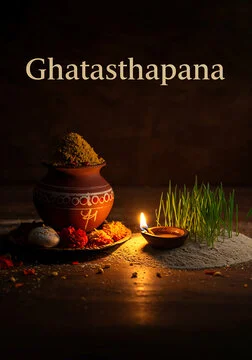
Not much is visible on this day. There is no procession and no tika. The work happens inside the house. A pot of water is placed on a bed of sand. Barley and maize seeds are scattered around it. A lamp is lit. Then the room is closed.
Everything else in Dashain starts here. The jamara your elders put behind your ear on Dashami is sown in that room on this morning.
The name says what it is. Ghata means pot. Sthapana means to set up. Ghatasthapana means setting up the pot.
|
Nepali name |
घटस्थापना (Ghatasthapana) |
|
Also called |
Ghatasthapana Vrata, Kalash Sthapana, Navaratra Arambha |
|
Tithi |
Ashwin Shukla Pratipada |
|
Date in 2083 BS |
Asoj 25, Sunday, 11 October 2026 |
|
Which day of Dashain |
Day 1 of 15 |
|
Which day of Navaratri |
Day 1 of 9 |
|
Done at |
A fixed site. The Nepal Panchanga Nirnayak Vikas Samiti announces it every year |
|
What is set up |
A kalash of clean water, a bed of sand, barley and maize seeds, and a lamp |
|
Where |
The Dashain Ghar, a dark room or corner kept for the festival |
|
Public holiday |
Yes. Asoj 25 is listed on its own in the 2083 holiday list |
|
Also on this day in 2083 |
Navaratra Arambha and Non-Resident Nepali Day |
|
The day before |
Pitri Visarjan Aunsi, the last day of Sohra Shraddha |
|
Ends on |
Bijaya Dashami, Kartik 4, Wednesday, 21 October 2026 |
Asoj 25, 2083. That is Sunday, 11 October 2026.
Two things about this year's date are worth knowing before you plan anything.
Ghatasthapana is fixed to a tithi called Ashwin Shukla Pratipada. It is not fixed to a calendar date.
A lunar year is about eleven days shorter than a solar year. So most years, festivals come about eleven days earlier than the year before. Most of us plan by that without thinking.
This year is different. An extra lunar month called Adhik Jyeshtha Maas ran from 17 May to 15 June 2026. When an extra month is added, festivals after it do not come earlier. They come about nineteen days later.
So Ghatasthapana moved from 22 September 2025 to 11 October 2026. If you thought Dashain would start in late September because it did last year, you are three weeks off.
Ghatasthapana is in Asoj. Bijaya Dashami is in Kartik. If you think of Dashain as an Asoj festival, you will book leave, bus tickets, and family visits for the wrong two weeks.
|
Bikram Sambat |
Nepali date |
English date |
Day |
|---|---|---|---|
|
2082 |
Asoj 6 |
22 September 2025 |
Monday |
|
2083 |
Asoj 25 |
11 October 2026 |
Sunday |
The date for 2084 and after is not fixed yet. The Nepal Panchanga Nirnayak Vikas Samiti sets it when it releases that year's patro, usually around Falgun of the year before.
Ghatasthapana is one of the few Nepali rituals with a time announced for the whole country.
The Nepal Panchanga Nirnayak Vikas Samiti announces the saita. That is the good moment for setting up the kalash. It is broadcast on the news and on the radio. Families do the ritual at that time instead of whenever they are free.
In 2082, the saita was 9:13 in the morning on Asoj 6. In other years, it has been close to midday. It is not the same hour every year. You cannot guess it from last year.
Check Digital Patro on the morning of Asoj 25 for this year's saita. Get everything ready before the saita. Do the ritual at the saita. If your family cannot manage that exact moment, do it as soon as you can after it on the same day.
This is the part most pages skip. It is also the part people search for.
Clean out a room, or a corner of a room, and keep it for the festival. This is the Dashain Ghar.
It has to be somewhere you can keep it dark. It also has to be somewhere nobody walks through, because it stays in use for ten days.
In a small flat, this is often a cupboard space or a screened corner of the puja kotha. You need darkness and quiet, not space.
Spread a thin layer of clean sand or fine soil. Families usually bring it from a riverbank. This is what the seeds go into. Water it before you sow so it is damp, not wet.
Fill a copper, brass, or clay pot with clean water. Depending on your family practice, you may add sacred leaves, a coin, a betel nut, and kush grass. Most families put a coconut on top and tie red cloth around it. Place it in the middle of the sand.
The kalash is the seat of the goddess for the whole festival. Do not move it and do not empty it until the festival is over.
Barley and maize. Jau and makai. That is the Nepali way.
Some families add wheat or other grains, but barley is the important one. Sprouted barley is the offering Durga is said to like, and barley is what gives jamara its shape.
Scatter the seeds by hand over the sand. Do not bury them deep.
Light an oil lamp at the saita and keep it burning through Dashain. Keeping it lit for ten days without a break is real work. In most families, one person quietly takes care of it.
Jamara is the pale yellow sprout of barley and maize that you sow on Ghatasthapana. On Bijaya Dashami, elders put it behind your ear along with the tika.
Everything about how you grow it is for one result.
|
Step |
What you do |
Why |
|---|---|---|
|
Sowing |
Scatter barley and maize on damp sand on Ghatasthapana |
It needs ten days to grow long enough |
|
Darkness |
Keep the Dashain Ghar shut, with no daylight |
Without sunlight, the sprout cannot turn green, so it stays pale gold |
|
Watering |
Sprinkle a little water daily, often from the kalash |
Sand dries fast, and the roots are shallow |
|
Daily puja |
Worship in the room every day of Navaratri |
Jamara is not a plant you are growing. It is an offering you are keeping |
|
Cutting |
Pull or cut it on Dashami morning, before tika starts |
It goes to the whole family, and often to neighbours too |
The yellow colour is on purpose. Jamara is not a plant that failed to turn green. It is grown in the dark so it cannot turn green. If light gets in, it goes green, and green jamara is treated as spoiled.
Jamara grows for ten days, not nine. You sow it on day one and give it on day ten. Any page that says it grows over the nine days of Navaratri and is then given on Dashami is contradicting itself.
Jamara is not fulpati. The nine sacred plants that come into the house on Fulpati, day seven, are a different ritual with a different name. Jamara is not one of them. It has been in the same room since day one.
The page is called Ghatasthapana Vrata, so the word vrata needs explaining.
A vrata is a vow to observe something. It is not only a day without food. On Ghatasthapana, it can mean any of these, depending on the family:
The nine-day one is the serious version. Families who take it read the Durga Saptashati, also called the Chandi Path, for nine days. In many neighbourhoods, a priest is called to do the reading. Many families also visit a different Devi temple on each of the nine days.
One thing worth saying plainly: most Nepali families do not keep a full day fast without water on Ghatasthapana. This is a setting-up day. The hard fasting days of Dashain come later, at Ashtami and Navami.
Ghatasthapana opens Navaratri, the nine nights of the goddess. Each night belongs to one of the nine forms of Durga. Together they are called the Navadurga
|
Navaratri day |
Form of Durga |
2083 date |
|---|---|---|
|
1 |
Shailaputri |
Asoj 25, Sunday, 11 October |
|
2 |
Brahmacharini |
Asoj 26, Monday 12 October |
|
3 |
Chandraghanta |
Asoj 27, Tuesday 13 October |
|
4 |
Kushmanda |
Asoj 28, Wednesday 14 October |
|
5 |
Skandamata |
Asoj 29, Thursday 15 October |
|
6 |
Katyayani |
Asoj 30, Friday 16 October |
|
7 |
Kalaratri |
Asoj 31, Saturday 17 October, marked as Fulpati |
|
8 |
Mahagauri |
Kartik 1 and 2, 18 and 19 October, marked as Maha Ashtami |
|
9 |
Siddhidatri |
Kartik 3, Tuesday, 20 October, marked as Maha Navami |
One note for 2083. The Shashthi tithi comes twice this year, on Asoj 30 and again on Asoj 31. Because of that, the tithi names and the festival day names do not line up the way they usually do, and Maha Ashtami covers two dates. This year, read the day names from the patro. Do not count forward from Ghatasthapana in your head.
|
Day |
What it is |
Nepali date |
English date |
|---|---|---|---|
|
1 |
Ghatasthapana, Navaratri begins |
Asoj 25 |
Sunday 11 October 2026 |
|
2 to 6 |
Navaratri days |
Asoj 26 to 30 |
12 to 16 October |
|
7 |
Fulpati, Dashain holiday begins |
Asoj 31 |
Saturday 17 October 2026 |
|
8 |
Kalratri and Maha Ashtami Vrata |
Kartik 1 |
Sunday 18 October 2026 |
|
8 |
Dashain Bida |
Kartik 2 |
Monday 19 October 2026 |
|
9 |
Maha Navami |
Kartik 3 |
Tuesday 20 October 2026 |
|
10 |
Bijaya Dashami, tika and jamara |
Kartik 4 |
Wednesday 21 October 2026 |
|
15 |
Purnima, Dashain ends |
Kartik 9 |
Monday 26 October 2026 |
The day before Ghatasthapana is Pitri Visarjan Aunsi. That is Asoj 24, Saturday 10 October 2026. It is the last day of Sohra Shraddha, the two weeks of rites for the ancestors.
The two days sit together for a reason. The fortnight for those who have died closes, and the festival for the living starts the next morning.
Yes. And it is a separate holiday from the main Dashain holiday.
The 2083 holiday list gives Asoj 25 as a holiday for Ghatasthapana on its own. The long Dashain holiday then runs from Asoj 31 to Kartik 6, that is, Fulpati to Dwadashi.
The days in between, Asoj 26 to Asoj 30, are normal working days. Banks, offices, government departments, and schools all run. This is the busiest shopping and queue week of the year. Finish anything that needs a counter, a stamp, or a signature this week.
One more thing for 2083. Ghatasthapana falls on a Sunday, which is a working day in Nepal. So this is a real day off, not a holiday that disappears into the weekend.
Along with every household ritual, there is one national one.
At the Dashain Ghar of Hanuman Dhoka in Kathmandu, priests set up the kalash and sow barley at the announced saita, following Vedic rites. A Nepal Army band plays the Mangal Dhun.
The jamara grown in that room is not for one family. It is grown for the state tika distribution on Bijaya Dashami.
The same thing is done at the Dashain Ghar of Gorkha Durbar, the old seat of the Shah kings. That is also where the fulpati that reaches Kathmandu on day seven starts its journey.
Like the twenty-one-gun salute on Fulpati, this is a royal ritual that was carried on after the monarchy ended in 2008, with the President in the place the King used to hold.
Most people searching for this day are planning. Here is the list.
|
Timeframe / Date |
Tasks / Action Items |
|---|---|
|
A week before, from Asoj 18 |
|
|
Two or three days before, Asoj 22 to 24 |
|
|
The day before, Asoj 24 |
|
|
On the day, Asoj 25 |
|
Ghatasthapana in Nepal and Kalash Sthapana in India are the same tithi and the same ritual. Two things are different.
The date can differ by one day. Nepal's Panchanga and Indian panchangas sometimes read the tithi differently, and the Nepali date can be one day later. This is not a fixed gap. It changes year to year. For a Nepali family, the Nepali calendar date and the announced saita are the ones to follow.
The festival is a different length. In most of India, Sharad Navaratri runs nine days and ends at Navami and Dussehra. In Nepal, those nine days are only the first part of a fifteen-day Dashain. It peaks on the tenth day at Bijaya Dashami and ends at Kojagrat Purnima on the fifteenth. Jamara is a Nepali part of the festival, and it is why the tenth day, not the ninth, is the main day here.
When is Ghatasthapana 2083?
Asoj 25, 2083. That is Sunday, 11 October 2026.
What is Ghatasthapana?
It is the first day of Dashain and the first day of Navaratri. A kalash of clean water is set up on a bed of sand in the house, barley and maize are sown around it, and a lamp is lit for the festival.
What does the word Ghatasthapana mean?
Ghata means pot, and sthapana means to set up. Ghatasthapana means setting up the pot.
Which day of Navaratri is Ghatasthapana?
The first. Navaratri starts on Ghatasthapana with the worship of Shailaputri.
Which tithi does Ghatasthapana fall on?
Ashwin Shukla Pratipada, the first day of the bright fortnight of Ashwin.
What time should Ghatasthapana be done in 2083?
At the time announced by the Nepal Panchanga Nirnayak Vikas Samiti for Asoj 25. The time changes every year. In 2082, it was 9:13 in the morning. Check Digital Patro on the morning of Asoj 25 for this year's saita.
What if I miss the saita?
Do it as soon as you can after it on the same day. For most families, the day matters more than the exact minute, but the saita is the intended time.
Is Ghatasthapana a public holiday in Nepal?
Yes. Asoj 25 is listed as a public holiday in the 2083 list. It is separate from the main Dashain holiday, which runs from Asoj 31 to Kartik 6.
Are the days between Ghatasthapana and Fulpati holidays?
No. Asoj 26 to Asoj 30 are working days. Banks, offices, and schools run as normal. The long holiday starts at Fulpati on Asoj 31.
What seeds are used for jamara?
Barley and maize, called jau and makai. Some families add wheat or other grains, but barley is the important one.
Why is jamara yellow and not green?
Because it is grown in a dark room. Without sunlight, it cannot turn green, so it stays pale gold. That colour is wanted.
How many days does jamara take to grow?
Ten. It is sown on Ghatasthapana and cut on the morning of Bijaya Dashami.
Is jamara one of the fulpati plants?
No. The nine plants of the Nawapatrika come on Fulpati, the seventh day. Jamara has been growing in the house since the first day. It is a different thing.
What goes inside the kalash?
Clean water. Depending on family practice, also sacred leaves, a coin, a betel nut, and kush grass. Most families put a coconut on top and tie red cloth around it.
Where should the kalash be kept?
In the Dashain Ghar, a room or corner cleaned and kept for the festival. Keep it dark and undisturbed until Dashami.
Do you have to fast on Ghatasthapana?
Not everyone does. The person doing the ritual often fasts and eats after the evening puja. Many families only keep a satvik meal. Many keep no fast at all. The harder fasting days come at Ashtami and Navami.
What is read during Navaratri?
The Durga Saptashati, also called the Chandi Path. Families who take the full nine day vrata read it every day, often with a priest.
What happens the day before Ghatasthapana?
Pitri Visarjan Aunsi, Asoj 24, Saturday 10 October 2026. It is the last day of Sohra Shraddha, the two weeks of rites for the ancestors.
What is the next big day after Ghatasthapana?
Fulpati, Asoj 31, Saturday 17 October 2026. That is day seven, and the day the Dashain holiday starts.
When is Bijaya Dashami 2083?
Kartik 4, Wednesday 21 October 2026. That is the day tika and jamara are given.
Why is Dashain so late in 2026?
Because of Adhik Jyeshtha Maas, an extra lunar month that ran from 17 May to 15 June 2026. Festivals after it moved about nineteen days later instead of eleven days earlier.
Why is Dashain in two Nepali months this year?
Because Dashain follows lunar tithis, not the Nepali months. In 2083, it starts in Asoj and its main days fall in Kartik.
Is Ghatasthapana the same as Kalash Sthapana in India?
It is the same tithi and the same ritual. The Nepali date can be one day later than the Indian one in some years. In Nepal, the festival runs fifteen days to Kojagrat Purnima instead of ending at Navami.
What happens at Hanuman Dhoka on Ghatasthapana?
Priests set up the kalash and sow barley at the Dashain Ghar following Vedic rites, and a Nepal Army band plays the Mangal Dhun. The jamara grown there is used for the state tika distribution on Bijaya Dashami.
When is Ghatasthapana 2084?
Not fixed yet. The Nepal Panchanga Nirnayak Vikas Samiti sets it when it releases the 2084 patro, usually around Falgun of the previous year.