
बकर ईद | Eid al-Adha 2026, Nepal Date: Wednesday, 14 Jestha 2083 BS, Gregorian Date: May 28, 2026, Islamic Date: 10 Dhul Hijjah 1447 AH, National Public Holiday in Nepal
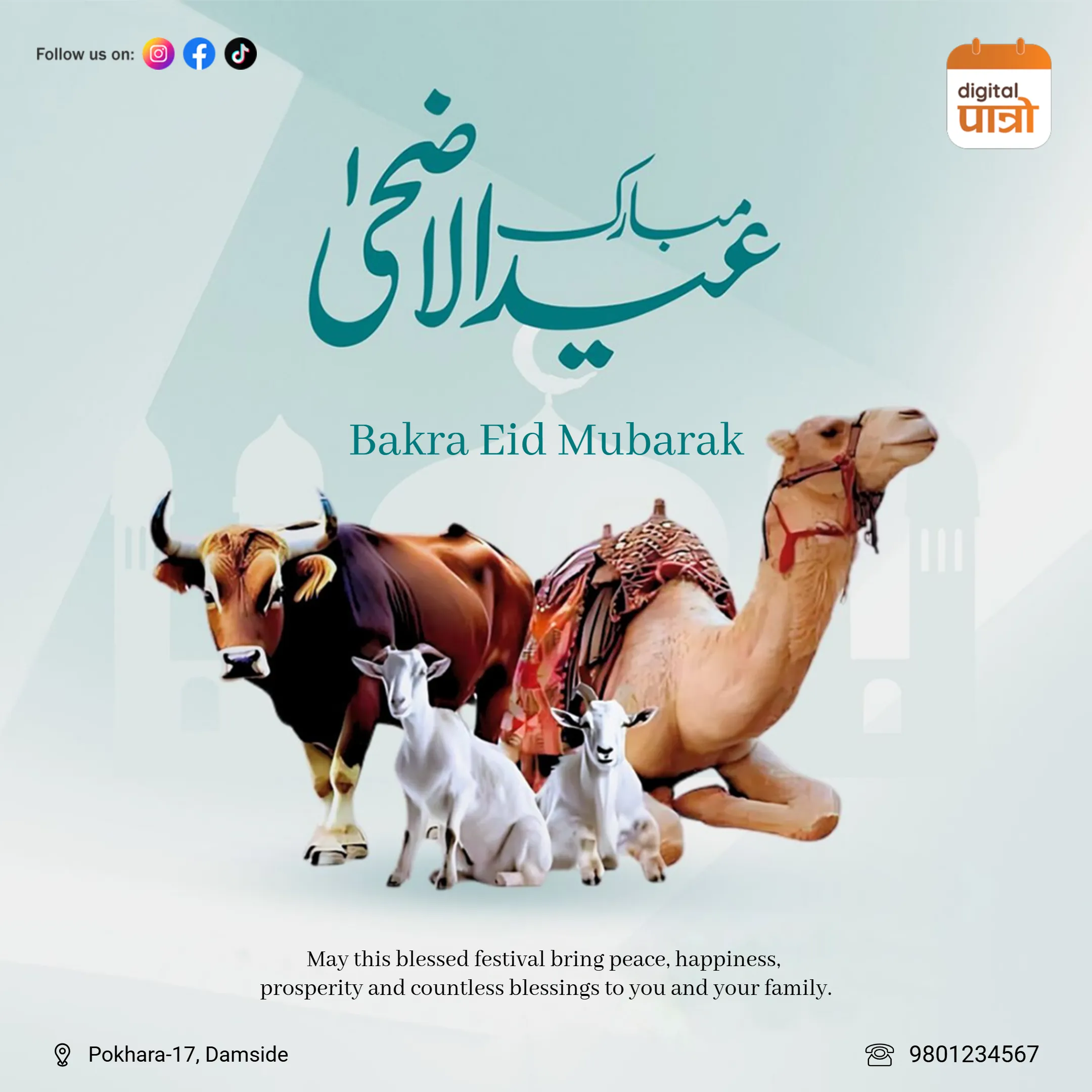
Want to share Bakra Eid wishes with your friends, family, or on social media using a post like the above post? Create a personalized Bakra Eid post for free in seconds using our post generator. Your text, your Style.
| Detail | Information |
|---|---|
| Festival Name | Bakar Eid / Eid al-Adha / Eid ul-Zuha |
| 2026 Date in Nepal | May 28, Wednesday |
| Nepali Date | 14 Jestha 2083 BS |
| Islamic Date | 10 Dhul Hijjah 1447 AH |
| Duration | 3–4 days |
| Public Holiday in Nepal | Yes |
| Observed By | Muslim community worldwide |
| Nepal's Muslim Population | ~14.83 lakh (5.09% of total) |
| Highest Muslim Districts | Rautahat, Banke, Kapilvastu, Parsa, Bara |
| Main Mosque in Kathmandu | Kashmiri Takiya Jame Mosque, Ghantaghar |
| Central Ritual | Qurbani (animal sacrifice) |
| Meat Division | 1/3 family · 1/3 friends/relatives · 1/3 poor |
| Festival Greeting | Eid Mubarak / Eid Mubarak Ho |
| Connection to Hajj | Coincides with the final days of the Hajj pilgrimage |
| Also Known As | Bakra Eid, Al-Eid al-Kabeer, Hari Raya Haji |
Bakar Eid, also called Eid al-Adha, Eid ul-Zuha, or the "Festival of Sacrifice," is the holier of the two major Eids in the Islamic calendar. While Eid al-Fitr marks the end of Ramadan fasting and is more festive in character, Eid al-Adha is deeply spiritual in nature. It is also called Al-Eid al-Kabeer, "The Grand Eid." It is observed by over 1.8 billion Muslims across the world with prayer, sacrifice, charity, and togetherness.
The word "Adha" in Arabic means sacrifice. The word "Bakar" in South Asian languages means goat, hence the name "Bakra Eid" or "Bakar Eid," reflecting the tradition of sacrificing a goat or other animal on this day.
The history of Eid al-Adha dates back to the time of the Prophet Ibrahim (AS), who is considered to be one of the greatest men in the history of humanity. In a series of dreams, Prophet Ibrahim (AS) was commanded by Allah to sacrifice his beloved son, Ismail (AS). He asked Ismail to travel with him to Mount Arafat. Deeply conflicted, he confided in Prophet Ismail about his dreams, who calmly encouraged his father to follow Allah's commands.
When the time of sacrifice came, and Ibrahim rose to follow God's command, God sent forth the Angel Gabriel (Jibra'il), who replaced his son with a ram. This act served as confirmation that Ibrahim and Ismail had both fully submitted to God's instructions.
Due to the firm faith of both father and son, Ismail (AS) was replaced by a ram, and his life was spared by Allah (SWT). Eid al-Adha is therefore not just a celebration but a remembrance of one of the greatest sacrifices in history.
Ibrahim (AS) is recognized as Khalilullah, "Friend of Allah," and is a revered figure in Islam, Christianity, and Judaism alike. His story is a timeless reminder that true faith means trusting God's plan even in the most difficult of moments.
Eid al-Adha falls on the 10th of Dhul Hijjah, the 12th and final month of the Islamic lunar (Hijri) calendar, and lasts for 3 to 4 days from the 10th to the 12th or 13th of Dhul Hijjah. Because it follows a lunar calendar, the date shifts approximately 10–11 days earlier every year on the Gregorian calendar.
The Day of Arafat in Nepal falls on Tuesday, May 26, 2026 (9 Dhul Hijjah 1447), and the first day of Eid al-Adha is Wednesday, May 27, 2026 (10 Dhul Hijjah 1447).
The festival also marks the completion of Hajj, the annual Islamic pilgrimage to Mecca, which is one of the Five Pillars of Islam. Muslims who have completed Hajj perform the sacrifice at Mina, near Mecca, while Muslims around the world simultaneously perform Qurbani in their own communities.
The day before Eid al-Adha is the Day of Arafat (Yawm al-Arafah), considered one of the most sacred days in the Islamic year. Pilgrims performing Hajj stand on the plains of Mount Arafat in supplication. For Muslims not on Hajj, it is highly recommended to fast on this day. The Prophet Muhammad (PBUH) said that fasting on the Day of Arafat expiates the sins of the past two years and the coming year.
According to the 2021 National Population and Housing Census of Nepal, the Muslim population stands at 1,483,602, representing 5.09% of the national population. Muslims are primarily concentrated in the Terai (Madhesh) belt, with the highest district-level shares in Rautahat, Banke, Kapilvastu, Bara, and Parsa.
Islam is believed to have been introduced in Nepal as early as the 11th century through trade and migration routes from Kashmir, Tibet, and Northern India. The earliest Muslim settlers were primarily Kashmiri merchants and traders who established themselves in the Kathmandu Valley and other parts of the Terai region.
Historians believe that the first Muslims settled in Kathmandu during King Ratna Malla's reign in the late 15th century. These Muslims were Kashmiri merchants permitted by Ratna Malla to settle in Kathmandu.
Despite being a small minority, Bakra Eid is a public holiday in Nepal a reflection of the country's commitment to religious inclusivity. Islam is the fastest-growing religion in Nepal, with the Muslim population increasing from 4.39% in 2011 to 5.09% in 2021.
Morning Preparations Muslims wake up before sunrise, perform ritual bathing (Ghusl), wear their finest and often new clothes, and apply perfume. It is Sunnah (prophetic tradition) not to eat anything before the Eid prayer, unlike Eid al-Fitr, where eating something sweet before prayers is customary.
The Eid Prayer (Salat al-Eid). The day begins early as devout Muslims assemble at mosques for prayers at sunrise. The atmosphere is filled with camaraderie and warmth, with many exchanging heartfelt hugs and greetings after offering their prayers.
Nepali Muslims gather in different mosques, including the Kashmiri Takiya Jame Mosque in the heart of Kathmandu, and celebrate the festival with joy and gaiety. Similar celebrations take place across the country, including big and small towns across the southern Terai belt and hill districts like Gorkha, Kaski, and Syangja.
The Eid prayer consists of two units (Rakat) and is followed by a khutbah (sermon), in which the imam recounts the Quranic story of Prophet Ibrahim's sacrifice and calls for peace, gratitude, and brotherhood.
Greetings. After prayers, Muslims embrace one another and exchange the greeting "Eid Mubarak" (Blessed Eid). The proper response is "Khair Mubarak," wishing goodness back to the one who greeted you. In Nepali Muslim communities, you'll also hear "Eid Mubarak Ho."
Qurbani: The Ritual Sacrifice. The meat is divided into three parts: one third for the family, one third for relatives and friends, and one third for those in need.
One small animal, such as a sheep or goat, is equal to one Qurbani, and a large animal, such as cattle or a camel, is equal to seven Qurbanis. The timeframe for the sacrifice is between post-Eid prayer and the 13th of Dhul Hijjah.
Streets leading to mosques are bustling with merchants selling goats, symbolizing the animals traditionally sacrificed during the festival.
Family Gatherings and Food Unlike Eid al-Fitr, where whole Muslim communities come together at a local mosque, Eid al-Adha is primarily celebrated with families. While the men and women are busy preparing the animal, they are also dividing the meat into portions to be shared with other households and the less fortunate.
As the day draws to a close, the air is filled with the aroma of delicious traditional dishes prepared with the sacrificial meat. Families and friends gather to enjoy these meals, further reinforcing bonds of community.
Charity (Sadaqah) Beyond Qurbani, the day emphasizes giving money, food, and clothing to those who cannot afford to celebrate. The act of giving is central to the spirit of Eid al-Adha.
The purpose of offering Qurbani is to draw near to Allah. Through Qurbani, Muslims reaffirm that they completely submit to Allah and are willing to sacrifice whatever is asked of them to be close to Him, just as Prophet Ibrahim (AS) demonstrated.
The Quran states: "It is not their meat nor their blood that reaches Allah, it is your piety that reaches Him." (Surah Al-Hajj, 22:37)
This verse clarifies that Qurbani is not a physical ritual but an act of sincere devotion. The sacrifice is symbolic — of ego, attachment, and worldly desires.
Eid al-Adha coincides with the final days of Hajj, the fifth pillar of Islam. Every year, millions of Muslims from around the world travel to Mecca, Saudi Arabia, to perform Hajj. The pilgrimage follows the footsteps of Prophet Ibrahim, his wife Hajar, and son Ismail, including circling the Kaaba (Tawaf), walking between Safa and Marwa, and standing on the plains of Arafat. Eid al-Adha is the culminating celebration of this pilgrimage, and Muslims across the globe celebrate it in solidarity with the pilgrims.