Bikram Sambat (B.S.): Nepal's Official Calendar Explained (बिक्रम सम्वत)
Bikram Sambat (B.S.) is Nepal's official calendar. It counts years from 57 BCE, so it runs about 56 years and 8 months ahead of the English (Gregorian) calendar, and each year starts on 1 Baisakh in mid-April. The current year is 2083 BS.
Today, 27 November 2026, is 11 Mangsir 2083 in Bikram Sambat. See today's date and the whole month on the Nepali calendar, or turn any date into AD with the BS to AD date converter.
| Also called | Vikram Samvat (V.S.), Bikrami (विक्रम संवत्) |
|---|---|
| Used in Nepal as | The civil calendar for government, documents and daily life |
| How it works in Nepal | Solar months that start at each Sankranti; festivals follow the lunar tithi |
| Counts years from | 57 BCE |
| Difference from AD | About 56 years 8 months: add 57 to the AD year from mid-April to December, 56 from January to mid-April |
| New Year | 1 Baisakh, on 13 or 14 April |
| Months | 12 months of 29 to 32 days |
| Week | 7 days, Aaitabar (Sunday) to Shanibar (Saturday) |
| Decided by | Nepal Panchanga Nirnayak Bikas Samiti |
| Current year | 2083 BS: 14 April 2026 to 13 April 2027 |
What year is it in Bikram Sambat?
It is 2083 BS. The year started on 1 Baisakh 2083 (Tuesday, 14 April 2026) and ends on 30 Chaitra 2083 (13 April 2027). 2084 BS starts on 14 April 2027.
| Year | Starts (1 Baisakh) | Ends (last day of Chaitra) | Days |
|---|---|---|---|
| 2080 BS | 14 April 2023 | 12 April 2024 | 365 |
| 2081 BS | 13 April 2024 | 13 April 2025 | 366 |
| 2082 BS | 14 April 2025 | 13 April 2026 | 365 |
| 2083 BS | 14 April 2026 | 13 April 2027 | 365 |
| 2084 BS | 14 April 2027 | 12 April 2028 | 365 |
| 2085 BS | 13 April 2028 | 13 April 2029 | 366 |
So in English year 2026, Nepal was in 2082 BS until 13 April and has been in 2083 BS since 14 April.
Why is Bikram Sambat 56 or 57 years ahead of AD?
Bikram Sambat counts its years from 57 BCE, so for most of the year its year number is 57 more than the AD year. From 1 January until the Nepali New Year in mid-April, the AD year has already changed but the BS year has not, so the gap is 56.
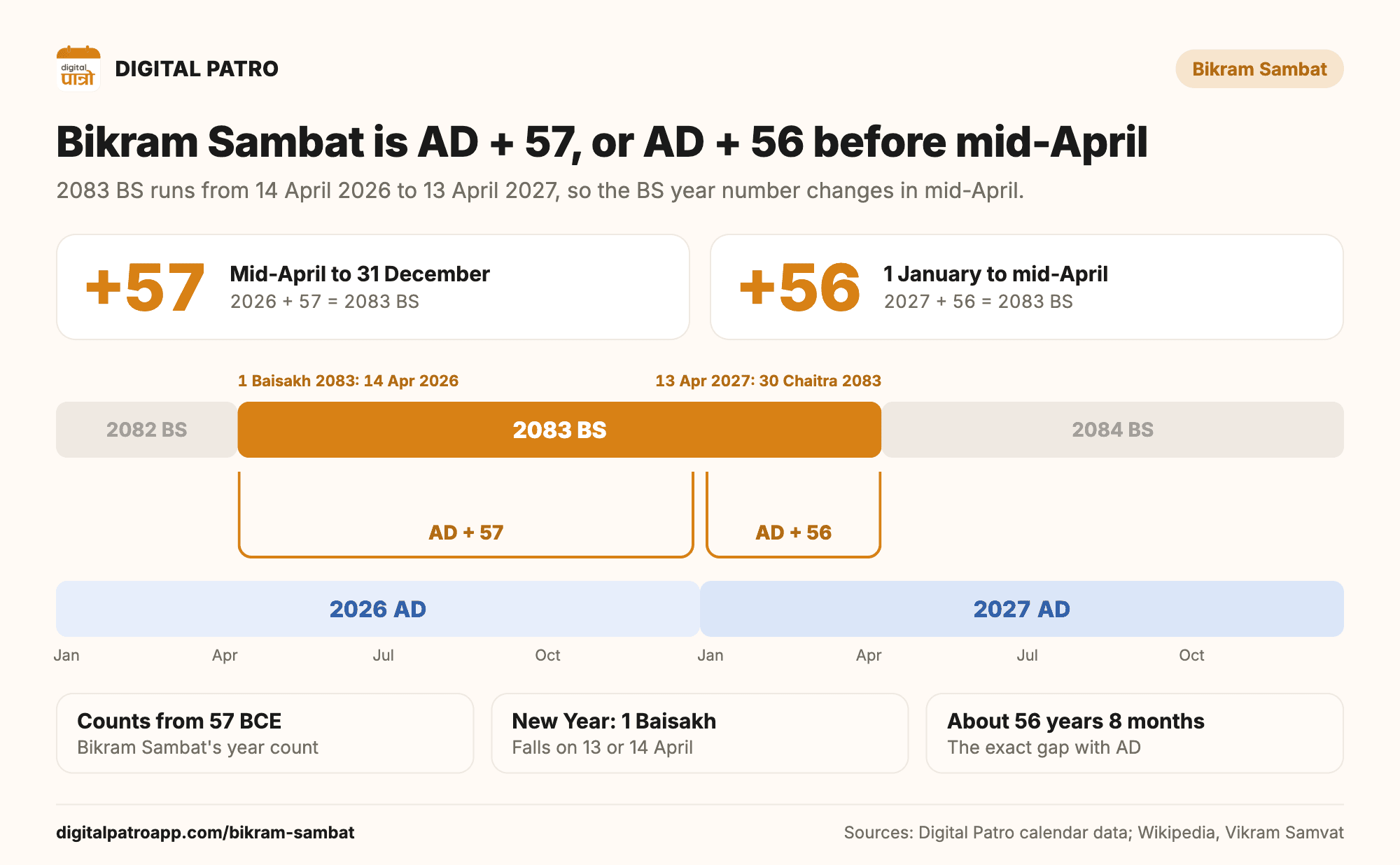
Figures in this image
| Period of 2083 BS | Dates | BS year |
|---|---|---|
| Mid-April to December | 14 April 2026 to 31 December 2026 | 2026 + 57 = 2083 |
| January to mid-April | 1 January 2027 to 13 April 2027 | 2027 + 56 = 2083 |
| Date in AD | BS year | Example |
|---|---|---|
| Mid-April to 31 December | AD year + 57 | 27 November 2026 is in 2083 BS (2026 + 57) |
| 1 January to mid-April | AD year + 56 | 1 March 2027 is in 2083 BS (2027 + 56) |
The exact gap is about 56 years and 8 months. For a date near the change of year, check it in the date converter, because 1 Baisakh can fall on 13 or 14 April.
Who started Bikram Sambat?
Tradition says King Vikramaditya of Ujjain started the era after defeating the Shakas. Historians are less sure: inscriptions do not call this era "Vikrama" before 842 CE, and earlier records use other names for it, such as Krita and Malava.
The legend of King Vikramaditya
The best-known version of the story comes from the Kalakacharya Kathanaka, a Jain text by the monk Mahesarasuri. In it, Vikramaditya, king of Ujjain, defeats the Shakas and starts a new era, the "Vikrama era", to mark the victory.
What the inscriptions show
The era beginning in 57 BCE appears in old inscriptions under the names Krita and Malava. The earliest known inscription that calls it "Vikrama" is from 842 CE. Several historians think Vikramaditya may be a legendary king, or a title taken by a later king who renamed the era after himself.
How Bikram Sambat became Nepal's official calendar
Bikram Sambat was used in Nepal for centuries as a lunar calendar. In the early 1900s, under Rana Prime Minister Chandra Shumsher, the government changed official dates from lunar tithis to solar day numbers (gate), which is the calendar Nepal still uses.
Bikram Sambat in Nepal before the change
The earliest known inscription in Nepal that uses Bikram Sambat is at Patan Sundhara and dates from 1404 AD. It gives the year as VS 1461, alongside Nepal Sambat 524, Saka 1326 and Kaligata 4505. Centuries later, the Muluki Ain, the legal code compiled under Jang Bahadur Rana in BS 1910, was also dated in Bikram Sambat.
Chandra Shumsher's switch from tithi to gate
Until the change, official dates were written by lunar tithi, which led to confusion. According to the history published by Nepal's calendar committee, in one year Falgun Sankranti was printed on different days in different calendars, which made work in government offices difficult. Chandra Shumsher, prime minister from 1901 to 1929, called a council of pandits and gave Pandit Hemraj Sharma the task of revising the panchang. From then on, dates were written in solar days (gate) instead of tithis.
Sources differ on the exact year of the change: 1901 (1958 BS), 1903 (1960 BS) or 1904 (1961 BS). The committee's own history says the practice of writing gate began in BS 1961.
How the Bikram Sambat calendar works
In Nepal, Bikram Sambat is a solar calendar. Each month starts at a Sankranti, the day the sun enters a new zodiac sign, and Baisakh starts when the sun enters Mesh (Aries). Festivals and fasts still follow the lunar calendar, which is why their dates move from year to year.
The 12 months
The 12 months of Bikram Sambat are Baisakh बैशाख, Jestha जेठ, Ashadh असार, Shrawan साउन, Bhadra भदौ, Ashwin असोज, Kartik कात्तिक, Mangsir मंसिर, Poush पुस, Magh माघ, Falgun फागुन and Chaitra चैत. Baisakh starts in mid-April and Chaitra ends in mid-April of the next English year. The Nepali months page lists each month's dates, days, zodiac sign and season.
Why months have 29 to 32 days
A month lasts as long as the sun takes to cross one zodiac sign. The Earth moves slowest around early July and fastest around early January, so summer months such as Ashadh run to 31 or 32 days, while winter months such as Poush and Magh have 29 or 30. The lengths also change from one year to the next: Ashwin has 31 days in 2083 and 30 in 2084, and Mangsir has 29 days in 2083 and 30 in 2084.
Why festivals move between dates
Festivals follow the tithi (lunar day) in the panchang, so their solar dates change every year. That is why Bijaya Dashami fell on 4 Kartik in 2083 (21 October 2026) and Laxmi Puja on 22 Kartik (8 November 2026), while days tied to the sun, such as Nepali New Year on 1 Baisakh and Maghe Sankranti on 1 Magh, keep the same Nepali date every year.
The 7 days of the week
| Vaar | नेपाली | English |
|---|---|---|
| Aaitabar | आइतबार | Sunday |
| Sombar | सोमबार | Monday |
| Mangalbar | मंगलबार | Tuesday |
| Budhabar | बुधबार | Wednesday |
| Bihibar | बिहीबार | Thursday |
| Shukrabar | शुक्रबार | Friday |
| Shanibar | शनिबार | Saturday |
Who decides the Nepali calendar each year?
The Nepal Panchanga Nirnayak Bikas Samiti (नेपाल पञ्चाङ्ग निर्णायक विकास समिति) decides the Nepali calendar. It is a government committee under the Ministry of Culture, Tourism and Civil Aviation, and no panchang or calendar may be published in Nepal without its approval.
The committee works under a formation order of 2077 BS, issued under the Development Board Act, 2013 BS, and published in the Nepal Gazette on 18 Shrawan 2078. It is based at the Narayanhiti Palace premises in Kathmandu. An earlier state body, the Nepal Rajkiya Panchang Nirnayak Samiti, revised the calendar from BS 2035. The Nepali panchang page explains what the committee approves and why two calendars can still show a different tithi.
Bikram Sambat in Nepal and Vikram Samvat in India
Nepal and India count the same era, but their calendars work differently. Nepal's Bikram Sambat is a solar civil calendar that starts on 1 Baisakh. India's Vikram Samvat is a lunisolar calendar used for religious dates, which adds an extra lunar month when needed and starts in Chaitra in North India.
| Nepal: Bikram Sambat | India: Vikram Samvat | |
|---|---|---|
| Type | Solar months | Lunisolar: 12 lunar months, plus an extra month when needed |
| Used for | Official civil calendar | Religious and festival dates |
| New year | 1 Baisakh, mid-April | Chaitra new moon in North India; Kartik in Gujarat |
| Year 2083 began | 14 April 2026 | 19 March 2026 (amanta) |
| Year 2083 length | 12 months, 365 days | 13 lunar months (includes an adhika masa) |
Bikram Sambat and AD (Gregorian)
BS and AD count from different starting points and use different months. 11 Mangsir 2083 in BS is 27 November 2026 in AD. Each Nepali month starts in the middle of an English month, so a BS date has to be converted day by day.
| Bikram Sambat (BS) | AD (Gregorian) | |
|---|---|---|
| Year starts | 1 Baisakh, mid-April | 1 January |
| Months | 12 months of 29 to 32 days; lengths change every year | 12 months of 28 to 31 days; lengths fixed |
| Leap years | No leap day; a year has 365 or 366 days | 29 February is added in leap years |
| Year number | AD + 57 (mid-April to December), AD + 56 (January to mid-April) | BS - 57 or BS - 56 |
| Used in Nepal for | Government work, documents and daily life | Passports and international dealings |
Where Bikram Sambat is used in Nepal
- Government and official documents are dated in Bikram Sambat, Nepal's civil calendar.
- Citizenship certificates give the date of birth in BS. The passport application asks for the date of birth from the citizenship certificate and its conversion to AD.
- The fiscal year runs from 1 Shrawan to the last day of Ashadh.
- Printed calendars and panchangs need approval from the Nepal Panchanga Nirnayak Bikas Samiti before publication.
Bikram Sambat and Nepal Sambat
Nepal also has Nepal Sambat, the lunisolar calendar of the Newar people, which counts from 20 October 879. The government declared Nepal Sambat the national era on 24 October 2008, and on 13 November 2023 the cabinet decided to use it in all government documents and work.
The two calendars are used side by side. The calendar committee's own website, for example, shows both the BS and the Nepal Sambat date. Nepal Sambat 1147 started on 24 Kartik 2083 (10 November 2026), the day of Mha Puja, and Digital Patro shows the Nepal Sambat date next to today's BS date.
Questions about Bikram Sambat
What does B.S. stand for?
B.S. stands for Bikram Sambat, the official calendar of Nepal. The same era is written V.S. (Vikram Samvat) or Bk. (Bikrami) elsewhere.
Who started Bikram Sambat?
Tradition credits King Vikramaditya of Ujjain, who is said to have started the era after defeating the Shakas. In Nepal, the solar form used today was introduced under Rana Prime Minister Chandra Shumsher in the early 1900s.
Why is Nepal 57 years ahead?
Nepal's calendar counts years from 57 BCE, so its year number is 57 more than the AD year from mid-April to December, and 56 more from January to mid-April.
What is the Bikram Sambat date today?
Today, 27 November 2026, is 11 Mangsir 2083 BS, a Friday (Shukrabar).
Which Bikram Sambat year is 2026?
2026 covers two BS years: 2082 BS until 13 April 2026 and 2083 BS from 14 April 2026.
Is it the year 2080 in Nepal?
No. 2080 BS ran from 14 April 2023 to 12 April 2024. The current year is 2083 BS.
Is Bikram Sambat solar or lunar?
In Nepal, Bikram Sambat is solar: each month starts when the sun enters a new zodiac sign. Festivals still follow the lunar tithi. In India, Vikram Samvat is lunisolar.
When does the Bikram Sambat new year start?
The new year starts on 1 Baisakh, when the sun enters Mesh (Aries), which falls on 13 or 14 April. It is a public holiday in Nepal. 2084 BS starts on 14 April 2027.
Who decides the Nepali calendar?
The Nepal Panchanga Nirnayak Bikas Samiti, a government committee under the Ministry of Culture, Tourism and Civil Aviation, approves every panchang and calendar published in Nepal.
Which calendar does Nepal use?
Nepal uses Bikram Sambat as its civil calendar, alongside the AD (Gregorian) calendar for international use. Nepal Sambat is also recognised as a national era.
Sources
- Definition, solar use in Nepal, 57 BCE, Vikramaditya legend, inscriptions, India comparison: Wikipedia, Vikram Samvat, en.wikipedia.org/wiki/Vikram_Samvat
- Solar months, Sankranti, lunar festivals, weekday names: Wikipedia (Nepali), विक्रम सम्वत्, ne.wikipedia.org/wiki/विक्रम_सम्वत्
- Earliest BS inscription in Nepal, Chandra Shumsher's reform, Nepal Sambat as national era: Bal Gopal Shrestha, HIMALAYA 35(1), 2015, digitalcommons.macalester.edu/cgi/viewcontent.cgi?article=2116&context=himalaya
- Calendar committee history (tithi to gate, Falgun Sankranti): Nepal Panchanga Nirnayak Bikas Samiti, nepalpanchanga.com/org-history
- Committee, ministry and approval rule: Nepal Panchanga Nirnayak Bikas Samiti, npns.gov.np/
- Formation order 2077: Nepal Law Commission, lawcommission.gov.np/content/12400/12400-nepal-panchang-adjudicatory-de/
- Passport date of birth rule: Department of Passports, nepalpassport.gov.np/en/process/process-40
- Earth's speed in orbit: NASA, science.nasa.gov/solar-system/orbits-and-keplers-laws/
- Cabinet decision on Nepal Sambat, 2023: The Rising Nepal, risingnepaldaily.com/news/35014
- Year and month dates: Digital Patro calendar data, 2080 to 2085 BS.