
Quick Reference Card
| Date | Bhadra 29, 2083 BS (September 14, 2026) |
| Duration | 1–3 days (extended Teej festival period) |
| Observance | Public Holiday and Women's Religious Fast |
| Celebrated in | Nepal, India and Hindu communities worldwide |
| Observing Communities | Hindu women of all ages |
| Type of Event | Vrata and festival celebration |
| Purpose of Event | To honor Goddess Parvati's sacred devotion to Lord Shiva and seek blessings for marital bliss, family welfare, and the well-being of spouses and children. |
| Holiday Status | Yes (Public holiday in Nepal for the 3-day extended Teej period) |
| First Observed in | Ancient Hindu tradition |
Quick Fact: Haritalika Teej is Nepal's most celebrated women's festival, observed exclusively by Hindu women on the third lunar day (Tritiya) of Bhadrapada month's waxing moon. The name "Haritalika" derives from the legend of Goddess Parvati being taken by her friends to the forest (Hara-tala) to perform penance for Lord Shiva's love, representing the ultimate power of feminine devotion and spiritual practice.
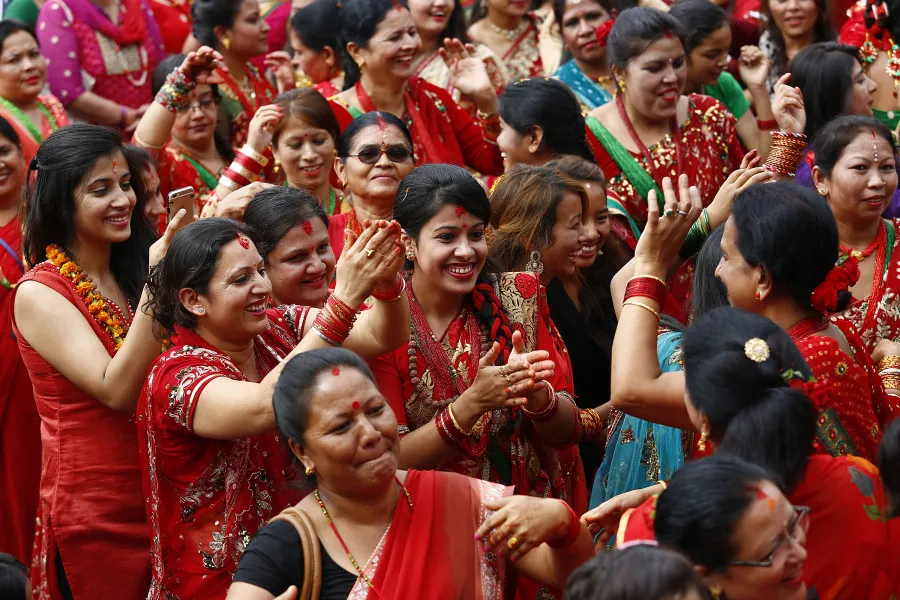
Haritalika Teej is one of Nepal's most beloved and visually magnificent festivals, celebrated exclusively by Hindu women to honor the sacred union of Goddess Parvati and Lord Shiva. Observed on the third lunar day (Tritiya) of Bhadrapada month's waxing moon, this festival combines rigorous fasting with vibrant community celebration, traditional folk songs, and the joyful expression of feminine solidarity. As a national public holiday spanning three days, Haritalika Teej represents the heart of women's spiritual and cultural expression in Nepal.
History and Background
Haritalika Teej's roots lie in the ancient legend of Goddess Parvati, who was taken by her companions to the forest (Hara = taken, Alika = by companions, Tala = to the forest) to escape a marriage arranged by her father Himalaya to Lord Vishnu. In the forest, she performed intense penance and created a Shiva lingam from sand, worshipping it with absolute devotion to win Lord Shiva as her husband. Her devotion succeeded, and Shiva accepted her. This story of selfless, unwavering feminine devotion became the philosophical and mythological foundation of Haritalika Teej. The festival has been a cornerstone of Nepali women's cultural identity for centuries, blending religious observance with community celebration and the preservation of folk music traditions.
Purpose of Haritalika Teej
This festival is primarily celebrated to:
Seek marital bliss and an eternal bond with one's spouse through Goddess Parvati's blessings.
Pray for progeny and healthy, happy children within the household.
Celebrate the power of feminine devotion and independent spiritual practice.
Strengthen family unity, conjugal harmony, and the bonds of love and partnership.
How is Haritalika Teej Observed?
Haritalika Teej is observed through a rich combination of devotional and festive activities:
Complete Fast: Women observe a complete fast from dawn to dusk (some observe a waterless fast).
Ritual Bathing: Sacred bathing and wearing of fine clothes, red sarees, and jewelry.
Sand Worship: Preparation and worship of sand images of Shiva-Parvati as per ancient tradition.
Teej Songs: Singing of traditional Teej songs (folk melodies) expressing devotion and women's experiences.
Swinging: Traditional swinging on decorated swings (Jhulna) as a festive celebration.
Fast-Breaking Feast: Consumption of special Teej foods including Dahi (yogurt), Kichdi, and fruits upon breaking fast.
Community Gathering: Women gather collectively for shared worship, songs, and celebration.
Importance of Haritalika Teej
Haritalika Teej carries profound cultural and spiritual significance:
It celebrates the primacy of devoted feminine consciousness as an independent force in Hindu spirituality.
It reinforces ideals of marital commitment, family stability, and loving partnership.
It represents the cosmic union of Shiva (pure consciousness) and Parvati (creative power/Shakti).
It acknowledges women as independent spiritual practitioners capable of commanding divine grace.
It preserves a rich tradition of folk music, song, and collective feminine culture across generations.
Conclusion
Haritalika Teej is far more than a religious observance—it is a vibrant celebration of feminine strength, spiritual devotion, and community solidarity. Through fasting, prayer, and joyful singing, women across Nepal and the Hindu world reconnect with the timeless story of Goddess Parvati's devotion and claim their own spiritual agency. This magnificent festival stands as one of Nepal's most treasured cultural traditions.