
Saraswati Puja is the day the Nepali school year effectively begins in spirit, regardless of what the academic calendar says. Children who have never held a pen are guided to write their first letters. Students carry their books and pens to the temple and leave them at the feet of the goddess overnight. Musicians place their instruments on the altar. Painters put down their brushes and do not touch them until the puja is over.
It falls on Magh Shukla Panchami, the fifth day of the bright fortnight of Magh, and it goes by three names in Nepal. Saraswati Puja, after the goddess. Basanta Panchami, after the season it opens. Shree Panchami, after the auspiciousness the day is held to carry.
That third name matters more than people realise. Shree Panchami is the one day in the Nepali year on which you do not need a priest to calculate a sait for you. Weddings, Bratabandha, Ihi, opening a shop, laying a foundation, starting anything at all. The day itself is the sait.
|
Detail |
Information |
|
Nepali Names |
सरस्वती पूजा, श्री पञ्चमी, वसन्त पञ्चमी |
|
Tithi |
Magh Shukla Panchami, the fifth day of the bright fortnight of Magh |
|
Usual Gregorian Window |
Late January to mid-February |
|
Deity |
Saraswati, goddess of knowledge, speech, learning, music and the arts |
|
Season |
Marks the start of Basanta (spring), the first of the six ritus |
|
Holiday Status |
A holiday for educational institutions. Schools, colleges and campuses close. It is not a general public holiday, so most offices and banks remain open |
|
Colour of the Day |
Yellow |
|
Also Observed As |
Vidyarambha or Akshararambha, the beginning of learning for young children |
|
Also Known For |
Being an abuja sait, a day that requires no separately calculated auspicious hour |
|
Main Sites in Kathmandu Valley |
Saraswati Temple at Swayambhu, Neel Saraswati at Lazimpat, Saraswati Temple at Dillibazar, and Saraswati Kunda at Lele in Lalitpur |
|
BS Date |
AD Date |
Day |
|
Magh 9, 2082 BS |
23 January 2026 |
Friday |
|
Magh 28, 2083 BS |
11 February 2027 |
Thursday |
The gap between those two dates is unusually wide because 2083 carries an intercalary month, which pushes the lunar tithi later against the solar calendar. This is exactly why the date must be read from the panchang each year and never assumed.
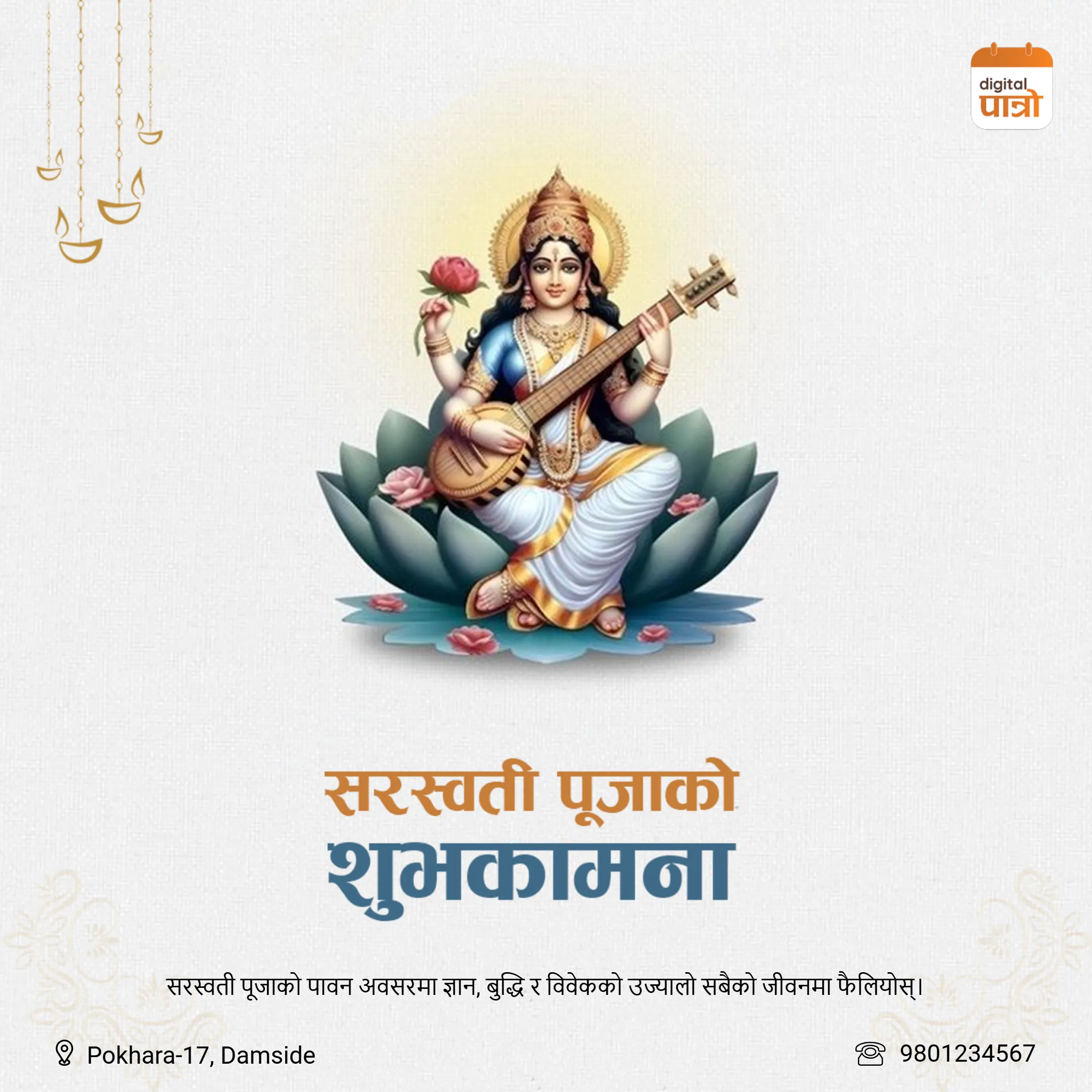
Want to share wishes with your friends, family, or on social media using a post like the above post? Create a personalized post for free in seconds using our post generator. Your text, your Style.
Saraswati is the goddess of vidya, meaning knowledge and learning, and of vak, meaning speech. In the Vedic tradition, she is closely associated with the power of language itself, with the composition of the Vedas, and with the river of the same name. Later tradition places her as the consort of Brahma, the creator.
Her iconography is consistent, and every element in it carries meaning.
She is dressed in white. Not gold, not red, not the heavy ornamentation of other goddesses. White for purity of mind, and for the absence of the distractions that wealth and power bring.
She holds the veena, a stringed instrument. Knowledge without expression is incomplete, and the veena is her mastery of music and of the arts. An instrument that is out of tune produces nothing, which is the point being made.
She holds a book, the Vedas in most depictions. This is the accumulated learning of the tradition, held rather than worn, because it has to be carried and passed on.
A rosary, usually of rudraksha or crystal, for the discipline and repetition that any real learning requires. Talent without practice is not represented anywhere in her iconography.
She sits on a lotus, which grows out of mud and is not stained by it. Knowledge exists in the world without being corrupted by it.
Her vahana is the swan. The swan in this tradition is said to be able to separate milk from water when the two are mixed. That is the faculty of discrimination, the ability to tell what is true from what is merely presented as true, and it is arguably the most important thing on her entire iconographic list.
In some depictions, a peacock stands nearby, representing the pride and display that a student is expected to keep under control.
In the Kathmandu Valley, the goddess of wisdom is also approached as Manjushree, the bodhisattva of wisdom in the Buddhist tradition, who, in Newar accounts, drained the lake that filled the Valley by cutting the Chobar gorge with his sword. Manjushree Hill at Swayambhu is one of the busiest sites on Shree Panchami, and people go there to worship Saraswati and Manjushree without treating the two as being in conflict. This overlap is normal in Nepal, and it is one of the more interesting features of the day.
Homes, schools, colleges, libraries, music schools, dance academies, art studios and printing presses all hold a puja. The altar is set with a Saraswati image, white or yellow flowers, incense, a lamp, fruit, and the tools of whatever work the household or institution does.
The most common practice among students is to place books, notebooks, pens, and instruments at the altar the night before and to leave them there overnight, then to collect them after the puja the following morning. During that period, the tools are not used. It is a deliberate day off from study, ended by a blessing.
ॐ सरस्वती मया दृष्ट्वा, वीणा पुस्तक धारणीम् ।
हंस वाहिनी समायुक्ता मां विद्या दान करोतु में ॐ ।।
Line by line explanation:
ॐ सरस्वती मया दृष्ट्वा – I meditate upon and behold Goddess Saraswati
वीणा पुस्तक धारणीम् – the one who holds a veena (music) and a book (knowledge)
हंस वाहिनी समायुक्ता – who is seated on a swan, symbolizing purity and discernment
मां विद्या दान करोतु मे – may she grant me knowledge and learning
This mantra is a prayer to the Goddess Saraswati seeking knowledge, wisdom, creativity, and clarity of thought. It is commonly recited by students, teachers, and scholars, especially during Saraswati Puja and before studying or engaging in learning activities.
This is the part of the day that people remember for the rest of their lives.
Young children, usually between three and five years old, are brought to a temple or to the puja at home and are guided to write their first letters. A parent or a priest holds the child's hand and forms the letters, most often on a slate, on rice spread on a plate, or directly on the wall or step of a Saraswati temple with chalk or coloured powder.
The letters written are usually the opening of the Nepali alphabet, or the syllable Om, or the phrase Om Namah Siddham. Temple walls at Saraswati sites are covered in these marks by the end of the day.
The ceremony has two names in use, Vidyarambha, meaning the beginning of knowledge, and Akshararambha, meaning the beginning of letters.
Shree Panchami is what Nepali tradition calls an abuja or unbounded auspicious day. On almost every other day, a priest has to calculate a sait, an auspicious hour, before a wedding, a Bratabandha, a Griha Pravesh, a business opening, or a foundation laying can begin.
On Shree Panchami, the calculation is not required. The whole day carries the auspiciousness.
The practical effect is visible. Wedding venues in Kathmandu are booked out. Panche baja bands work all day. Mass Bratabandha ceremonies are held. Newar families hold Ihi, the ceremony in which young girls are married to the bel fruit. Shops open, businesses launch, foundations are laid, and vehicles are taken out for their first puja.
If you see an unusual number of wedding processions on a Magh morning in Nepal, this is why.
Basanta Panchami announces Basanta, spring, the first of the six seasons of the traditional year. Mustard fields are yellow across the Tarai and the inner valleys at exactly this point, which is where the colour of the day comes from.
At Hanuman Dhoka Durbar in Kathmandu, the historic palace complex, a formal ceremony called Basanta Shrawan is held on this day. A traditional melody is played by the Nepal Army band, and the arrival of spring is proclaimed. In the monarchy period, this was a state ceremony attended by the king. It continues in the republic and is one of the more direct survivals of the old court calendar into the present one.
Yellow is worn and offered on this day, and there are three reasons stacked on top of each other.
The mustard fields are in full flower in Magh, so yellow is simply what the country looks like
Yellow is associated with Basanta, spring, and with the sun's strengthening after the winter solstice
Yellow is the colour linked to intellect and to the quality of sattva, clarity, in the traditional scheme
People wear yellow or white. Offerings include yellow flowers, yellow fruit, and in many households a sweet rice dish coloured with turmeric or saffron.
Saraswati temple at Swayambhu, on the hill approach, along with Manjushree Hill. The busiest single site in the Valley on this day
Neel Saraswati temple at Lazimpat
Saraswati temple at Dillibazar
Saraswati Kunda at Lele in Lalitpur
Numerous smaller neighbourhood shrines, where the queues start before dawn
Saraswati shrines and temples in Pokhara, Chitwan, Janakpur, Biratnagar, Butwal and Nepalgunj all draw large crowds. In the Tarai, the day carries additional weight because of the strong Saraswati Puja tradition across the border, including large public pandals in some towns.
The single largest number of pujas happens inside educational institutions rather than at temples. Almost every school and campus in the country sets up an altar, and student unions and clubs run the arrangements.
If you want to know exactly what the day looks like in an ordinary household:
The house is cleaned the night before, and the puja space is set up
Children's books, pens, and school bags are placed at the altar overnight
Family members bathe early and wear yellow or white
The image of Saraswati is bathed, dressed, and decorated with yellow flowers
A lamp is lit, incense is offered, and the Saraswati Bandana is recited
Offerings are made of fruit, sweets, milk, and yellow flowers
Young children are guided through their first letters
The family visits a Saraswati temple, often queuing for a long time
Prasad is distributed, and the books are taken back
Schools hold their programme, usually with the puja in the morning followed by cultural events
This claim appears on a number of Nepali and Indian websites, and it is wrong. Mahishasura was killed by Durga, and that story belongs to the Devi Mahatmya and is commemorated at Dashain, not at Shree Panchami. Saraswati is not a warrior goddess and carries no weapon in her standard iconography. She holds a veena, a book, a mala, and a lotus.
Educational institutions close. Schools, colleges, and campuses take the day off, and Nepali calendars mark it specifically as a holiday for teaching institutions. Government offices, banks, and most private businesses work normally. This differs from India, where several states give a general holiday.
They are two names for the same tithi, not two separate observances. Shree Panchami is a third name for it.
The day is not only for students
It is for anyone whose work involves knowledge, skill, language, or art. Musicians, dancers, painters, writers, printers, teachers, tailors and craftspeople all place their tools on the altar. In many workshops, the machines are cleaned and given tika on this day.
The tithi is the same, and the goddess is the same, but the shape of the day is different.
In Nepal, the emphasis falls heavily on vidyarambha and on the abuja sait, which makes it a major wedding and Bratabandha day. In most of India, it is not a wedding day of that scale
In West Bengal, Assam and Odisha, Saraswati Puja is celebrated with large public pandals, community idols and immersion after the puja. Nepal's practice is more temple- and household-based, with fewer public pandals outside the eastern Tarai
Nepal has the Basanta Shrawan ceremony at Hanuman Dhoka, which has no Indian equivalent
Nepal has the Manjushree overlap at Swayambhu, which is specific to the Kathmandu Valley
Kite flying, which is associated with Basant Panchami in Punjab and parts of north India, is not part of the Nepali observance
| Term | Meaning |
|---|---|
| Shree Panchami | The fifth day of the bright fortnight of Magh, with the name emphasising auspiciousness |
| Basanta Panchami | The same day, named for the beginning of spring |
| Vidyarambha | The beginning of learning, marked by a child's first writing ceremony |
| Akshararambha | The beginning of letters, another name for the Vidyarambha ceremony |
| Abuja Sait | An auspicious day considered complete in itself, so no separate auspicious hour needs to be calculated |
| Saraswati Bandana | An invocation recited to Goddess Saraswati, beginning with Ya Kundendu Tushar Har Dhavala |
| Veena | The stringed musical instrument traditionally held by Goddess Saraswati |
| Hamsa | The swan, her vahana (vehicle), symbolising the ability to distinguish truth from falsehood |
| Basanta | Spring, the first of the six traditional seasons |
| Basanta Shrawan | A ceremony at Hanuman Dhoka announcing the arrival of spring |
| Ihi | A Newar ceremony in which a young girl is symbolically married to a bel fruit, commonly held on this day |
| Bratabandha | The initiation ceremony for boys, commonly held on this day |
When is Saraswati Puja celebrated in Nepal?
→ On Magh Shukla Panchami, the fifth day of the bright fortnight of Magh. In 2082 BS, it fell on Magh 9, which was 23 January 2026. In 2083 BS it falls on Magh 28, which is 11 February 2027.
Why is the 2083 date so much later than the 2082 date?
→ Because 2083 carries an intercalary lunar month, which shifts the tithi later against the solar calendar. The gap between consecutive years is not fixed, which is why the date has to be read from the panchang.
Is Saraswati Puja a public holiday in Nepal?
→ It is a holiday for educational institutions. Schools, colleges, and campuses close. Government offices, banks, and most private businesses work normally, so it is not a general public holiday.
What are the other names for Saraswati Puja?
→ Shree Panchami and Basanta Panchami. All three names refer to the same day.
Why is Shree Panchami considered so auspicious?
→ Because it is treated as an abuja sait, a day whose auspiciousness is complete in itself. On most days, a priest calculates a specific auspicious hour before a wedding, Bratabandha, or business opening. On Shree Panchami, that calculation is not required, so the day is used for all of these.
Can weddings be held on Shree Panchami without checking a sait?
→ Yes. That is precisely why it is one of the busiest wedding days in the Nepali year, along with Bratabandha and Ihi ceremonies.
What is vidyarambha?
→ The ceremony in which a young child, usually between three and five, is guided to write their first letters, often on a slate, on rice, or on the wall of a Saraswati temple. It is also called Akshararambha.
Why do students leave their books at the altar?
→ Because the tools of learning are being offered to the goddess of learning. Books, pens, and instruments are placed at the altar the night before, left untouched overnight, and collected after the puja. It functions as a deliberate pause in study, closed with a blessing.
Why is yellow worn on Basanta Panchami?
→ Because the mustard fields are in full flower in Magh, because yellow is the colour of Basanta and of the strengthening sun after the winter solstice, and because yellow is traditionally linked to clarity of intellect.
Where should I go for Saraswati Puja in Kathmandu?
→ The Saraswati temple at Swayambhu together with Manjushree Hill is the busiest site. Neel Saraswati at Lazimpat, the Saraswati temple at Dillibazar, and Saraswati Kunda at Lele in Lalitpur all draw large crowds. Go before sunrise if you want to avoid a long queue.
Did Saraswati kill Mahishasura?
→ No. Mahishasura was killed by Durga, and that story belongs to Dashain. Saraswati is not a warrior goddess and carries no weapon. She holds a veena, a book, a rosary, and a lotus.
What is Basanta Shrawan?
→ A ceremony held at Hanuman Dhoka Durbar in Kathmandu on this day, in which the arrival of spring is formally proclaimed with a traditional melody played by the Nepal Army band. It was a state ceremony under the monarchy and continues under the republic.
Why is Saraswati worshipped as Manjushree at Swayambhu?
→ Because Manjushree is the bodhisattva of wisdom in the Buddhist tradition and, in Newar accounts, drained the lake that filled the Kathmandu Valley by cutting the Chobar gorge. The wisdom function overlaps, and worshippers at Manjushree Hill approach both without treating them as competing.
Is Saraswati Puja only for students?
→ No. It is observed by anyone whose work involves knowledge, language, skill or art. Musicians place their instruments on the altar, painters their brushes, tailors their machines, and printers their presses.
How is Saraswati Puja in Nepal different from India?
→ Nepal places far more weight on vidyarambha and on the day being an abuja sait, which makes it a major wedding and Bratabandha day. Public pandal culture with community idols and immersion, strong in West Bengal, Assam, and Odisha, is much less common in Nepal outside the eastern Tarai. Nepal also has the Basanta Shrawan ceremony and the Manjushree overlap, neither of which exists in India.
What is the Saraswati Bandana?
→ The standard invocation recited on this day, beginning with Ya Kundendu Tushar Har Dhavala, describes the goddess as white as jasmine, the moon, and snow, seated on a white lotus, holding the veena, and asks her to remove dullness and inertia.