Quick Reference Card
| Date | Bhadra 17, 2083 BS (September 4, 2026) |
| Duration | 1–2 days (main midnight celebration plus following day) |
| Observance | National Public Holiday and Religious Festival |
| Celebrated in | Nepal, India and Hindu communities worldwide |
| Observing Communities | All Hindu communities, particularly Krishna devotees (Vaishnavas) |
| Type of Event | Birthday celebration of Lord Krishna |
| Purpose of Event | To celebrate the divine incarnation of Lord Krishna, honor his teachings on dharma and devotion as enshrined in the Bhagavad Gita, and seek blessings for wisdom, love, and liberation. |
| Holiday Status | Yes (National public holiday in Nepal) |
| First Observed in | Ancient Hindu tradition |
Quick Fact: Shree Krishna Janmashtami celebrates the birth of Lord Krishna, the eighth avatar of Lord Vishnu, on the eighth lunar day (Ashtami) of the waning moon in Bhadrapada month traditionally at midnight, the exact moment of Krishna's birth. Lord Krishna's teachings in the Bhagavad Gita on dharma, devotion, and liberation remain among the most influential spiritual texts in all of human civilization, guiding hundreds of millions of devotees worldwide.
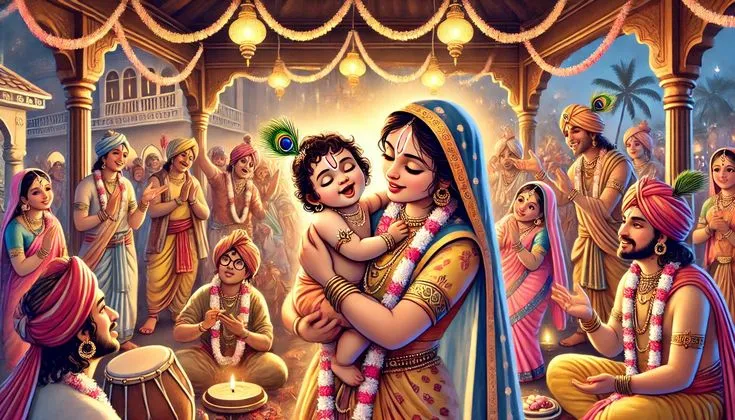
Shree Krishna Janmashtami is one of Hinduism's most beloved and universally celebrated festivals, marking the birth anniversary of Lord Krishna the divine teacher, cosmic lover, and supreme playful being whose life and wisdom have shaped Hindu civilization more profoundly than almost any other figure. Observed on the eighth lunar day (Ashtami) of Bhadrapada month's waning moon, this national public holiday brings devotees together in temples, homes, and community spaces for a night of fasting, devotional singing, and the joyful midnight celebration of Krishna's birth.
History and Background
Lord Krishna was born in Mathura (in present-day Uttar Pradesh, India) to Devaki and Vasudeva in the prison of the demon king Kansa, who feared a prophecy that Devaki's eighth son would destroy him. Krishna's miraculous birth at midnight when the prison doors opened supernaturally and his father carried him across a flooded river to safety in Gokul, is one of the most beloved stories in all of Hindu mythology. Krishna's childhood exploits as a divine cowherd, his youth as a teacher of dharma to Arjuna on the Kurukshetra battlefield (Bhagavad Gita), and his cosmic role as the supreme personality of the Hindu tradition have made him the most multifaceted and beloved of all Hindu deities. In Nepal, Janmashtami is observed with particular fervor at Pashupati temple and numerous Krishna temples throughout the country.
Purpose of Shree Krishna Janmashtami
This festival is celebrated to:
Celebrate the divine incarnation of Lord Krishna and his birth into the human world.
Honor Krishna's transformative teachings on righteous living, devotion, and the spiritual path.
Seek blessings for wisdom, unconditional love, and liberation from the cycle of suffering.
Celebrate the victory of divine love, playfulness (Lila), and joy as essential dimensions of creation.
How is Shree Krishna Janmashtami Observed?
Shree Krishna Janmashtami is observed through a beautiful blend of devotion, fasting, and joyful celebration:
Krishna Idol Decoration: Elaborate decoration of Krishna idols with flowers, jewels, and traditional attire.
Full-Day Fasting: Devotees fast from dawn until midnight when Krishna was born.
Bhajan Singing: Continuous devotional singing of Krishna bhajans, kirtans, and hymns throughout the day.
Scripture Recitation: Reading of Bhagavad Gita and recitation of Krishna's divine stories (Krishna Katha).
Midnight Celebration: Rocking of Krishna's cradle (Jhula) at the exact midnight birth moment with great rejoicing.
Sacred Offerings: Preparation of Krishna's beloved foods Makhan (butter), sweets, and milk preparations.
Dahi Handi: In some communities, breaking of a clay pot filled with butter and curds as symbolic celebration.
Importance of Shree Krishna Janmashtami
This festival holds immense importance across Hindu tradition:
Lord Krishna represents the incarnation of divine love, cosmic playfulness, and the highest wisdom simultaneously.
His Bhagavad Gita teachings on dharma, karma, and devotional service constitute one of humanity's greatest spiritual texts.
The festival emphasizes Hindu spirituality's unique integration of joy, beauty, and playfulness with serious philosophical truth.
It unites diverse Hindu communities across Nepal and the world in a shared celebration of their most beloved deity.
It inspires millions of devotees to integrate Krishna's teachings on love, duty, and surrender into daily life.
Conclusion
Shree Krishna Janmashtami is a festival of extraordinary spiritual depth and irresistible joy—perfectly reflecting the divine personality it celebrates. Lord Krishna's synthesis of cosmic wisdom with playful love, serious teaching with lighthearted laughter, makes him uniquely beloved among all Hindu deities. This national public holiday brings all of Nepal together in celebrating one of the most luminous figures in the history of human spiritual consciousness.