
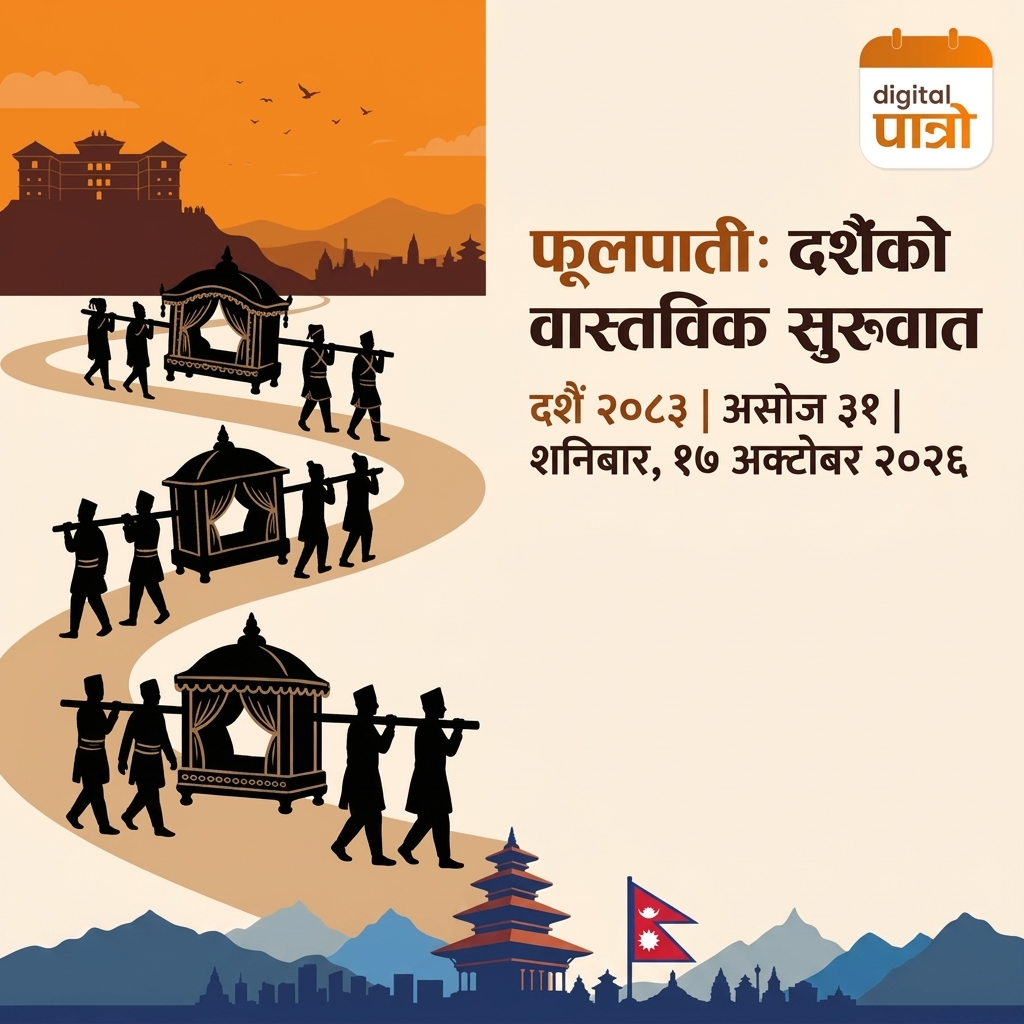
Fulpati: The Day Dashain Stops Being a Preparation and Starts Being a Holiday
Fulpati 2083 falls on Asoj 31, which is Saturday, 17 October 2026. It is the seventh day of Dashain, and for most of the country it is the day the holiday actually starts.
Up to Fulpati, Dashain is something happening in the background. The jamara is growing in a dark room, the house is half cleaned, the shops are busy, and everyone is still going to work. On Fulpati, that stops. Offices shut. The roads out of Kathmandu fill. A palanquin that left Gorkha three days earlier reaches the old palace in the capital, the army fires a twenty-one-gun salute at Tundikhel, and the country changes gear.
The name is plain enough. Phul is flower and pati is leaf. What arrives on this day is a bundle of sacred plants, and the fact that a bundle of leaves can move a national holiday is the most Nepali thing about it.
Fulpati only makes sense in position. Here is the whole shape of Dashain this year.
|
Day |
Marker |
Nepali date |
English date |
|
|
1 |
Ghatasthapana |
Asoj 25 |
Sunday 11 October 2026 |
Jamara sown, Navaratri begins |
|
2 to 6 |
Navaratri days |
Asoj 26 to 30 |
12 to 16 October |
Working days. Cleaning, shopping, travel booking |
|
7 |
Fulpati |
Asoj 31 |
Saturday 17 October 2026 |
Nine plants brought in. Holiday begins |
|
8 |
Maha Ashtami |
Kartik 1 |
Sunday 18 October 2026 |
Kalratri. The heaviest night of worship |
|
9 |
Maha Navami |
Kartik 3 |
Tuesday 20 October 2026 |
Vishwakarma Puja, tools and vehicles worshipped |
|
10 |
Bijaya Dashami |
Kartik 4 |
Wednesday 21 October 2026 |
Tika and jamara from elders |
|
15 |
Purnima |
Kartik 9 |
Monday 26 October 2026 |
Dashain closes |
Dashain crosses a month boundary. Ghatasthapana and Fulpati are in Asoj. Ashtami, Navami and Dashami are in Kartik. If you are used to thinking of Dashain as an Asoj festival, check the dates before you book anything.
Ashtami sits oddly in 2083. The Ashtami tithi runs across two sunrises this year, so Maha Ashtami Vrata is marked on Kartik 1, while Kartik 2 also carries the Ashtami tithi and the Dashain holiday. Households vary in which day they keep the Ashtami observance. Check your own patro or ask your family priest rather than assuming, because this is exactly the year the two answers will not match across a neighbourhood.
This is the thing to understand about the day.
One Fulpati is a state ceremony. It involves a palanquin, a three-day walk from Gorkha, six Magar bearers, six Brahmin bearers, the Nepal Army, a twenty-one-gun salute, and the President of Nepal. It happens once, in one place, and most Nepalis watch it on television.
The other Fulpati happens in your house. Somebody buys or gathers the plants, carries them in, and sets them by the jamara. It takes ten minutes, and no one fires a cannon.
Both are Fulpati. The first is the reason the day is on the news. The second is the reason the day is on the calendar. Here is each of them.
When Prithvi Narayan Shah took Kathmandu in 1768 and moved his seat of rule to Hanuman Dhoka, the dynasty's ancestral Dashain Ghar remained at Gorkha Durbar, where it had always been. Rather than abandon it, the royal fulpati was sent from the old seat to the new one each year.
That is the arrangement that has run ever since. The monarchy has gone. The journey has not.
|
Leg |
From |
To |
Carried by |
|
1 |
Dashain Ghar, Gorkha Durbar |
Jeevanpur, Dhading |
Six men of the Magar community, with priests |
|
2 |
Jeevanpur |
Jamal, Kathmandu |
Six Brahmins of Jeevanpur |
|
3 |
Jamal |
Dashain Ghar, Hanuman Dhoka |
Formal installation at an auspicious hour |
The bundle sets out from Gorkha Durbar early in the morning, three days ahead, after a ritual performed by the palace caretaker. It travels in a decorated palanquin. Part of the route is now covered by vehicle, with the handover point at the Fulpati Chautara at Satipipal, but the walking legs and the two sets of bearers have stayed.
On the day itself, it is installed at the Dashain Ghar of Hanuman Dhoka at an hour fixed by the priests, usually in the late afternoon.
Once the fulpati and jamara from Gorkha are formally inducted at Hanuman Dhoka, the Fulpati Badhain ceremony takes place at the Army Pavilion at Tundikhel.
The Nepal Army runs it. A conch salvo, a collective rifle salute, a twenty-one-gun salute, a military parade, a Durga dance, a feu de joie, and in recent years, helicopters and drones trailing banners and showering flowers over the ground.
The President attends as chief guest, along with the Vice President, the Prime Minister, the Chief Justice, the Speaker, and the Chairperson of the National Assembly.
The twenty-one-gun salute is the part with the history in it. It was the signal that formally opened the royal Dashain. The monarchy ended in 2008, and the salute did not, which puts it alongside the Kumari's tika as one of the few royal observances that simply transferred to the republic and carried on.
In an ordinary home, Fulpati means the sacred plants are brought in and placed in the puja kotha or the Dashain Ghar, beside the jamara that has been growing since Ghatasthapana. They are tied together, often wrapped in red cloth, and worshipped.
Banana stalks and sugarcane usually come with them and are set at the doorway or beside the shrine. Neither is one of the nine, but both are part of a Nepali Fulpati, and nobody would call a house properly done without them.
In many families this is also the day the house is finished: the last cleaning done, the new clothes brought out, the guest bedding aired. From this evening the cooking changes and the visiting starts.
The plants are bought in the days before from local markets. In Kathmandu, Asan and the Kalimati area do steady trade in fulpati bundles in the week beforehand, and every district headquarters has its own corner where the bundles appear.
Nawa is nine, and patrika is leaves. The nine are not decorative. Each one carries a form of the goddess, so the bundle is understood as Durga herself arriving in the house in plant form.
|
# |
Plant |
Nepali or common name |
Form of Durga |
|
1 |
Kadali |
Banana, kera |
Brahmani |
|
2 |
Dadima |
Pomegranate, anar |
Raktadantika |
|
3 |
Dhanya |
Paddy, dhan |
Lakshmi |
|
4 |
Haridra |
Turmeric, besar |
Durga |
|
5 |
Mankachu |
Arum |
Chamunda |
|
6 |
Kachu |
Colocasia, pidalu |
Kalika |
|
7 |
Bilva |
Bel, wood apple |
Shivadooti |
|
8 |
Ashoka |
Ashoka |
Shokarahita |
|
9 |
Jayanti |
Jayanti |
Kartiki |
The nine are bound together and, in the fuller form of the ritual, dressed and treated as a figure of the goddess, with the banana plant as the body and the bel fruits placed as the breasts. In eastern India, the same bundle is called Kola Bou and given a sari.
From Fulpati.
The days between Ghatasthapana and Fulpati are working days. Banks, offices, schools and government departments run normally, which is why the week before Fulpati is the busiest shopping and queuing week of the Nepali year.
From Asoj 31, Saturday 17 October 2026, the Dashain holiday block opens and runs through Ashtami, Navami and Dashami. Government offices, banks and schools close. Many private businesses close for longer.
What this means practically:
When is Fulpati 2083?
Asoj 31, 2083, which is Saturday, 17 October 2026.
Which day of Dashain is Fulpati?
The seventh day, Ashwin Shukla Saptami. It comes six days after Ghatasthapana and the day before Maha Ashtami.
What does Fulpati mean?
Phul means flower, and pati means leaf. The name refers to the bundle of sacred plants brought into the home and the shrine on this day.
What is the Nawapatrika?
The nine sacred plants brought in on Fulpati are: kadali (banana), dadima (pomegranate), dhanya (paddy), haridra (turmeric), mankachu (arum), kachu (colocasia), bilva (bel), ashoka, and jayanti. Each represents a form of Durga.
Is jamara one of the nine plants?
No. Jamara is sown on Ghatasthapana, the first day of Dashain, and grows through the festival to be given with tika on Dashami. It is a separate ritual object and is not part of the Nawapatrika.
Is sugarcane one of the nine plants?
No. Sugarcane is commonly present in Nepali households and in the procession, but it is not one of the Nawapatrika.
Does the Dashain holiday start on Fulpati?
Yes. Government offices, banks, and schools work normally up to the day before, and close from Fulpati through Dashami.
Where does the national Fulpati come from?
From the Dashain Ghar at Gorkha Durbar, the ancestral seat of the Shah dynasty, it is carried to the Dashain Ghar at Hanuman Dhoka in Kathmandu.
Who carries the Fulpati from Gorkha?
Six men of the Magar community carry it with priests from Gorkha Durbar to Jeevanpur in Dhading. Six Brahmins of Jeevanpur then carry it from there to Jamal in Kathmandu.
How long does the journey take?
Three days. It sets out from Gorkha to arrive in Kathmandu on Saptami.
What happens at Tundikhel on Fulpati?
After the Fulpati is installed at Hanuman Dhoka, the Nepal Army holds the Fulpati Badhain ceremony at the Army Pavilion, with a parade, conch and rifle salutes, a Durga dance and a twenty-one-gun salute. The President attends as chief guest.
Why does the President attend?
Because the ceremony was a royal one. The King received it until the monarchy ended in 2008, after which the role passed to the head of state.