Indra Jatra 2083 runs from Asoj 7 to Asoj 14, which is Wednesday 23 September to Wednesday 30 September 2026. The main chariot day, and the day the Kathmandu Valley gets a public holiday, is Friday 25 September 2026.
For eight days at the end of the monsoon, the old city of Kathmandu stops behaving like a capital and starts behaving like a very old town. A pine trunk is hauled in from a forest outside the valley and stood up in front of the palace. A mask that is kept locked away for the rest of the year is uncovered, and rice beer runs out of its mouth into the crowd. A wicker elephant charges down lanes too narrow for it. Three children are pulled through the streets on wooden chariots, and one of them is worshipped as a goddess.
The Newars who built this city call it Yenya, which simply means Kathmandu's festival. That is not modesty. For most of the valley's history, there was no larger public event, and there still is not.
|
Day |
Nepali date |
English date |
Tithi |
What happens |
Where |
|
1 |
Asoj 7 |
Wed 23 Sep |
Dwadashi |
Yosin thanegu, the pole is raised. Festival opens. Displays open. Upaku Wanegu in the evening |
Hanuman Dhoka, then the old city route |
|
2 |
Asoj 8 |
Thu 24 Sep |
Trayodashi |
Masked dances begin. Bhairav displays open. Dashavatar at night |
Indra Chowk, Kumari Ghar, Durbar Square |
|
3 |
Asoj 9 |
Fri 25 Sep |
Chaturdashi |
Kwaneya, chariot day 1. The big one. Kumari, Ganesh and Bhairav pulled the southern route. Kathmandu Valley holiday |
Basantapur, then south |
|
4 |
Asoj 10 |
Sat 26 Sep |
Purnima |
Yenya Punhi. Thaneya, chariot day 2, northern route |
Basantapur, Indra Chowk, Asan |
|
5 to 7 |
Asoj 11 to 13 |
Sun 27 to Tue 29 Sep |
Krishna Pratipada to Tritiya |
Dances and displays continue nightly. Quieter days, better for actually seeing things |
Indra Chowk, Durbar Square, Kilagal |
|
8 |
Asoj 14 |
Wed 30 Sep |
Chaturthi |
Nanicha ya, chariot day 3, central route. Then Yosin kwathalegu, the pole comes down. Festival ends |
Kilagal and the central lanes, then Hanuman Dhoka |
Times move. The pole raising is a daytime event. The chariot processions begin in the late afternoon and run into the night. The masked dances are mostly in the evening. Exact hours are set each year by the festival committee and the priests and are announced only a few days ahead, so check locally on the day.
Indra Jatra is fixed to the moon, not to the calendar. It begins on the twelfth day of the bright fortnight of Bhadra and ends on the fourth day of the dark fortnight of Ashwin. In the Newar calendar, Nepal Sambat, that is the month of Yanla.
Because it is a lunar festival, it moves against the English calendar every year, and it does not stay in the same Nepali month either. Note that in 2083 the entire festival falls inside the Nepali solar month of Asoj, even though the lunar month it is named for is Bhadra. Those are two different calendars doing two different jobs, and they do not have to agree.
Nothing starts until the pole is up.
A pine is selected by ritual from a forest near Nala, a small town about 29 kilometres east of Kathmandu. It is felled, stripped and brought into the city, and on the twelfth day of the bright fortnight it is hauled upright in front of Hanuman Dhoka, the old royal palace, by teams pulling on ropes. Indra's banner is unfurled from it.
The raising is a genuine feat of coordinated muscle, and it is worth seeing on its own. It is also the moment the festival is legally and ritually open. On the final day, the pole is lowered again, and the flag is taken to the river.
The pole is called Yosin or Ya: si in Nepal Bhasa, and lingo in Nepali. Raising it is Yosin thanegu. Lowering it is Yosin kwathalegu.
The chariot procession is called Kumari Jatra, and strictly speaking, it is a separate festival that was folded into Indra Jatra in 1756 by King Jaya Prakash Malla. It is now the part everybody comes for.
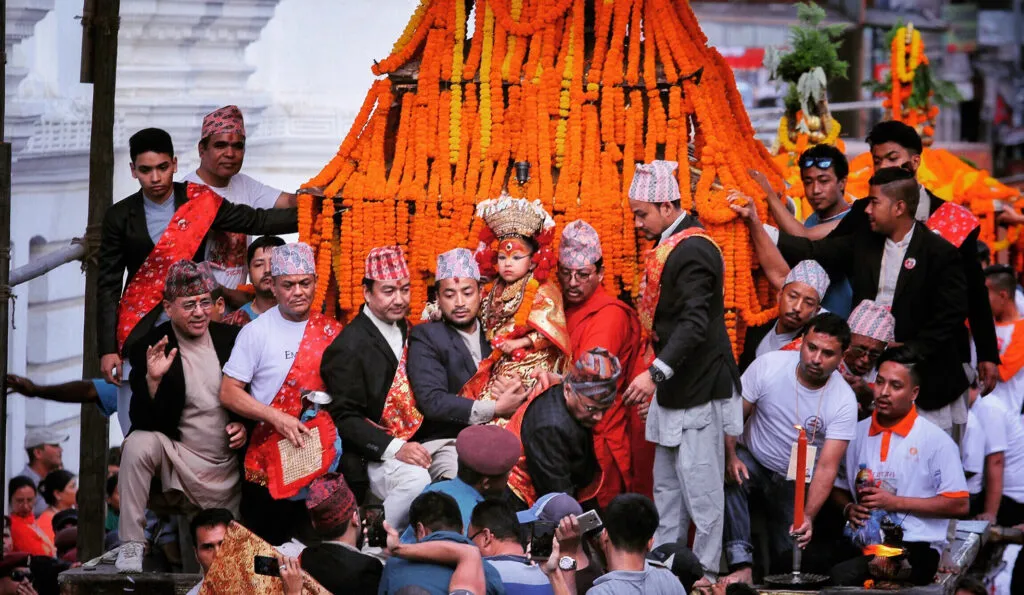
Three wooden chariots are pulled through the old city. They carry three living children:
The Kumari. A young girl from the Shakya community of Kathmandu, selected as a child and worshipped as a living goddess, who lives at the Kumari Ghar at Basantapur. She rides the largest chariot in red, her eyes outlined in the distinctive black extending to her temples, and she does not walk on the ground during the procession.
Ganesh. A boy, riding a smaller chariot.
Bhairav. A second boy, riding the third.
The chariots are pulled by hand on ropes by crowds of volunteers, with music groups walking ahead and alongside. They are heavy, the lanes are narrow, and getting a chariot round a corner in the old city is a slow, loud, physical business that draws its own cheering.
|
Day |
Name |
Route |
Roughly |
|
Asoj 9, Fri 25 Sep |
Kwaneya |
South through the lower old city, via Basantapur, Maru and Bhimsensthan |
2.2 km |
|
Asoj 10, Sat 26 Sep |
Thaneya |
North through the upper bazaar, via Indra Chowk and Asan |
1.8 km |
|
Asoj 14, Wed 30 Sep |
Nanicha ya |
The central lanes, around Kilagal |
1.2 km |
Since 2012, the Kumari's chariot on the last day, Nanicha ya, has been pulled by women.
Three faces of Bhairav are brought out for Indra Jatra and put away again afterwards. Seeing them is the reason to come on a non-chariot day.
A very large gilded mask set into the palace wall at Durbar Square, kept behind a screen for most of the year and uncovered only for this festival.
Its famous feature: a pipe runs out through the mouth, and thwon, Newari rice beer, is poured through it in a stream into the crowd below. People push forward to catch it straight from the mouth of the god. It is chaotic, competitive and entirely good-natured, and it is the single most photographed thing at Indra Jatra after the Kumari.
An enormous head, displayed outdoors facing its own temple at Indra Chowk for the run of the festival, garlanded and lit. Tradition links this head to Yalambar, the first Kirat king of the valley, which makes it one of the oldest strands of identity in the city.
A third Bhairav is displayed at Wotu, near Indra Chowk. Smaller and much quieter, and worth the two-minute walk from the Akash Bhairav crowd.
Indra Jatra looks from outside like eight days of noise. It is also, at the same time, the valley's collective funeral observance for the year, and the two things run side by side without any apparent contradiction.
On the first evening, from around four o'clock, families who have lost someone during the past year walk a set route through the old city. They carry incense, and they set down small butter lamps at shrines along the way for their dead.
The route is the same one the chariots will run later in the week. So the first thing that happens on these streets, before any chariot moves, is a slow procession of people lighting lamps for the people who are gone. If you are in the old city on Asoj 7 in the evening, you will walk into it.
A woman walks the route representing Dagini, Indra's mother, searching the city for her missing son. She is accompanied by music and by a crowd. It is a re-enactment of the search in the legend, and in practice it becomes a procession of mourning that families join.
A long, snake-like structure carried through the streets, strung with lamps, low and glowing, moving through the dark lanes. It follows the Kwaneya procession.
10th century. Tradition credits King Gunakamadeva, the founder of Kathmandu, with starting the festival to mark the founding of the city.
1756. King Jaya Prakash Malla, the last Malla king of Kathmandu, adds Kumari Jatra, the chariot procession of the living goddess, to the existing Indra Jatra. The two have been one festival ever since.
1768. Prithvi Narayan Shah takes Kathmandu on the day of Indra Jatra. The city is absorbed in the festival, its defences are thin, and the conquest that creates modern Nepal happens on a public holiday. It is the most consequential thing that has ever happened at this festival, and it is the reason Indra Jatra appears in every Nepali history textbook.
2008. The monarchy ends. The Kumari's tika, which had gone to the King, passes to the President of Nepal.
2012. Women begin pulling the Kumari's chariot on the last day.
Yes, but only inside the Kathmandu Valley.
Indra Jatra is a local public holiday for Kathmandu, Lalitpur, and Bhaktapur districts, granted on the main chariot day. In 2083, that is Friday, 25 September 2026. Offices, schools and most businesses inside the valley close. Outside the valley, it is a normal working day, so if you are in Pokhara, Chitwan, Biratnagar or anywhere else, the banks are open.
Valley offices receive four local jatra holidays across the year: Gai Jatra, Indra Jatra, Ghode Jatra and Bhoto Jatra. Indra Jatra is the largest of the four.
The festival itself is observed most intensely in Kathmandu, and in a smaller form in Lalitpur, Bhaktapur, Dhulikhel and Dolakha.
The king of the gods spends his own festival under arrest. Images of Indra with his hands tied are displayed at Maru and Indra Chowk.
The pole is not local. The pine for the Yosin is selected by ritual in a forest near Nala, about 29 kilometres east of the city, and brought in.
Nepal was conquered during it. Prithvi Narayan Shah entered Kathmandu on Indra Jatra day in 1768, while the city was watching the festival.
The chariots carry living children, not statues. A girl as Kumari, and two boys as Ganesh and Bhairav.
A god pours beer into the crowd. Thwon runs from the mouth of the Seto Bhairav mask at Hanuman Dhoka, and people drink it straight from the source.
Akash Bhairav may be a king's head. Tradition connects the great mask at Indra Chowk with Yalambar, the first Kirat king of the valley.
A republic still receives a goddess's blessing. The tika the Kumari once gave the King now goes to the President.
The elephant is looking for someone. Pulukisi is Indra's mount, Airavata, running through the streets searching for a master who has been arrested.
Yenya just means "Kathmandu's festival." In a city with hundreds of jatras, this is the one that needed no other name.
When is Indra Jatra 2083?
It runs from Asoj 7 to Asoj 14, which is Wednesday 23 September to Wednesday 30 September 2026. The main chariot day is Friday 25 September 2026.
Which is the main day?
Asoj 9, Friday 25 September 2026. That is Kwaneya, the first and largest of the three Kumari chariot processions, and the day of the Kathmandu Valley public holiday.
What is Yenya Punhi?
Yenya is the Newar name for the festival, and Punhi means full moon. Yenya Punhi is the full moon day of the festival, which in 2083 is Asoj 10, Saturday 26 September 2026, and the day of the second chariot procession.
Why do the dates change every year?
Because the festival is set by lunar tithis, from Bhadra Shukla Dwadashi to Ashwin Krishna Chaturthi, not by a fixed calendar date. It shifts against the English calendar every year.
Is Indra Jatra a public holiday?
It is a local public holiday for the Kathmandu Valley only, on the main chariot day. Outside the valley, it is a normal working day.
Who is on the chariots?
Three living children. The Kumari, a girl from the Shakya community worshipped as a living goddess, rides the main chariot, and two boys ride the smaller chariots as Ganesh and Bhairav.
What is Kumari Jatra?
The chariot procession of the living goddess. It was added to Indra Jatra in 1756 by King Jaya Prakash Malla and is now the best-known part of the festival.
How many chariot processions are there?
Three. Kwaneya on the southern route, Thaneya on the northern route, and Nanicha ya on the central route on the final day.
Where is the best place to watch?
Kathmandu Durbar Square and Basantapur for the main day, Indra Chowk for the Akash Bhairav display, and Kilagal on the last day if you want to see a chariot without a heavy crowd.
What is the pole at Durbar Square?
The Yosin, called lingo in Nepali. A pine trunk brought from a forest near Nala and raised in front of Hanuman Dhoka to open the festival. It is lowered on the final day to close it.
Why is Indra shown with his hands tied?
Because in the story, he came down to the valley to steal night jasmine for his mother's ritual, was caught by farmers at Maru, and was tied up before anyone realised who he was.
What did Indra's mother promise?
Dew and mist for the winter crops, and to take the people who had died during the past year to heaven with her. That second promise is why the festival also honours the year's dead.
What is Upaku Wanegu?
On the first evening, families who lost someone in the past year walk the festival route carrying incense and setting down butter lamps for their dead.
What is the mask that pours beer?
Seto Bhairav at Hanuman Dhoka. It is uncovered only for this festival, and thwon, Newari rice beer, is poured out through its mouth into the crowd.
What masked dances should I look out for?
Majipa Lakhey the red-faced demon, Pulukisi the wicker elephant, Sawa Bhakku the blue Bhairav from Halchowk, Mahakali Pyakhan with the tumbling Khyah figures, and the Dashavatar tableau at the Kumari Ghar.
Does the Kumari still give tika to the head of state?
Yes. The blessing that once went to the King has gone to the President of Nepal since the monarchy ended in 2008.
Who started Indra Jatra?
Tradition credits King Gunakamadeva, the founder of Kathmandu, in the 10th century. Kumari Jatra was added much later, in 1756.
What happened at Indra Jatra in 1768?
Prithvi Narayan Shah took Kathmandu on the day of the festival, while the city was occupied with the celebrations. It led to the unification of modern Nepal.
Is Indra Jatra celebrated outside Kathmandu?
Yes, in a smaller form in Lalitpur, Bhaktapur, Dhulikhel and Dolakha. Kathmandu's is by far the largest.
Can visitors and non-Hindus attend?
Yes. It is a public street festival held in open squares and lanes, and everyone watches together. Follow the attendants' directions around the Kumari and be respectful during the mourning processions.