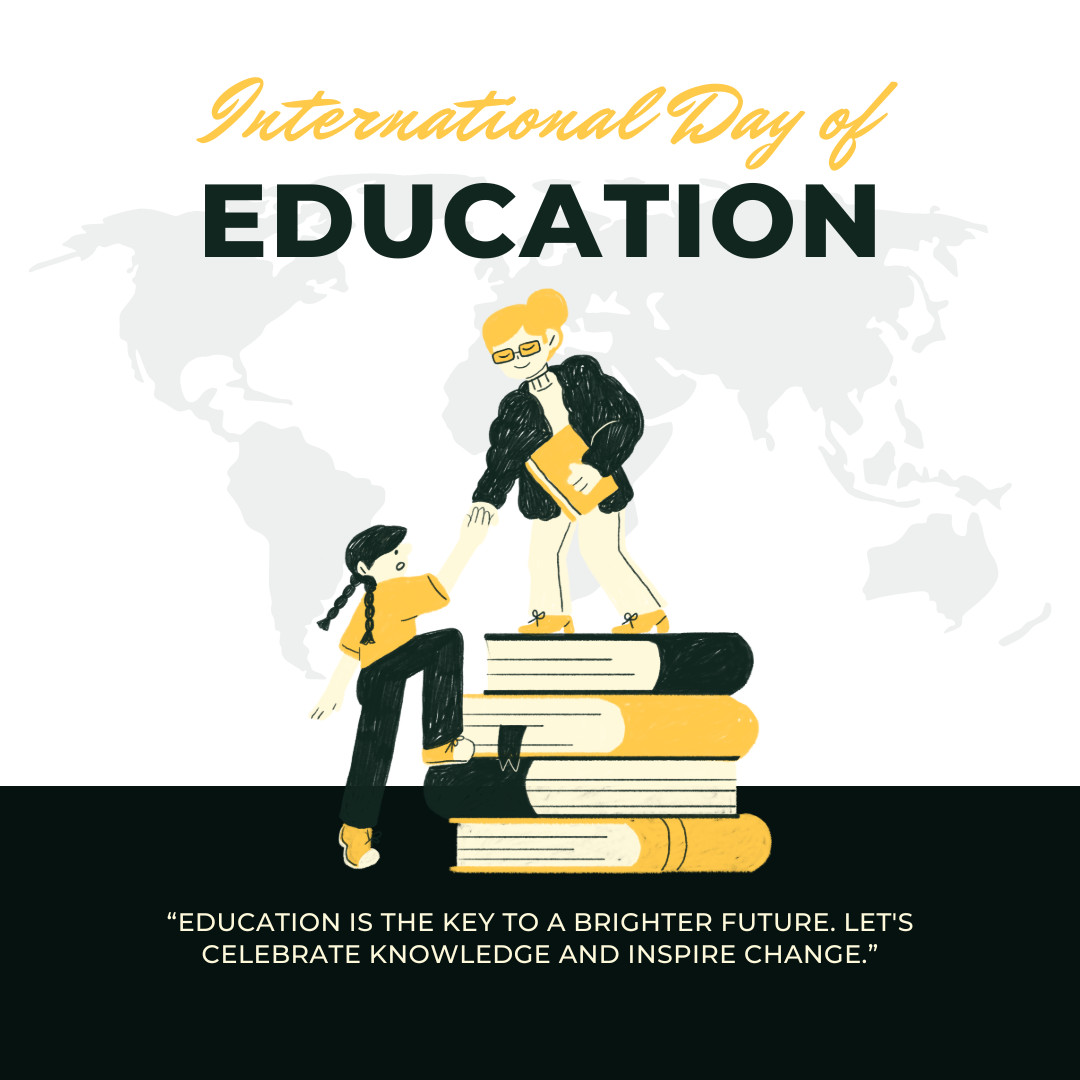
International Day of Education (अन्तर्राष्ट्रिय शिक्षा दिवस) is a global observance celebrated annually on January 24th to honor education's critical role in peace, development, and human dignity. Proclaimed by the United Nations General Assembly on December 3, 2018, this international day mobilizes governments, organizations, and individuals worldwide to reaffirm education as a fundamental human right, a public good, and a shared global responsibility essential for sustainable development.
The United Nations General Assembly unanimously adopted Resolution 73/25 on December 3, 2018, proclaiming January 24 as the International Day of Education. This landmark decision was co-authored by Nigeria and 58 other UN Member States, demonstrating an overwhelming global consensus on education's importance.
Co-Sponsoring Countries:
Nigeria (Primary sponsor)
Ireland
Norway
Qatar
Singapore
Supporting Organizations:
UNESCO
UNICEF
UN Women
The date was strategically chosen to commemorate the anniversary of the first Global Education Meeting, held in Brussels on January 24, 2012. This meeting brought together world education leaders and policymakers to address the global education crisis and reaffirm commitment to quality education for all.
On January 24, 2019, the world celebrated the first International Day of Education. UNESCO, as the UN's specialized agency for education, took the lead in organizing global commemorations. Since then, the day has grown into a major international observance with events and activities in over 150 countries.
Despite progress in education access, the world faces a severe education crisis affecting hundreds of millions of people:
Children and Youth Out of School:
244-250 million children and youth globally remain out of school
This represents a violation of their fundamental right to education
Particularly high in sub-Saharan Africa, South Asia, and conflict zones
Learning Crisis:
617 million children and youth cannot read or perform basic mathematics
Even students in school are not acquiring essential skills
Quality education gaps persist across developed and developing nations
Gender Disparities:
Less than 40% of girls in sub-Saharan Africa complete lower secondary education
Global gender parity in education still not achieved
Millions of girls denied education due to poverty, culture, or conflict
Adult Illiteracy:
739-763 million adults globally remain illiterate
Nearly two-thirds are women
Limited literacy restricts economic opportunity and empowerment
Refugee and Displaced Children:
4 million refugee children and youth remain out of school
Conflict displaces millions more annually
Education is often inaccessible in crises
The COVID-19 pandemic devastated global education:
Hundreds of millions of students fell behind in learning
School closures created massive learning gaps
Disadvantaged students suffered disproportionately
The digital divide prevented millions from remote learning
Learning loss particularly severe in low-income countries
Education is enshrined as a fundamental human right in the United Nations Universal Declaration of Human Rights (1948):
"Everyone has the right to education. Education shall be free, at least in the elementary and fundamental stages. Elementary education shall be compulsory."
This principle is non-negotiable: education is not a privilege for the wealthy, but a right belonging to every human being.
The Convention on the Rights of the Child, adopted in 1989 and ratified by 196 countries, goes further:
States must ensure children have access to education
Education must prepare children for responsible adult life
Education must promote respect for human rights and dignity
States must make higher education accessible to all children
Education enables:
Economic opportunity and decent employment
Informed citizenship and democratic participation
Health awareness and better life decisions
Breaking cycles of poverty and inequality
Understanding, tolerance, and peaceful coexistence
The Sustainable Development Goal 4 (SDG 4) is central to the 2030 Agenda for Sustainable Development, adopted by all UN Member States in 2015:
Goal: "Ensure inclusive and equitable quality education and promote lifelong learning opportunities for all"
Targets by 2030:
4.1 Primary & Secondary Education
All girls and boys complete free, equitable, quality primary and secondary education
Learning outcomes are effective and relevant
4.2 Early Childhood Development
Quality pre-primary education accessible to all children
Preparation for primary school
4.3 Affordable Higher Education
Affordable and quality technical, vocational, and higher education
Equal access regardless of economic background
4.4 Relevant Skills
Substantially increase the number of youth and adults with job-relevant skills
Technical, vocational, and entrepreneurship training
4.5 Equity and Inclusion
Eliminate gender disparities in education
Ensure equal access for vulnerable populations:
Persons with disabilities
Indigenous peoples
Children in vulnerable situations
Girls in disadvantaged regions
4.6 Literacy and Numeracy
All youth and a substantial proportion of adults achieve literacy and numeracy
Essential skills for functioning in society
4.7 Sustainable Development Education
All learners acquire knowledge and skills for sustainable development
Education for:
Sustainable lifestyles
Human rights
Gender equality
Peace and non-violence
Global citizenship
Cultural diversity appreciation
4. A Safe Learning Environments
Build and upgrade education facilities that are:
Child-sensitive
Disability-inclusive
Gender-sensitive
Safe, non-violent, and effective
4. B Scholarships and Teacher Supply
Expand scholarships for developing countries
Increase the qualified teacher supply in developing regions
The 2026 theme emphasizes youth as agents of change in reshaping education systems for the modern world:
Youth Represent:
More than 50% of the global population is under 30
The largest generation in human history
Digital natives with unique perspectives
Direct recipients of education policies
Stakeholders in educational futures
Youth must be active co-creators, not passive recipients, of education systems:
Co-Creation Means:
Youth participation in education planning and policy
Student voice in curriculum development
Youth leadership in educational innovation
Involving young people in legislation affecting them
Youth-led solutions to educational challenges
Context:
Rapid technological transformation is reshaping education
Increasing inequality is affecting young people
Climate crisis requiring youth action
Post-pandemic recovery needs youth input
Digital divide requiring youth perspectives
The Challenge:
Traditional education systems are not designed for 21st-century needs
Technology is changing faster than curricula can adapt
Young people need relevance in what they learn
Youth unemployment despite education
Need for skills-based, not just knowledge-based, education
UNESCO Global Event: January 23-24, 2026
Location: UNESCO Headquarters, Paris
Format: Hybrid (in-person and online)
Participants: Students, youth leaders, policymakers, education experts
Focus: Youth-led discussion on education transformation
1. Education is a Human Right
Recognized in international law and human rights instruments
Not conditional on wealth, gender, or background
Essential for human dignity and freedom
2. Education is a Public Good
Benefits society beyond individual advantage
Creates informed, capable citizens
Enables democracy and social cohesion
Should be publicly provided and funded
3. Education is a Shared Responsibility
Governments must provide quality, free education
Communities must support learning
The private sector must contribute responsibly
International cooperation essential for global education
Governments:
Educational policy announcements
Infrastructure investment pledges
Teacher salary and training improvements
Curriculum reform initiatives
Increased education budgets
Policy Discussions:
Education forums and consultations
Academic conferences and seminars
Legislative discussions on education
Minister-level meetings on education
Global commitments and agreements
Schools and Universities:
Special assemblies and events
Student competitions and performances
Debates on education issues
Career guidance and scholarship information
Community engagement programs
Activities Include:
Educational workshops and seminars
Student talent showcases
Science and math fairs
Cultural performances
Debate competitions
Awareness campaigns
Civil Society:
NGO-led education advocacy campaigns
Community literacy programs
Scholarship announcements
Educational resource distribution
Mentorship program launches
Global Reach:
Hashtags: #EducationDay #EducationForPeace #SDG4
Social media campaigns highlighting education stories
Digital events and webinars
Online classroom discussions
Virtual global connections
Content Shared:
Personal education stories
Statistics on education gaps
Solutions and innovations
Teacher appreciation posts
Student achievements and aspirations
Teaches conflict resolution and negotiation
Promotes understanding across cultures
Reduces prejudice and discrimination
Builds critical thinking to resist propaganda
Creates economic opportunity (alternative to violence)
Education Enables Development:
Provides skills for economic participation
Creates informed, capable citizens
Enables democratic governance
Promotes innovation and entrepreneurship
Builds resilient, adaptive communities
If you're a student in Nepal looking to continue your education journey, exploring higher education opportunities is an important step. Colleges in Nepal provide comprehensive information about colleges, universities, courses, and admission processes across Nepal—helping you make informed decisions about your educational future. Quality education starts with access to the right information about available opportunities.
Human Rights: Education is a fundamental right belonging to every person
Global Crisis: 250 million children remain out of school globally
Transformative Power: Education breaks poverty cycles and builds peace
Sustainability Link: Education is key to achieving all 17 SDGs
Youth Voice: Young people must shape education for their futures
Shared Responsibility: Governments, communities, and individuals must support education
Quality Matters: Access alone isn't enough; quality education is essential
Call to Action: International Day of Education mobilizes global commitment to education
On January 24, 2026, join the global community in celebrating International Day of Education.
This is a day to:
Recognize education's power to transform lives and societies
Celebrate teachers and educational institutions
Acknowledge the rights of all children to quality education
Mobilize action to ensure inclusive education for all
Support youth as co-creators of education systems
Commit to achieving SDG 4 and Sustainable Development by 2030
Literacy Day (September 8) - Focuses on adult literacy
Teachers' Day (October 5) - Celebrates and honors teachers
Girls' Education Day (October 11) - Advocates for girls' education
Sustainable Development Goals Days (Throughout the year)
International Day of Education on January 24 celebrates education as the foundation for peace, development, and human dignity. For too long, millions of children and adults have been denied education, a fundamental human right. The global education crisis demands urgent action from governments, organizations, and individuals worldwide.
The 2026 theme, "The Power of Youth in Co-Creating Education," reminds us that young people are not just the future of education; they are the present shapers of educational systems. As technology transforms learning, inequality grows, and the world faces unprecedented challenges, youth must have a voice in designing education for their futures.
Every child deserves quality education. Every young person deserves to develop their potential. Every community deserves the benefits that educated citizens bring. International Day of Education is our annual reminder of this urgent imperative and our collective responsibility.