Every year on Bhadra 29, Nepal observes Rashtriya Bal Diwas, written in Nepali as राष्ट्रिय बाल दिवस and known in English as National Children's Day. In 2083 BS, that date is Monday, 14 September 2026, and it is the 62nd National Children's Day.
Most countries picked a pleasant date for their children's day. Nepal picked a legal one. Bhadra 29 is the anniversary of 14 September 1990, the day Nepal formally ratified the United Nations Convention on the Rights of the Child, the most widely accepted human rights treaty in the world. On that day, Nepal stopped treating the welfare of children as a matter of kindness and started treating it as a matter of obligation. Every child in the country acquired a set of rights that the state is legally bound to deliver and can be held to account for failing to deliver.
This page covers the correct date and the years around it, why Bhadra 29 was chosen, how the edition number is counted, the laws that now protect Nepali children, the institutions responsible for them, what the numbers actually say about how children in Nepal are doing, the yearly national slogans, and how the day is observed.
|
Detail |
Information |
|
Name |
Rashtriya Bal Diwas (राष्ट्रिय बाल दिवस) |
|
English name |
National Children's Day |
|
Also called |
Bal Diwas, Children's Day Nepal, Bal Adhikar Diwas |
|
Date (Nepali calendar) |
Bhadra 29, every year |
|
Date (2083 BS / 2026) |
Monday, 14 September 2026 |
|
Which edition |
The 62nd National Children's Day |
|
Commemorates |
Nepal's ratification of the UN Convention on the Rights of the Child on 14 September 1990 (Bhadra 29, 2047 BS) |
|
Date used before 2063 BS |
Bhadra 4, the birthday of Queen Ratna Rajya Lakshmi Devi Shah |
|
First observed |
2022 BS (1965), under the Nepal Children's Organization |
|
Moved to Bhadra 29 |
2063 BS (2006), after the restoration of democracy |
|
Public holiday |
No. It is a working day and an official observance |
|
Lead agency |
Ministry of Women, Children and Senior Citizens |
|
National body |
National Child Rights Council (राष्ट्रिय बाल अधिकार परिषद्) |
|
Governing law |
The Act Relating to Children, 2075 (2018) |
|
Constitutional basis |
Article 39 of the Constitution of Nepal, Rights of the Child |
|
Who is a child in Nepali law |
Anyone below the age of 18 |
|
Child helplines |
104 (National Centre for Children at Risk) and 1098 (Child Helpline Nepal, run by CWIN) |
|
Annual theme |
A national slogan is announced each year by the ministry |
Rashtriya Bal Diwas falls on Bhadra 29 every single year. It is a fixed date in the Nepali solar calendar, not a lunar one, so it does not wander the way Dashain, Tihar, Teej or Janai Purnima do. It lands on the same Nepali date every year and on almost exactly the same English date.
In 2026, which is 2083 BS, National Children's Day falls on Monday, 14 September 2026.
|
Year (CE) |
Bikram Sambat |
Nepali date |
English date |
Day |
Edition |
|
2024 |
2081 BS |
Bhadra 29 |
14 September 2024 |
Saturday |
60th |
|
2025 |
2082 BS |
Bhadra 29 |
14 September 2025 |
Sunday |
61st |
|
2026 |
2083 BS |
Bhadra 29 |
14 September 2026 |
Monday |
62nd |
|
2027 |
2084 BS |
Bhadra 29 |
14 September 2027 |
Tuesday |
63rd |
|
2028 |
2085 BS |
Bhadra 29 |
14 September 2028 |
Thursday |
64th |
The English date has been 14 September in every recent year, which makes sense, because the whole point of Bhadra 29 is that it maps to the 14 September anniversary of the ratification. In years where the Nepali month lengths shift, Bhadra 29 can land on 15 September instead, so always trust the Nepali gate rather than assuming the English date.
No. National Children's Day is not on the Government of Nepal's public holiday list. Offices, banks and schools stay open. Programmes are run during working hours, and that is deliberate, because the audience is schoolchildren and the people who work with them.
One point of confusion is worth clearing up. In 2083 BS, Bhadra 29 happens to fall on Hartalika Teej, which is a public holiday for women employees, and also on Ganesh Chaturthi. So on 14 September 2026 a lot of Nepal will indeed be on holiday, but because of Teej, not because of Children's Day. Teej is lunar and moves every year. Children's Day does not. In most years they fall nowhere near each other.
On 20 November 1989, the United Nations General Assembly adopted the Convention on the Rights of the Child, usually shortened to the CRC or UNCRC. It was the first legally binding international agreement to set out the full range of rights that belong to every human being under the age of eighteen, covering civil, political, economic, social and cultural rights in a single document. It went on to become the most widely ratified human rights treaty in history.
Nepal did not wait long. On 14 September 1990, which is Bhadra 29, 2047 BS, Nepal ratified the Convention. This was less than five months after the People's Movement of 2046 BS had ended the Panchayat system, and the interim government of the day used one of its earliest opportunities to bind Nepal to international child rights standards.
Ratifying the Convention meant Nepal accepted four broad principles that now sit underneath all of its child law:
Non-discrimination. Every right applies to every child, regardless of caste, ethnicity, gender, religion, language, disability, birth status or the status of their parents.
Best interests of the child. In any decision affecting a child, by a court, an office, a school or a family, the child's best interest comes first.
The right to survival and development. Not just staying alive, but growing up with health, education, nutrition and care.
Respect for the views of the child. A child has the right to be heard in matters that affect them, and to have that view taken seriously according to their age and maturity.
Every year the news reports "the 61st National Children's Day" or "the 60th National Children's Day," and every year some people ask how the count can be that high when Bhadra 29 has only been used since 2063 BS.
The answer is that the count was never restarted. The government continued the numbering from the original observance that began in 2022 BS, straight through the date change. So the sequence runs unbroken across two completely different dates and two completely different political systems.
The reason Bhadra 29 exists is legal, so the law deserves a proper look. Nepal has one of the more complete child rights frameworks on paper in South Asia. The gap is in delivery, not in drafting.
Article 39 of the Constitution of Nepal 2072 (2015) places children's rights among the fundamental rights, which is a very strong position for them to occupy. It has ten clauses:
This is the main child law of the country. It replaced the older Children's Act 2048 (1992), which had been Nepal's first attempt after ratification and was badly out of date by the time it went. Key points of the 2075 Act:
A child is anyone below the age of 18. One clean definition, applied across the law.
It sets out the rights of children in detail, including the right to life, name, nationality and identity, to non discrimination, to live with and meet their parents, to expression and participation, and to protection.
Corporal punishment is prohibited. Physical or mental punishment or degrading treatment of a child at home, in school or anywhere else is treated as violence against a child, punishable by a fine of up to fifty thousand rupees and up to one year of imprisonment. This is one of the least known provisions in the whole Act and one of the least enforced.
Child marriage is an offence against a child.
It builds a juvenile justice system: no criminal liability below the age of ten, child-friendly procedure, and a Juvenile Court or juvenile bench for children in conflict with the law.
It defines the duties of parents and guardians, and lays out what happens when they fail in them.
It creates the institutional machinery, from the national council down to child welfare officers and local committees.
A day built on a treaty is really an annual audit. Here is the state of the audit.
Population. The 2021 census counted a total population of 29,164,578, of whom 27.8 percent were aged 14 or under, roughly 8.1 million children. The joint CBS and ILO child labour survey counted about seven million children aged five to seventeen. Children are close to a third of the country. That share is falling fast, down from nearly 35 percent aged 14 or under in the 2011 census, which means Nepal is ageing quickly and the window for investing in this generation is narrower than it looks.
Child labour. The Nepal Child Labour Report 2021, produced jointly by the Central Bureau of Statistics and the ILO, found 1.1 million children in child labour, which is 15.3 percent of children aged five to seventeen. Around 200,000 of them are in hazardous work. About 87 percent of child labour is in agriculture. The number is falling, from roughly 1.6 million in 2008, but slowly, and Article 39(4) of the Constitution has been in force for a decade.
Child marriage. Nepal has one of the highest rates in the world despite it being illegal and unconstitutional. Roughly a third of Nepali women aged 20 to 24 were married before the age of 18, down from about 55 percent in the late 1990s but still far above where the law says it should be. Prevalence is higher in rural areas than urban ones. Nepal is also unusual in that it appears in the global top ten for child marriage among boys as well as girls, with around one in ten men aged 20 to 24 married as children. The government's National Strategy to End Child Marriage, endorsed in 2016, targets ending the practice by 2030.
Children in institutions. Around 11,000 to 15,000 children live in registered child care homes in Nepal, spread across roughly 489 registered institutions, with a large majority of those homes clustered along tourist routes. The critical fact, and the one that surprises people most, is that around 80 to 85 percent of these children are not orphans and have at least one living parent. Many were separated from families that were poor, not absent. The trade in so-called paper orphans, children given falsified documents declaring them orphaned so that a home can attract donations and volunteers, is a recognised child protection problem in Nepal and a direct violation of the Convention's family principles.
Birth registration. Article 39(1) makes birth registration a fundamental right, and it is the gateway right: without it a child struggles to prove age, claim citizenship, enrol properly, or be protected from child marriage and trafficking. Coverage has improved a great deal over the past decade but remains incomplete, with recent estimates ranging from the low sixties to the high seventies in percentage terms depending on the survey. A meaningful share of Nepali children still have no legal proof that they exist.
Corporal punishment. Banned outright by both the Constitution and the 2075 Act, at home and at school. Survey after survey nevertheless finds that a large majority of Nepali children experience violent discipline. This is the widest gap between law and daily life in the entire child rights framework, and it is the one that requires no budget to close.
Each year the Ministry of Women, Children and Senior Citizens announces a national slogan, the नारा, which is printed on banners, read at assemblies and used across every programme held that day. The slogan is a genuinely good indicator of what the state thinks the priority is that year.
|
Year (BS) |
Edition |
National slogan |
|
2075 |
54th |
सुखी नेपाली समृद्ध नेपालः बाल अधिकार सबैको सरोकार |
|
2076 |
55th |
सुनिश्चित बाल अधिकार, समृद्ध नेपालको आधार |
|
2079 |
58th |
बालमैत्री समाजको आधारः जिम्मेवार परिवार, उत्तरदायी समाज |
|
2080 |
59th |
बालबालिकामा लगानीः सुनिश्चित भविष्यको थालनी |
|
2081 |
60th |
बालबालिकामा लगानीः सुनिश्चित भविष्यको थालनी |
|
2082 |
61st |
बालबालिकामा लगानीः सुनिश्चित भविष्यको थालनी |
|
2083 |
62nd |
To be announced by the ministry |
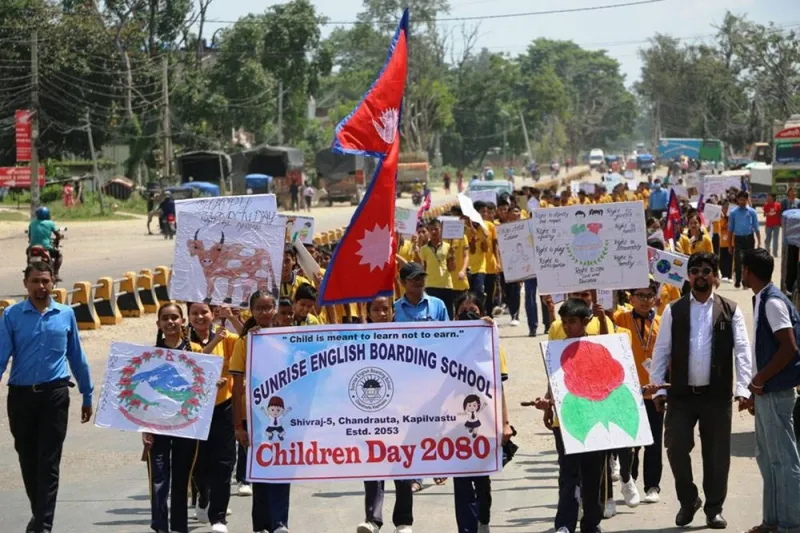
Child-led rallies. The most visible activity. Children march through the local bazaar with placards and the year's national slogan, usually organised by child clubs with the ward office. In many towns this is the only day of the year when children occupy public space as a group with a message of their own.
Child assemblies and mock parliaments. Municipalities and rural municipalities hold a bal bhela, a children's assembly, where children put questions directly to the mayor, ward chair or chief administrative officer. Some run a full mock council or child parliament, with a child mayor and child ward chairs. This is the participation right in Article 39(3) being exercised in the most literal way available.
School programmes. Essay competitions, speech and debate contests, art and poster competitions, quiz programmes, poetry, songs, dance and drama. The essay and speech topics usually come straight off the national slogan.
Awareness campaigns. Child rights organisations use the day to campaign on child marriage, child labour, corporal punishment, birth registration, online safety and school dropout. Street theatre and community drama are common in the districts.
Official messages and functions. The President and the Prime Minister issue messages. The ministry holds a main national programme, and provincial and local governments run their own.
Honours and recognition. Children who have achieved something notable, in study, sport, art or community work, are recognised, along with teachers, campaigners and organisations working in child protection.
Care home visits. Schools, offices, clubs and businesses visit child care homes and hospital children's wards. This is worth doing thoughtfully: the current best practice, given how many children in these homes have living families, is to support family reunification and community-based care rather than to arrange one-off visits.
Children's Day is not one global date. It is dozens of different dates, and mixing them up is the single most common error in Nepali school programmes.
|
Day |
Date |
Basis |
|
Rashtriya Bal Diwas, Nepal |
Bhadra 29, about 14 September |
Nepal's ratification of the CRC in 1990 |
|
Children's Day, India |
14 November |
The birthday of Jawaharlal Nehru |
|
World Children's Day |
20 November |
The UN adoption of the Declaration in 1959 and the Convention in 1989 |
|
International Children's Day |
1 June |
Marked widely across the former socialist bloc and parts of Asia since 1949 |
|
Universal Children's Day |
20 November |
The UN's recommended date, from 1954 |
Nepal is one of relatively few countries whose national children's day is tied to a legal commitment the country itself made, rather than to a person's birthday or to a general UN recommendation. Nepal also observes World Children's Day on 20 November, so children's rights get two dates in the Nepali calendar, one national and one global.
Nepal ratified the UN Convention on the Rights of the Child on 14 September 1990, less than five months after the People's Movement of 2046 BS ended the Panchayat system.
The day used to be Bhadra 4, the birthday of Queen Ratna Rajya Lakshmi Devi Shah, and it moved to Bhadra 29 in 2063 BS.
The edition count was never restarted after the date changed, which is why 2083 BS is the 62nd National Children's Day even though Bhadra 29 has only been in use since 2063 BS.
The formula for the edition number is the Bikram Sambat year minus 2021.
It is not a public holiday, though in 2083 BS it coincides with Hartalika Teej, which is.
Bhadra 29 is a fixed solar date, so unlike almost every Nepali festival it does not move around the calendar.
The Nepal Children's Organization, known as Bal Mandir and founded in 2021 BS, was given about 119 ropanis of land at Naxal in Kathmandu, and that land has since become the subject of a major embezzlement case.
Nepal has two separate child helplines, 104 run by the state and 1098 run by CWIN Nepal.
CWIN Nepal was founded in 1987, two years before the Convention on the Rights of the Child even existed.
Nepal has more than seven thousand child clubs, one of the largest child participation networks anywhere in South Asia.
Child participation is a fundamental right under Article 39(3) of the Constitution, not merely a programme idea.
Corporal punishment is completely illegal in Nepal, at home and at school, and carries up to a year in prison.
Nepal is one of the very few countries that appears in the global top ten for child marriage among boys as well as girls.
Around 80 to 85 percent of children living in Nepal's child care homes have at least one living parent.
The national slogan was kept identical for three years running, 2080 through 2082, an unusual choice for an annual observance.
Rashtriya Bal Diwas, or National Children's Day, is Nepal's official observance dedicated to children and child rights. It is held on Bhadra 29 every year and marks the anniversary of Nepal ratifying the United Nations Convention on the Rights of the Child on 14 September 1990. The day is used to promote child rights, child protection and child participation, and to review how far the state has actually got in delivering them.
When is Rashtriya Bal Diwas celebrated in Nepal?
On Bhadra 29 every year, which is almost always 14 September in the Gregorian calendar. In 2083 BS it falls on Monday, 14 September 2026. Because Bhadra 29 is a fixed date in the Nepali solar calendar rather than a lunar date, the day does not shift around the way Dashain, Tihar or Teej do.
Why is National Children's Day celebrated on Bhadra 29 in Nepal?
Because Nepal ratified the UN Convention on the Rights of the Child on 14 September 1990, which was Bhadra 29, 2047 BS. From 2063 BS the government began marking that anniversary as National Children's Day, so the date commemorates a legal commitment rather than a person or a season.
Was Nepal's Children's Day always on Bhadra 29?
No. For about four decades it was observed on Bhadra 4, the birthday of Queen Ratna Rajya Lakshmi Devi Shah, who founded the Nepal Children's Organization, known as Bal Mandir, in 2021 BS. After the political changes of 2062/63 BS, the government moved the observance to Bhadra 29 so that it would rest on child rights rather than on a royal birthday.
Which National Children's Day is 2083 BS?
The 62nd. The edition number is calculated as the Bikram Sambat year minus 2021, because the count runs continuously from the first observance in 2022 BS and was never restarted when the date moved. 2082 BS was the 61st, so 2083 BS is the 62nd and 2084 BS will be the 63rd.
Is Rashtriya Bal Diwas a public holiday in Nepal?
No. It is a working day and an official observance, not a gazetted public holiday. Schools, offices and banks stay open and hold programmes during working hours. In 2083 BS Bhadra 29 happens to coincide with Hartalika Teej, which is a public holiday for women employees, but that holiday is for Teej, not for Children's Day.
What is the theme or slogan of National Children's Day?
The Ministry of Women, Children and Senior Citizens announces a national slogan each year. For 2080, 2081 and 2082 BS the same slogan was used, "बालबालिकामा लगानीः सुनिश्चित भविष्यको थालनी," meaning "Investment in children: the beginning of an assured future." The slogan for 2083 BS was announced by the ministry shortly before Bhadra 29.
Who is considered a child under Nepali law?
Anyone below the age of 18. This definition comes from the Act Relating to Children, 2075 (2018) and matches the definition in the UN Convention on the Rights of the Child.
What rights do children have under the Constitution of Nepal?
Article 39 of the Constitution lists them as fundamental rights: the right to a name, identity and birth registration; to education, health, care, sport, recreation and personality development; to early child development and to child participation; freedom from hazardous work; freedom from child marriage, trafficking, abduction and hostage taking; freedom from recruitment into armed forces or armed groups; freedom from physical, mental or any other torture at home, at school or anywhere else; the right to juvenile friendly justice; and special protection for children who are orphaned, disabled, displaced, conflict affected or otherwise vulnerable. Anyone who violates these can be punished by law, and the child is entitled to compensation.
What is the main child rights law in Nepal?
The Act Relating to Children, 2075 (2018), which replaced the earlier Children's Act 2048 (1992). It is supported by the Children's Rules, 2078 and the National Children's Policy, 2080. Together, they define who a child is, list children's rights, criminalise violence and child marriage, prohibit corporal punishment, set up juvenile justice, and create the institutions responsible for child protection.