
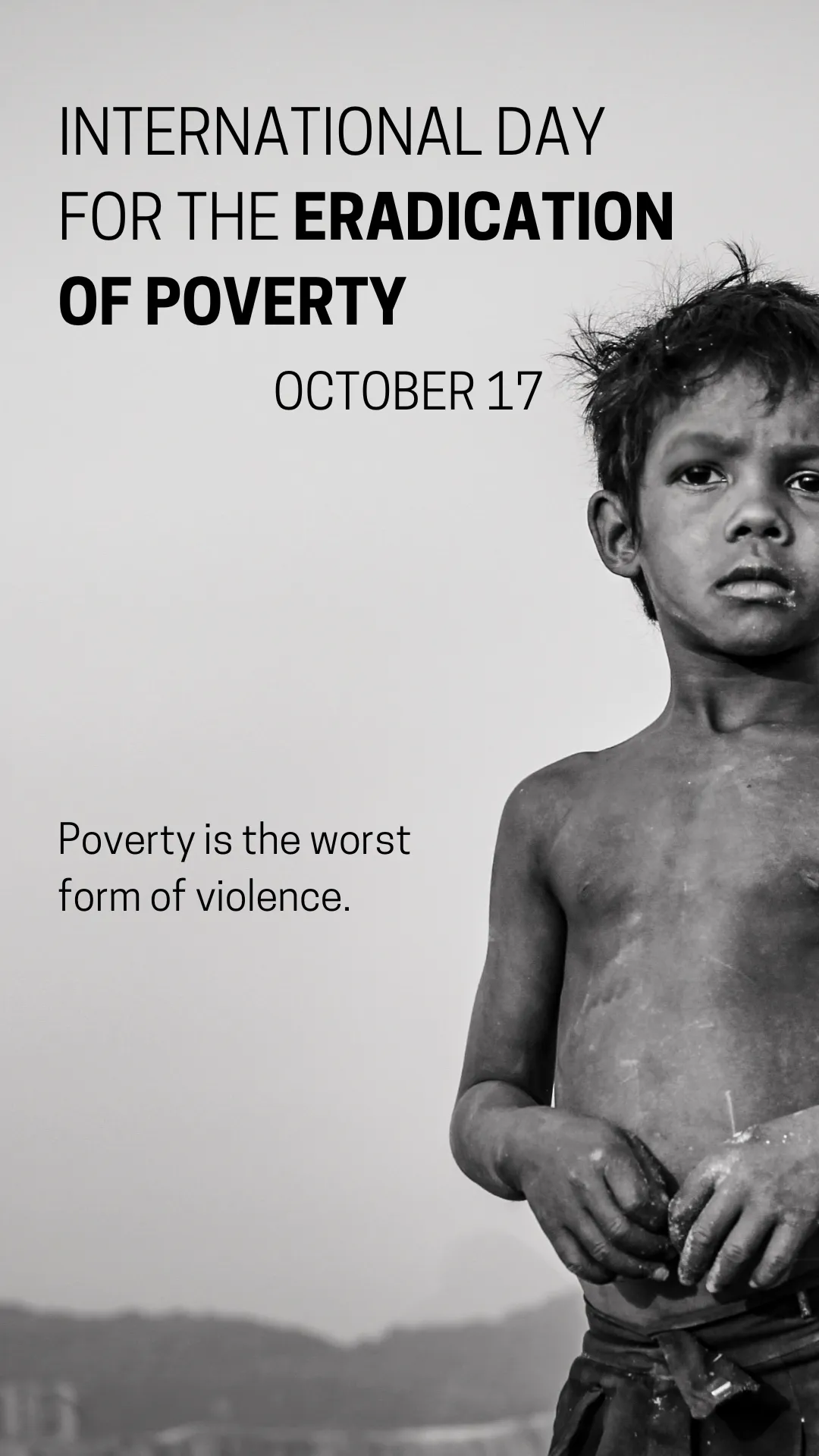
The International Day for the Eradication of Poverty is an annual global observance held on October 17. It is a day to raise awareness about poverty in all its forms and to call for action to end it. This day reminds the world that poverty affects millions and that eliminating it requires cooperation, commitment, and respect for human dignity.
|
Fact |
Details |
|
Date Observed |
October 17 each year. |
|
Officially Recognized By |
United Nations General Assembly. |
|
Origins |
First observed in 1987 in Paris, France. |
|
UN Resolution |
Adopted by UN in 1992 (Resolution 47/196). |
|
Main Goal |
End poverty in all its forms everywhere. |
|
Type of event |
International observance / Awareness day |
|
Linked to SDGs |
Closely tied to SDG 1 “No Poverty”. |
|
Global Participation |
Civil society, governments, NGOs, and individuals worldwide. |
|
Holiday Status |
Not a Public Holiday |
Poverty is more than not having enough money. It can mean lack of access to clean water, health care, food, education, housing, and opportunities. The International Day for the Eradication of Poverty draws attention to these realities. It reminds people that poverty denies basic human rights and dignity, and that it can only be overcome by working together.
The United Nations uses this day to push for policies and programs that protect vulnerable people, create decent jobs, and expand social services. It also highlights the importance of including the voices of those who live in poverty when planning solutions.
The roots of this observance go back to October 17, 1987. On that day, more than 100,000 people gathered at the Trocadéro plaza in Paris, France, where the Universal Declaration of Human Rights was signed. They honored victims of extreme poverty, violence, hunger, and fear, and declared that poverty is a violation of human rights.
A commemorative stone unveiled at that event became a symbol of the struggle against poverty. It has inspired replicas around the world. In 1992, the United Nations General Assembly officially declared October 17 as the International Day for the Eradication of Poverty through Resolution 47/196. Since then, it has been observed globally with events, talks, and campaigns.
The United Nations promotes this day through its programs and agencies to support global poverty reduction efforts. The UN encourages member states to organize activities tailored to their local and national needs.
Every year, the UN chooses a theme that reflects current global challenges related to poverty, inclusion, dignity, and justice. These themes guide discussions and help focus attention on specific issues within the broader goal of reducing poverty.
The observance also supports the 2030 Agenda for Sustainable Development. Ending poverty is the first of the 17 Sustainable Development Goals (SDGs), officially known as SDG 1: No Poverty, which aims to eradicate extreme poverty worldwide by 2030.
Each year, the International Day for the Eradication of Poverty highlights a theme to bring attention to a particular aspect of poverty or inequality. These themes are often developed in consultation with communities experiencing poverty and civil society groups.
Here are recent themes:
2025: Ending social and institutional maltreatment and ensuring respect and support for families.
2024: Ending social and institutional maltreatment for just, peaceful, and inclusive societies.
2023: Decent work and social protection to protect human dignity.
These themes help frame global discussions and emphasize how poverty intersects with discrimination, social exclusion, and inequalities.
It is marked by many important activities worldwide. These include:4
Events at United Nations Headquarters in New York and other UN offices.
Community workshops and seminars that focus on poverty challenges and solutions.
Public talks and debates on human rights, job creation, education, and social protection.
Online campaigns and awareness posts to draw global attention.
People living in poverty are often invited to speak at events so their experiences and solutions can be heard and considered directly.
Despite global efforts, more than half a billion people still live in extreme poverty. Many others struggle with limited access to basic services, jobs, and support. Factors like conflict, climate change, discrimination, and economic inequality make it harder for poor communities to escape poverty.
The UN uses this day to remind world leaders that poverty is both a moral and practical challenge. Ending it requires investing in education, health, social protection, fair wages, and stronger institutions.
Even if you live far from major events, you can still participate:
Learn about poverty issues and solutions in your country and globally.
Share posts and stories on social media during the week of October 17.
Join or support NGOs and civil society groups fighting poverty.
Support policies that expand access to education, jobs, and health care.
Every small action helps build a fairer and more inclusive world.
The International Day for the Eradication of Poverty is an important reminder that ending poverty is not just a goal in a book. It is a real human struggle that needs urgent action. By recognizing the dignity of all people, promoting justice, and working together, we can make progress toward a future where everyone can live with dignity and opportunity.