
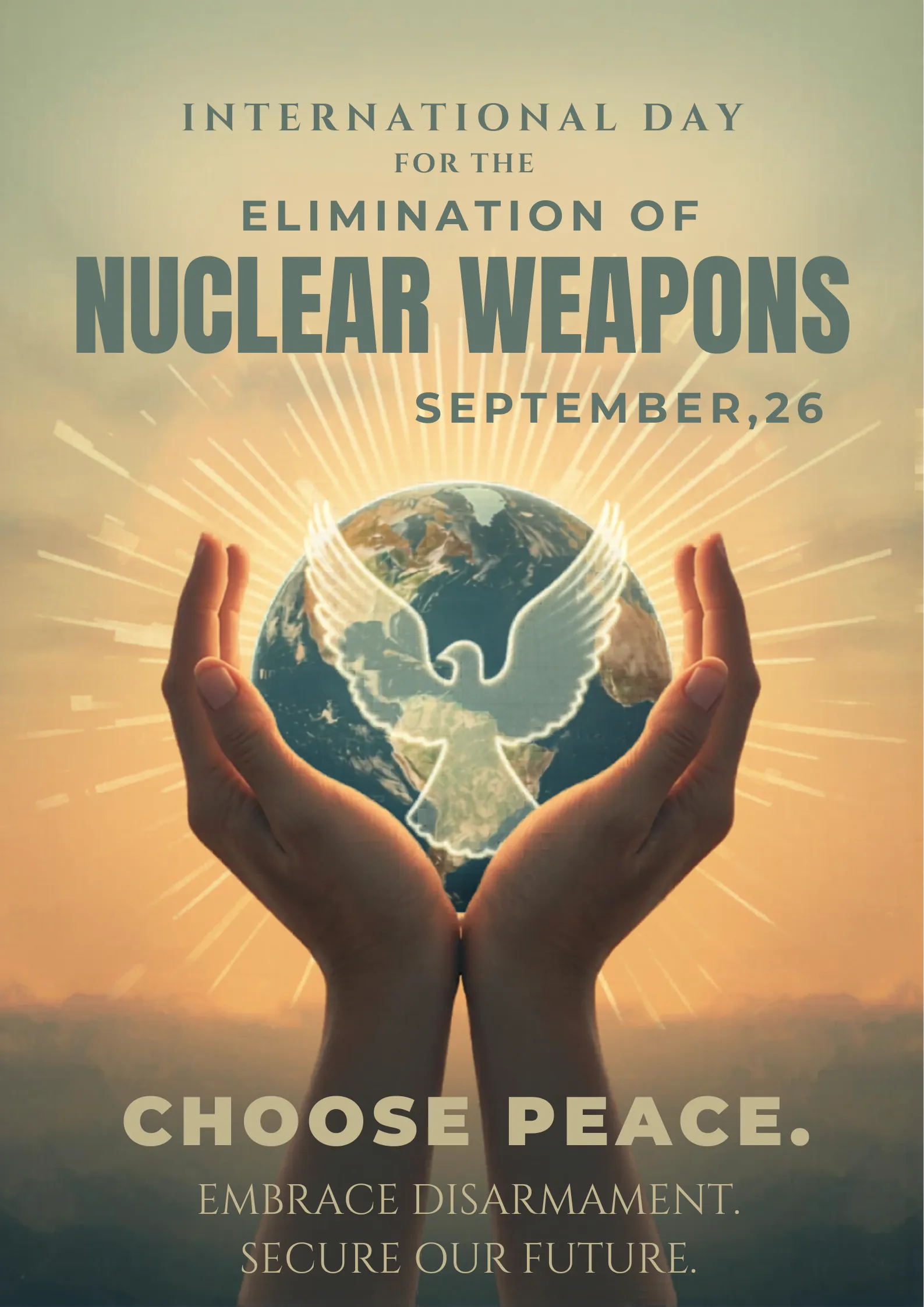
The International Day for the Total Elimination of Nuclear Weapons is observed every year on 26 September. Established by the United Nations, this global observance promotes nuclear disarmament and calls for the complete elimination of nuclear weapons worldwide.
Nuclear weapons remain among the most destructive tools ever created. Even decades after the Cold War, thousands of warheads still exist. Their continued presence raises concerns about global security, accidental launches, and humanitarian consequences. This international day reminds governments and citizens that a nuclear weapon free world is not just an ideal, but a necessary goal for lasting peace.
| Key Detail | Information |
| Official Name | International Day for the Total Elimination of Nuclear Weapons |
| Date Observed | 26 September |
| Established By | United Nations General Assembly |
| Year Proclaimed | 2013 |
| First Observed | 2014 |
| Main Objective | Promote global nuclear disarmament |
| Related Resolution | UN Resolution 68/32 |
| Observed By | UN Member States, NGOs, civil society groups, schools |
| Connected Treaties | NPT, TPNW, CTBT |
| Estimated Global Warheads | Around 12,000 worldwide |
| Public Holiday Status | Not a public holiday |
The date marks a high level meeting on nuclear disarmament held in 2013 at United Nations Headquarters in New York. Following this meeting, the United Nations General Assembly adopted Resolution 68/32 in December 2013, officially proclaiming 26 September as the International Day for the Total Elimination of Nuclear Weapons.
The first official observance took place in 2014. Since then, it has become an annual reminder of the global commitment to nuclear disarmament.
The push for nuclear disarmament began soon after nuclear weapons were first used in 1945. The devastating bombings of Hiroshima and Nagasaki showed the world the catastrophic humanitarian and environmental impact of atomic warfare.
Recognizing the danger, the United Nations placed nuclear disarmament on its agenda in 1946. Over the decades, global tensions, especially during the Cold War, led to an arms race between major powers. However, international efforts gradually shifted toward arms control and reduction.
Important milestones include:
1946: The UN created the Atomic Energy Commission.
1968: The Treaty on the Non Proliferation of Nuclear Weapons was opened for signature.
1996: The Comprehensive Nuclear Test Ban Treaty was adopted.
2017: The Treaty on the Prohibition of Nuclear Weapons was adopted.
2021: The Treaty on the Prohibition of Nuclear Weapons entered into force.
The establishment of this international day reflects the long standing global effort to eliminate nuclear threats.
The United Nations continues to lead international discussions on nuclear disarmament. Through the General Assembly and related bodies, it encourages member states to reduce and eliminate nuclear arsenals.
Each year on 26 September:
A high level plenary meeting is held at UN Headquarters.
Member States deliver national statements.
Civil society organizations participate in discussions.
The UN Secretary General issues a message highlighting global risks.
These activities help maintain political attention on nuclear disarmament and encourage renewed commitments.
Several international agreements support the goals of the International Day for the Total Elimination of Nuclear Weapons.
The NPT aims to:
Prevent the spread of nuclear weapons.
Promote peaceful use of nuclear energy.
Encourage gradual disarmament.
It remains one of the most widely supported arms control treaties.
Adopted in 2017, this treaty:
Prohibits development, testing, production, and possession of nuclear weapons.
Focuses on the humanitarian consequences of nuclear warfare.
Entered into force in 2021.
The CTBT seeks to ban all nuclear explosions worldwide. Although adopted, it has not yet entered into force because several required countries have not ratified it.
Despite progress in arms reduction since the Cold War, nuclear weapons have not been eliminated. Today:
Around nine countries possess nuclear weapons.
Approximately 12,000 nuclear warheads exist globally.
Some states are modernizing their nuclear arsenals.
Political tensions in different regions increase strategic risks.
Experts warn that even a limited nuclear conflict could cause devastating humanitarian and environmental damage. The risks include:
Immediate loss of life
Long term health effects from radiation
Environmental destruction
Global economic disruption
These realities explain why nuclear disarmament remains a priority issue.
The International Day for the Total Elimination of Nuclear Weapons is marked through educational and diplomatic activities across the globe.
Common observances include:
UN high level meetings and panel discussions
Academic seminars and research presentations
Public awareness campaigns
Youth engagement programs
Social media advocacy promoting peace and disarmament
Non governmental organizations and peace movements also organize events to encourage dialogue and raise awareness about nuclear risks.
The world continues to face security challenges, regional conflicts, and political tensions. In such an environment, nuclear weapons represent a constant and severe threat.
This day matters because it:
Keeps nuclear disarmament on the global agenda
Encourages diplomatic dialogue over military escalation
Promotes international cooperation
Reminds younger generations of the risks of nuclear conflict
Eliminating nuclear weapons is not only about reducing military power. It is about protecting humanity and ensuring long term global stability.
The International Day for the Total Elimination of Nuclear Weapons, observed on 26 September, reinforces the global commitment to nuclear disarmament. Proclaimed by the United Nations General Assembly in 2013, the day highlights the urgent need to remove nuclear weapons from the world.
Although progress has been made through treaties and diplomatic efforts, thousands of nuclear warheads remain. Continued awareness, international cooperation, and political will are essential to achieving a nuclear weapon free future. The path toward total elimination may be complex, but it remains one of the most important steps toward lasting peace and global security.