| Aspect | Details |
| Official Name | International Day Against Drug Abuse and Illicit Trafficking |
| Common Name | World Drug Day |
| Observed On | 26 June every year |
| Established By | United Nations General Assembly |
| Year Proclaimed | 1987 |
| First Observed | 1989 |
| Coordinating Body | United Nations Office on Drugs and Crime |
| Main Purpose | Raise awareness and strengthen global action against drug abuse and trafficking |
| Holiday Status | Not a public holiday |
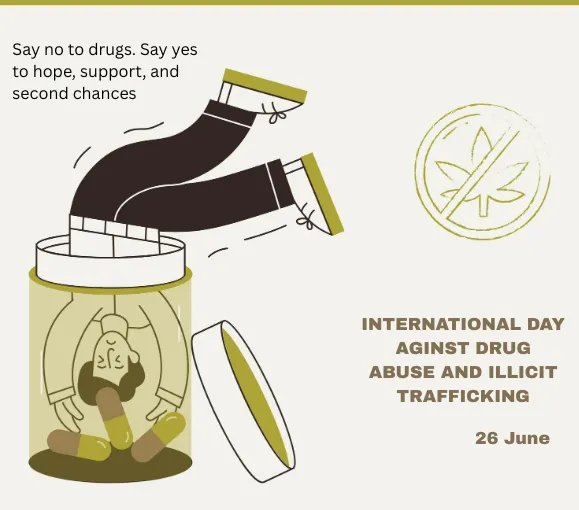
The International Day Against Drug Abuse and Illicit Trafficking is observed every year on 26 June to raise awareness about the serious impact of drug abuse and the illegal drug trade across the world. Also known as World Drug Day, this global observance encourages governments, communities, and individuals to strengthen prevention, treatment, and international cooperation.
Drug abuse affects millions of people globally. It harms health, destroys families, fuels organized crime, and weakens national economies. The illegal drug trade operates across borders, making it a global challenge that requires collective action.
This day reminds the world that drug prevention is not only a law enforcement issue. It is also a public health, education, and social responsibility issue.
The International Day Against Drug Abuse and Illicit Trafficking is a United Nations observance focused on:
Preventing drug abuse
Reducing illegal drug trafficking
Promoting treatment and rehabilitation
Encouraging global cooperation
Each year, governments and organizations organize awareness campaigns, seminars, community programs, youth education drives, and policy discussions. The United Nations Office on Drugs and Crime leads the global campaign and announces a theme to highlight urgent issues related to drugs.
Global concern about drug abuse began more than a century ago. Early international meetings in the early 1900s addressed the growing opium trade and its harmful effects.
Over time, countries developed international drug control treaties to regulate narcotic substances and prevent misuse. To strengthen international cooperation, the United Nations created systems and agencies to monitor and combat illicit drug production and trafficking.
On 7 December 1987, the United Nations General Assembly officially declared 26 June as the International Day Against Drug Abuse and Illicit Trafficking. The day was first observed in 1989.
The date was chosen to remember historical efforts to control the opium trade in the 19th century. It symbolizes long-standing global resistance against harmful drug practices.
The choice of 26 June carries historical and symbolic meaning. It represents one of the earliest large-scale efforts to stop the illegal opium trade.
Today, the date stands for:
International solidarity against drug abuse
A reminder of the damage caused by illicit drugs
Commitment to prevention and treatment
Stronger global partnerships to fight drug trafficking
It also serves as an annual checkpoint to review progress and identify new challenges.
Drug abuse remains a serious global issue.
According to international reports:
Hundreds of millions of people worldwide use drugs each year.
Young people are particularly vulnerable to substance abuse.
Synthetic drugs are rising rapidly in many regions.
Drug trafficking generates billions of dollars annually for organized crime groups.
Drug-related deaths continue to be a major public health concern.
The problem is evolving. New synthetic substances, online trafficking networks, and cross-border criminal organizations make enforcement more complex than ever.
This is why the International Day Against Drug Abuse and Illicit Trafficking remains highly relevant today.
The main goals of World Drug Day include:
Raising Awareness: Educating people about the physical, psychological, and social consequences of drug abuse.
Promoting Prevention: Encouraging early education programs in schools and communities.
Supporting Treatment and Rehabilitation: Highlighting the importance of medical support and recovery services for individuals struggling with addiction.
Strengthening International Cooperation: Encouraging countries to work together against drug trafficking networks.
Encouraging Evidence-Based Policies: Promoting policies based on research and public health principles rather than stigma.
On 26 June, countries organize various activities such as:
Public awareness rallies
School-based educational programs
Community workshops
Media campaigns
Policy discussions and conferences
Publication of research and annual reports
Some countries also use the day to highlight progress in reducing drug production and trafficking. Others focus on expanding rehabilitation and support services.
The International Day Against Drug Abuse and Illicit Trafficking continues to matter because:
Drug trends are constantly changing.
New synthetic substances are emerging.
Online platforms are being used for illegal sales.
Young people remain vulnerable.
Stigma still prevents many from seeking treatment.
The day reinforces the idea that drug abuse is preventable and treatable. It also reminds governments to balance enforcement with compassion and public health strategies. Global cooperation remains essential. No country can solve the drug problem alone.
The International Day Against Drug Abuse and Illicit Trafficking, observed every year on 26 June, is a powerful reminder of the ongoing global fight against drug abuse and illegal trafficking networks.
It calls for awareness, prevention, treatment, and stronger international collaboration. While progress has been made, the challenge continues to evolve. Communities, governments, educators, and families all have a role to play. By promoting education, supporting recovery, and strengthening cooperation, the world can move closer to reducing the harmful impact of drugs on society.