
|
Observed |
May 15 annually |
|
Also Known As |
International Pun Day |
|
Primary Keyword |
International Puns Day |
|
Focus |
Wordplay, humor, language appreciation |
|
Origin |
Internet culture; no single founder |
|
Related Observances |
National Pun Day (Feb 13), International Joke Day (Jul 1) |
|
Hashtag |
#InternationalPunsDay |
Every year on May 15, language lovers around the world celebrate International Puns Day. It is a day dedicated to puns, a playful form of wordplay that uses words with multiple meanings or similar sounds to create humor. Whether you enjoy clever one-liners or love a good groan-worthy joke, this observance is a fun reminder that language can be both smart and entertaining.
Puns are more than simple jokes. They bend language in unexpected ways and encourage people to see familiar words from a new angle. When a pun lands well, it often stays in your memory. In this article, we will explore what International Puns Day is, where puns came from, the main types of puns, and how you can celebrate the day yourself.
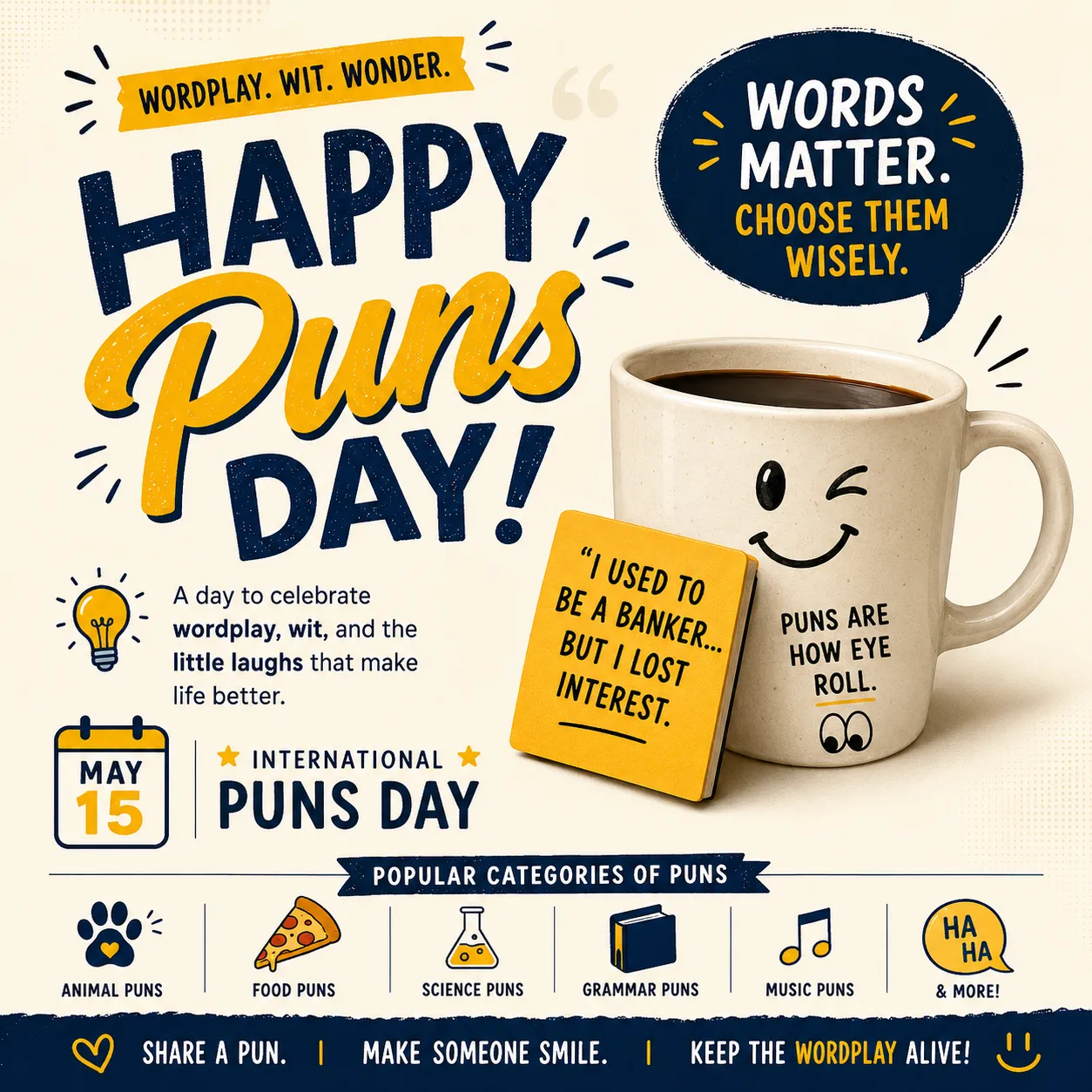
International Puns Day falls on May 15 each year. The purpose of the day is simple: tell puns, share them, and enjoy language together. You can post your favorite pun on social media, say one to a friend, or challenge someone to a pun-off.
There is no official founder or organizing committee behind the observance. Like many internet-born celebrations, it grew from online culture and the long-standing popularity of witty wordplay. Over time, it became a recurring day for pun lovers to celebrate creativity, humor, and language.
Puns have existed for as long as language itself. Early examples of wordplay appear in ancient civilizations, where writers and speakers used sound, meaning, and structure to create clever effects.
Some of the earliest forms of wordplay can be found in Sumerian, Egyptian, and Hebrew texts. In classical literature, Roman writers used puns in comedy, while Chinese language traditions made frequent use of homophones. Shakespeare later made puns a major feature of his plays, using them to add humor, character, and depth to dialogue.
Today, puns appear everywhere: in advertising, headlines, memes, captions, and everyday conversation. Their popularity proves that wordplay still has a place in modern communication.
The word pun itself was first recorded in English around 1644. Its exact origin is uncertain, but it may come from older terms connected to fine distinctions in language.
Linguists classify puns by how they exploit language. Below are the main types, with fresh examples.
Homophonic puns use words that sound alike but have different meanings or spellings.
Examples:
Why did the stadium get hot after the game? All the fans left.
I used to be a baker, but I could not make enough dough.
I'm reading a book about anti-gravity. It's impossible to put down.
The math teacher called in sick with algebra.
Homographic puns use words that are spelled the same but have different meanings, and sometimes different pronunciations.
Examples:
A bass was charged with assault after slapping another fish.
I did not recognize the desert at first, but it grew on me.
The firefighters had to tear through the tent, which brought them to tears.
It was too windy to wind the clock.
Homonymic puns use words that are spelled and pronounced the same but have different meanings.
Examples:
I wondered why the ball kept getting bigger. Then it hit me.
The painter had a brush with fame. Then he had a brush with the law.
I used to be a banker, but I lost interest.
A boiled egg every morning is hard to beat.
Compound puns include more than one pun in the same line or joke.
Examples:
England has no kidney bank, but it does have a Liverpool.
Seven days without a pun makes one weak (week).
Visual puns use images instead of words. They often appear in logos, cartoons, and ads.
Examples:
A picture of a mailbox with a sign reading “Man” to suggest “mailman.”
A “no parking” sign featuring a dinosaur, labeled “no-parking-saurus.”
A gym logo where the dumbbell doubles as the letter B.
Puns can also be grouped by topic. You can browse the extensive collection of jokes, wordplay, and themed puns available on Pun Magazine. Some of the most popular categories include:
Animal puns are memorable and easy to share. They work well across age groups.
What do you call a sleeping bull? A bulldozer.
Why do seagulls fly over the ocean? Because if they flew over the bay, they would be called bagels.
I am not kitten around; you are pawsitively the best.
That story sounds a little fishy.
Why don't crabs give to charity? Because they're shellfish.
Owls are such good listeners because they give a hoot.
Food puns land well at parties, picnics, and dinner tables.
I am on a strict seafood diet. I see food, and I eat it.
What do you call a fake noodle? An impasta.
You are the avocado to my toast.
Lettuce turnip the beet and get this party started.
This cake recipe is really on a roll.
Donut worry, be happy.
Science puns are especially popular with students and teachers.
Never trust atoms. They make up everything.
Oxygen and magnesium started dating. I was like OMG.
I make terrible science puns, but only periodically.
I'm reading a book about helium. I can't put it down.
A photon checks into a hotel and is asked if he needs help with luggage. He says, “No thanks, I'm traveling light.”
These puns play with spelling, punctuation, and grammar rules.
The past, present, and future walked into a bar. It was tense.
Let us eat, Grandma. Punctuation saves lives.
I used to be a grammar teacher, but I kept getting too tense.
I have a fear of speed bumps, but I'm slowly getting over it.
Exaggeration is a million times worse than understatement.
Music puns hit the right note with wordplay fans.
Why did the musician get locked out? All his keys were on the piano.
Without music, life would be flat.
You are really sharp today, and I don't mean your pitch.
I used to play piano by ear, but now I use my hands.
That drummer really knows how to keep the beat, and steal it.
Sports puns score points with a well-timed delivery.
Why did the soccer player bring string? To tie up the score.
That was a grand slam of a pun.
I am on a roll, and I cannot stop.
The golfer packed two pairs of pants in case he got a hole in one.
Basketball players never go on vacation; they'd get called for traveling.
Travel puns are perfect for postcards and captions.
Travel is the only thing you buy that makes you richer.
I need a vacation, pun intended.
Let us get lost together. I know a shortcut through these puns.
Airports are basically runway shows for luggage.
I'm not lost, I'm just on an alternate route to fun.
Technology puns are always logging in with a laugh.
Why did the computer see the doctor? It had a virus.
There is no place like 127.0.0.1.
Why was the smartphone wearing glasses? It lost its contacts.
I changed my password to “incorrect,” so whenever I forget it, the computer reminds me: “Your password is incorrect.”
Why do programmers prefer dark mode? Because light attracts bugs.
Nature puns branch out into gentle, feel-good humor.
I am glad we are growing old together. You are the root of my happiness.
You are unbe-leaf-ably amazing.
Let us branch out and try something new.
Fall is my favorite season; it just has such a-peel.
I planted some birdseed. A bird came up. Now I don't know what to feed it.
Love puns are cheesy on purpose; that's the whole charm.
You make my heart skip a beet.
Are you a magician? Because whenever I look at you, everyone else disappears.
You are grate and I am not trying to be cheesy.
You're the missing pizza to my heart.
I love you a waffle lot.
Some people dismiss puns as the lowest form of humor. But that criticism misses the point. Puns are more than quick jokes; they showcase creativity, linguistic skill, and the ability to see connections that others might overlook. Crafting or understanding a good pun requires quick thinking, a strong vocabulary, and an ear for how words sound and carry multiple meanings.
Puns also bring people together. Sharing one creates a moment of connection, inviting others to appreciate a clever twist in language. Whether the response is genuine laughter or a playful groan, the exchange creates a shared experience and often sparks conversation. Beyond entertainment, puns can also benefit the brain.
Research suggests that wordplay supports language development by encouraging people to think about words from different perspectives. For children, engaging with puns can help expand vocabulary, improve awareness of multiple meanings, and strengthen creative thinking. For adults, they offer a fun way to keep language skills sharp while reminding us that communication can be both meaningful and playful.
Rather than being the "lowest" form of humor, puns highlight the richness and flexibility of language. They encourage us to think differently, laugh together, and appreciate the many ways words can surprise us.
You do not need a big plan. The whole point is to share a laugh with someone.
Send a punny text to a friend first thing in the morning.
Post your favorite pun on social media with #InternationalPunsDay.
Host a pun competition at work or school. Give a small prize for the best entry.
Write a pun-themed greeting card instead of a store-bought one.
Challenge a friend to a back-and-forth pun duel.
Make punny signs around your home: label the fridge “the cool zone” or the bathroom “the think tank.”
International Puns Day on May 15 reminds us that words can be fun. You do not need to be a professional comedian to take part. One good pun and the courage to say it out loud is enough.
Puns have been part of human culture for thousands of years, from Sumerian clay tablets to Roman comedy to Shakespearean theater to today's internet memes. They reward linguistic skill, create connection, and keep our brains flexible. Whether you prefer animal puns or science puns, food jokes or romantic wordplay, there is a pun for every person and every mood.
A day without a pun is just a day without a punchline. So go ahead: tell a bad pun. Tell ten. Make your friends groan, and your coworkers laugh. That is what International Puns Day is all about.