
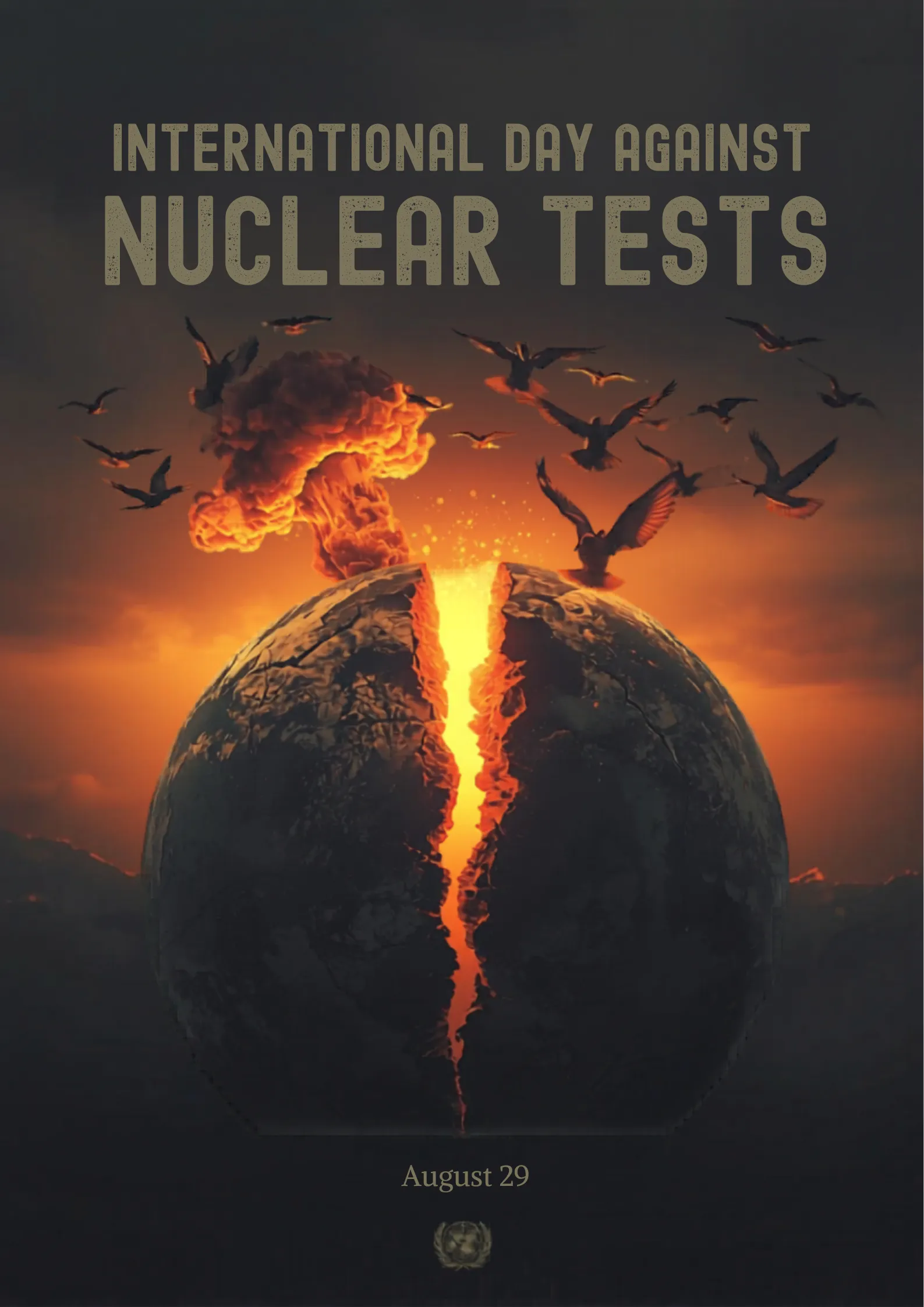
The International Day Against Nuclear Tests is observed annually on 29 August to raise awareness about the dangers of nuclear weapons testing and to promote global efforts toward peace and nuclear disarmament. This day highlights the devastating human, environmental, and societal impacts of nuclear tests and calls for international collaboration to create a safer world for future generations.
Nuclear tests have shaped world history since the mid-20th century. They have left lasting scars on communities and ecosystems. By commemorating this day, the international community aims to prevent such tragedies from happening again and to educate people about the importance of eliminating nuclear weapons.
| Aspect | Details |
| Name | International Day Against Nuclear Tests |
| Date Observed | 29 August (Annually) |
| First Observed | 2010 |
| Established By | United Nations General Assembly, Resolution 64/35 |
| Purpose | To raise awareness of nuclear testing dangers and promote a nuclear-free world |
| Significant Dates | 29 August 1949: First Soviet nuclear test29 August 1991: Closure of Semipalatinsk Nuclear Test Site |
| Related Treaty | Comprehensive Nuclear-Test-Ban Treaty (CTBT) |
| Number of Nuclear Tests | Over 2,000 worldwide between 1945 -1996 |
| CTBT Status | Not yet in force; pending ratification by key states |
| Holiday status | Not a public holiday |
These facts provide a clear snapshot of the day’s significance and the ongoing global efforts to prevent nuclear testing.
The United Nations General Assembly recognized the importance of raising awareness about nuclear tests and their harmful effects. On 2 December 2009, it adopted Resolution 64/35, designating 29 August as the International Day Against Nuclear Tests. The date was chosen to commemorate two key events:
29 August 1949 – The Soviet Union conducted its first nuclear test, escalating the global nuclear arms race.
29 August 1991 – Kazakhstan closed the Semipalatinsk Nuclear Test Site, one of the most active nuclear testing grounds in the world.
This day serves as both a reminder of past destruction and a platform for promoting nuclear disarmament and peace.
Nuclear tests are explosions conducted to develop, improve, or demonstrate nuclear weapons technology. They have been carried out in different environments:
Atmospheric tests: Conducted above ground, spreading radioactive fallout across nearby communities.
Underground tests: Explosions below the surface aimed to contain radiation, but still caused seismic activity and groundwater contamination.
Underwater tests: Performed in oceans or lakes, affecting marine life and ecosystems.
Since the first nuclear test, the Trinity Test in New Mexico on 16 July 1945, over 2,000 nuclear explosions have been conducted worldwide. These tests caused long-term health issues, including cancer and genetic disorders, and led to environmental damage that still affects regions today.
The Comprehensive Nuclear-Test-Ban Treaty (CTBT), adopted in 1996, prohibits all nuclear explosions worldwide. Its goal is to prevent the development of new nuclear weapons and limit nuclear proliferation.
Although most countries have signed the treaty, it has not yet entered into force, as several key states, including the United States, China, India, and North Korea, have not ratified it. Despite this, the treaty has created a strong global norm against nuclear testing, contributing to a significant reduction in tests since its adoption.
The consequences of nuclear testing are widespread and enduring:
Human Health: Communities near test sites face increased cancer rates, birth defects, and long-term illnesses.
Environmental Damage: Soil, water, and air contamination disrupts ecosystems, threatening plant and animal life.
Social Disruption: Many people were displaced from affected areas, losing homes, livelihoods, and cultural heritage.
Over 2,000 nuclear tests were conducted worldwide between 1945 and 1996.
The largest nuclear explosion, the Tsar Bomba by the Soviet Union in 1961, was 3,800 times more powerful than the Hiroshima bomb.
Semipalatinsk, Kazakhstan, witnessed over 450 nuclear tests, leaving lasting health and environmental damage.
Pacific Islands, like Bikini Atoll, were displaced and contaminated due to nuclear testing.
Even underground tests can leak radiation, cause earthquakes, and pollute groundwater.
Radiation from nuclear tests has caused cancers, birth defects, and long-term health issues for affected populations.
Since its first celebration in 2010, the International Day Against Nuclear Tests has been observed worldwide with various educational and awareness activities:
Workshops and Seminars: Educating students and communities about the dangers of nuclear weapons.
Media Campaigns: Broadcasting documentaries, articles, and social media posts highlighting nuclear test risks.
Community Events: Peace rallies, poster contests, and public lectures to engage citizens.
Policy Advocacy: Encouraging governments to ratify the CTBT and strengthen international disarmament efforts.
These activities aim to inform the public, especially younger generations, about the importance of global peace and nuclear disarmament.
The International Day Against Nuclear Tests is important because it:
Raises awareness of the human and environmental costs of nuclear testing.
Reinforces international cooperation to prevent further nuclear proliferation.
Encourages nations to support CTBT ratification and other nuclear-free initiatives.
Educates future generations about the importance of global peace and security.
The International Day Against Nuclear Tests is more than a remembrance, it is a call to action. By learning from history, supporting international treaties, and raising awareness, individuals and nations contribute to a safer, nuclear-free future. Each year, this day reminds us that peace is not just the absence of war but the presence of action to protect humanity and the environment from nuclear threats.
By observing this day and promoting global disarmament efforts, we move closer to a world where nuclear testing is a distant memory, and safety, security, and sustainability prevail for generations to come.