
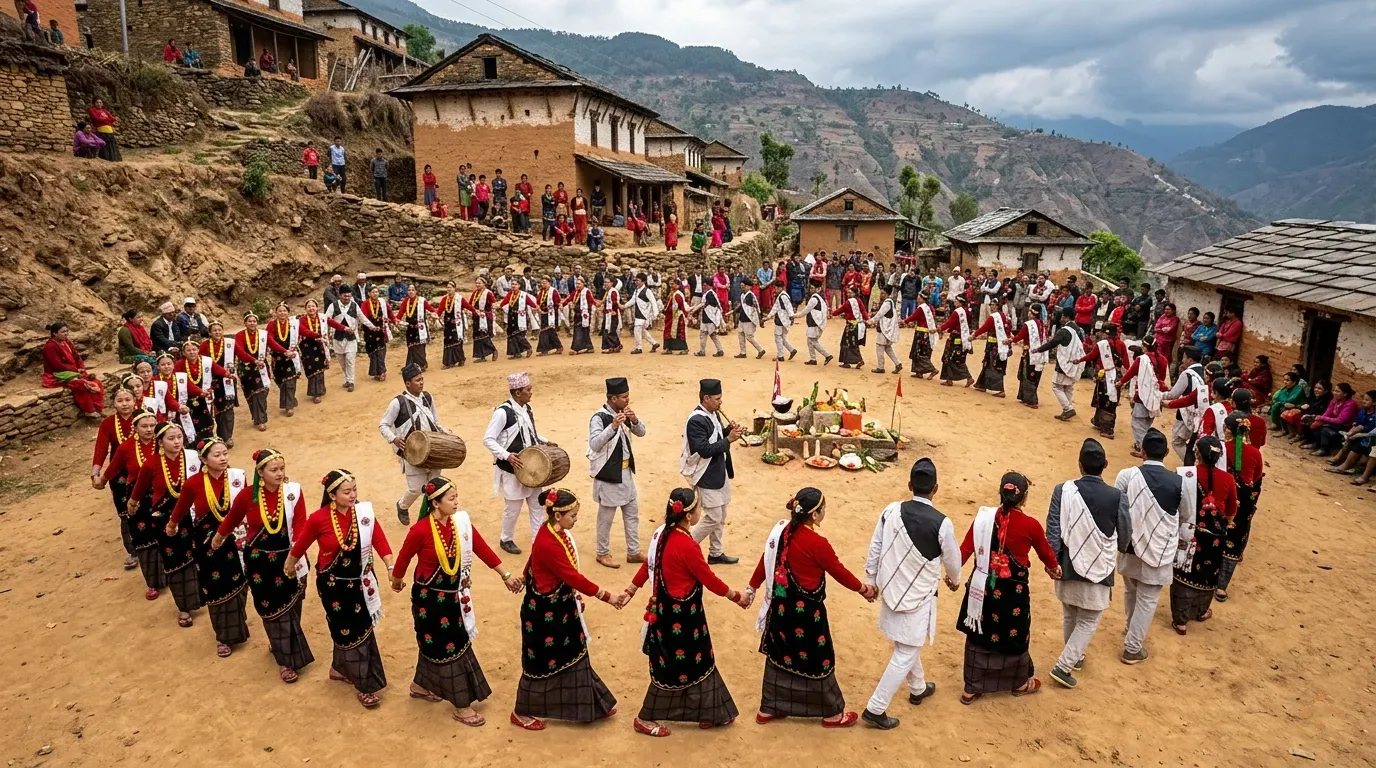
Bhume Puja (भूमे पूजा), also known as Bhume Parva (भूमे पर्व), is a traditional festival celebrated by Magar communities in Nepal, centered on worship of the earth, nature, and agriculture. It is often confused with Bhumi Puja (भूमि पूजा), a separate Hindu ritual usually performed before construction or foundation-laying. This article focuses on Bhume Puja, the Magar cultural festival.
The festival is especially important to Kham-speaking Magar communities in districts such as Rukum, Rolpa, Pyuthan, Dang, and Myagdi. Villagers gather at local shrines, perform rituals to honor the land, and celebrate with traditional dance and music, most notably the Bhume Naach (भूमे नाच), or "earth dance." For many families, the festival is also a time to return to their home villages and reconnect with community.
|
Fact |
Details |
|
Festival |
Bhume Puja (भूमे पूजा) |
|
Also Known As |
Bhume Parva (भूमे पर्व); some communities use the name Bal Puja |
|
Community |
Magar community (मगर समुदाय), particularly Kham-speaking Magars |
|
Main Significance |
Earth worship, nature, agriculture, and community well-being |
|
Major Regions |
Rukum (including East Rukum), Rolpa, Pyuthan, Dang, Myagdi |
|
Type |
Traditional cultural and nature-worship festival |
|
Date |
Varies by community and region; no single fixed date nationwide |
"Bhume" comes from the Nepali word for earth, and "Puja" means worship. Bhume Puja is an act of gratitude toward the earth (भूमि/धरती) and the natural forces that support daily life, farming, and survival in the hills of western Nepal.
For the Magar community (मगर समुदाय), especially the Kham Magar people, Bhume Puja is a cultural tradition centered on the relationship between people and the land they farm. Villagers worship the earth, water sources, and forests together, and ask for good crop yields, healthy livestock, and protection from natural disasters.
Because agriculture (कृषि) has long been the main livelihood for Magar communities in the hills and forested areas of western Nepal, the festival reflects a simple, practical belief: honoring the land helps ensure it continues to provide.
Bhume Puja is closely associated with the Magar people, one of Nepal's major indigenous ethnic groups. Within this broader community, it holds particular cultural significance for Kham-speaking Magar communities, who live mainly in parts of Lumbini and Karnali provinces.
Not every Magar community observes Bhume Puja in the same way, or even under the same name. Some communities use the name Bal Puja, and specific rituals, offerings, and timing can differ from one village to the next. The shared thread across communities is respect for the earth and nature, expressed through locally distinct traditions.
There is no single, universal date for Bhume Puja. Because the festival follows local lunar calendar references rather than a fixed Gregorian date, the timing shifts each year and differs by region.
|
Region |
Traditional celebration period |
|
East Rukum |
Begins around Baisakh Purnima (the full moon in Baisakh, typically late April to mid-May) and can continue for several weeks, sometimes into early June |
|
Rolpa |
Follows a similar Baisakh Purnima-linked period in Kham Magar villages such as Thabang and Jelbang |
|
Myagdi |
Observed on a Tuesday during the bright lunar fortnight of Chaitra (March–April), locally known as Ujeli Mangalbar |
|
Other regions |
Timing varies by local tradition and community calendar |
Because practices differ this widely, readers looking for an exact date in a given year should check local or provincial sources rather than assume one fixed date applies everywhere.
Across regions, a few consistent purposes appear in how communities describe the festival:
Expressing gratitude to the earth (भूमि/धरती) for sustaining life
Seeking blessings for good crop yields and agricultural prosperity
Asking for favorable rainfall (वर्षा) and monsoon (मनसुन) conditions
Seeking protection from natural calamities such as floods, landslides, hailstorms, and drought
Strengthening community bonds through shared rituals and celebration
Passing cultural and agricultural knowledge to younger generations
In Myagdi, villagers have described the ritual as a way to "please nature" so that disasters are avoided, and crops grow well, a purpose consistently reported by local participants performing the puja at village shrines.
Specific rituals vary between communities, but some elements are documented across multiple regions.
Worship at Bhume Than (भूमे थान): Communities gather at a designated shrine, often called Bhume Than, to perform the main rituals. In Myagdi, such shrines have been documented in locations including Banduk, Beg, and Chimkhola.
Offerings: Offerings commonly include chhyang, a local alcoholic drink, which is offered to the deities before being shared among participants. In some communities, animal sacrifice is part of the ritual, offered with hopes for a good harvest and protection from harm. These specific practices are documented in Myagdi and should not be assumed to apply identically everywhere.
Worship of multiple nature deities: Alongside the earth deity, some communities also worship river deities and deities believed to reside on hilltops and ridges, reflecting a wider tradition of nature worship (प्रकृति पूजा) rather than earth worship alone.
Return of villagers: In several Magar communities, Bhume Puja is an occasion for people who have moved away for work or study to return to their home villages once a year, reinforcing family and community ties.
These practices differ across villages. Some communities emphasize the shrine ritual itself, while others place more weight on the days of dance and music that follow.
Bhume Naach (भूमे नाच), meaning "earth dance," is one of the most recognized parts of the festival in East Rukum and Rolpa. It is a traditional group dance performed by Kham-speaking Magar communities, particularly in Bhume Rural Municipality and Putha Uttarganga Rural Municipality in East Rukum, and in Thabang and Jelbang in Rolpa.
In some regions, related festival traditions carry other local names, reflecting the diversity of Kham Magar culture across villages. The dance typically follows the earth-worship rituals, with community members singing and dancing in open village spaces.
In East Rukum, local accounts describe young villagers travelling to the highlands after the main rituals to gather wildflowers, including Buki flowers, before returning to the village and dancing through the settlement. This tradition shows how closely the festival is tied to the surrounding natural landscape.
Detailed documentation of clothing and musical instruments used in every regional variation is limited, so this article does not describe practices that are not well documented. What is clear is that Bhume Naach remains an active, living tradition, including organized dance competitions held in East Rukum alongside the ritual celebrations.
East Rukum and Rolpa are central regions for Bhume Puja among Kham-speaking Magar communities. Here, the festival is closely linked to the Bhume Naach dance tradition and is celebrated over an extended period rather than a single day.
Communities in Bhume Rural Municipality and Putha Uttarganga Rural Municipality in East Rukum, along with Thabang and Jelbang in Rolpa, hold multi-week celebrations that combine ritual worship, dancing, singing, and open cultural competitions. Some residents in these areas describe Bhume Puja as holding more personal and cultural importance to them than Dashain and Tihar, though this reflects local sentiment rather than a claim that applies to all Magar communities nationwide.
In recognition of the festival's cultural importance, the Lumbini Provincial Government has declared a public holiday in districts with a significant Magar population, including Dang, Rolpa, Rukum East, and Pyuthan.
In Myagdi, Bhume Puja follows a different calendar reference and set of local customs than East Rukum and Rolpa. The festival is traditionally observed on Ujeli Mangalbar, a specific Tuesday during the bright half of Chaitra.
Communities in Myagdi's Raghuganga and Annapurna rural municipalities, including the settlements of Banduk, Beg, Doba, and Chimkhola, hold ceremonies at local Bhume Than shrines. Villagers here emphasize protection from natural disasters and a good harvest as central goals, alongside the tradition of worshipping river and hilltop deities.
These regional differences are not inconsistencies. They show how Magar communities across different valleys and districts have developed their own local expressions of a shared value: respect for the earth and nature.
Agriculture (कृषि) and farming (खेती) sit at the center of Bhume Puja. Many Magar communities that observe the festival live in hill and mountain areas where farming and forest resources form the backbone of daily life.
Common themes in the festival's prayers include:
Good yields for crops (बाली)
Timely, sufficient rainfall (वर्षा) during the monsoon (मनसुन) season
Protection of livestock and, in some communities, livestock-related livelihoods (पशुपालन)
A safe and successful harvest season
Long-term food security for the village
By timing the festival around the agricultural calendar, particularly the period leading into the planting season, communities connect their spiritual practices directly to the practical demands of farming life.
Bhume Puja plays an important role in how Kham-speaking Magar communities express their cultural identity. Villagers who have moved to cities or abroad for work often return home specifically to take part, which reflects how strongly some communities value this occasion for maintaining a sense of belonging.
The festival also creates space for intergenerational knowledge transfer. Shared rituals, communal meals, and group dances bring older and younger community members together, allowing traditional practices to be passed down directly rather than only described secondhand.
The relationship at the center of Bhume Puja follows a clear chain: people depend on land, land depends on nature, nature supports agriculture, and agriculture supports the community. Villagers worship the land because they rely on it for food. Good farming depends on rainfall and stable weather, so nature and weather are honored as well. Because a good harvest supports the entire village, the celebration is communal rather than individual.
This form of nature worship (प्रकृति पूजा) is rooted in the everyday, practical needs of farming communities. It is distinct from, and should not be equated with, Hindu earth-goddess worship performed in other contexts, such as before construction. While some Magar communities describe worshipping an earth deity, the beliefs and cultural context behind Bhume Puja are specific to Magar, and particularly Kham Magar, heritage.
Bhume Puja continues to be actively celebrated in East Rukum, Rolpa, and Myagdi, with participation from residents as well as villagers who travel back from other parts of Nepal or abroad for the occasion.
In East Rukum, celebrations now include organized cultural events, such as open Bhume dance competitions held alongside the traditional rituals, showing how the festival has incorporated modern community organization while retaining its traditional core.
The recognition of Bhume Parva with a public holiday in parts of Lumbini Province reflects a broader institutional effort to support Magar cultural heritage, encouraging younger generations to stay connected to the tradition even as many now live and work outside their home villages.
Beyond the communities that celebrate it, Bhume Puja is a working example of Nepal's cultural diversity and the traditional ecological knowledge that many indigenous communities hold about their local environment.
The festival highlights the value of indigenous farming and weather knowledge, an everyday model of environmental awareness embedded in cultural practice, and the importance of community ties for people who have migrated away from their home villages. It also reflects an active, ongoing effort to preserve intangible cultural heritage as younger generations grow up in increasingly urban or global settings.
Bhume Puja (भूमे पूजा), or Bhume Parva (भूमे पर्व), is a Magar cultural tradition centered on gratitude to the earth, respect for nature, and community well-being. From the extended Bhume Naach celebrations of East Rukum and Rolpa to the Chaitra rituals of Myagdi, the festival takes different forms across different regions, connected by a shared belief that a healthy relationship with the land supports a healthy community. As Kham-speaking Magar communities continue to celebrate Bhume Puja each year, it remains a meaningful part of Nepal's indigenous cultural heritage.
What is Bhume Puja?
Bhume Puja is a traditional Magar festival centered on worshipping the earth and nature. It is closely tied to agriculture, community well-being, and Kham Magar cultural identity, and is also known as Bhume Parva.
Who celebrates Bhume Puja in Nepal?
It is celebrated mainly by Magar communities, particularly Kham-speaking Magars, in districts such as Rukum, East Rukum, Rolpa, Pyuthan, Dang, and Myagdi. Practices differ between communities.
When is Bhume Puja celebrated?
The date varies by region. In East Rukum and Rolpa, celebrations commonly begin around Baisakh Purnima (April–May) and can continue for several weeks. In Myagdi, it is traditionally observed on Ujeli Mangalbar, a Tuesday during the bright half of Chaitra (March–April).
Why do Magar communities celebrate Bhume Puja?
The festival expresses gratitude to the earth, seeks blessings for good crop yields and rainfall, and asks for protection from natural calamities such as floods, landslides, and drought. It also strengthens community bonds.
Where is Bhume Puja mainly celebrated?
It is most prominently celebrated in East Rukum, Rolpa, Pyuthan, Dang, and Myagdi, all areas with significant Kham-speaking Magar populations in western Nepal.
What is Bhume Naach?
Bhume Naach, or "earth dance," is a traditional group dance performed as part of Bhume Puja celebrations, especially in East Rukum's Bhume and Putha Uttarganga rural municipalities and in Thabang and Jelbang in Rolpa.
Is Bhume Puja the same as Bhumi Puja?
No. Bhume Puja (भूमे पूजा) is a Magar cultural festival centered on nature worship, agriculture, and community. Bhumi Puja (भूमि पूजा) is a separate Hindu ritual, typically performed before construction begins on a building or home, to seek the blessing of Bhumi Devi and ensure a stable foundation. Both involve honoring the earth, but they come from different cultural traditions and serve different purposes.