| Date | Jyeshtha Shukla Paksha Ekadashi (June 25) |
| Duration | Single day fast (complete until Parana on June 27) |
| Observance | Most austere religious fast/vow |
| Celebrated in | Across Hindu communities in Nepal and India |
| Observing Communities | Brahmins, Chhetris, Vishnu devotees, and all Hindus |
| Type of Event | Ekadashi vrat (most austere and spiritually powerful) |
| Purpose of Event | Gain the merit of all 24 ekadashis in one day through complete waterless fast, achieve spiritual liberation. |
| Holiday Status | Not an official public holiday |
| First Observed in | Vedic period (documented in Brahma Vaivarta Purana) |
Quick Fact: Nirjala Ekadashi, also called Pandava Bhima Ekadashi, is the only ekadashi where even water is forbidden during the fast. It is believed that observing this single fast grants the devotee the complete spiritual merit of observing all 24 ekadashis of the year. This connection to Bhima of the Pandavas gives it a unique place in Hindu epic tradition.
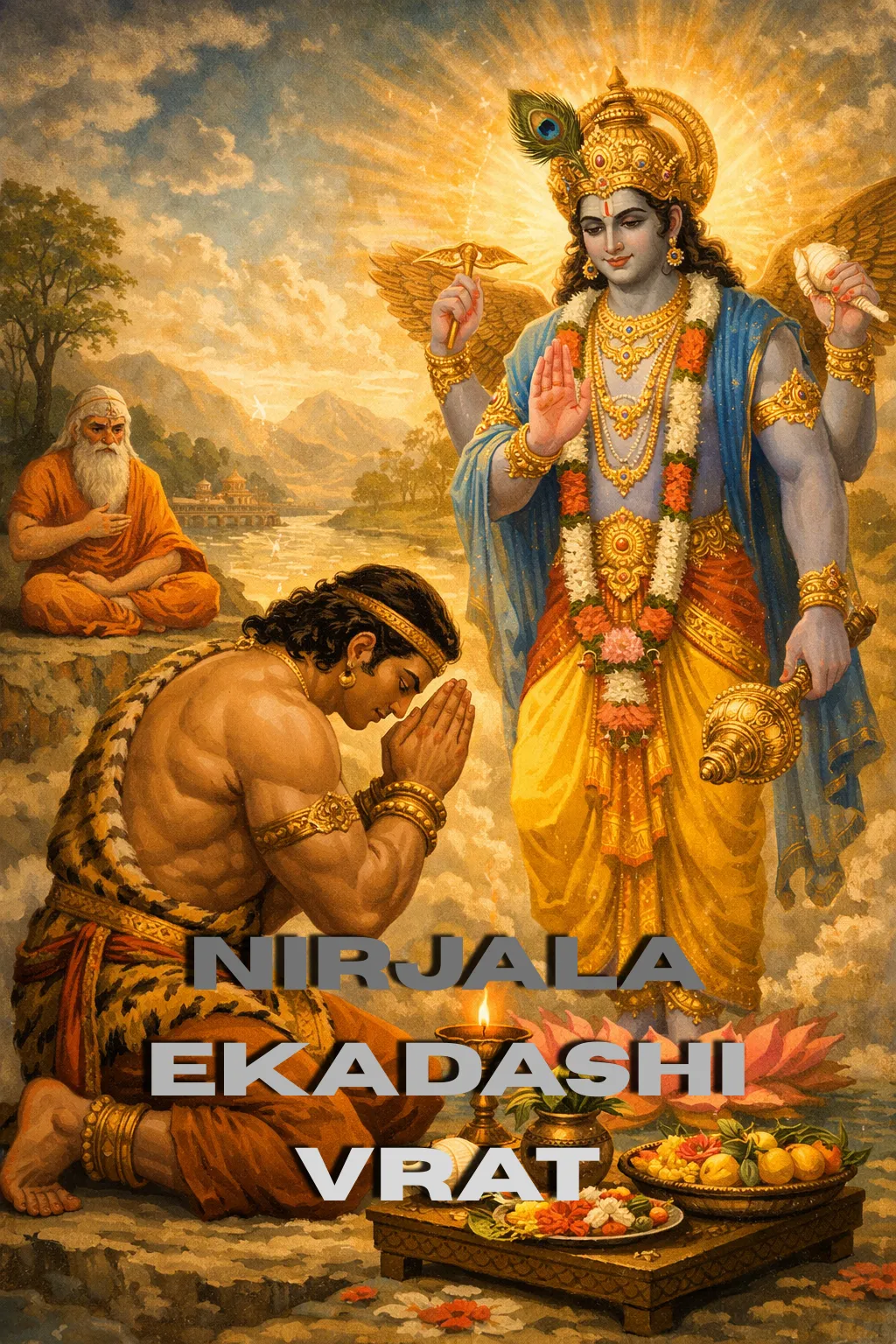
Nirjala Ekadashi Vrata is the most austere and spiritually powerful of all 24 ekadashi observances in the Hindu calendar. Its name "Nirjala" (nir = without, jala = water) reveals its defining characteristic, complete abstinence from both food and water throughout the day. Observed on the 11th day of the bright lunar fortnight in the Jyeshtha month, this vrat is also known as Pandava Bhima Ekadashi due to its origin story involving the mighty Pandava hero Bhima. The spiritual merit earned by observing this single fast is said to equal the combined merit of all 24 ekadashis in a year.
Nirjala Ekadashi falls on the 11th lunar day of Jyeshtha month's bright fortnight. Its story is documented in the Brahma Vaivarta Purana. According to this scripture, Bhima, the second of the five Pandava brothers, was a man of great appetite and tremendous physical strength. When the sage Vyasa instructed the Pandavas to observe all 24 ekadashis to control desires, Bhima found himself unable to fast without water due to a divine fire within his stomach called Vrikodara. Sage Vyasa compassionately offered an alternative: observe one strict, waterless fast annually on Nirjala Ekadashi to gain the complete merit of all 24 ekadashis. Bhima accepted and through this extraordinary austerity, attained spiritual advancement. This ekadashi thus became known as Bhima Ekadashi in his honor.
This supreme vrata is observed to:
Grant the full spiritual merit equivalent to observing all 24 ekadashis of the entire year in a single day.
Achieve complete spiritual purification and the removal of all accumulated sins.
Obtain divine protection and personal guidance from Lord Vishnu through supreme self-discipline.
Attain moksha, liberation from the cycle of birth and death, through the most intense ekadashi observance.
This vrat demands the highest level of spiritual discipline:
Complete and total abstinence from all food and water for the entire day, not even a single drop of water is permitted (Nirjala = waterless).
No consumption of any food items whatsoever, including fruits, milk, or sattvic foods.
Continuous meditation and chanting of Vishnu mantras including the Vishnu Sahasranama throughout the day.
Religious rituals and elaborate worship of Lord Vishnu performed during auspicious timings.
Parana (fast-breaking) observed on the following day: June 27 between 5:46 AM and 8:30 AM.
Nirjala Ekadashi holds an unparalleled position in Hindu spiritual life:
It is the most austere and spiritually significant of all 24 ekadashis in the Hindu calendar year.
It provides a practical alternative for those unable to observe all 24 ekadashis throughout the year.
It grants the merits equivalent to feeding 88 Brahmin priests and complete forgiveness of accumulated sins.
Devotees who observe it faithfully are believed to receive Lord Vishnu's messengers at death rather than Yama's judgment.
It represents the ultimate expression of self-discipline and total spiritual commitment in Hindu practice.
Nirjala Ekadashi Vrata is a testament to the extraordinary depth of Hindu spiritual practice. In a single day of absolute self-denial, no food, no water, a devotee can accumulate the spiritual merit of an entire year of ekadashi observances. This is not merely a physical fast but a complete surrender of the ego to Lord Vishnu, a declaration that the divine is more sustaining than anything the material world can offer.