Most people in Nepal can name three Lhosars. Tamu Lhosar for the Gurung community in Poush, Sonam Lhosar for the Tamang and Hyolmo communities in Magh, and Gyalpo Lhosar for the Sherpa and Tibetan Buddhist communities in Falgun. All three are public holidays. All three are covered in every calendar and every listicle.
There is a fourth, and it is older than all of them.
Tol Lhosar falls on Poush Shukla Pratipada, the first day of the bright fortnight of Poush. It is kept in the highest and most remote parts of the country: Humla, Jumla, Dolpa, Mugu and Manang. The same day is observed across the border in Tibet and in parts of Bhutan. It is not a public holiday in Nepal; it appears on very few calendars, and it is described by the communities who keep it as the oldest of the Lhosars.
The name is the clue. Tol means the cycle of time. Tol Lhosar is not just a new year. It is the turn of a wheel.
|
Field |
Details |
|
Nepali name |
तोल ल्होसार |
|
Also written as |
Tola Lhosar, Tol Losar |
|
Tithi |
Poush Shukla Pratipada, the first day of the bright fortnight of Poush |
|
Usual Gregorian window |
Mid-December to early January |
|
Meaning of “Tol” |
The cycle of time. The festival is also referred to as samvatsar, the year cycle |
|
Communities |
Sherpa, Lama, Bhote, and other Himalayan Buddhist communities of the high north |
|
Main districts |
Humla, including Simikot and Namkha, Jumla, Dolpa, Mugu, and Manang |
|
Also observed in |
Tibet and parts of Bhutan on the same date |
|
Status |
Described locally as the oldest Lhosar in Nepal |
|
Public holiday |
No. Unlike Tamu, Sonam, and Gyalpo Lhosar, Tol Lhosar has no federal public holiday |
|
Falls before |
Tamu Lhosar is in the same month, and Sonam Lhosar is roughly one lunar month later |
|
Bikram Sambat (BS) Year |
Gregorian (AD) Date |
Nepali Calendar Date |
Day of the Week |
|
2082 BS |
December 20, 2025 |
Poush 5, 2082 |
Saturday |
|
2083 BS |
January 8, 2027 |
Poush 24, 2083 |
Friday |
|
2084 BS |
January 10, 2028 |
Poush 28, 2084 |
Monday |
The tithi is fixed at Poush Shukla Pratipada. The Gregorian date moves every year because it is lunar, and in some years it slips into the last days of December and in others into the first days of January. Read it from the panchang rather than assuming.
A useful anchor: Tol Lhosar always falls roughly one lunar month before Sonam Lhosar and one lunar month before that again from Gyalpo Lhosar. The three sit a month apart in sequence, with Tamu Lhosar fixed separately to a solar date.
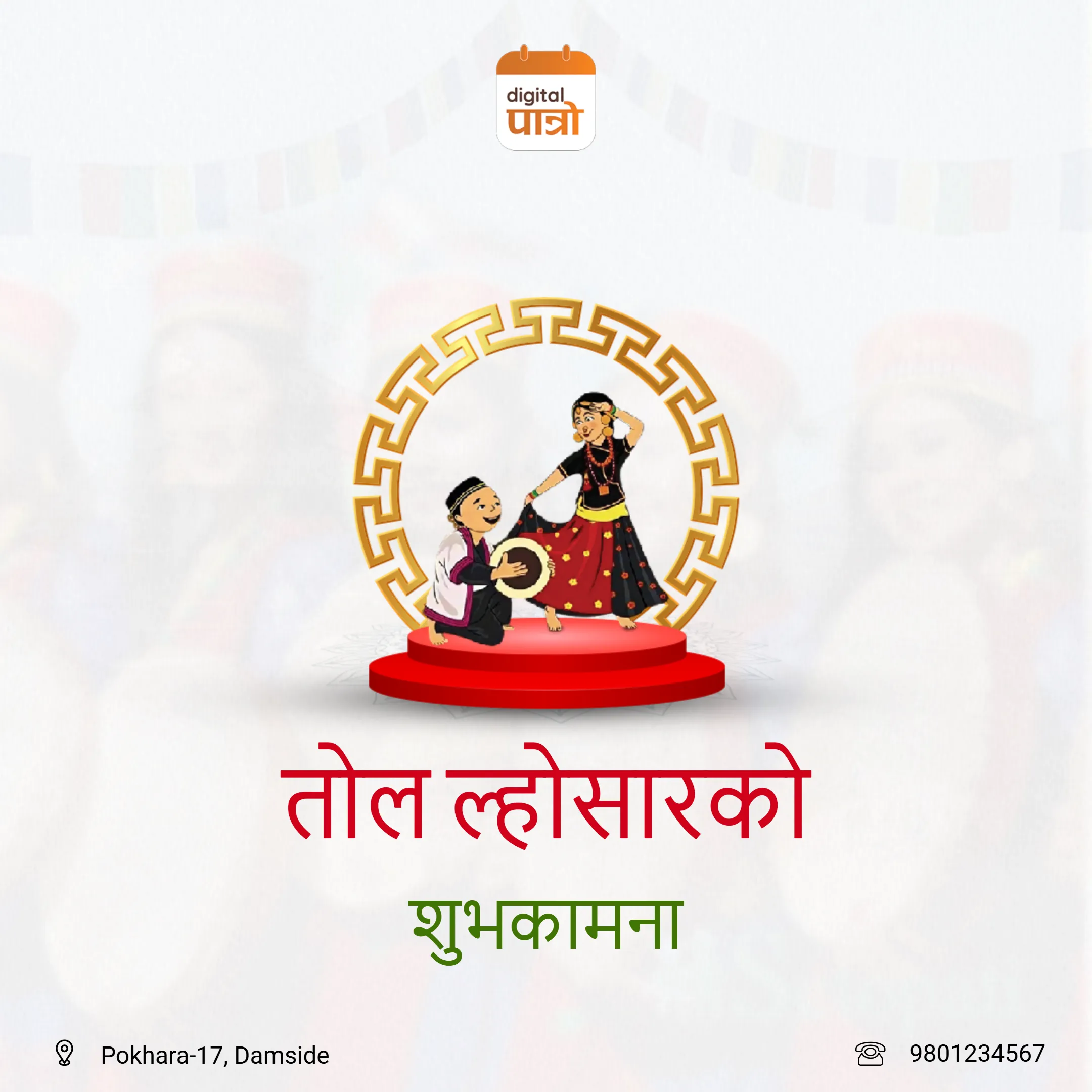
Want to create a personalized wish post for your friends, family, or social media? Make one in seconds with our free post generator. Choose your style, add your message, and create a post that’s yours.
This is the single most useful thing this page can carry, because the confusion between the four is total and even national media mix them up.
|
Lhosar |
Date |
Communities |
Region |
Public Holiday |
Note |
|
Tol Lhosar |
Poush Shukla Pratipada, a lunar date |
Sherpa, Lama, Bhote, and other high Himalayan Buddhist communities |
Humla, Jumla, Dolpa, Mugu, Manang, and across the border in Tibet and Bhutan |
No, but may be observed as a local holiday in some areas |
Described by its own communities as the oldest of the four |
|
Poush 15, a fixed solar date in the Nepali calendar, usually December 30 |
Gurung, who call themselves Tamu |
Kaski, Lamjung, Gorkha, Syangja, Manang, Tanahun, Pokhara and Kathmandu |
Yes, but holiday arrangements may vary by region |
The only one of the four fixed to a solar date rather than a lunar tithi, so its Gregorian date barely moves |
|
|
Magh Shukla Pratipada, a lunar date. In 2026, it falls on January 19 |
Tamang and Hyolmo; also observed in Sikkim and Darjeeling |
Central hills around the Kathmandu Valley, Rasuwa, Nuwakot, Dhading, Sindhupalchok, Kavre, and Makwanpur |
Yes, but may vary by region |
Sonam refers to the farming or earth year. This is the largest of the four by number of people |
|
|
Falgun Shukla Pratipada, a lunar date, usually February or March |
Sherpa, Tibetan Buddhist communities, and communities in Bhutan and Tibet |
Solukhumbu, Taplejung, Dolakha, Rasuwa, Sindhupalchok, Boudha, and Swayambhu in Kathmandu |
Yes, but may vary by region |
Gyalpo means “king.” This is the Losar of the wider Tibetan world |
Because Tol Lhosar is regularly reported, listed, and marked with Sonam Lhosar's date, Sonam Lhosar's communities, and Sonam Lhosar's animal year. They are separate observances roughly a month apart, kept by different communities in different parts of the country. Getting this wrong is the most common error on this topic.
Lhosar itself is straightforward. Lho means year and sar means new. Every Lhosar is a new year.
Tol is the part that carries the specific meaning. It refers to the cycle of time, and the festival is described locally as samvatsar, the year cycle. That is not decoration. It points to the calendar system underneath.
The Himalayan calendar runs on a twelve-year cycle of animals: mouse, ox, tiger, hare, dragon, snake, horse, sheep, monkey, bird, dog and pig. Each new year takes the next animal in the sequence, and a person's birth animal is considered to shape character and fortune.
Layered over that is a five-element cycle: wood, fire, earth, iron and water. Each element runs for two consecutive years, in a male and then a female form.
Twelve animals multiplied by five elements gives sixty. The full combination of a given element with a given animal repeats only once every sixty years. That sixty-year round is the samvatsar, the complete cycle of time, and it is what Tol names.
So Tol Lhosar is not merely the start of another year. It is the community's marking of its position inside a wheel that takes a lifetime to complete. A person who reaches their sixtieth year has returned to the element and animal they were born under, and that return is treated as significant across the Himalayan Buddhist world.
Simkot, the district headquarters, and Namkha Rural Municipality along the northern border. This is among the most remote inhabited areas in Nepal, connected by air and by trail rather than by road for much of the year.
The Karnali headquarters district, where the observance runs alongside the region's other traditions.
Including the upper Dolpo valleys, one of the most culturally intact Tibetan Buddhist regions inside Nepal's borders.
Including the Mugum Karmarong area in the far north of the district.
The high valleys north of the Annapurna range, including the Nar and Phu areas.
The same date is kept in parts of Tibet and Bhutan, which is one of the strongest arguments for the claim that Tol Lhosar is the older observance. It survives on both sides of a border that has been closed and reopened many times.
Altitude, isolation, a Tibetan Buddhist religious life, a barley and buckwheat agriculture rather than a rice agriculture, and a calendar that was never absorbed into the dominant lowland one. Tol Lhosar has survived precisely because these districts were too far from Kathmandu to be standardised.
The sequence in a household is consistent across the districts, with local variation.
The house and the courtyard are cleaned thoroughly. The head of the household purifies themselves. Old and broken things are cleared out. In many households, debts are settled, and disputes are resolved before the year turns, on the reasoning that nothing unfinished should be carried across.
Prayer flags are replaced. The old lungta and darchog, faded by a year of wind, come down and new ones go up on the roof, on the ridge and at the passes.
A puja is performed, led either by a lama or by the head of the household, depending on what the family can arrange in a district where a lama may be a day's walk away.
Tsampa, roasted barley flour, is thrown upward as an offering to the deities and to the mountain. This gesture is common across the Himalayan Buddhist world at New Year, and it is one of the defining images of Tol Lhosar.
Butter lamps are lit. Incense of juniper and other mountain herbs is burned, a practice called sang, and the smoke is carried around the house and the fields.
Younger members of the household receive blessings from the elders. This is the ritual centre of the day. In these communities, the order of who blesses whom is taken seriously and is followed exactly.
Households visit each other. Food and chhyang are shared. Community gatherings, singing, and circle dancing run for several days. Monasteries hold prayers, and in some places masked dance is performed.
The dishes named for this festival are the food of the high north, not of Kathmandu.
Furul, the fried festive bread of the northern communities
Babri, the local flat bread
Roots and tubers gathered and stored for the winter
Tsampa, roasted barley flour, eaten and also used in the offering
Butter tea and chhyang, the local barley or millet beer
Dried and preserved meat, since this falls in deep winter when nothing fresh is growing
The menu tells you where you are. Barley, buckwheat, butter and preserved food are what a village at 3,000 metres and above has in Poush.
This is the live political point attached to Tol Lhosar, and any honest page should carry it.
Tamu Lhosar, Sonam Lhosar and Gyalpo Lhosar all receive federal public holidays in Nepal. Tol Lhosar does not.
The communities that keep it have raised this repeatedly. Their argument runs as follows.
Tol Lhosar is the oldest of the four and the one the others are held to have grown out of
It is kept in districts that are already among the least served by the state
The populations involved are small, remote, and politically light, which is exactly why the omission persists
A day that is observed across five districts and across two international borders is not a private family custom
There is a counterargument, which is that Nepal already carries a heavy public holiday load and that the 2075 BS review cut holidays rather than adding them.
Whichever way the reader leans, the factual position is clear. Tol Lhosar is observed; it is old, it is documented in national media every year; and it is not on the holiday list. Local governments in the districts concerned sometimes declare their own day.
Worth stating plainly, because it explains why almost every page about Tol Lhosar online is short, wrong, or copied.
The districts that keep it have the lowest internet penetration and the least local media in the country
The communities are small in number and are not concentrated in Kathmandu, so the diaspora amplification that carried Tamu and Sonam Lhosar into national visibility did not happen here
The festival falls in deep winter, when Humla, Dolpa and Mugu are hardest to reach and least likely to be visited by journalists
Without a public holiday, there is no annual government notice, which is what generates most calendar coverage in Nepal
English-language sources are almost non-existent, so international reference sites have nothing to draw on
That gap is an opportunity. A page that gets Tol Lhosar right, with the correct tithi, the correct districts, the correct communities, and a clear separation from Sonam Lhosar, will be one of a very small number of accurate references on the subject in any language.
| Term | Meaning / Description |
|---|---|
| Lho | Year |
| Sar | New |
| Lhosar | New Year |
| Tol | The cycle of time |
| Samvatsar | The year cycle, used here for the sixty-year element and animal round |
| Tsampa | Roasted barley flour, eaten and used in offerings |
| Sang | The burning of juniper and herbs as purifying smoke |
| Lungta | Prayer flags, literally “wind horse” |
| Darchog | The vertical prayer flag pole |
| Chhyang | The local fermented barley or millet drink |
| Furul | The fried festive bread of the northern communities |
| Babri | The local flatbread |
| Khata | The ceremonial scarf offered as a greeting and blessing |
| Tashi Delek | A greeting used across the Himalayan Buddhist world, roughly meaning “good fortune and blessings” |
When is Tol Lhosar celebrated?
→ On Poush Shukla Pratipada, the first day of the bright fortnight of Poush. In 2082 BS, it fell on Poush 5, which was 20 December 2025. Because it is a lunar date, it moves each year and can fall in late December or early January.
Which community celebrates Tol Lhosar?
→ Sherpa, Lama, Bhote, and other Himalayan Buddhist communities of Nepal's high northern districts. It is not the Tamang festival, which is Sonam Lhosar, and it is not the Gurung festival, which is Tamu Lhosar.
Where in Nepal is Tol Lhosar celebrated?
→ Mainly in Humla, including Simkot and Namkha, along with Jumla, Dolpa, Mugu, and Manang. The same day is also observed in parts of Tibet and Bhutan.
What does Tol mean?
→ Tol means the cycle of time. The festival is also referred to as samvatsar, the year cycle, which points to the sixty year round formed by the twelve animals and the five elements.
Is Tol Lhosar a public holiday in Nepal?
→ No. Tamu Lhosar, Sonam Lhosar and Gyalpo Lhosar all receive federal public holidays. Tol Lhosar does not, which is a long-standing grievance among the communities that keep it. Some local governments in the districts concerned declare their own day.
Is Tol Lhosar the same as Sonam Lhosar?
→ No, and this is the most common mistake made about it. Sonam Lhosar falls on Magh Shukla Pratipada and belongs to the Tamang and Hyolmo communities. Tol Lhosar falls on Poush Shukla Pratipada, roughly one lunar month earlier, and belongs to the high Himalayan Buddhist communities of the north. The rituals are similar, which is why they get conflated, but the dates, the regions, and the communities are all different.
How many Lhosars are there in Nepal?
→ Four are commonly recognised. Tol Lhosar on Poush Shukla Pratipada, Tamu Lhosar on Poush 15, Sonam Lhosar on Magh Shukla Pratipada, and Gyalpo Lhosar on Falgun Shukla Pratipada.
Which Lhosar is the oldest?
→ Tol Lhosar is described as the oldest by the communities that keep it and by Nepali media reporting on it, with the other Lhosars understood to have developed from the same underlying calendar.
Why is Tamu Lhosar on a fixed date while the others move?
→ Because Tamu Lhosar is set to Poush 15 in the solar Nepali calendar, its Gregorian date barely shifts and usually falls on 30 December. The other three are set to lunar tithis, so their Gregorian dates move by several weeks from year to year.
What is the animal year at Tol Lhosar?
→ The Himalayan calendar cycles through twelve animals: mouse, ox, tiger, hare, dragon, snake, horse, sheep, monkey, bird, dog and pig. Each new year takes the next in sequence. Because Tol Lhosar falls about a month before Sonam Lhosar, the animal year for a given Tol Lhosar should be read from its own date rather than copied from Sonam Lhosar coverage.
What is the sixty-year cycle?
→ Twelve animals combined with five elements, wood, fire, earth, iron, and water, each element covering two consecutive years, give sixty distinct year names before the combination repeats. Reaching the year of your own birth element and animal again, at sixty, is treated as a significant life event across the Himalayan Buddhist world.
What food is eaten at Tol Lhosar?
→ Furul, the fried festive bread, babri flat bread, stored roots and tubers, tsampa, butter tea, chhyang, and preserved meat. It is deep winter food from a barley and buckwheat region, not rice-based festival food.
What rituals are performed?
→ The house and courtyard are cleaned, old prayer flags are replaced with new ones, a puja is performed by a lama or by the household head, tsampa is thrown upward as an offering, juniper incense is burned, butter lamps are lit, and younger members receive blessings from elders. Visiting, feasting, and community dancing follow over several days.
How do you greet someone at Tol Lhosar?
→ Tashi Delek is the standard greeting across the Himalayan Buddhist world, often with the offering of a khata, the ceremonial scarf. Lhosar ko hardik shubhakamana is used in Nepali.
Why is there so little information about Tol Lhosar online?
→ Because the districts that keep it have the least media and internet coverage in Nepal, the communities are small and not concentrated in Kathmandu, the festival falls when those districts are hardest to reach, and the absence of a public holiday means there is no annual government notice to generate coverage.