
Rashtriya Dhan Diwas is the one day in the Nepali year when the country stops and looks straight at its own food. It falls on Asar 15, which is around 29 June, and it sits at the exact point in the monsoon when rice seedlings go into flooded fields across the country.
Most Nepali festivals are built around gods, ancestors, or seasons. This one is built around work. The picture that defines it is a field full of mud, a line of people bent over planting seedlings by hand, someone singing a long, drawn-out asare bhaka from the far end of the plot, and a plate of dahi chiura waiting on the dry ridge.
The government calls it Rashtriya Dhan Diwas. Farmers call it Asar Pandhra. Both mean the same day.
|
Detail |
Information |
|
Nepali Name |
राष्ट्रिय धान दिवस |
|
Other Names Used |
Asar Pandhra, Ropain Diwas, Dhan Ropai Diwas, National Paddy Day, Rice Plantation Day |
|
Date in Bikram Sambat |
Asar 15, every year |
|
Usual Gregorian Date |
29 or 30 June |
|
Decided By |
Council of Ministers decision on Mangsir 29, 2061 BS (14 December 2004) |
|
First Observed |
Asar 15, 2062 BS |
|
Lead Agency |
Ministry of Agriculture and Livestock Development |
|
National Public Holiday |
No, it is a national observance and not a gazetted national holiday |
|
Provincial Holiday |
Karnali Province has declared Asar 15 a public holiday within the province |
|
Signature Food |
Dahi chiura (curd with beaten rice) |
|
Signature Sound |
Asare geet, also called asare bhaka or asare jhyaure |
|
Number of Years Observed |
The 22nd National Paddy Day fell in 2083 BS |
|
Bikram Sambat Date |
Day |
Gregorian Date |
National Paddy Day |
|
Asar 15, 2083 BS |
Monday |
29 June 2025 |
22nd National Paddy Day |
|
Asar 15, 2084 BS |
Tuesday |
29 June 2026 |
23rd National Paddy Day |
|
Asar 15, 2085 BS |
Thursday |
29 June 2027 |
24th National Paddy Day |
Asar 15 does not move in the Nepali calendar. Only the Gregorian equivalent shifts, and it stays inside a two-day window at the end of June.
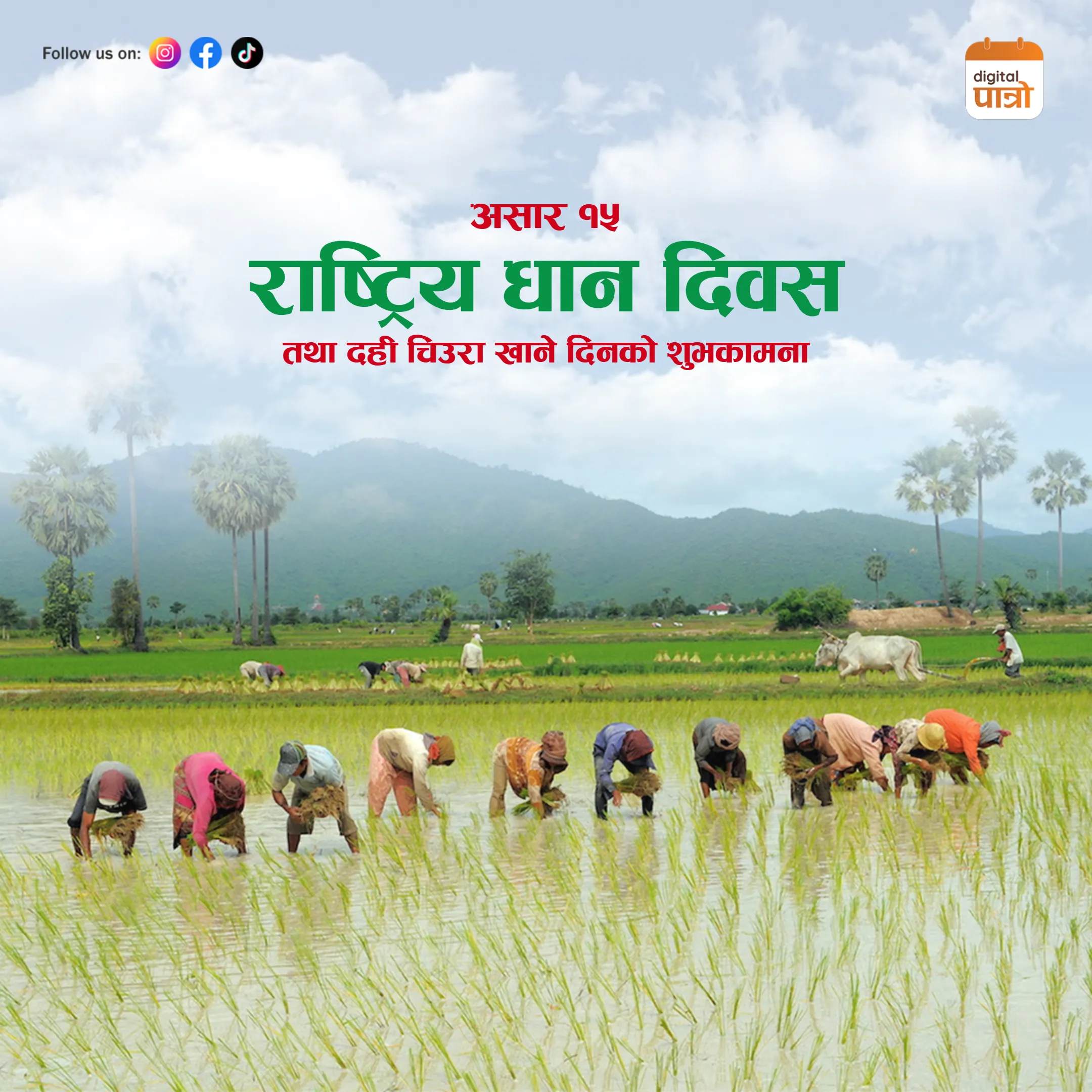
Want to share wishes with your friends, family, or on social media using a post like the above post? Create a personalized post for free in seconds using our post generator. Your text, your Style.
The date was not picked for symbolism. It was picked because of water.
Rice is the one major cereal that needs standing water in the field for most of its growing life. In Nepal, that water comes almost entirely from the monsoon. The monsoon usually enters the country through the eastern Tarai around the second week of June and spreads west over the following ten to fifteen days. By Asar 15, the rain has normally settled in across the middle hills and the Tarai at the same time, which is the only window in the year when the whole country can plant together.
Plant much earlier, and the seedlings sit in dry mud. Plant much later, and the crop runs out of warm days before it can fill its grain, which cuts the yield and pushes the harvest into the wet end of autumn.
So Asar 15 is the middle of a real biological deadline. Farmers have an old line for it: Asar bitera ropeko dhan, ghar bhanda pahile paral. Roughly, paddy planted after Asar gives you more straw than rice.
The government simply put a name on a day that was already the busiest day of the farming year.
The Government of Nepal decided on Mangsir 29, 2061 BS, which is 14 December 2004, to mark Asar 15 every year as Rashtriya Dhan Diwas and Dhan Ropai Mahotsav. The first official observance was held on Asar 15 of 2062 BS.
The reason given at the time was not an agricultural technique. It was respect. Farming employs the largest share of Nepal's workforce, and the ministry wanted one fixed date on which the state publicly acknowledged farm labour instead of only talking about production figures.
Each year the ministry issues a slogan for the day. Past slogans have run along the lines of protecting farmland and raising paddy output, and building climate-resilient farming to increase paddy production. The slogan is printed on banners at ministry events, agriculture knowledge centres and provincial functions.
Long before the ministerial decision, Asar 15 carried its own weight.
One story tied to the day comes from Tilaurakot in Kapilvastu, the site identified with ancient Kapilvastu where Siddhartha Gautam grew up. In that account, King Suddhodhan, Siddhartha's father, ploughed the first furrow of the season himself with a golden plough and planted the first paddy, and the court followed. The idea inside the story is the same idea that survives in the modern day: the person at the top of society is not above the field.
The second and much more widespread tradition is simply the ropain itself, which has no origin story because it has always been there. Rice has been grown in the Kathmandu Valley and the Tarai for thousands of years, and the terraced hillsides of the middle hills are one of the oldest continuous pieces of engineering in South Asia. The day did not create the ritual. It just gave it a date on the national calendar.
Eating curd with beaten rice on Asar 15 is the part of this day that even people who have never seen a paddy field take part in. There are practical reasons behind it, not only custom.
Transplanting is heavy work done bent at the waist in shin-deep water for six to eight hours. Nobody can go home to cook a hot meal in the middle of it.
Chiura is already cooked. It is parboiled, flattened, and dried rice, so it needs no fire and no pot. It can be carried to the field in a cloth.
Curd sets overnight without any equipment and stays fit to eat through a hot, humid morning better than cooked rice does.
Together they give slow-release carbohydrate from the chiura and protein, fat and live cultures from the curd. It is field fuel, and it sits light enough that you can bend over again straight afterwards.
Curd is cooling, which matters when the humidity is at its yearly peak.
Households usually add sugar or honey, sometimes a banana or mango, sometimes achar for people who want it savoury. Some families add aalu ko achar and bhatmas. Newar households in the Kathmandu Valley may serve dhau, the local set curd, in clay pots.
The phrase Dahi Chiura Khane Din has become an unofficial second name for the day. City dwellers who own no land still buy curd and chiura on Asar 15, and dairies in Kathmandu and Pokhara report their biggest single day of curd sales of the year.
Ropain is repetitive, painful and slow, and the traditional answer to that is song.
Asare geet, also called asare bhaka or asare jhyaure, is the folk form sung in the field while planting. It is call and response. One person opens with a long drawn-out line called the legro, held out across the field so it carries over water and wind. Others answer with short rhyming couplets called tukka. A typical line runs to about sixteen syllables with a pause after the tenth, which is roughly the length of one full breath while bent over.
The content is rarely religious. It is teasing, romantic, complaining, gossipy, and often improvised on the spot about whoever is standing in the next row. Men in the ploughing role, called bause, and the planters, called ropar, throw mud at each other between verses. That mud throwing is not decoration. It is how a group of people gets through eight hours of the same movement without falling out with each other.
Asare geet is now under real pressure. Younger workers plant with earphones in, tractors and power tillers have replaced the ox teams that set the rhythm, and labour shortages caused by foreign employment mean fewer large planting groups. Cultural organisations and provincial governments now run asare geet competitions on Asar 15 specifically to keep the form alive.
The Ministry of Agriculture and Livestock Development holds a main function, usually at a research farm or a model field, where ministers and officials plant seedlings themselves
The National Agriculture Research Council and the agriculture knowledge centres in each district hold field days
Awards and honours go to farmers with outstanding yields, to cooperatives and to seed producers
New rice varieties released by NARC are announced or promoted on the day
Provincial ministries hold parallel functions, and Karnali Province observes it as a provincial public holiday
The main planting of the year happens, often with parma, the reciprocal labour exchange where neighbours plant each other's fields in turn without cash payment
Elders perform a short puja at the corner of the field before the first seedlings go in, offering to the earth and to the local deity
Dahi chiura is served on the field ridge at midday
Asare geet is sung through the planting
Schools organise field visits so town children see transplanting first hand
Colleges and youth clubs run mud games, tug of war in flooded fields, mud football and mud volleyball
Cultural programmes feature asare geet, madal and folk dance
Media run features on food security, farmland loss and irrigation
Organised ropain festivals run in the Kathmandu Valley and around Pokhara, where visitors are given a plot, a bundle of seedlings and a plate of dahi chiura
Homestays in Chitwan, Kaski, Kavre, Dhading and Ilam market the day as an agri-tourism experience
These packaged events are the version most visible on social media, and they are genuine, but they are a small slice of what actually happens on Asar 15
Rice is not a sentimental crop in Nepal. It is the largest single crop by area, by output and by household importance.
Paddy is planted on roughly 1.4 million hectares, the largest area given to any crop in the country
National average productivity sits around 4 tonnes per hectare, which is below the yields achieved in neighbouring Indian states with comparable land
The best recorded national output has been around 5.7 million tonnes of paddy in a good monsoon year
Rice is commonly cited as contributing close to 7 percent of national GDP on its own, and it is the single largest line inside agricultural output
Despite that, Nepal imports rice every year. In fiscal year 2081/82, the country imported roughly 753,000 tonnes of paddy and rice worth close to Rs 60 billion, mostly from India
That gap between a record harvest and a rising import bill is the honest tension inside this day. The reasons are well documented and get repeated in every Asar 15 news cycle.
Farmland is being converted to housing and plotting, especially in the Tarai and around the Kathmandu Valley
Irrigation covers only part of the paddy area, so a weak monsoon becomes a national shortfall
Chemical fertiliser supply routinely arrives late, sometimes after transplanting is finished
Labour has moved abroad, so families who own land cannot always find people to plant it
Yields per hectare have not risen fast enough to match population and consumption
Chaite dhan, the spring rice crop planted in Chaitra and harvested before the main season, is one of the responses being pushed. Its productivity is higher than main season paddy, close to 5.8 tonnes per hectare, but it is limited to areas with reliable irrigation.
The largest paddy area in the country. Planting here is often on a scale that needs hired labour and machinery. Jhapa, Morang, Sunsari, Bara, Parsa, Rupandehi, Banke and Kailali are the heavy production districts. Dahi chiura here often comes with fresh mango.
This is where the terraced ropain images come from. Fields are small, irrigation runs from a khet muhan or a hill stream, and parma labour exchange is still common. Kavre, Dhading, Kaski, Syangja, Palpa and Ilam are typical.
Newar farming communities in Khokana, Bungamati, Chapagaun, Thecho, Bode and the Bhaktapur belt still plant, though the area shrinks every year. Local dhau in clay pots is served instead of packaged curd.
The only province that observes Asar 15 as an official public holiday. Jumla is the exception inside the exception, because Jumla sits at over 2,300 metres and its short season means rice goes in far earlier in the year. Jumli marshi, the cold-tolerant red rice grown there, is one of the highest altitude rice varieties in the world.
In parts of Sudurpaschim, the timing shifts with local rainfall and the day is observed more as a government programme than as a household event.
Dhan - unhusked paddy, the crop in the field
Chamal - milled raw rice, what you buy in a sack
Bhat - cooked rice on the plate
Chiura - beaten or flattened rice
Ropain - the act of transplanting rice seedlings
Beu or biu - the seedbed and the seedlings raised in it
Bause - the person who ploughs and levels the field
Ropar - the person who plants the seedlings
Parma - reciprocal labour exchange between neighbouring households
Hilo - the mud of a flooded, puddled field
Legro - the long opening line of an asare geet
Khet - irrigated paddy land, as opposed to bari, which is unirrigated upland
Marshi - the traditional red rice variety of Jumla
When is Rashtriya Dhan Diwas celebrated?
On Asar 15 every year in the Bikram Sambat calendar. In the Gregorian calendar, this falls on 29 or 30 June. In 2083 BS, it falls on 29 June 2026.
Is Rashtriya Dhan Diwas a public holiday in Nepal?
It is not a gazetted national public holiday, so banks, offices and schools stay open across most of the country. Karnali Province has declared Asar 15 a public holiday inside the province.
Why do Nepali people eat dahi chiura on Asar 15?
Because transplanting is long, wet, exhausting work with no chance to cook. Chiura needs no fire, curd sets overnight without equipment, and together they give energy, protein, and a cooling effect during the most humid part of the year. The custom then spread beyond farming households.
What is another name for Asar 15?
Asar Pandhra, Ropain Diwas, Dhan Ropai Diwas, Dahi Chiura Khane Din and National Paddy Day all refer to the same day.
When did Nepal start celebrating National Paddy Day?
The government decided on Mangsir 29, 2061 BS, which is 14 December 2004, and the first official observance was held on Asar 15, 2062 BS.
Why is rice planted specifically in Asar?
Because rice needs standing water and Nepal's monsoon reaches the whole country by the middle of Asar. Planting later shortens the growing period and cuts the yield, which is why farmers treat the end of Asar as a hard deadline.
What is asare geet?
The folk song form sung while planting rice. One singer holds a long opening line called the legro, and others answer with short rhyming couplets. The lyrics are usually improvised, teasing, and about the people working in the field.
How much rice does Nepal produce?
Paddy is grown on about 1.4 million hectares with an average productivity of roughly 4 tonnes per hectare. The best recorded national output has been close to 5.7 million tonnes of paddy.
If Nepal grows so much rice, why does it import rice?
Because consumption has outgrown production. Farmland is being converted to housing, irrigation is incomplete, fertiliser arrives late, and labour has moved abroad. Nepal imported roughly 753,000 tonnes of paddy and rice worth close to Rs 60 billion in fiscal year 2081/82, mostly from India.
Can tourists take part in the ropain festival?
Yes. Organised ropain events run in the Kathmandu Valley and around Pokhara on Asar 15, and homestays in Chitwan, Kaski, Kavre and Ilam offer a plot, seedlings, mud games and dahi chiura as a package.
What should I wear if I am joining a ropain?
Old clothes you can throw away or wash hard, shorts or trousers you can roll above the knee, and nothing on your feet. Field mud stains permanently and footwear gets stuck. Take a change of clothes and expect to be covered head to toe.
What is parma?
Parma is the labour exchange system where neighbours work in each other's fields in rotation instead of paying wages. It is still common in the middle hills, and it is the reason a single family can plant an area far larger than it could manage alone.
What is chaite dhan?
Spring paddy, planted in Chaitra and harvested before the main monsoon crop goes in. It gives higher yields than main season paddy but only works where irrigation is reliable.
What is the difference between dhan, chamal and bhat?
Dhan is the paddy still in its husk, chamal is the milled rice you buy and cook, and bhat is the cooked rice on your plate.
How do you wish someone on Asar 15?
Common greetings are राष्ट्रिय धान दिवसको हार्दिक शुभकामना and असार पन्ध्रको शुभकामना, often sent alongside a picture of dahi chiura.